

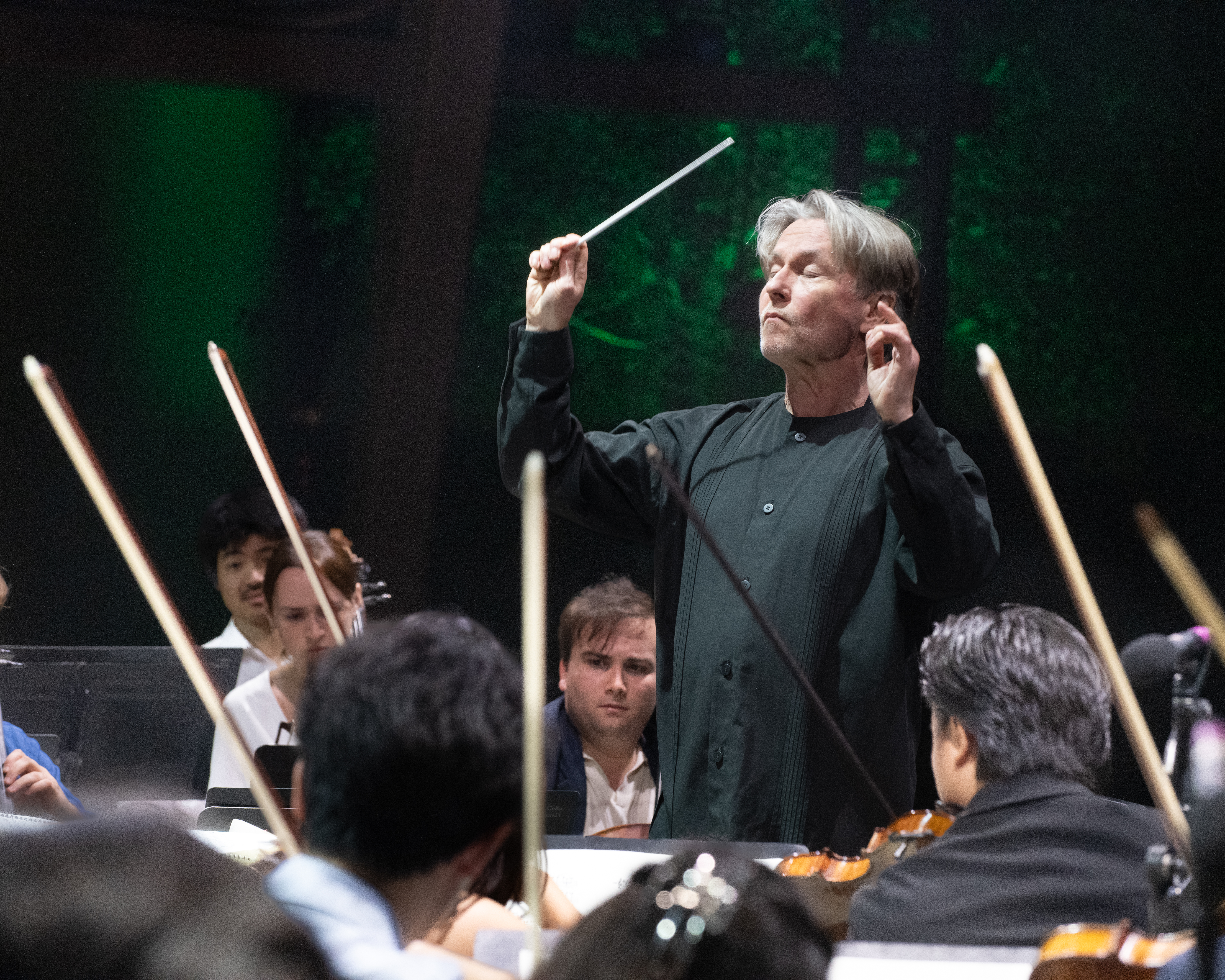
Rifling through a thick and happy pile of memories from last weekend’s Ojai Music Festival (OMF @ 80), the program contained an embarrassment of rich highlights, including premieres from its pillar heroes, music director Esa-Pekka Salonen and John Adams. But one clear pinnacle moment, from Sunday evening’s finale concert, stands out.
It happened when Leila met Ligeti. Dazzling violinist Leila Josefowicz braved the daunting modernist challenge of György Ligeti’s iconoclastic Violin Concerto and upped the ante with her own self-created cadenza, which stunned the audience and clearly wowed conductor Salonen, leading the over-achieving student forces in the Colburn Orchestra. In the decades of having admired and watched Salonen in concert action, in Santa Barbara and Los Angeles, I’ve never seen the often stoic Finn more openly ecstatic on the podium. After her cadenza and the brief orchestral cherry on top, the maestro’s face lit up several degrees and we could see his mouth wrapped around a major “wow.”
“Wow” could be the operative term in conveying the power and full dimensionality of last weekend’s festival, the strongest I’ve experienced in many years, as a hopelessly engaged fan of this great contemporary-leaning beacon of a festival.
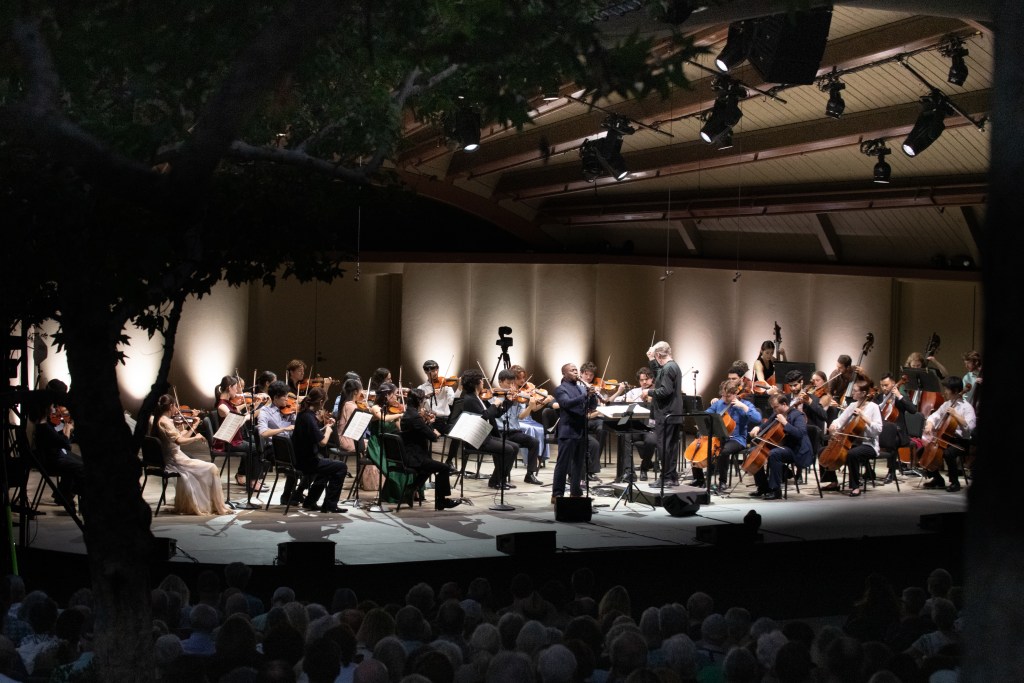
For those as-yet unfamiliar with this festival’s grand history, OMF boasts a legacy as one of the world’s finer contemporary music events is built on a resume including such prominent figures as Stravinsky, Copland, Arnold Schoenberg, Pierre Boulez, John Adams, and yes, Salonen and countless others of note (including the left-of-classical directors, jazzer Vijay Iyer, eclecticist Rhiannon Giddens, and next year’s director, Bach-ian post-bluegrasser Chris Thile).
Part of the sure charm of the OMF, which takes place mostly at the inviting and central Libbey Bowl, is the lived-in ambience comes courtesy of the magical hamlet of Ojai herself. As always, there were resident sonic contributors to the experience: the songs of birds and crickets, the occasional whirl of weed whackers (at the early Saturday morning concert at the Ojai Meadows Preserve performance) and, this year, periods and howlers from the nearby restaurant screening the World Cup.
Also part of the experience is the sense of solidarity and community within the audience, some of it diehard (present company included), which becomes a contemporary-music-hungry throng for this special weekend in the beginning of June. Before Thursday’s opening concert, Ara Guzelimian, who is ending his stellar run as artistic director this year, commented, “in a time when optimism is not in full supply, the pleasure of your company is something very precious.”
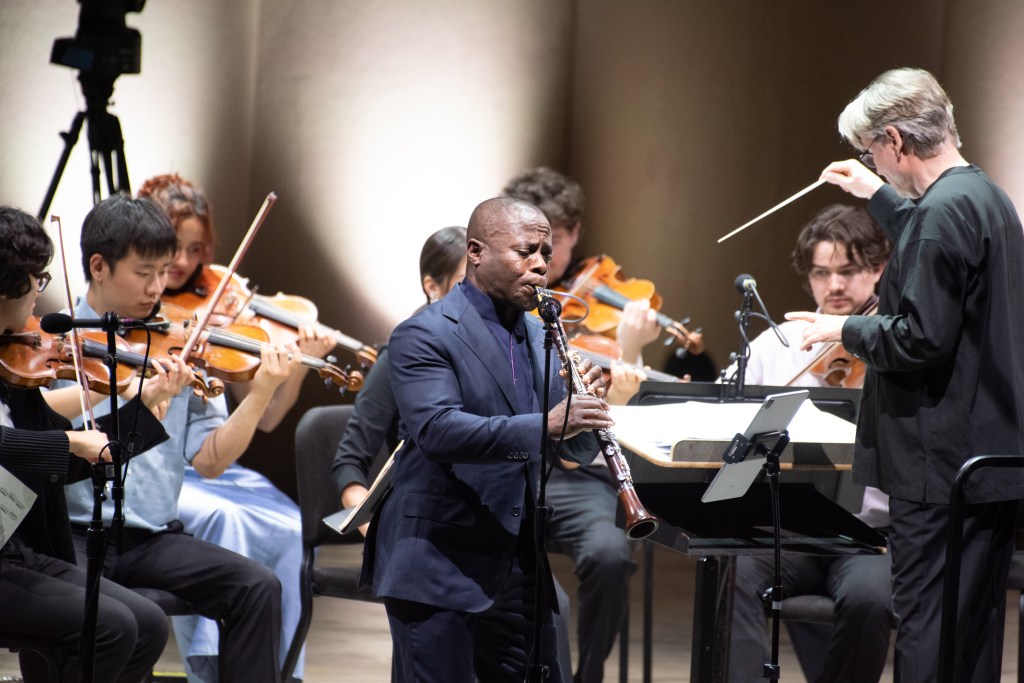
Fittingly, this 80th festival program crystallized the all-important in-house balance of embracing the new and revering the historic old, or at least a swath of time going back a century or so. For Thursday’s opening night, for instance, the musical mix ranged from East-meets-West enticement by Indian-American Reena Esmail to fresh and fresher work by Salonen and Adams, but was topped off by a profound reading of Quartet for the End of Time by the great French composer Olivier Messiaen, who appeared here in 1985. The solo clarinet movement from the Quartet, “Abyss of the Birds” (performed by Anthony McGill), became a virtual festival theme song, played by itself twice more during the festival.
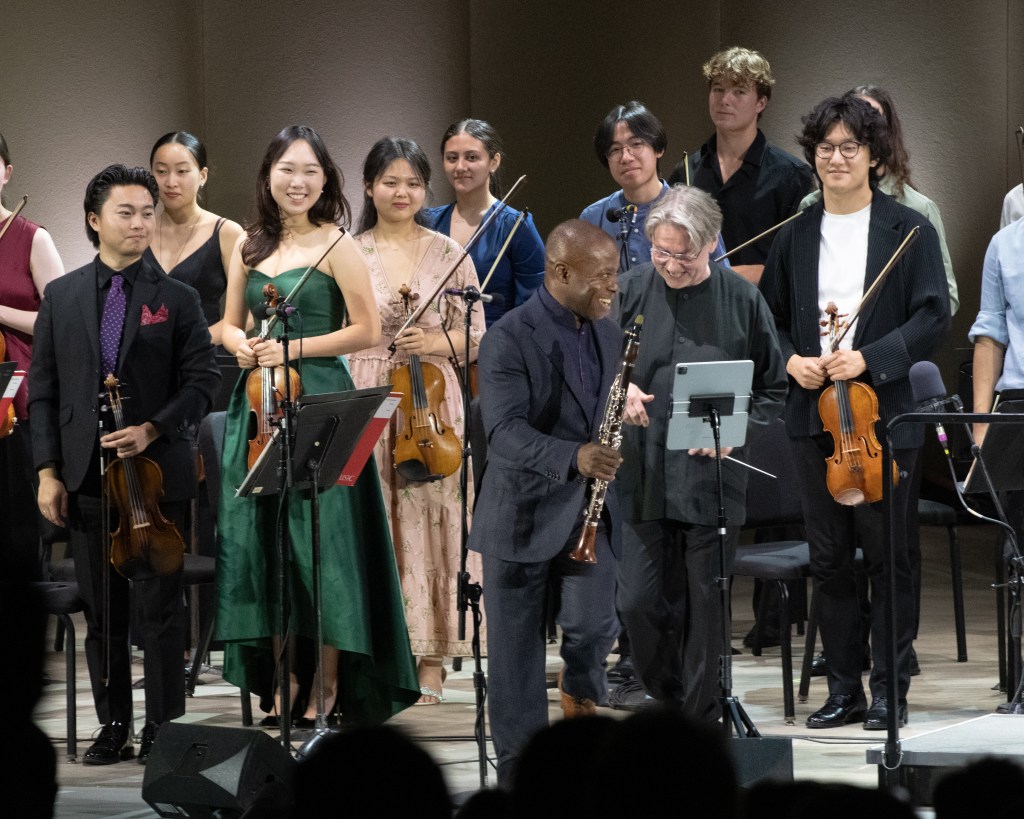
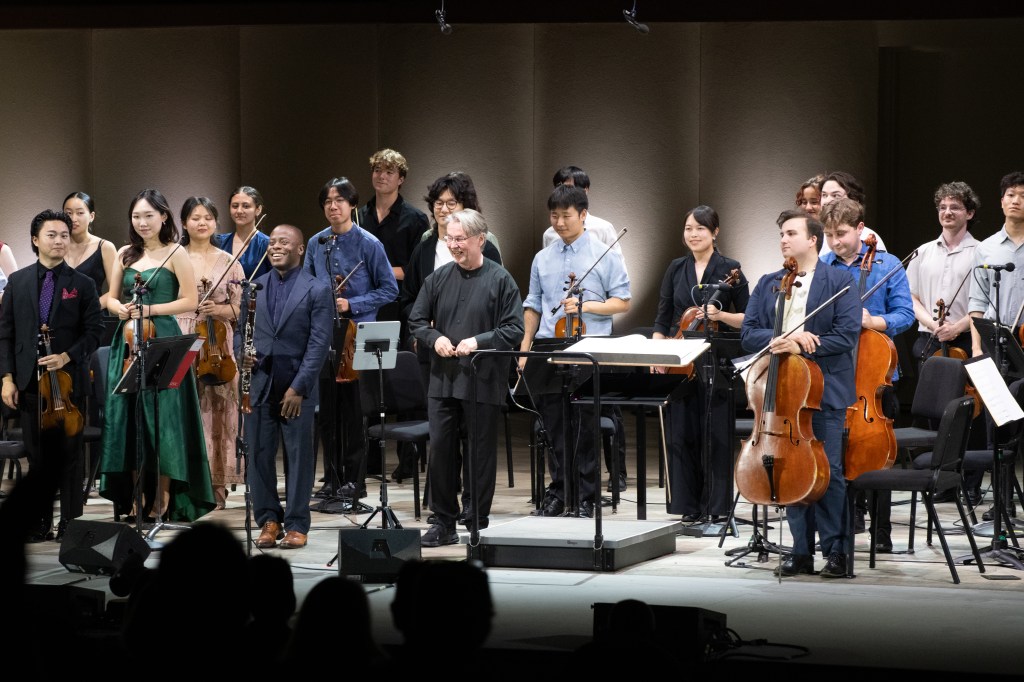
Thursday’s program added up to an especially powerful opening night statement, perhaps the best overall and cohesive program of the weekend.
(Incidental note: Esmail is an inspired and ascending composer on the scene, whose music was heard in a special OMF-hosted concert at the Krotona Institute in March. Her music will also be featured in two separate concerts in the upcoming UCSB Arts & Lectures season.)
Clearly, and thankfully, the pillar composers in Ojai this year were Salonen and Adams, whose musical riches threaded through the program and provided continuity, including with the festival’s history itself. Salonen was making his third appearance as music director, but the first since 2001 (although he was slated to direct the 2017 festival, that fell through, passed on to Patricia Kopatchinskaja). Salonen’s impressive life as a composer, versus his more celebrated work as a conductor, has really only flowered after that last Ojai visit. Here was a chance to catch up with what he has built with his bold and diverse compositional oeuvre.
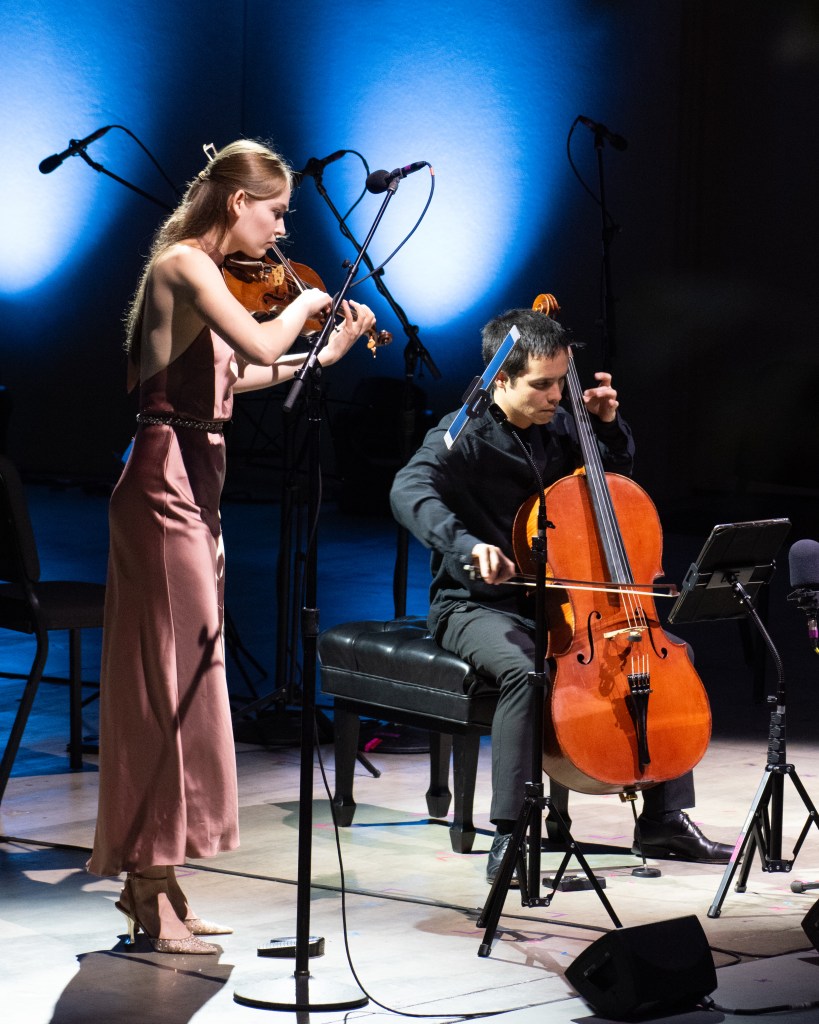
A summary impression of his music heard here is that this guy truly has range as a composer, doubtlessly fed through his exposure and performance of a vast array of music as a conductor. The diverse list this weekend included the tough love intensity of Thursday’s Drømmelogikk (Norwegian for “dream logic”) in its U.S. premiere, with violinist Geneva Lewis and cellist Jay Campbell doing the honors, and the string quartet Homunculous, shifting to the reworked film music lyricism of kínēma.
He touched on personal connections, as well, from Arabesques for Olly, his memoriam piece for the late composer Oliver Knussen — whose music has often been heard in Ojai — and Fog, written for friend and Walt Disney Concert Hall architect Frank Gehry (Frank Owen Gehry).
Adams has also been a central figure in the Ojai festival saga, as periodic music director and as a trusty supplier of OMF-friendly repertoire. He circulates easily amongst the villagers and the village: There he was with his wife, eating a veggie omelet at Bonnie Lu’s Country Café.
Adams’s vibrant and erudite pieces have often served as ideal concert closers. That again happened this year with his inspired and technically complex Chamber Symphony — with its gamey mix of influences from Schoenberg and Carl (“Loony Tunes”) Stalling — and his rollicking Road Movies — call it thinking person’s driving music. Another strong set-closer was the world premiere of Adams’s Iron Jig, a sparkling lark of a string quartet Baroque-esque gigue meets Irish jigging, given spit and polish by the in-residence Attacca Quartet on Sunday morning.
Yet another Adams world premiere swung into Libbey Bowl on Thursday in the form of selections from the solo piano work Visions fugitives, a post-minimalist and much more twofer masterfully played by Conor Hanick (an important member of the Music Academy of the West faculty). Hanick also did impressive honors with four pieces from Salonen’s diverse solo piano opus Six Preludes, on Saturday morning.
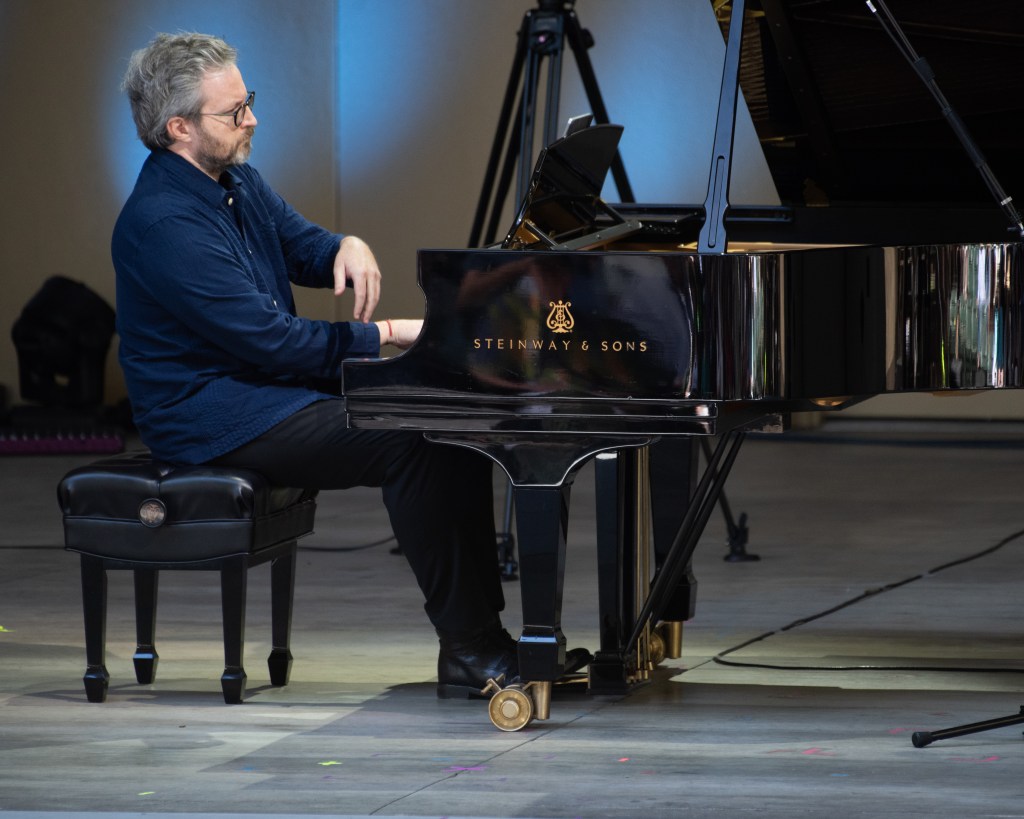
Hanick was on the short list of festival’s starring musician protagonists, as were the sensational young violinist Geneva Lewis and accordionist Hanzhi Wang, making her third 805 appearance in the past two years. Lewis’s strong and sensitive performances were a repeatable pleasure, starting with Esmail’s “Darshan, III. Charukeshi,” and ending with her solo Bach piece introducing Sunday’s final concert, while dramatically perched up by the adjacent tennis courts. In between, came her persuasive readings of Salonen’s tour de force Lachen verlernt, Knussen’s Reflections, and more.
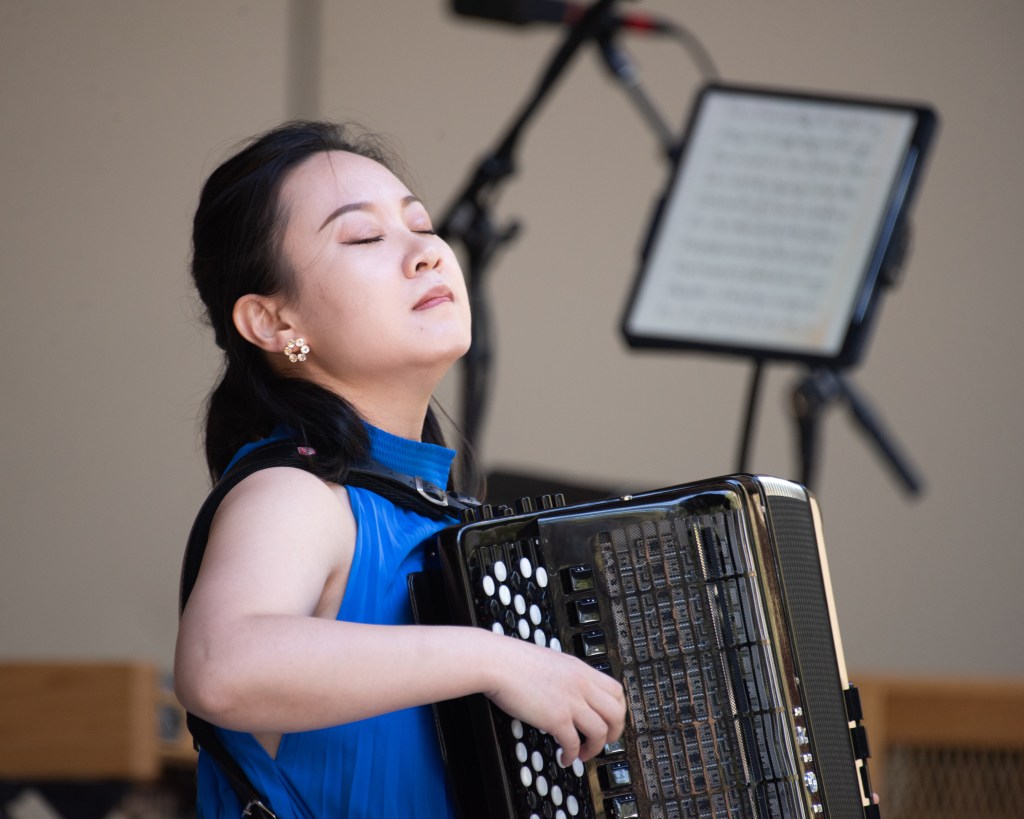
Wang showed up multiple times over the weekend, including performing Katherine Balch’s “Impromptu for Hanzhi” and Hanzhi’s own “Mountain Song” at the Ojai Meadows Preserve, and the piece de resistance being the tackling the virtuosic modernist gambit of Luciano Berio’s Sequenza XIII (Chanson) for solo accordion. She played that piece twice, at the Libbey Bowl and again at the Greenberg Center, during the music and dance program featuring the L.A. Dance Project. This company and Salonen collaborated last year on an unforgettable version of Boulez’s Rituel in memoriam Bruno Maderna at Disney Hall.
(Originally, the Boulez piece was slated to head up to the CAMA-sponsored L.A. Phil concert at the Granada last year, but logistics prevented the migration. Count it as a “one that got away” phenom for Santa Barbarans.)
For many years now, there has been considerable payoff for those brave souls willing to make the 8 a.m. concerts, which tend to be adventurous in different directions. This year, on Friday morning, the Attacca Quartet seized the Zalk Theatre, at the Besant School, with a stunning double-header of George Crumb’s bracing classic Black Angels and a newer work spinning off of that influence, David Lang’s daisy. Side note: Black Angels was put into wide circulation by the Kronos Quartet, whose longtime and now retired violinist Hank Dutt was in the house that morning.
In what will hopefully be a continuing tradition, Saturday morning again belonged to a free concert in the inspiring and vast Meadow Preserve, where percussionist-composer Susie Ibarra gave a memorable performance last year. And an overflow crowd flocked to Sunday morning’s program at the downtown Chaparral Auditorium, where Lewis and Campbell offered a contemplative set of mostly early music — Hildegard von Bingen, Marin Marais, and others — with Andrew Norman’s stirring solo violin piece Sabina and Ravel’s Sonate pour Violon et Violoncelle as the center nougat.
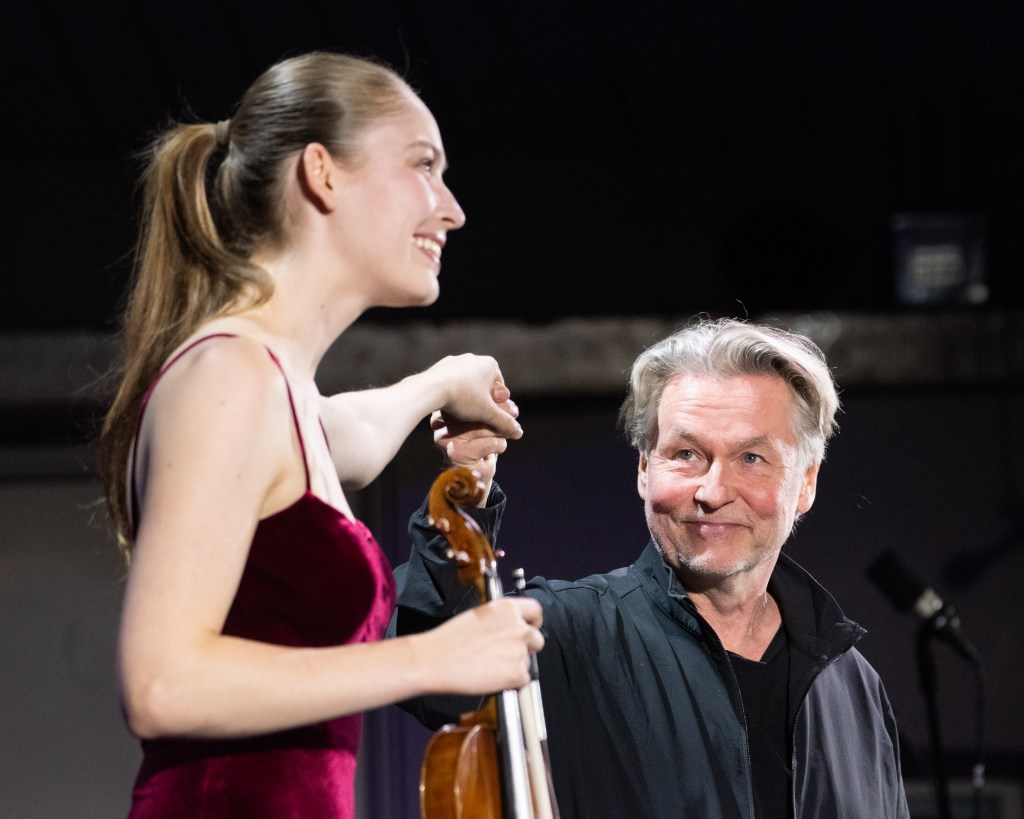
Ojai Music Festival, June 12, 2026, Geneva Lewis and Esa-Pekka Salonen | Photo: Timothy Teague 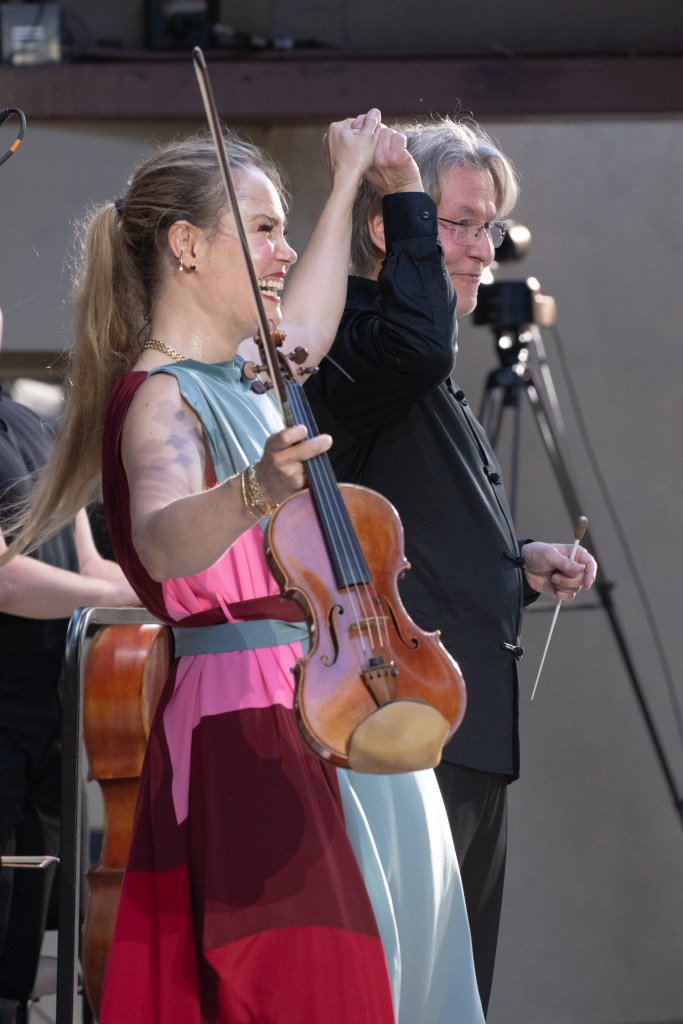
Leila Josefowicz and Esa-Pekka Salonen, Ojai Music Festival, June 14, 2026 | Photo: Timothy Teague 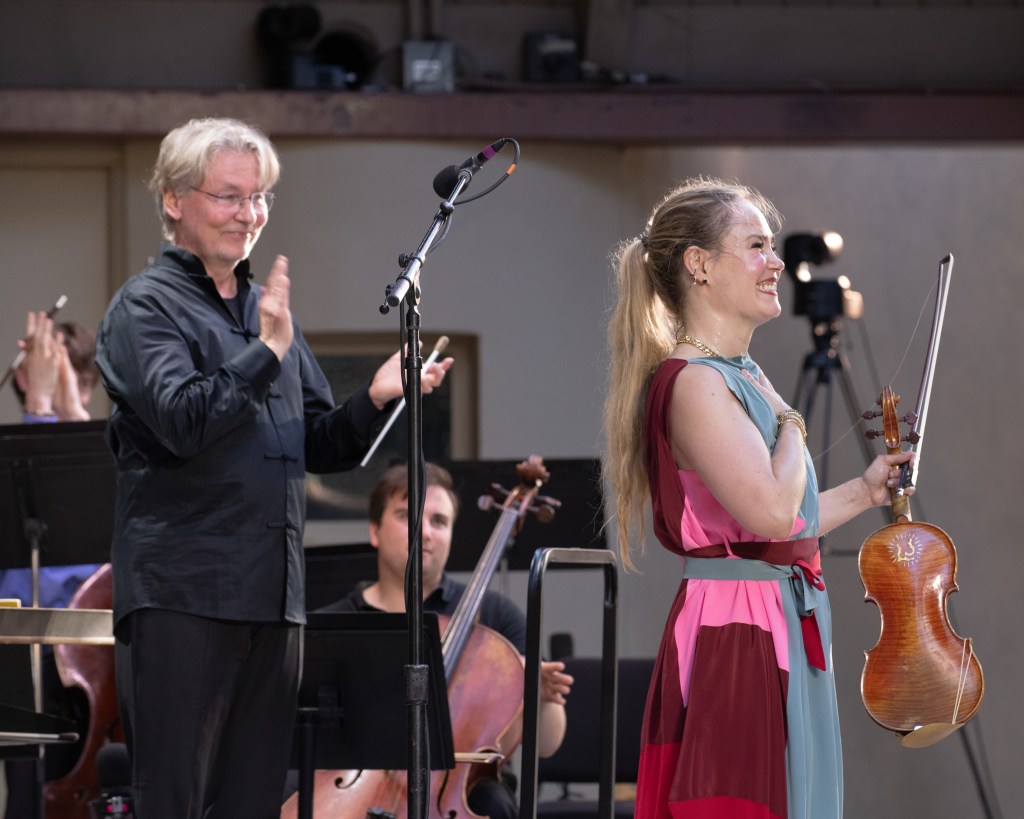
Leila Josefowicz and Esa-Pekka Salonen, Ojai Music Festival, June 14, 2026 | Photo: Timothy Teague 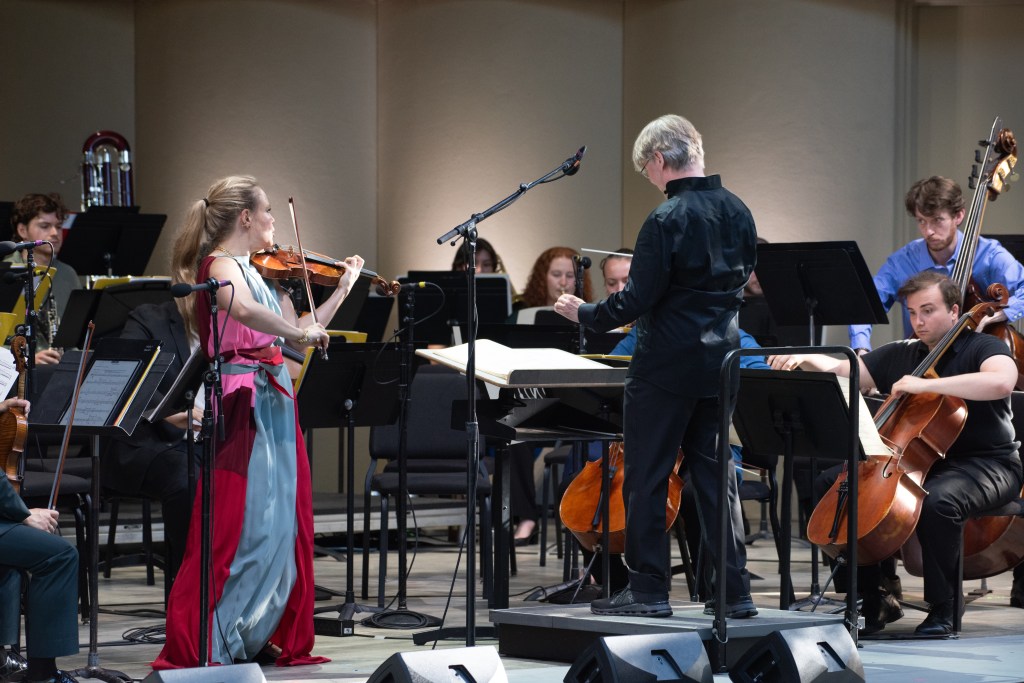
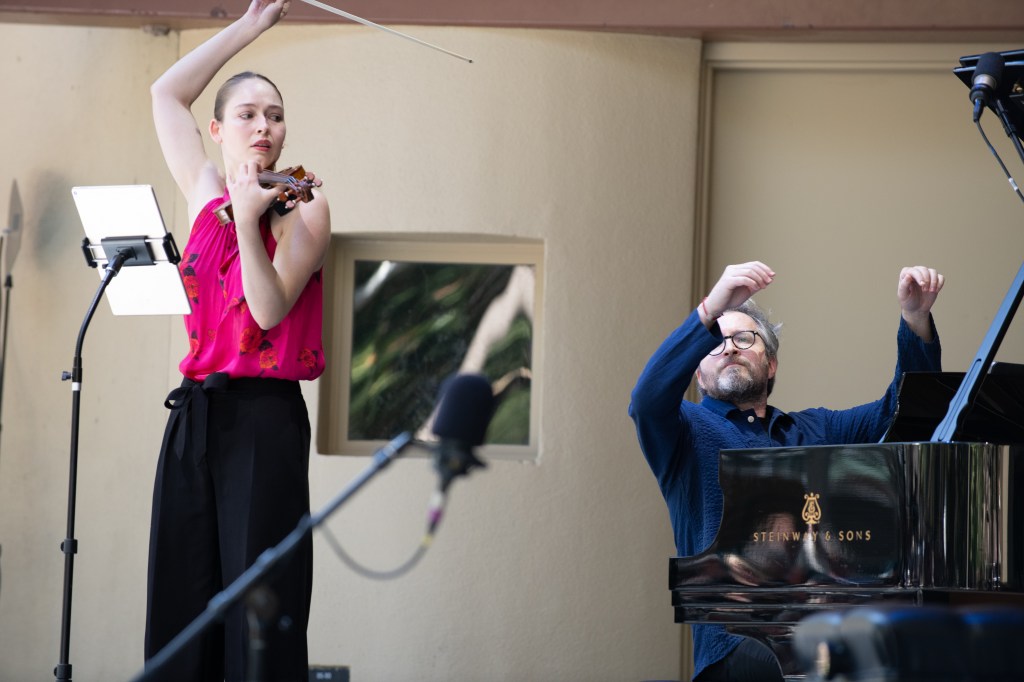
Ojai Music Festival, June 12, 2026, Geneva Lewis and Conor Hanick | Photo: Timothy Teague 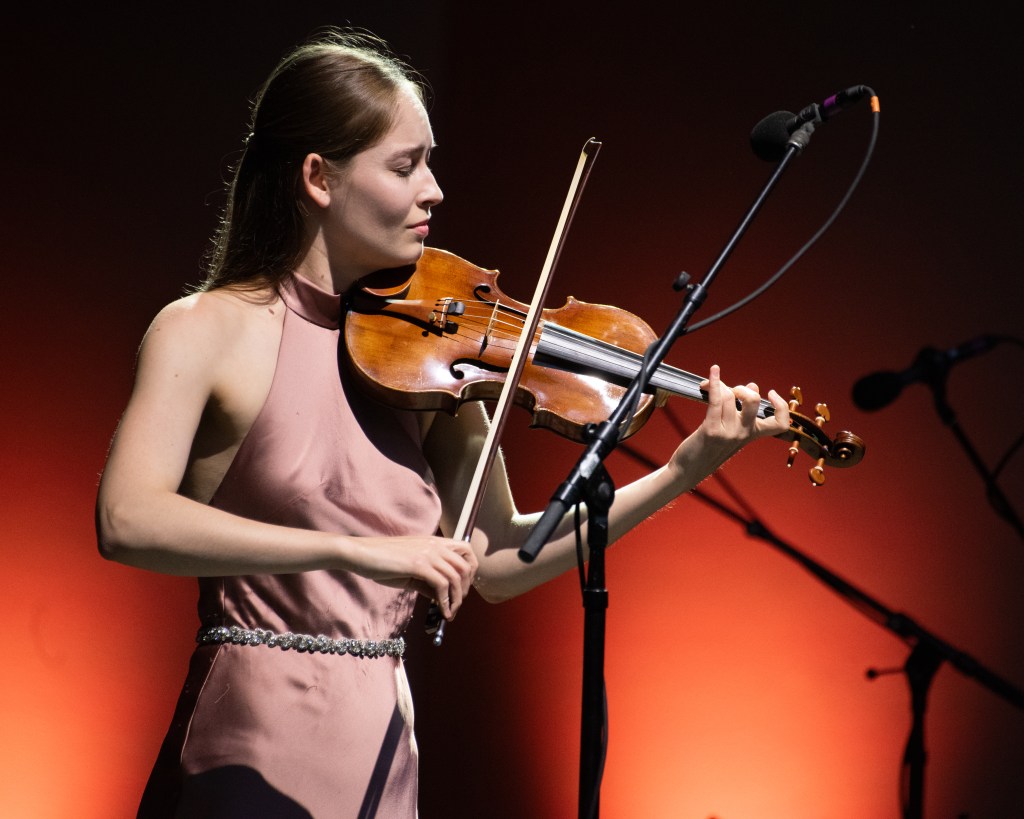
Ojai Music Festival, June 11, 2026, Geneva Lewis | Photo: Timothy Teague 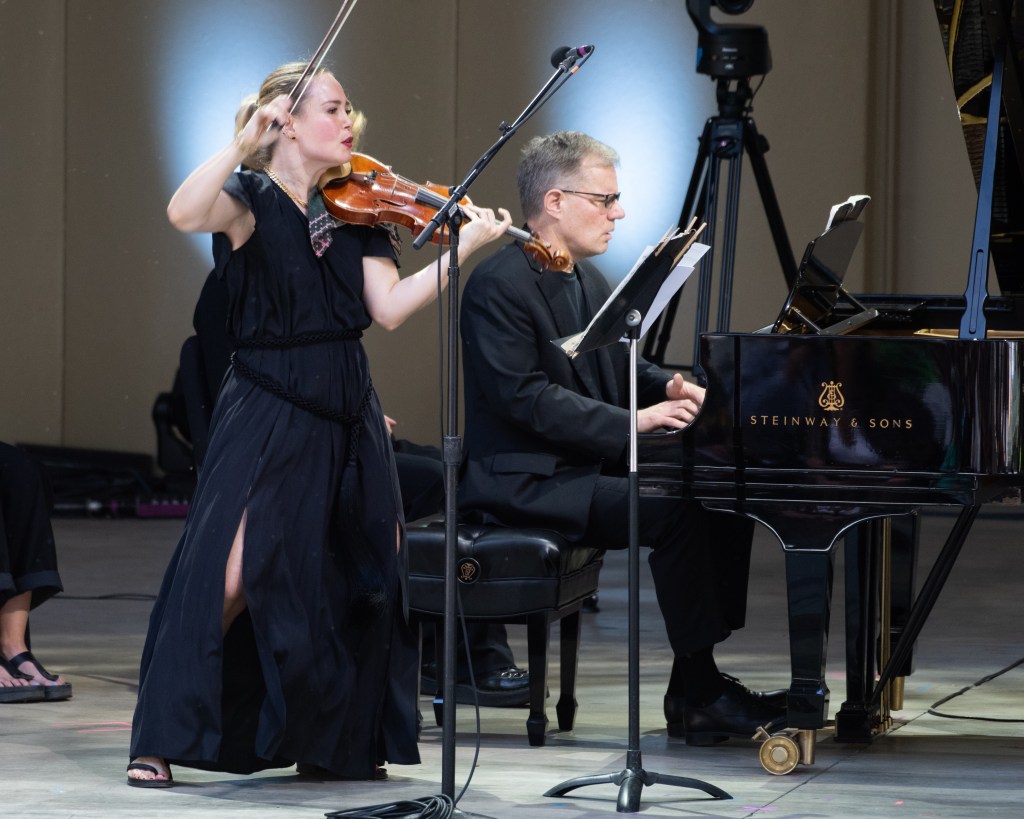
Leila Josefowicz and John Novacek, Ojai Music Festival, June 14, 2026 | Photo: Timothy Teague 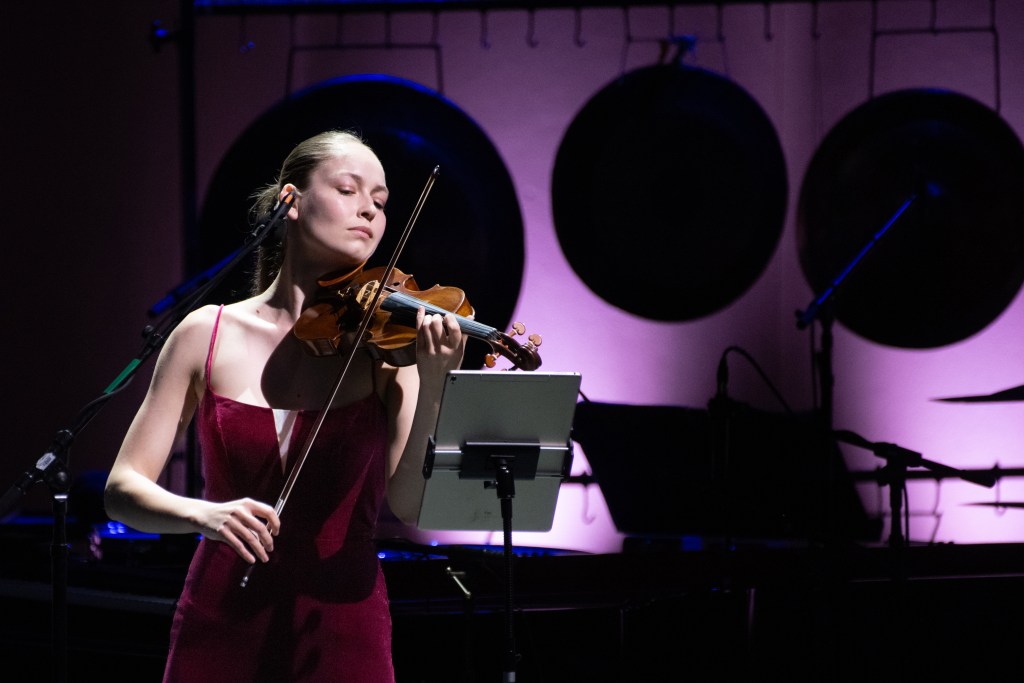
Ojai Music Festival, June 13, 2026, Geneva Lewis | Photo: Timothy Teague 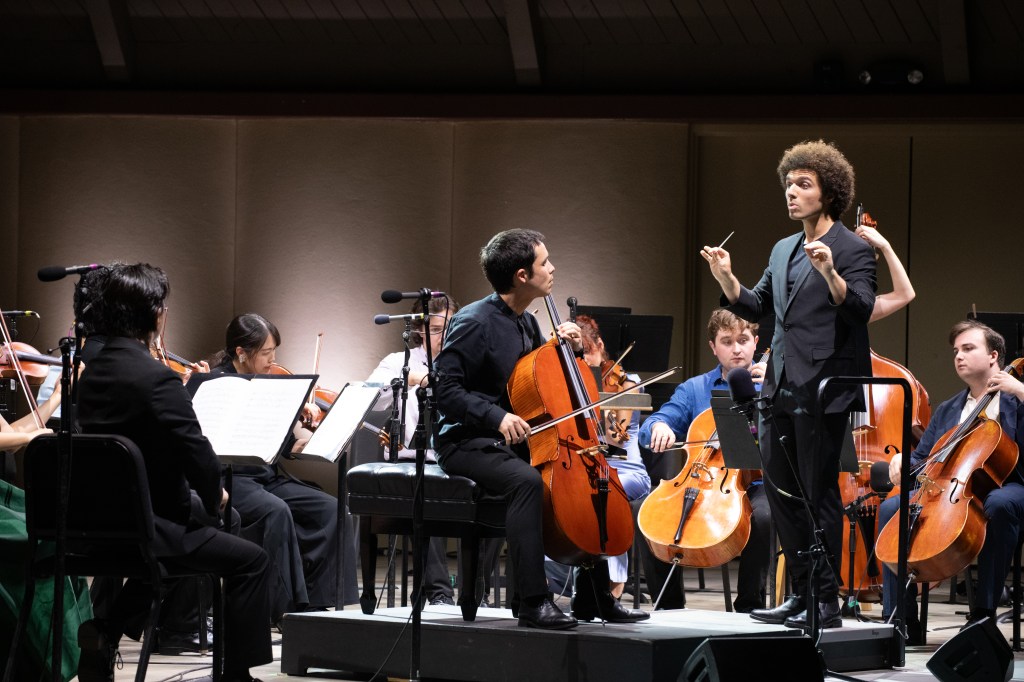
Ojai Music Festival, June 12, 2026, Jay Campbell, Mert Yalniz, and Colburn Orchestra | Photo: Timothy Teague
Other points of musical interest over the weekend included strong entries from Salonen’s Finnish colleagues going back to his salad days at the Sibelius Academy in Helsinki, with Magnus Lindberg’s potent piano and percussion piece Related Rocks (pianists Vicki Ray and Aron Kallay and percussionist Wesley Sumpter) and the cello work Sept Papillons by the late, great Kaija Saariaho (artist-in-residence in Ojai in 2016). The fetching young nature-channeling composer Gabriella Smith — who Salonen and the L.A. Phil have wisely championed — was represented by Anthozoa, inventively adapting her underwater field recordings of coral reefs into acoustic instruments, with an organically expressive way of finding and using new sounds in a painterly way.
Come Sunday evening’s closing program, the musical map wended through Lewis’s solo Bach and the Josefowicz-starring Ligeti to the capper, and the “straightest” piece of the weekend, Stravinsky’s neo-classical ballet Pulcinella. Given a rare complete airing, versus the usual abridged concert suite, with Salonen on the podium, the piece turned out to be a perfect final touch to a memorable festival. The ending, with its vigorous but tangled motive, served as a pleasing earworm to send us home from one of the more memorable Ojai fests in many years.
OMF is looking very good, indeed, at 80, thanks to Salonen.
(For after-the-fact savoring, the OMF has generously offered archived streaming options of the festival. Check it out here.)
Related Posts


Premier Events

Wed, Oct 14
5:30 PM
Santa Barbara
Free Home Hardening & Firescaping Workshop
Fri, Oct 16
7:00 PM
Santa Barbara
Divine Within: A Sufi Exploration of Love & Unity
Sat, Oct 17
9:30 AM
Santa Barbara
Divine Within: A Sufi Exploration of Love & Unity
Sun, Oct 18
9:30 AM
Santa Barbara
Divine Within: A Sufi Exploration of Love & Unity
Fri, Nov 13
7:00 PM
Santa Barbara
Divine Within: A Sufi Exploration of Love & Unity
Sat, Nov 14
9:30 AM
Santa Barbara
Divine Within: A Sufi Exploration of Love & Unity
Sun, Nov 15
9:30 AM
Santa Barbara
Divine Within: A Sufi Exploration of Love & Unity
Fri, Dec 11
7:00 PM
Santa Barbara
Divine Within: A Sufi Exploration of Love & Unity
Sat, Dec 12
9:30 AM
Santa Barbara
Divine Within: A Sufi Exploration of Love & Unity
Sun, Dec 13
9:30 AM
Santa Barbara
Divine Within: A Sufi Exploration of Love & Unity
Wed, Oct 14 5:30 PM
Santa Barbara
Free Home Hardening & Firescaping Workshop
Fri, Oct 16 7:00 PM
Santa Barbara
Divine Within: A Sufi Exploration of Love & Unity
Sat, Oct 17 9:30 AM
Santa Barbara
Divine Within: A Sufi Exploration of Love & Unity
Sun, Oct 18 9:30 AM
Santa Barbara
Divine Within: A Sufi Exploration of Love & Unity
Fri, Nov 13 7:00 PM
Santa Barbara
Divine Within: A Sufi Exploration of Love & Unity
Sat, Nov 14 9:30 AM
Santa Barbara
Divine Within: A Sufi Exploration of Love & Unity
Sun, Nov 15 9:30 AM
Santa Barbara
Divine Within: A Sufi Exploration of Love & Unity
Fri, Dec 11 7:00 PM
Santa Barbara
Divine Within: A Sufi Exploration of Love & Unity
Sat, Dec 12 9:30 AM
Santa Barbara
Divine Within: A Sufi Exploration of Love & Unity
Sun, Dec 13 9:30 AM
Santa Barbara



You must be logged in to post a comment.