
This article was underwritten in part by the Mickey Flacks Journalism Fund for Social Justice, a proud, innovative supporter of local news. To make a contribution go to sbcan.org/journalism_fund.
[Updated: Mon., June 29, 2026, 4:22pm]
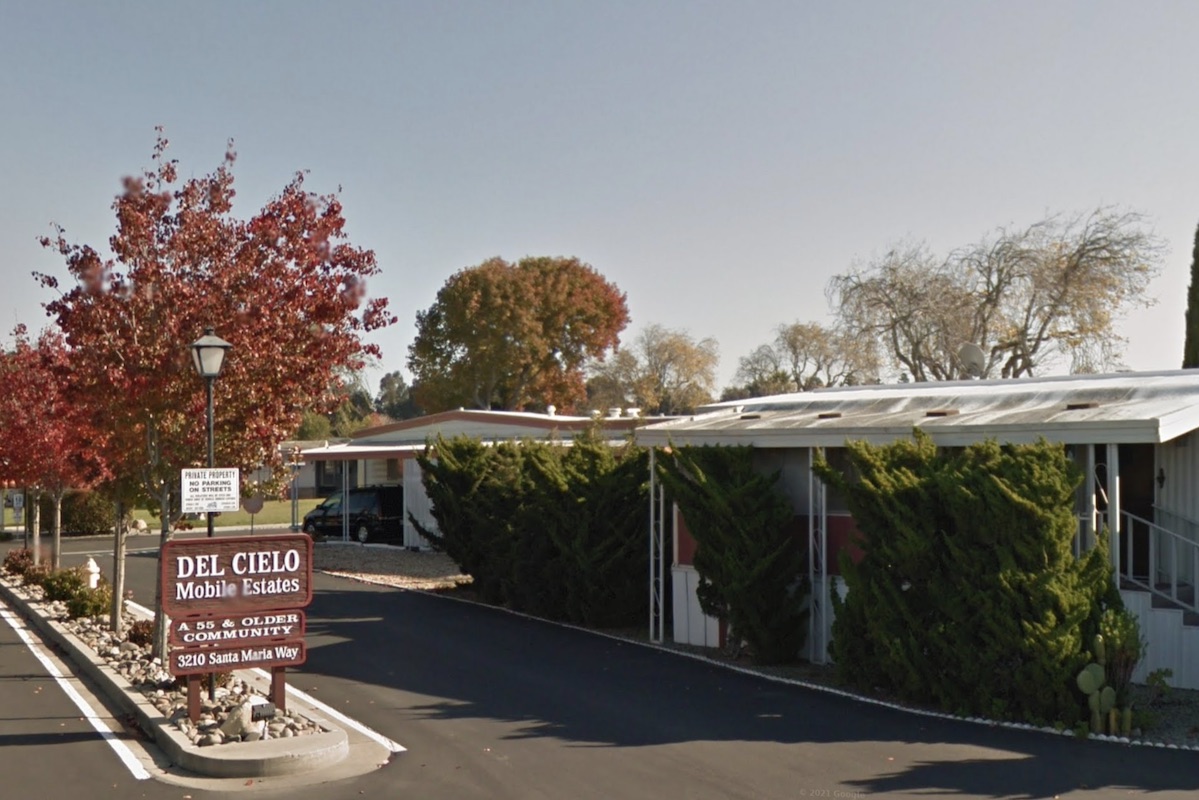
Rent will go up for tenants of Del Cielo Mobile Estates in Orcutt, but not as much as the park’s owners requested. On Tuesday, Santa Barbara County’s Board of Supervisors voted to deny the owner’s petition to overturn an independent arbitrator’s decision to limit the rent increase.
Del Cielo is owned by a company called Del Cielo Manufactured Housing Community LLC. The company has no other assets and has ties to Harmony Communities, a company that manages dozens of parks across California and Oregon. Individuals or a group connected to Harmony purchased Del Cielo Mobile Estates in April 2024, and shortly after moved to open the ages-55+ park to all ages and increase rents.
Residents pushed back, arguing that for decades the park had served as senior housing. Six months later, the supervisors passed an emergency ban on mobile home park conversions. Within the week, the company sued the county.
Because the county has a rent control law for mobile home parks on the books, rent increases on mobile home spaces are limited to 75 percent of the consumer price index, or about $18 for Del Cielo. Further increases could be permitted if ownership shows an increase in costs for running the park. Management must meet with residents about the rent increase, and residents have a chance to object. If the two parties can’t reach an agreement, they can take the issue to an independent arbitrator — a person who will formally hear both sides of the issue and settle the dispute.
Del Cielo’s owners wanted a $39.16 increase per space (the land, not the mobile home). The owners have argued that operating costs have climbed and returns have diminished. In its response to the arbitrator’s decision, Del Cielo’s owners said that the park, as of 2024, was operating at a shortfall of about $344,000 per year.
Ultimately, arbitrator John Derrick permitted a $24.02 per space monthly rent increase. Derrick determined some of the owner’s proposed incidental and operating costs were not permitted.
He determined the park was not allowed to recoup the $20,000 broker fees the company owes after purchasing the park. Park management, Derrick said in the arbitration report, cited this cost as an incidental expense. But, he said, it came from before the park was purchased, and argued a broker’s commission does not fall under any of the definitions of the word incidental.
Derrick nixed the increase connected to the $7,500 in legal costs incurred as part of the company’s lawsuit against the county. Litigation costs, he argued, are not operational costs. He said that if court costs were considered reasonable operating costs for the park, owners could enter unnecessary lawsuits and have their tenants pay for them.
“Litigation can cost hundreds of thousands of dollars. If the first $7,493 is allowable, why not the next $75,000 in a following year?” Derrick wrote.
The arbitrator also disallowed about $3,100 in unspecified costs. Derrick writes that these costs were originally listed as office supplies, but during the hearing, park management said it was for dues and subscriptions.
“It is not at all clear to me what other dues and subscriptions those were,” he said.
Derrick found that the roughly $18,000 in other legal fees, the $745 LLC fees, travel expenses, and 50 percent of fees to a trade association for manufactured housing were permissible.
Del Cielo’s appeal to the Board of Supervisors argued Derrick had abused his role as arbitrator. The argument hinged on two points: firstly, that the ordinance itself is unlawful, because it limits a “fair rate of return” as part of the maximum allowed rent increase, which is not connected to the park’s actual costs. The law does not give the arbitrator discretion to adjust the rental amount for this reason.
At Tuesday’s appeal, Del Cielo MHC LLC’s representative, Jason Dilday said this argument may be one for the courts, not the board.
Secondly, Dilday argued that the $20,000 broker fees incurred by the park’s sale were incidental expenses. He also argued that timing did not matter, so that the fee coming as part of the park’s sale did not stop it from being a valid cost.
The supervisors were not persuaded by Dilday’s logic. Board Chair Bob Nelson, who represents Orcutt, said that, based on the hearing and reviewing the record, he thought the arbitrator followed the law.
Supervisor Joan Hartmann said she followed the arbitrator’s argument that passing through additional costs comes after the change in ownership, not before.
“To interpret the ordinance differently would be to allow a slew of other expenses to do with purchase of the park,” she said.
In a response to the Independent, a Harmony Communities spokesperson said that Del Cielo MHC LLC plans to pursue legal action challenging the decision.
“We always assume (and so far, it has held true 100 percent of the time) that supervisors or council members will vote precisely as instructed by staff. We plan to file a writ challenging the decision,” Harmony said in an email to the Independent, through representative Nick Ubaldi.
Harmony Communities has a history of managing mobile home parks where ownership pursues rent increases. Harmony employees are listed on the state filing documents of some of the LLCs that are Harmony-managed, either as the registering agent (the point of contact for the LLC’s formation and legal correspondence) or as a manager/member. Harmony says that all properties managed by Harmony have Harmony’s address.
Last year, Harmony Communities sought to increase the rent of seniors-only University Mobile Home Park in Goleta — initially by $200 per month. That monthly increase would have nearly doubled some tenants’ rent. Residents and park ownership reached a settlement agreement for a staggered rent increase of $150 per month over five years.
Harmony also sought to open the park for all-ages, against residents’ protest. Earlier this year. Goleta passed an emergency ordinance creating a senior overlay over the park. University Park Manufactured Housing Community, LLC — another company linked to Harmony — has taken the city to federal court over this law, arguing it forces the owners to discriminate against families. In May, a federal judge took a motion to dismiss the case under submission.
In 2023, Harmony aimed to raise rent at La Hacienda Mobile Estates in Fresno by $350 per spot per month. Fresno’s Mobilehome Park Rent Review and Stabilization Commission rejected this increase, instead setting it to an increase of $24.92, the maximum allowed by city law.
Fresno news publication GV Wire reported that management Harmony threatened to close the park. The following year, La Hacienda Mobile Estates, LLC, filed for bankruptcy. The LLC and Harmony share the same address, and Harmony’s CEO is listed as the LLC’s manager. Judge Jennifer Niemann denied the LLC’s plan in the filing, saying it was in bad faith and ordered a trustee to oversee the park’s sale.
In San Luis Obispo County, Oak Terrace MHP LLC, another LLC connected to Harmony, aimed to raise rents at Oak Terrace Mobile park by $106 per month. A Harmony employee is listed as the company’s agent on its state filing documents, and Harmony and the LLC share an address. S.L.O.’s Board of Supervisors unanimously rejected this increase. That came a year after Harmony settled a case with the county’s district attorney’s office over failing to reimburse background fees and making misleading statements about listed housing units. Companies with connection to Harmony have also faced investigation in San Joaquin, Fresno and Marin counties.
Editor’s Note: This article was corrected to clarify that Harmony Communities did not own La Hacienda Mobile Estates in Fresno but rather La Hacienda Mobile Estates LLC did (and filed for bankruptcy). Likewise, the article was corrected to say that Harmony did not own Oak Terrace Mobile Estates in San Luis Obispo County but rather Oak Terrace MHP LLC did. The article clarifies that Harmony employees are listed as the agents for these LLCs, and that the LLCs and Harmony share an address. The article was also updated to reflect that Harmony is a management company and does not own parks.
Related Posts


Premier Events

Wed, Oct 14
5:30 PM
Santa Barbara
Free Home Hardening & Firescaping Workshop

Fri, Oct 16
7:00 PM
Santa Barbara
Divine Within: A Sufi Exploration of Love & Unity
Sat, Oct 17
9:30 AM
Santa Barbara
Divine Within: A Sufi Exploration of Love & Unity
Sun, Oct 18
9:30 AM
Santa Barbara
Divine Within: A Sufi Exploration of Love & Unity
Fri, Nov 13
7:00 PM
Santa Barbara
Divine Within: A Sufi Exploration of Love & Unity
Sat, Nov 14
9:30 AM
Santa Barbara
Divine Within: A Sufi Exploration of Love & Unity
Sun, Nov 15
9:30 AM
Santa Barbara
Divine Within: A Sufi Exploration of Love & Unity
Fri, Dec 11
7:00 PM
Santa Barbara
Divine Within: A Sufi Exploration of Love & Unity
Sat, Dec 12
9:30 AM
Santa Barbara
Divine Within: A Sufi Exploration of Love & Unity
Sun, Dec 13
9:30 AM
Santa Barbara
Divine Within: A Sufi Exploration of Love & Unity
Wed, Oct 14 5:30 PM
Santa Barbara
Free Home Hardening & Firescaping Workshop
Fri, Oct 16 7:00 PM
Santa Barbara
Divine Within: A Sufi Exploration of Love & Unity
Sat, Oct 17 9:30 AM
Santa Barbara
Divine Within: A Sufi Exploration of Love & Unity
Sun, Oct 18 9:30 AM
Santa Barbara
Divine Within: A Sufi Exploration of Love & Unity
Fri, Nov 13 7:00 PM
Santa Barbara
Divine Within: A Sufi Exploration of Love & Unity
Sat, Nov 14 9:30 AM
Santa Barbara
Divine Within: A Sufi Exploration of Love & Unity
Sun, Nov 15 9:30 AM
Santa Barbara
Divine Within: A Sufi Exploration of Love & Unity
Fri, Dec 11 7:00 PM
Santa Barbara
Divine Within: A Sufi Exploration of Love & Unity
Sat, Dec 12 9:30 AM
Santa Barbara
Divine Within: A Sufi Exploration of Love & Unity
Sun, Dec 13 9:30 AM
Santa Barbara

