
Finding Flor y Canto in My Backyard
How I Came to Know This
Early Californian Musical and Dancing Group
Story and photos by Matt Kettmann
August 6, 2026

Read more from our 2026 Fiesta cover story here.
It began, one summer years ago, as a curious series of jangles, tweedles, and toots from over my backyard fence. I was firing up the grill for a midweek dinner, and suddenly the air of my Goleta neighborhood was filled with this cacophony of noises — violins, flutes, guitars, perhaps more? — that steadily wound themselves into rustic-sounding songs. They carried on for a half hour or so, and then returned the same time the next week, adding voices and more sounds as the weeks went on.

They disappeared by early August, but, like migrating birds, returned the following summer, and the summers after that, so much that I’ve come to anticipate their arrival and recognize the songs enough to know my favorites. I send videos to friends to mark their arrival, and I even nourish the flock these days, passing bottles of wine over the fence to wet their working whistles.
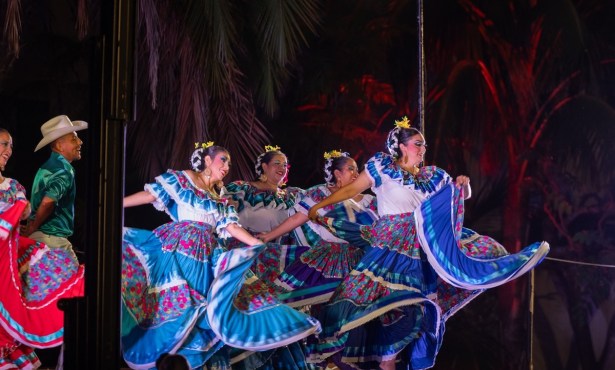
I eventually discovered that this was the rehearsal routine for Flor y Canto, the musical, choral, and dancing group founded by beloved historian Erin Graffy (who died last year) and her husband, Jim Garcia, in 2004. Though they are the only group that recreates the exact dances and songs from the Californio-Rancho era that Old Spanish Days was created to celebrate, Flor y Canto typically performs only once during Fiesta — on Friday night, at 7 p.m., before the Spanish flamenco and Mexican folklorico showcase known as Las Noches de Ronda kicks off at the Courthouse.
“I call it the Top 40 from the 1830s,” said guitarist and singer Luis Moreno, a longtime expert of early California music who was asked to join the group when it started. “I love mariachi music. I love flamenco music. But this is the actual music of the era that we are celebrating.”


My surprise introduction came in 2019, when Flor y Canto started practicing at the home of my neighbors Roger Knox, who sings and dances, and Clare Barrios-Knox, who plays guitar and sings. Their nearly 50 performers range in age from preteens to octogenarians, and in skin tone from pale white to dark brown, much like the Californios did. There are many retirees, as well as professional musicians, an allegedly famous child psychologist, and even Santa Barbara’s past poet laureate.
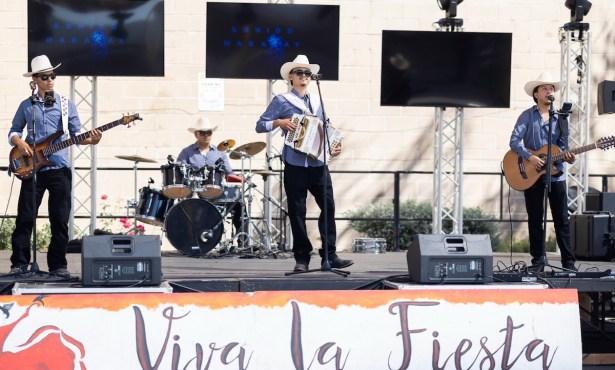
I met most of them last week, when they invited me to watch their final rehearsal. Though I’d peeked through the fence once or twice over the years — and they often end their gathering with a “Thank you Matt!!!” for the wine — this was the first time I’d witnessed the full production. Most had dressed up in full regalia, with the singers on one end of the yard, the dancers on the other, and musicians in the middle — most benefiting from the shade of my own redwood trees.
They ran through the entire set, complete with narration explaining aspects of the Californio lifestyle. There are a dozen songs, from “El Capotin” (popular across the Spanish-speaking world) and “El Charro” (about a Mexican cowboy with sing-along elements) to songs about buying new shoes and drinking too much that include playacting.
They always finish with “Adios Amores,” the traditional conclusion to any musical evening in early California. “Nothing happens after that,” said Moreno, who once saw De la Guerra descendant Dibblee Poett come to tears at a party when people demanded more music after “Adios Amores” finished. “He was right on. When you sing that song, that’s it.”
Graffy sourced many of the songs from the archives of Charles Fletcher Lummis, who used wax cylinders to record the tunes toward the end of the 19th century. He hung out with folks like Helen Hunt Jackson, who wrote Ramona, which also attempted to portray the Californio era in a romantic light. “All of these people got together to bring back the California traditions that were disappearing at the time,” said Moreno.
I’ve been fascinated with this period of California history my entire life — that window between when Spain abandoned its colony, when Mexican rulers couldn’t care less, and before the Yankees showed up in droves. The brief era was as much a melting pot as any in history, developing its own culture in a strange vacuum, surrounded by the same natural beauty we enjoy today. I wish Fiesta did a better job of telling that story in explicit ways.
“There are layers and layers of history here, and nobody has gone away,” said Moreno. “The Chumash are still here. The Spanish are still here. The Mexicans are still here. The people from the east are still here. You talk about history like it’s gone, but all those elements are still here among us. This is our chance and opportunity to celebrate all of these wonderful cultures that still survive here. This is our contribution that we are able to make.”
Flor y Canto plays the County Courthouse on Friday, August 7, 7-8 p.m. prior to Las Noches de Ronda.




You must be logged in to post a comment.