For habitual followers of the Music Academy of the West’s (MAW) thicket of a summer festival, the end point always brings on a certain bittersweet tinge — with a touch of relief in the mix. For six weeks, the calendar gets inked up with concerts of substance, master classes and more on the MAW agenda, and the enticements lure us in sometimes more than we had planned.
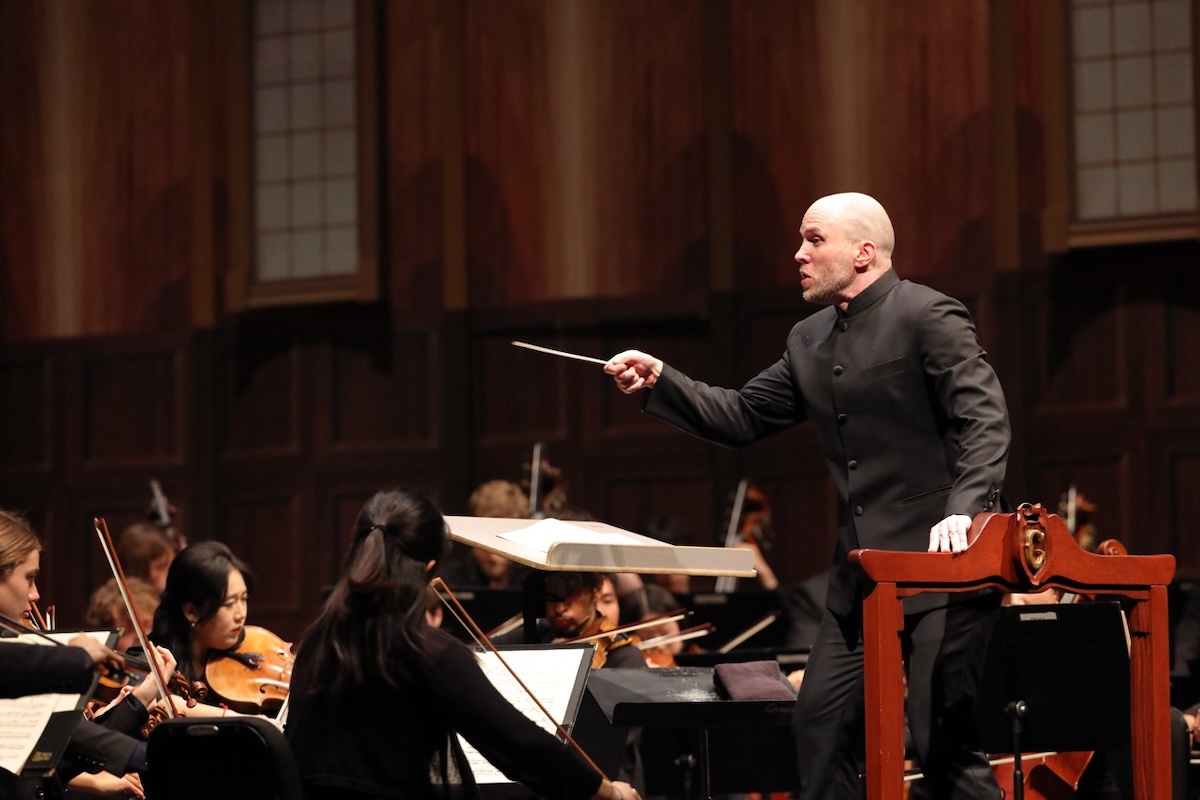
There were plenty of high points this year, but the finale event, the Academy Festival Orchestra (AFO) concert last Saturday at The Granada Theater, was more of a soft landing, and a bit anticlimactic. Performance-wise, the always surprisingly polished forces of the AFO, conducted this time by David Danzmayr, verged on the impeccable. But the program seemed like the slightest of the five orchestra concerts this summer, with the classical exquisiteness of Mozart’s delightful Sinfonia Concertante in E-flat topped off by the shamelessly romantic, crowd-pleasing Barcalounger of Rachmaninoff’s Symphony No. 2.
Yes, this is the one whose earwormy, slow, adagio movement was pilfered by pop artist Eric Carmen for his 1976 hit “Never Gonna Fall in Love Again.” Hard as we try to divorce our ears’ memory from that pop chart connection, Carmen’s nagging hook won’t be begone.
For the Mozart, written in 1778 at the age of 22, a smaller complement of players took to the stage. It was essentially a string orchestra joined by four strong faculty wind players up front — Eugene Izotov, oboe; Richie Hawley, clarinet; Judith LeClair, bassoon; and Nathaniel Silberschlag, horn. Soloists and ensemble engaged in a seamless accord, in a cleanly articulated and properly nuanced reading.
After intermission, the going got cushy. Rachmaninoff’s Symphony No. 2, written at the dawn of the 20th century but demonstrably a product of 19th-century thinking, unfolded with its desired lushness of being. The work did its part in fulfilling one mandate for the academy, which is, after all, an educational institution: Part of the goal is to put before the fellows a range of repertoire they are likely to encounter in the course of their careers to come. There will always be a market for the Rach.
MAW Wrap in Brief
Thinking back over the past several weeks of serious music listening, several musical moments stand out. The festival started auspiciously, with the long-in-residence group, Takács Quartet, giving us the final official concert for the now-retiring founding cellist András Fejér (51 seasons on the job). Jumping to the final week, mezzo-soprano (and Mosher guest) Stephanie Blythe danced to the MAW’s theme of “American Mosaic” by presenting Alan Louis Smith’s Vignettes: Ellis Island, written for her.
Of the events I was privy to (minus a two-week European jazz festival jaunt), the most affecting moment, to these ears, came via another orchestral occasion, when young composer Samuel Adams’s No Such Spring brought a fulfilling bounty of musical intrigue to the Granada. A direct MAW link came through piano soloist Conor Hanick, increasingly integral to the Academy as piano department head and creative advisor, whom Adams designated as the pianist of choice for this ambitious post-minimalist “almost piano concerto.”
Elizabeth Cree, this year’s edition of the annual fully-staged opera — always a showcase for the academy’s famously bold voice department — also impressed, in some unexpected ways. The one-act, by au courant composer Kevin Puts, is a comically sinister romp with narrative and musical similarities to Stephen Sondheim’s Sweeney Todd, but becomes tangled in a complex puzzle of its own devising in the final phase. Puts was one of the guest composers in town, along with Missy Mazzoli and Christopher Cerrone, whose The Only Way is Through — in its West Coast premiere, for the Sing! children’s chorus and percussion fellows — was another minimalist-adjacent charmer.
Surprises lined the way, including a stunning performance (as part of a new collaborative pact with the Santa Barbara Museum of Art) of the mesmeric Arvo Pärt classic Spiegel im Spiegel, here uniquely presented by roving violinist Miyabi Henriksen and stationary keyboardist Pei-Tsun Chiang. Sculptor Alison Saar’s reclining figure, “Terra Firma”, was the silent fine art partner in the experience.
These were a few of my favorite things in MAW 2026. Next year promises further and presumably richer riches, being the 80th anniversary year. A Santa Barbara summer without MAW seems inconceivable by this point, and that is a continuously blissful condition.