

Last month, we detailed the battle to protect Santa Barbara from the development of two high-rise condominium towers on the square block bordered by Micheltorena, Arrellaga, Garden, and Santa Barbara streets.
The citizens’ group Save Our City took the El Mirasol Investment Company — composed of leading members of the business community — and the City of Santa Barbara to court, and won. Here’s the rest of the story about what happened next to keep Santa Barbara, Santa Barbara in the 1960s.
The Political Aftermath
The El Mirasol Investment Company, stunned by its defeat, stated it would immediately put the property up for sale. Save Our City (SOC) encouraged community members to stay involved and work together.

Together with Citizens Planning Association and several other local groups, SOC developed a syllabus for a series of community lectures for an adult education class taught through Santa Barbara City College. “Should Santa Barbara Go High Rise: Community Environment and the High Rise.” Held at the Lobero Theatre, the discussion series featured a number of distinguished speakers, including San Francisco architect Robert A. Odermatt; urban economist Michael Marson; Dean of the School of Architecture and Fine Arts, USC, and high-rise expert Sam T. Hurst; Development Consultant from Washington, D.C., William R. Ewald; and Planning Consultant for the City of Santa Barbara Simon Eisner.
Additionally, opponents of high-rise development recognized that the fight would be repeated again and again, unless the policy of granting height variances was addressed and codified. The League of Women Voters took on the task of placing a height limits measure on the ballot. In the November election of 1972, the community voted overwhelmingly in support of height limits — 24,499 to 8,048. The amendment to the City Charter limits noted: “It is hereby declared the policy of the City that high buildings are inimical to the residential and historical character of the City.”
Building heights were specified as follows: “30 feet in areas zoned for single- and two-family dwellings; 45 feet for three or more families, hotels, motels and offices; 60 feet in areas zone for industrial, manufacturing and commercial uses; and 39 feet for all other zones.”
The Aftermath: Retaliation and Righteous Indignation Used Against Pearl Chase
After the community was successful in its challenge in the courts, many members of the business community and their supporters, were not pleased that their efforts been thwarted. Some leaders wrote letters to the editor bitterly complaining about what they considered the misguided efforts of community members who had dared to organize against them.
Jerry Beaver wrote about this El Mirasol Investment Group: “We have been damned, cursed, reviled, falsely accused and sued.” He added, “I have never been associated with a finer group of men and women whose motives have been more for the good of Santa Barbara than 29 Pearl Chases.” He concluded, “I shall be very interested to see how many of our critics will be waiting in line, with check in hand, to back up their oral accusations and statements. How many will be willing to make their investment and develop the land in a manner which they have stated would be far better than the proposed destruction of our human scale, Spanish heritage and natural environment. Will you be the first in line?”
Louis Lancaster wrote, “I realized that the opposition is coming from that hard core of individuals who are committed to stopping every kind of activity in this area.” He concluded, “If you own property here, if you are in business here, or if you merely want to live here, you should become alert to the things these people are doing to us.”
In another letter to the editor, Lancaster complained, “When substantial people are willing to move into town, pay city taxes, and spend their money here, I would think we should encourage and not discourage them. I don’t know many of the people who are blocking these needed developments. I do know some of them, and they don’t even own property here — have only been here a short time — and may not be here next year. How long are the business people and property owners going to let these things happen?’
Other letter writers chided Pearl Chase for her leadership, advise and opposition, and singled her out for criticism. One wrote, “We of the El Mirasol group have been vilified and called names as if we wished to destroy our beautiful Santa Barbara! While the truth is that our only crime is to wish to beautify our home town! Miss Chase is no doubt living in Santa Barbara’s glamorous past — the gracious living of the affluent on their large estates or in luxury hotels, ministered to by hordes of well-paid servants. But dear Miss Chase, Time, Tide and Population do not stand still, and high-rise must come unless we wish every square foot of this old earth covered with concrete.”
Another berated her: “Why did you not save El Mirasol from being destroyed? You had years to corral all those lovers of “charm and beauty: in one of the richest towns of the world…. Did you find out it was easier to pull heartstrings than purse-strings?”
And then they took the retaliation further by filing a complaint with the IRS in an attempt to strip the nonprofit Community Arts Association (CAA) of its nonprofit status. In 1920, she had been a founding member; she wrote its charter and its articles of incorporation and obtained original funding from the Carnegie Foundation. She had led CAA since 1927.
Upon lengthy review, the nonprofit status was reinstated by the IRS, when the CAA complied with the required changes in the organization’s articles of incorporation. Below is a statement about the incident from The Community Arts Association in 1977: “The Community Arts Association was founded in Santa Barbara in 1920. In 1923, it was incorporated as a non-profit 501(c)3 organization. Ever since under the leadership of Miss Pearl Chase of Santa Barbara, its President for over forty years, the Association has instigated and inspired countless advanced planning projects. It has ‘communicated, coordinated and cooperated’ with, and led many of the community-wide ‘plans and plantings,’ civic festivals and development of the arts of civilized living that have become the hallmark of Santa Barbara. In 1969, the Association inadvertently used a post-card imprinted with the address of the Community Arts Association in a public mailing concerning, and prior to, a vote by the Santa Barbara City Council to prohibit high-rise development in the city. This ‘political stand’ was protested to the Internal Revenue Service, which revised without public hearing, the nonprofit status of the Association from a tax-exempt 501(c) 3 to a 501(c) 4.”
According to one of her associates, the action by community members she knew well and had trusted “broke her heart”
Not a bright and shining moment in our community’s history, but a cautionary tale, or perhaps extra motivation for standing up and speaking out. Then and now.
Not even Pearl Chase was exempt from public disparagement and retaliation.
On the Ground: The Property Changes Hands — and Usage
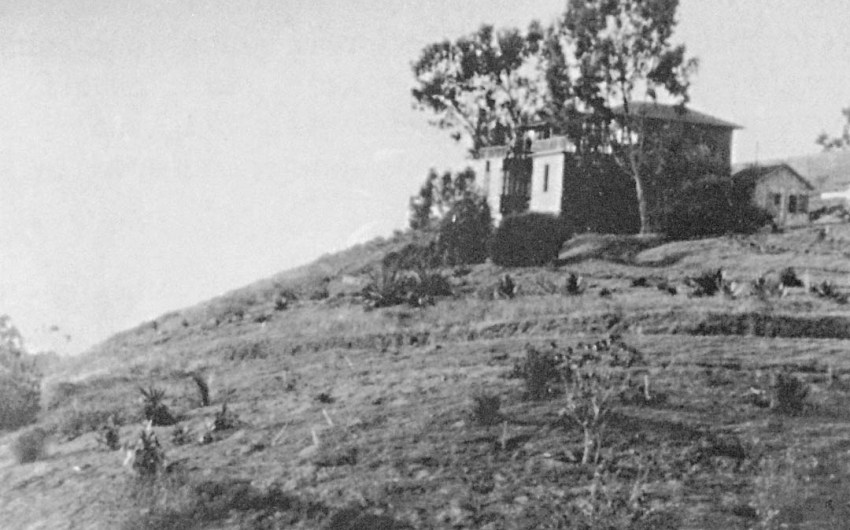
Early in 1970, the El Mirasol Investment Company announced it had sold the square-block property to the Santa Barbara Museum of Art. The decision received widespread praise, including from Storke, who noted, “I am truly delighted to know that El Mirasol block has a chance to serve such a fine purpose.” He added, “I had always dreamed that the lovely Herter villa site and surrounding grounds would become the home of something of community value.” It was even reported that he donated his $25,000 share in the condo project to the museum.
While trustees of the museum raised money for their potential building project, they leased the property to the Community Environmental Council. The innovative El Mirasol Farm garden was established on the land, and — at the time of heightened awareness about ecology and the newly established Earth Day — the property served as an urban center for environmental education, farming practices, solar power and composting, as well as lectures, exhibitions, recycling campaigns, and greater awareness about pollution and good stewardship.


Despite all best efforts, the museum was unable to raise the funding for the building. and in 1974 sold the property to a local development company, ValCoast, that hoped to build 80 three-story luxury condominiums. The News and Review wrote a scathing editorial about the plan that began, “As quietly as a weasel heading for the hen house nests, another developer is moving in on one of Santa Barbara’s most unique and irreplaceable open spaces. And from the lack of public reaction, it appears the hens and the farmhouse dog are sound asleep.”
Although the project was approved by the Planning Commission, the developers declined to pursue it. By that time, the bottom had fallen out of the luxury condo market, and it made no financial sense for the project to proceed.
A Park and a Garden
Finally, in 1975, the City of Santa Barbara was informed that an anonymous donor would purchase the property and donate it to the city with the stipulation it would become a horticultural garden. The City Council agreed, and the plans for El Mirasol Park were submitted and approved.
Two years later, upon the passing of philanthropist Alice Keck Park, it was revealed that she was the generous, visionary purchaser and donor of the property — and it was renamed Alice Keck Park Memorial Garden.
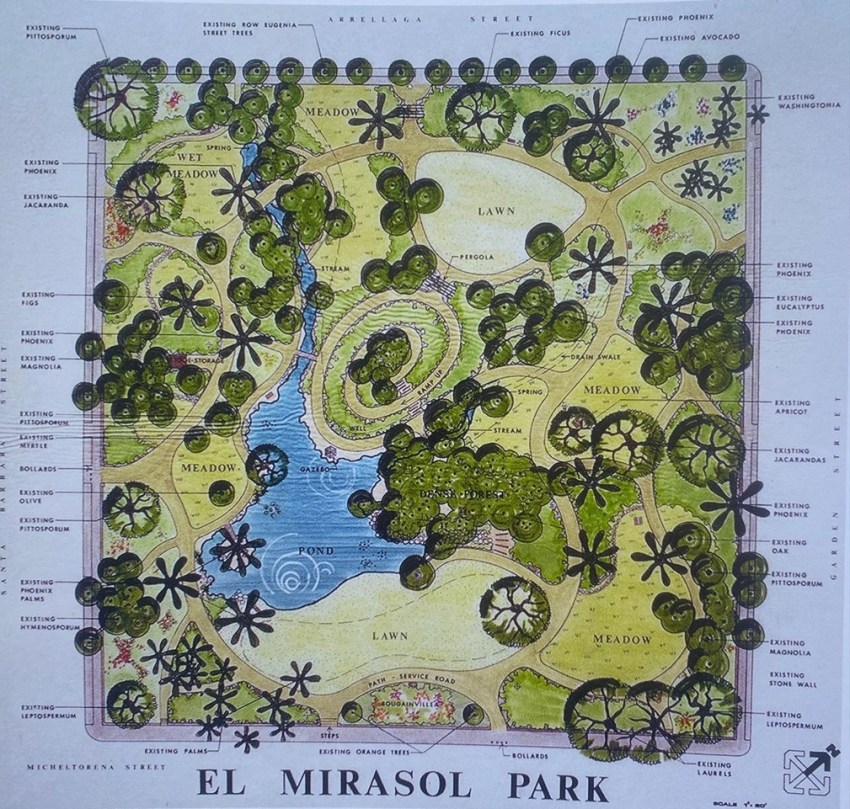
Original plans for El MIrasol Park, renamed Alice Keck Park Memorial Garden, after the passing of the philanthropist who made it possible. | Credit: Courtesy 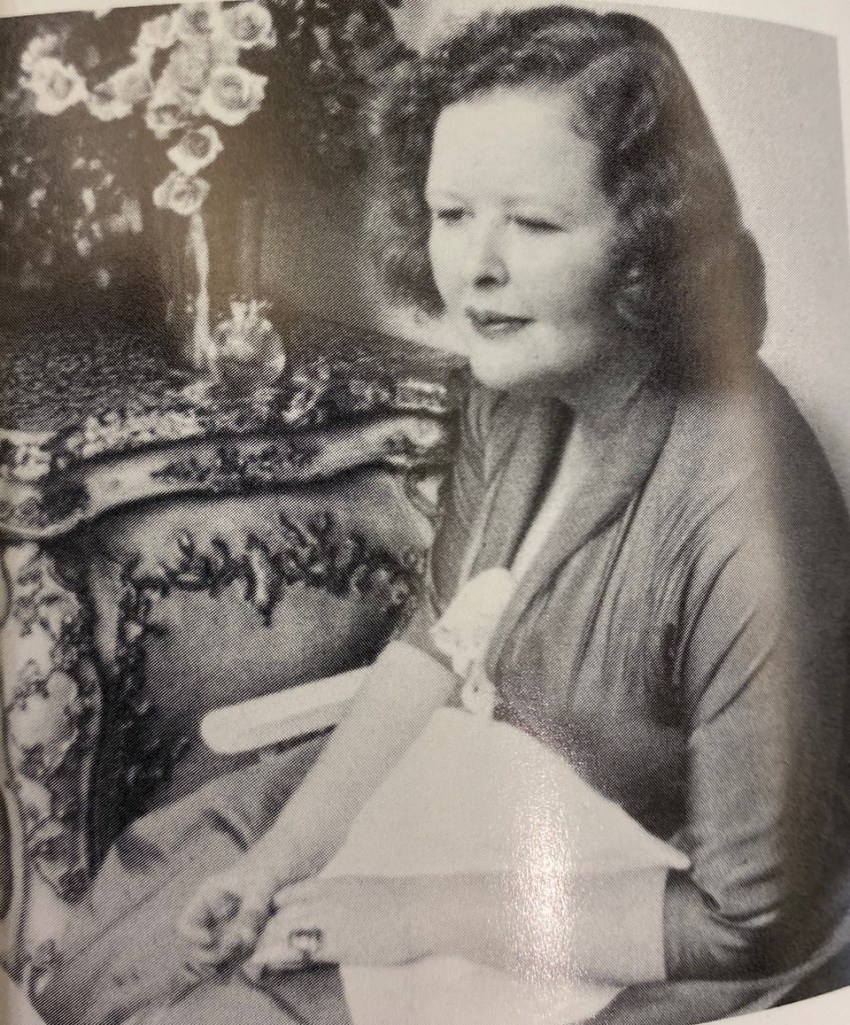
Philanthropist Alice Keck Park generously offered her vision that made possible the the oasis created in her name. | Credit: Courtesy 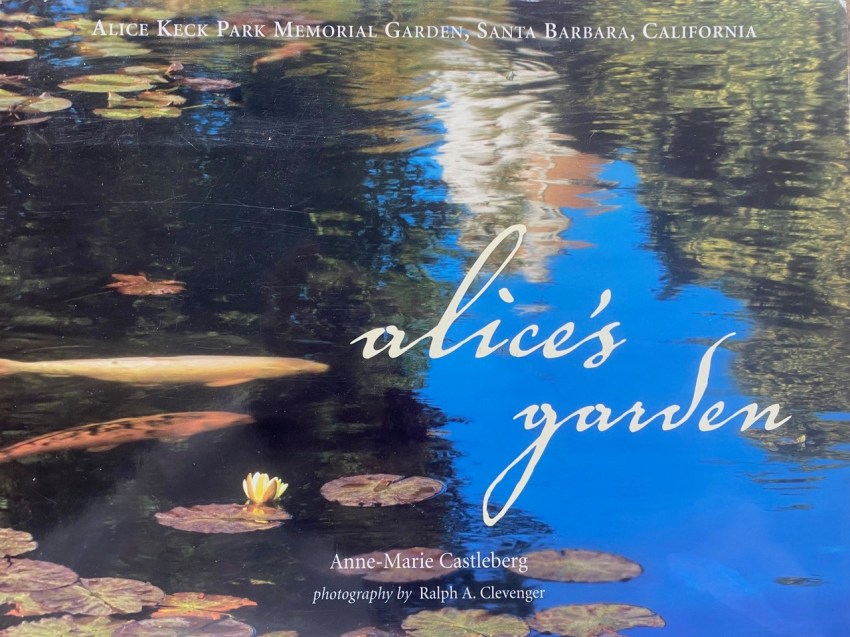
Excellent publication that details the history of the extraordinary Alice Keck Park Memorial Garden—a wonderful alternative to what might have been. | Credit: Courtesy
This treasured, tranquil oasis in the city gives no hint of what might have been built here. Next time you visit, try to imagine what might have been — on that square block and the surrounding ones — were it not for the determined efforts of community members who educated themselves, donated their time and treasure, and worked together to Save Our City.
Cheri Rae is a longtime neighborhood advocate and the author of A String of Pearls: Pearl Chase of Santa Barbara. She is a board member of the Pearl Chase Society, and the longtime editor of the society’s newsletter, “The Capital,” where this article first appeared. Email Cheri at pcs@pearchasesociety.org or visit pearlchasesociety.org.
Related Posts



Premier Events
Sat, Oct 10
9:00 AM
Santa Barbara
Treble Clef Chorus Fall Treasure Sale
Sun, Oct 11
5:00 PM
Santa Barbara
Trinity Choir: Choral Evensong
Thu, Oct 08
7:00 PM
Santa Barbara
“A Night of Blues” with Morganfield Burnett
Fri, Oct 09
7:00 PM
Santa Barbara
Paseo Nuevo Spooky Movie Nights
Sat, Oct 10
9:00 AM
Santa Barbara
SBNC 1st Annual Health & Wellness Fair

Sat, Oct 10
1:30 PM
Goleta
🌴 Another Day in Paradise at S.B’s Premier Ice Rink

Sun, Oct 11
7:00 AM
Ojai
Flamenco Guitarist Tony Ybarra
Sun, Oct 11
10:00 AM
Santa Barbara
18th Annual Domestic Violence Solutions Brunch
Sun, Oct 11
10:00 AM
Santa Barbara
Free Community Day at S.B. Botanic Garden
Sun, Oct 11
10:00 AM
Santa Barbara
Downtown Classic Car Show Santa Barbara
Sun, Oct 11
11:00 AM
Santa Barbara
Raíces y Sueños: Bilingual Storytime at Santa Barbara Museum of Art
Sun, Oct 11
2:00 PM
Santa Barbara
The Theatre Group at SBCC Presents: “CLUE”
Sat, Oct 10 9:00 AM
Santa Barbara
Treble Clef Chorus Fall Treasure Sale
Sun, Oct 11 5:00 PM
Santa Barbara
Trinity Choir: Choral Evensong
Thu, Oct 08 7:00 PM
Santa Barbara
“A Night of Blues” with Morganfield Burnett
Fri, Oct 09 7:00 PM
Santa Barbara
Paseo Nuevo Spooky Movie Nights
Sat, Oct 10 9:00 AM
Santa Barbara
SBNC 1st Annual Health & Wellness Fair
Sat, Oct 10 1:30 PM
Goleta
🌴 Another Day in Paradise at S.B’s Premier Ice Rink
Sun, Oct 11 7:00 AM
Ojai
Flamenco Guitarist Tony Ybarra
Sun, Oct 11 10:00 AM
Santa Barbara
18th Annual Domestic Violence Solutions Brunch
Sun, Oct 11 10:00 AM
Santa Barbara
Free Community Day at S.B. Botanic Garden
Sun, Oct 11 10:00 AM
Santa Barbara
Downtown Classic Car Show Santa Barbara
Sun, Oct 11 11:00 AM
Santa Barbara
Raíces y Sueños: Bilingual Storytime at Santa Barbara Museum of Art
Sun, Oct 11 2:00 PM
Santa Barbara


You must be logged in to post a comment.