

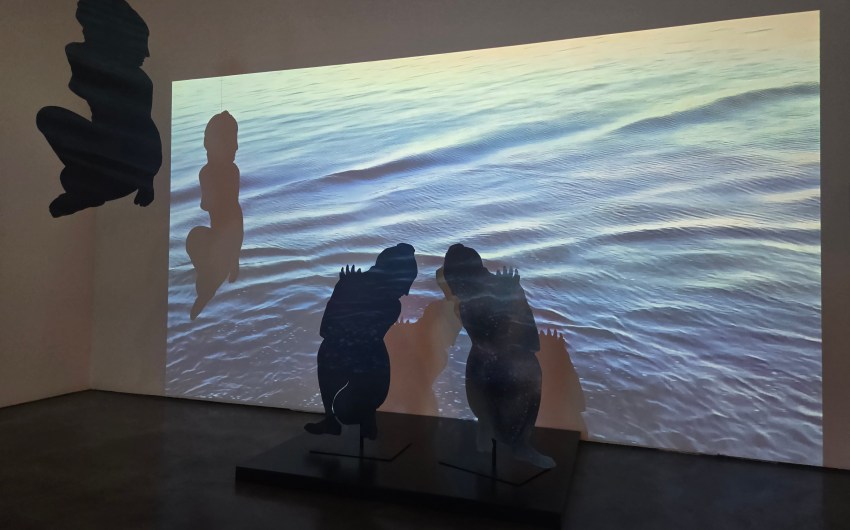
Certain art exhibitions tempt even the most ethically and aesthetically upright among us to violate a first rule in art spaces: “do not touch the art.” Ironically, or not, this temptation comes to roost at the Westmont Ridley Tree Museum of Art, with the fascinating show Haptic Knowing. “Haptic” is a term relating to touch, from the Greek word haptesthai. In various ways, the art here reaches across conventional boundaries of form and function, and makes representations of nature and ritual palpable, by their own expressive terms. In turn, we want IN, tactility-wise.
Gathered fortuitously under one museum roof, artists Carol Shaw-Sutton, Eliot Spaulding, Lea Feinstein, Andrea Bersaglieri, and Janet Neuwalder make art which is definitively unique, but somehow hangs together well in the show, organized by interim director and curator Chris Rupp, in collusion with Shaw-Sutton. Among other qualities, the exhibition is a refreshment and requires “being there,” as touch and physical presence are becoming rare and evermore precious in the AI suffused modern moment.
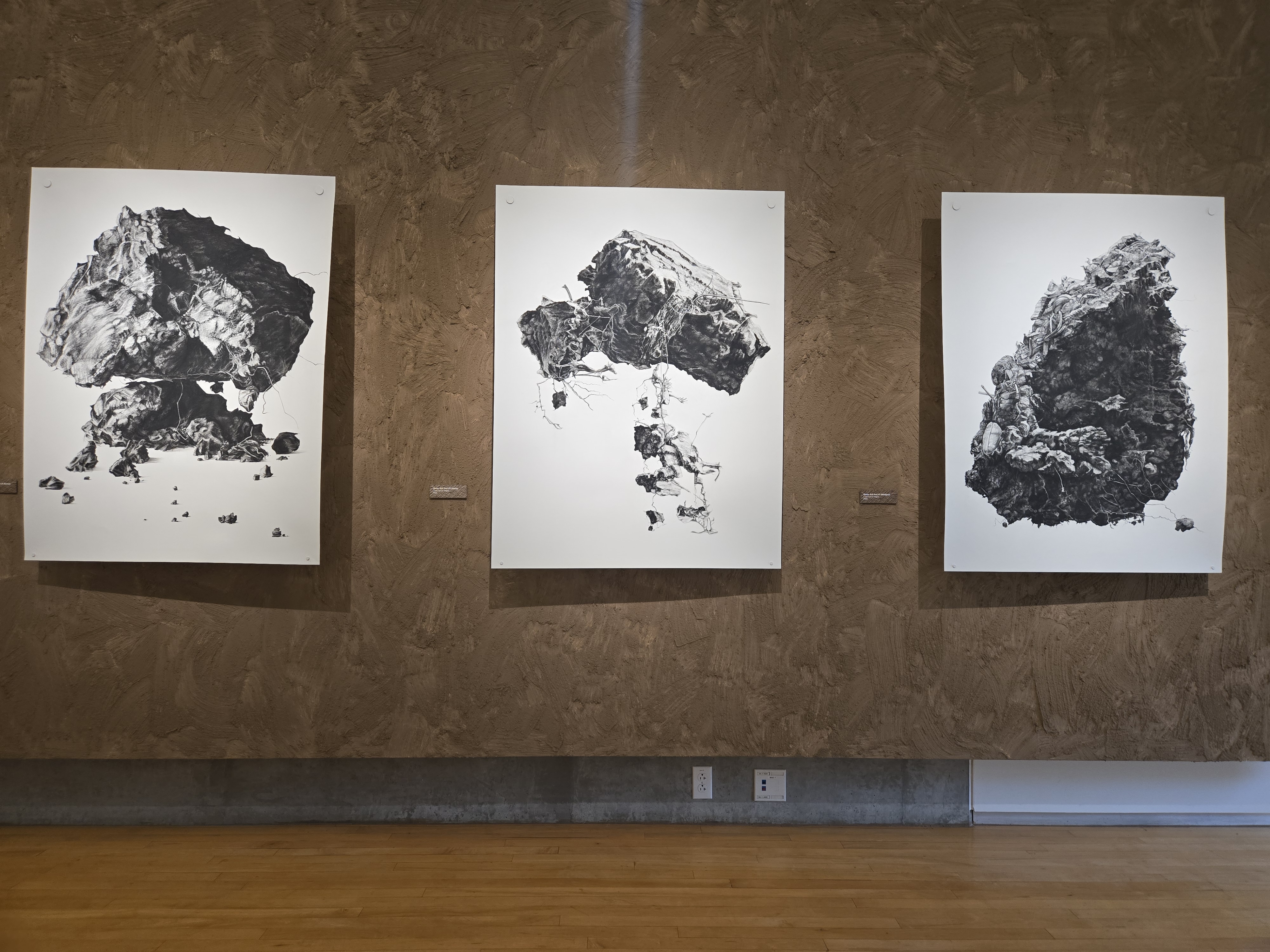
We get a strong introductory general impression in the Museum’s long entryway gallery, featuring the work of Los Angeles artist Andrea Bersagliari. She digs into and contemplates dirt — in finely detailed charcoal on paper “portraits” of discrete, almost sculptural hunks of earth and roots. These drawings, in the “Home Soil Pod” series, are isolated and lionized against white backdrops, for greater impact. Bersagliari is dealing with nature as subject, but also writes, “I am interested in the gray space between form and formlessness.”
Another artist with an intimate relationship with nature is Spaulding, whose deceptively faint and quiet art in one corner of the main gallery invites lingering and cogitating upon. Spaulding, whose work often involves inventive resourcing of ideas and actual elements of nature, conceptualized a new way of working while in a residency at Ojai’s Taft Garden, a special nature preserve with cultural intentions. There, she made palimpsest-like tracings of tree bark textures, as a way of preserving the innate look and literal feel of trees.
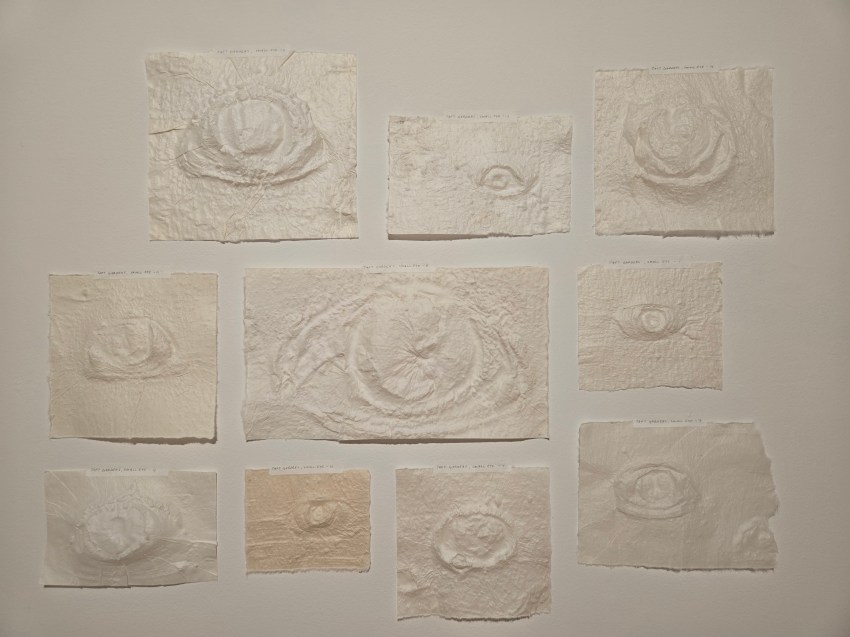
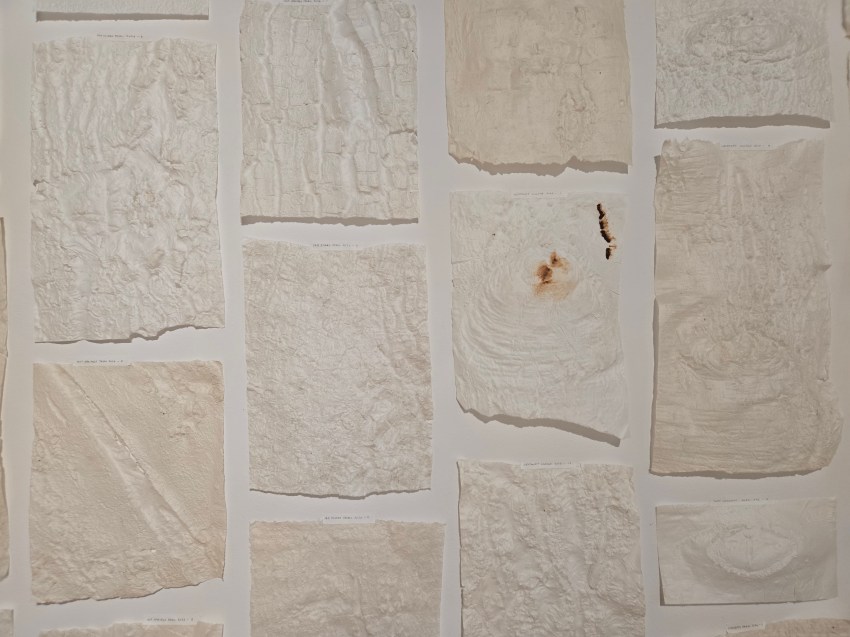
Her Taft Gardens impressions range from “daily prints,” indexing her own time there, and a set subtitled “small eyes,” for their resemblance of tree knots to animal eyes. In her series here, “Quercus Impressions,” made with the delicate and hard-to-find kozo paper, she shows images from Taft Garden mixed in with impressions from a personal tour of tree-adorned spots in Santa Barbara — Jesusita Trail, Romero Canyon, Cold Springs Trail, Alice Keck Park park and yes, the woodsy enclave of the Westmont campus.
Nature and art converge, conceptually and literally.
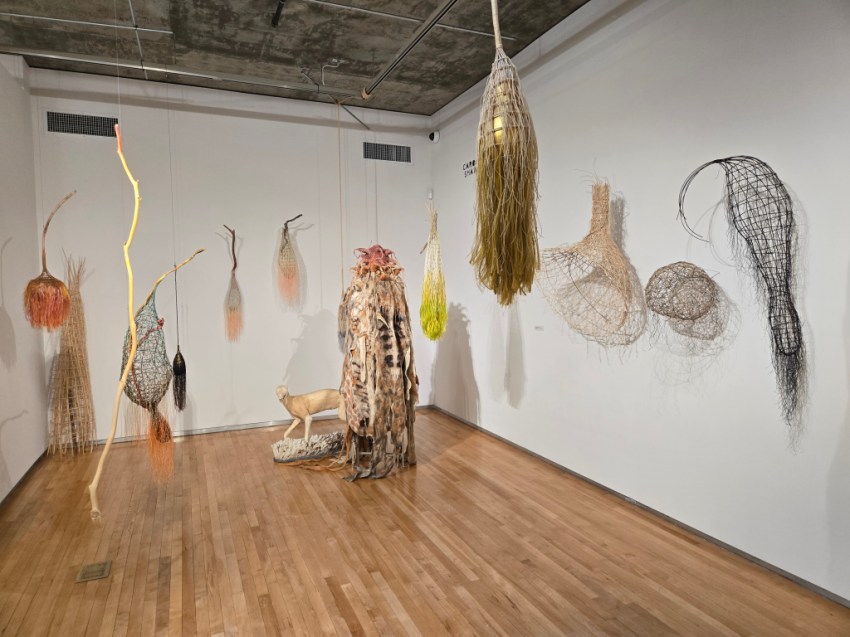
A starting point for this exhibition’s gestation came with a visit to the Ventura River-adjacent Ojai studio of Shaw-Sutton back in 2024, by Rupp and then museum director Judy Larsen. That encounter led to discussions and selections of other compatible artists. Shaw-Sutton’s art is unconventional and organic — in different definitions of the o-word. Essences of ritual and poeticized forms are expressed through work made from linen, reed, kozo paper, pigment, wool and, in the skeletal Trickster, a taxidermied creature and goat skin, and mythology makes an appearance in “Persephone’s Tools” and “Five Goddesses.”
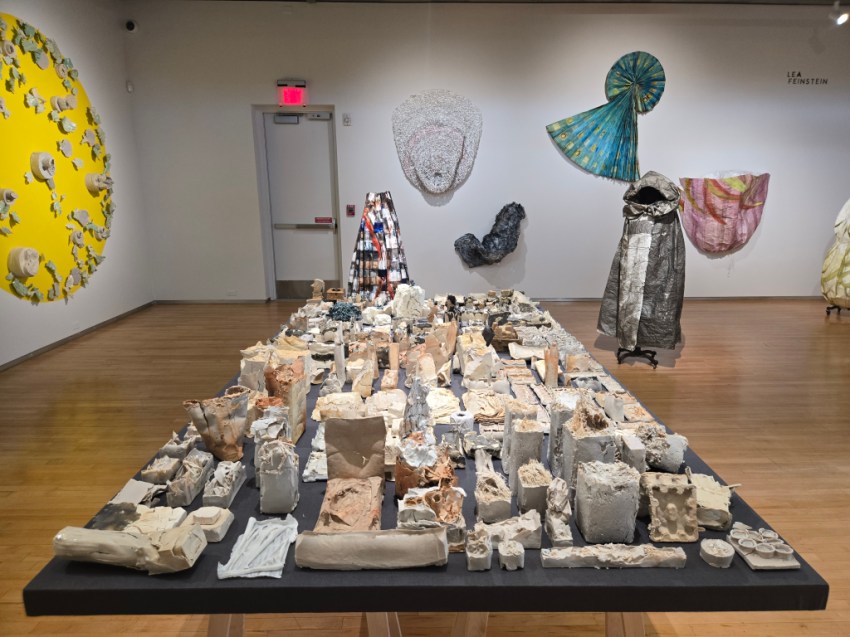
Neuwalder blurs lines of sculpture, nature and tactile forms in her own way. Multiples appear in compact, small works fitted into larger structures, but with a sense of organization less tidy than it might seem on paper. A large table greets visitors to the main gallery, spilling over with roughly-formed sculptural objects in stoneware and porcelain, in “Topography of Use,” and 18 rectangular stoneware slabs, varied in hue and surface character, in the mosaic “Accumulation.”
Similarly, yet disparately, “Aperture” sparsely places glossy leaf-like forms against a vast yellow circle on one wall.
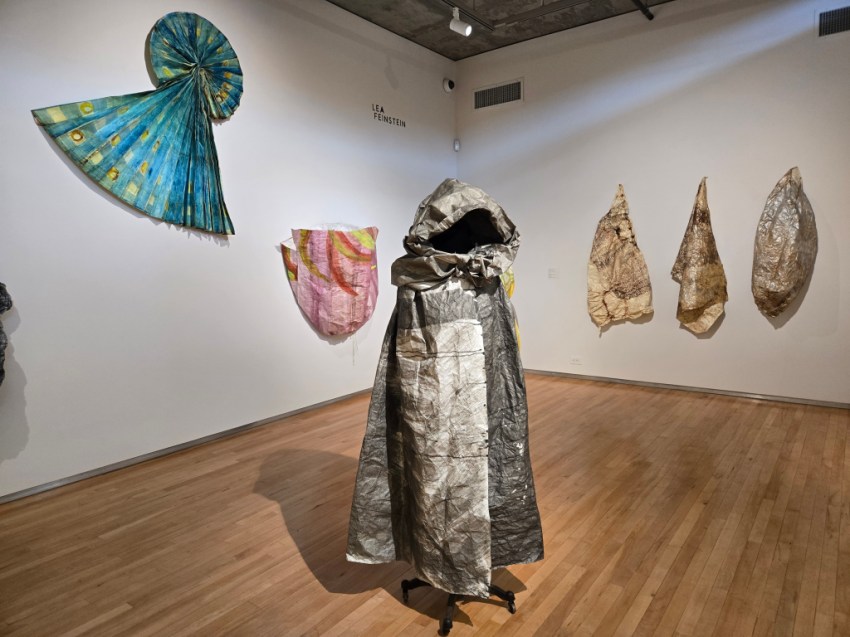
Alas, touch is allowed in the case of the “wearable art” by Feinstein. Her delicate yet fantastical, and sometimes deliciously absurd, brand of fashion is crafted from the material of Tyvek, which seems fragile and paper-like but is surprisingly durable, and often used in construction. Attention is paid to her treatment, and creative “mistreatment,” of the material, in regard to crinkled, cut-up and rainbow colored designs.
As proof-of-concept, some of her art was very much touched and worn by some insiders attendees of the opening for the Haptic Knowing show, including Rupp himself, clad in a coat of many Tyvek ruffles.
In this life, exceptions to rule can be a beautiful thing.
Related Posts




Premier Events
Fri, Oct 23
5:30 PM
Solvang
Solvang Haunted House and Street Fair

Fri, Oct 23
7:00 PM
Santa Barbara
Beth Amine’s 20th Anniversary Wildcat Dance Variety Show
Fri, Oct 23
7:00 PM
Santa Barbara
This & That Performs at Roy

Fri, Oct 23
9:00 PM
Santa Barbara
Casa de la Raza Fundraiser: Brasscals! with DJ Darla Bea
Sat, Oct 24
10:30 AM
Santa Barbara
Picnic in the Cemetery: A Live Historical Event
Sat, Oct 24
11:00 AM
Goleta
2nd Annual Charger Cup to Benefit DP High Golfers
Sat, Oct 24
12:00 PM
Santa Barbara
Makers Hive Market

Sat, Oct 24
2:00 PM
Santa Barbara
Japanese Sacred Architecture: Shinto and Buddhism

Sat, Oct 24
2:00 PM
Santa Barbara
Thriller 2026 – Get Scary for Charity!

Sat, Oct 24
3:00 PM
Santa Barbara
Downtown Santa Barbara Trick-or-Treat
Fri, Oct 23 5:30 PM
Solvang
Solvang Haunted House and Street Fair
Fri, Oct 23 7:00 PM
Santa Barbara
Beth Amine’s 20th Anniversary Wildcat Dance Variety Show
Fri, Oct 23 7:00 PM
Santa Barbara
This & That Performs at Roy
Fri, Oct 23 9:00 PM
Santa Barbara
Casa de la Raza Fundraiser: Brasscals! with DJ Darla Bea
Sat, Oct 24 10:30 AM
Santa Barbara
Picnic in the Cemetery: A Live Historical Event
Sat, Oct 24 11:00 AM
Goleta
2nd Annual Charger Cup to Benefit DP High Golfers
Sat, Oct 24 12:00 PM
Santa Barbara
Makers Hive Market
Sat, Oct 24 2:00 PM
Santa Barbara
Japanese Sacred Architecture: Shinto and Buddhism
Sat, Oct 24 2:00 PM
Santa Barbara
Thriller 2026 – Get Scary for Charity!
Sat, Oct 24 3:00 PM
Santa Barbara



You must be logged in to post a comment.