
Fracture Into Radiance
The Art of Cassandria Blackmore
By Roger Durling | October 1, 2026
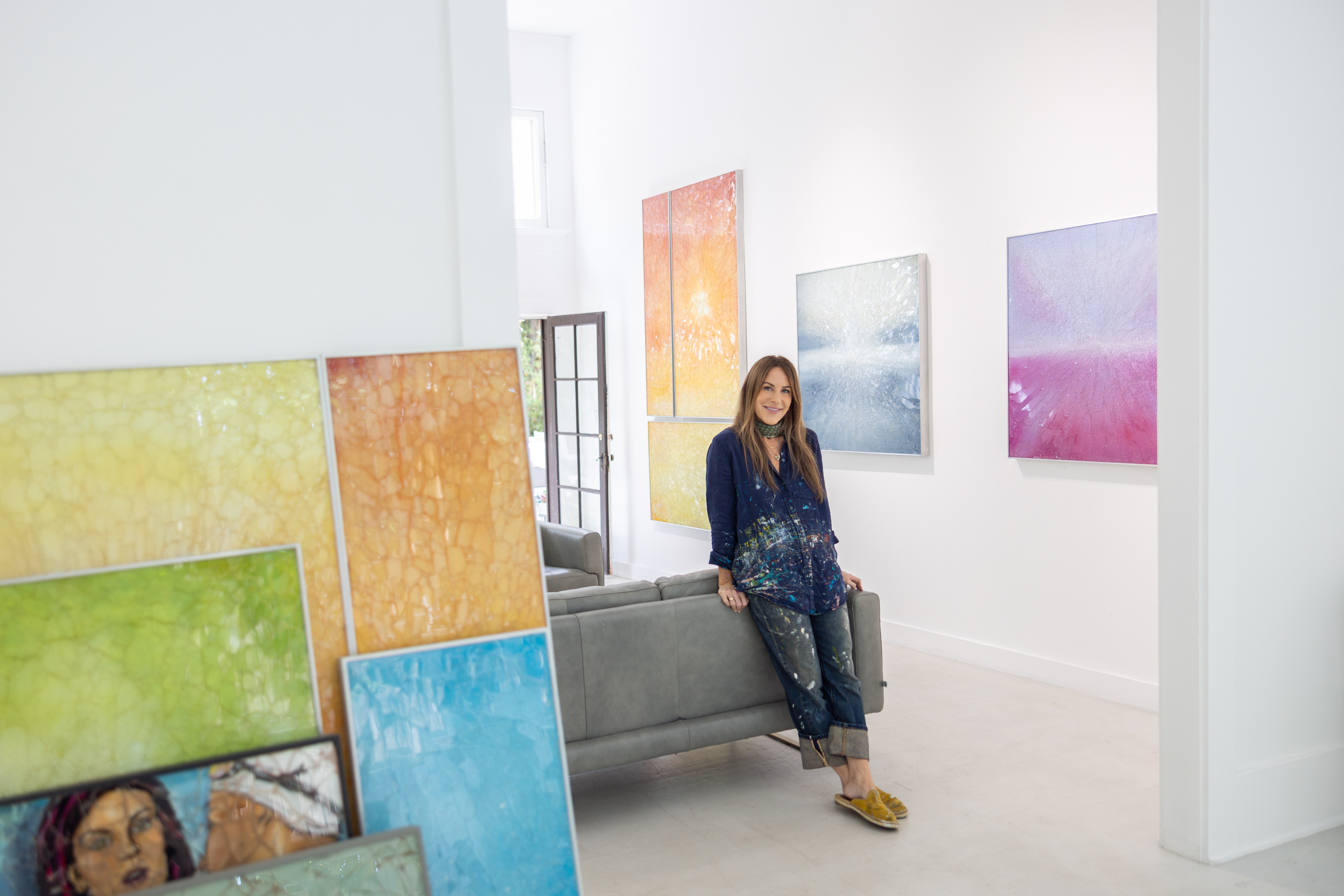
On my way to meet artist Cassandria Blackmore at her Santa Barbara home, I was listening to Leonard Cohen and thinking about the challenge of arriving on time. Parking in her neighborhood can be difficult, and as the minutes passed, I felt the familiar tension of punctuality begin to rise.
Then Cohen’s “Anthem” came on: “Ring the bells that still can ring / Forget your perfect offering / There is a crack in everything / That’s how the light gets in.” I have long admired the song for the way it beckons us to release ourselves from the burden of flawlessness. Cohen reminds us that our cracks, failures, and sorrows are not defects to conceal, but openings through which insight, empathy, and redemption can enter.
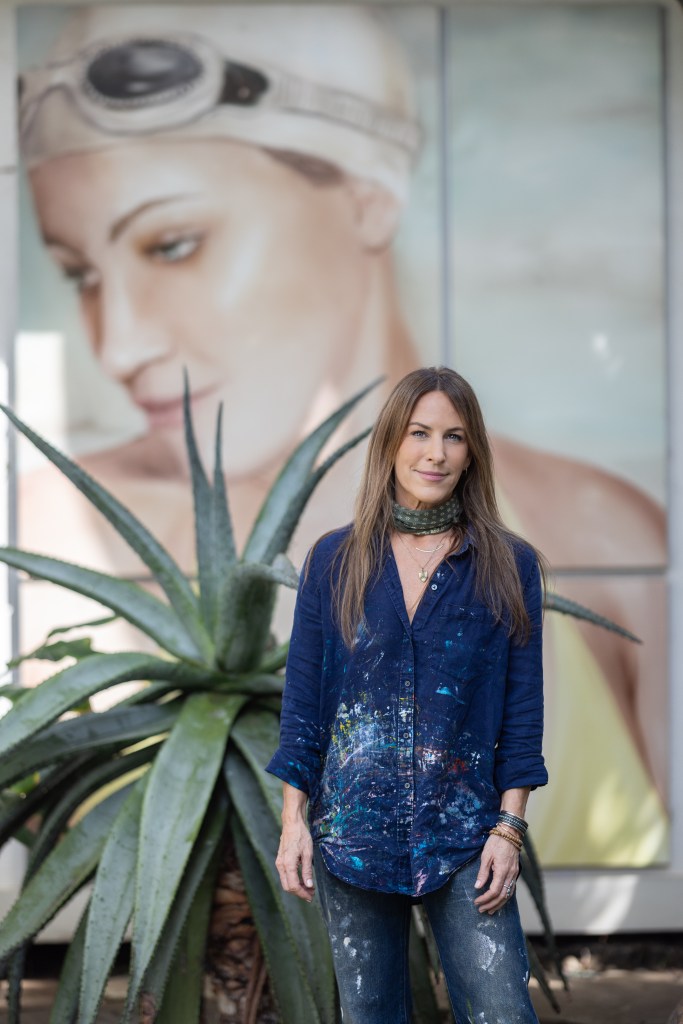
Only later would I realize how prescient those lyrics were. The song formed an uncanny prelude to my encounter with Cassandria Blackmore, an artist whose work transforms fracture into radiance.
Blackmore is acclaimed for her unconventional approach to reverse painting on glass. After painting the image in reverse, she shatters the glass and reassembles it, allowing every crack to become an essential part of the composition. The result is a body of work that pushes glass beyond its traditional boundaries and into the realm of contemporary painting.
“For me, her cracked glass works create a physical spiritual awe,” says Freddy Janka, contemporary art curator and president of the board of directors of the Museum of Contemporary Art Santa Barbara. “I admire her technical dexterity — something that appears so simple is far more complex and has a deep conceptual underpinning.”
Blackmore’s work has been collected internationally and exhibited by institutions across the country, including the Crocker Art Museum, the Fitchburg Art Museum, the Oakland Museum of California, the Portland Art Museum, and the Imagine Museum. It also belongs to numerous private collections, including those of Kevin Costner and Melinda Gates, among others.
Blackmore’s discovery of glass as an artistic language began during a painful season in Seattle in the early 1990s. She had lost her job, endured a major breakup, and found herself alone in a small apartment during the dark, rain-soaked months of a Pacific Northwest winter. One night, she opened a bottle of wine, dimmed the lights, and listened as Etta James sang “I’d Rather Go Blind.” Outside her window, a flashing red bookstore sign cast intermittent bursts of crimson across the room. She glanced at a photograph of herself with her parents in a picture frame. Each pulse of the red lights coming from outside illuminated the glass above the frame, briefly transforming the image into something vivid, charged, and unfamiliar.
At that moment, glass ceased to feel like a barrier. It became a surface capable of carrying memory, presence, and transformation. Moved by the image before her, Blackmore painted a self-portrait directly onto the sheet of glass covering the photograph — the same glass that had seemed to separate her (or perhaps shielded her) from the past.
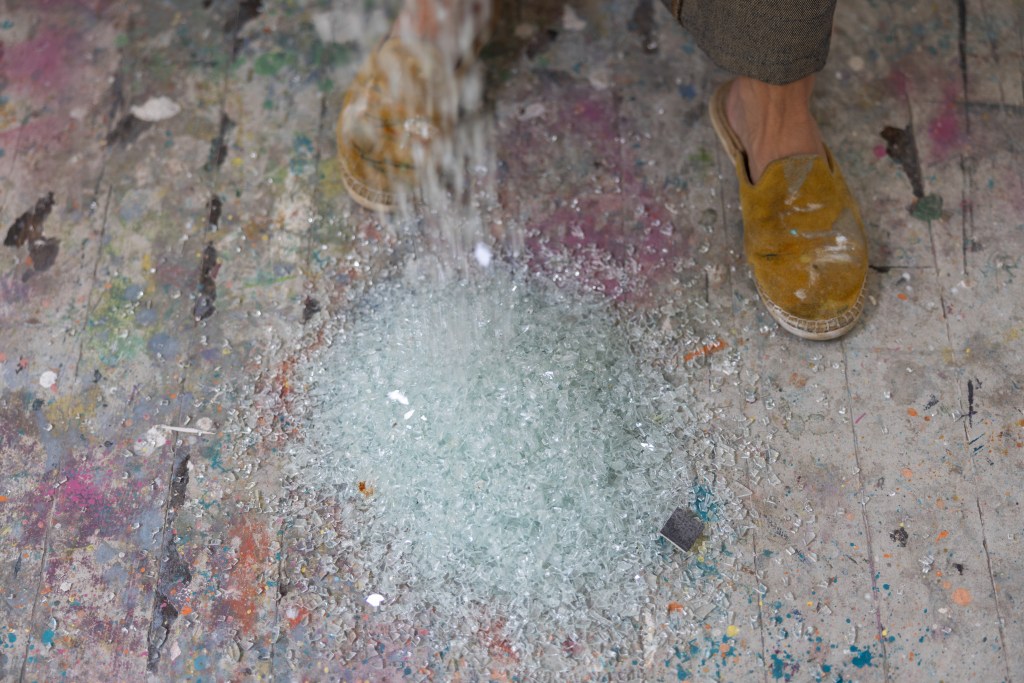
Overcome with emotion, she burst into tears and smashed the portrait. Looking down, she saw her own broken face scattered across the floor. Almost instinctively, she began piecing the shattered image back together.
“This was symbolic of my condition,” she clarifies. “I was going to put my broken pieces together, and the work became a reflection of the human condition. It was the perfect fusion of image-making, tactility, reflection, and resurrection.”
Glass is invisible in our daily life. We take it for granted. We look through it, drink from it, and drive behind it. Yet when it shatters, it reflects light. “I came to see these ‘shatter points’ as metaphors for the moments in our lives that define us,” she states. “We break not only in sorrow, but also in transformation. It is in those fractures that we begin to reflect light.”
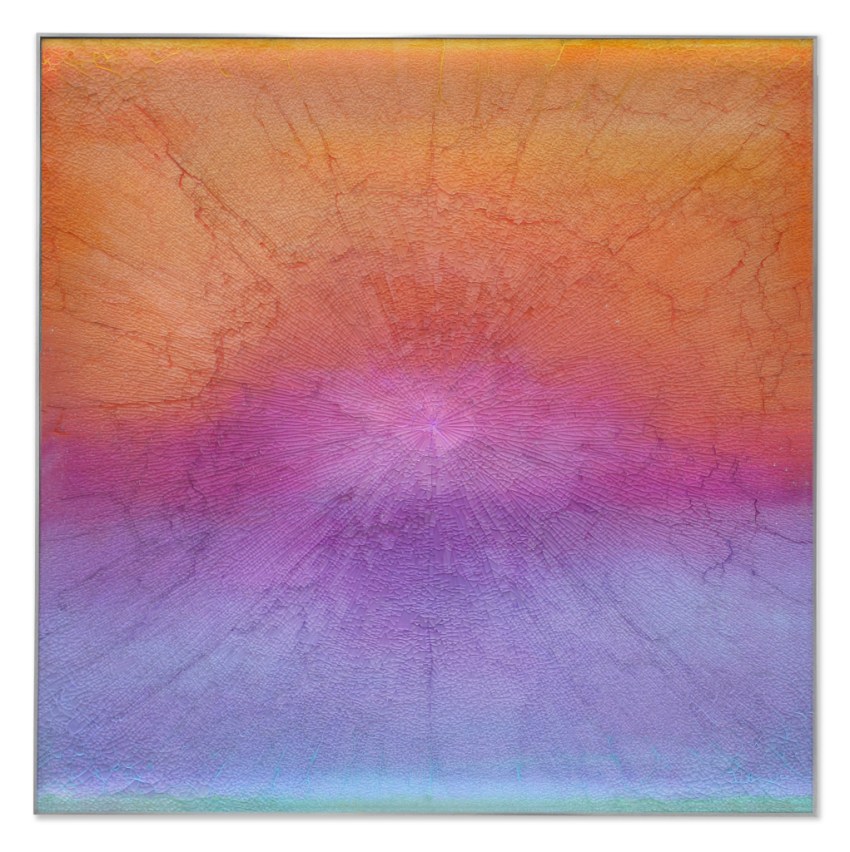
To better understand Blackmore’s place within contemporary art, I turned to Donna Davies, executive director of the renowned Pilchuck Glass School, for insight into the artist’s singular trajectory. She explains, “Cassandria’s work is obviously very unique in her use of reverse painting glass and then shattering it. What I find really compelling about Cassandria’s work is first and foremost, her remarkable approach to the material. Most people consider the characters of the material of glass — its perceived fragile nature, the perfection of a vessel or form, its translucence — and Cassandria takes those notions of the materials and literally shatters them to create work that is bold, dynamic, and rich in process. The depth of the material and colors interweave to create wonderful movement that seems to emanate from the crux of the breaks and extend beyond the frame. Further, her use of color is superb — sometimes so deeply luscious, other times contemplative.”
“Cassandria is beautiful — inside and out,” Ginni Drier, a collector of her work, tells me. “She has a heart that glows, a quick and happy sense of humor, and a funny, contagious laugh.”
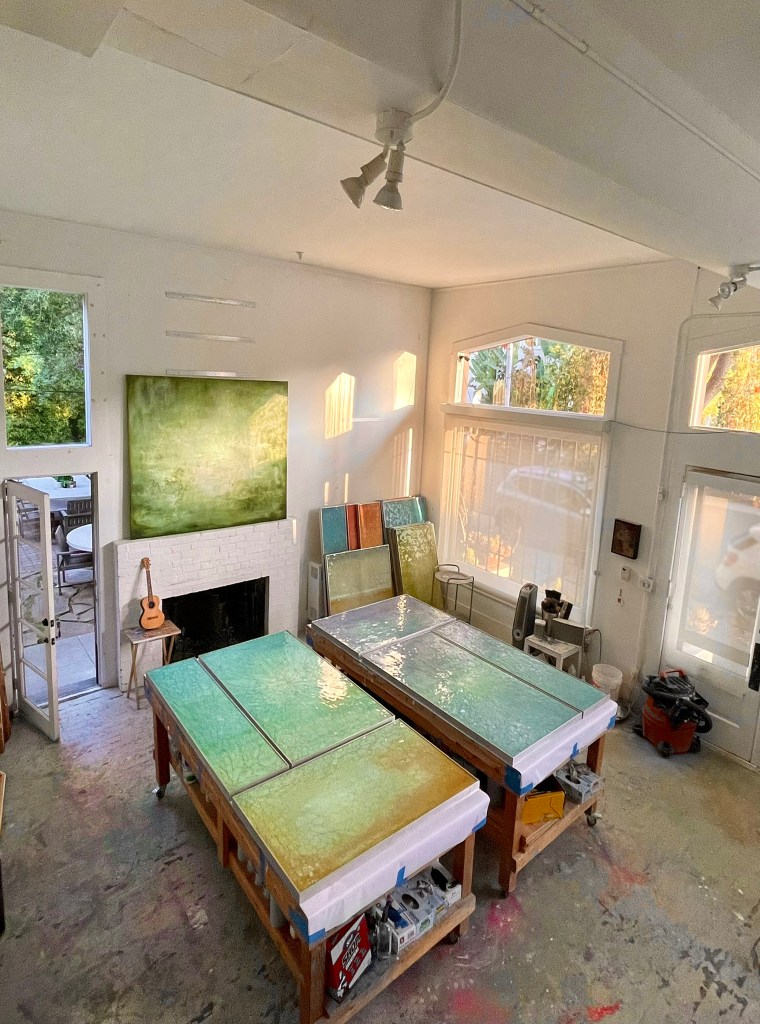
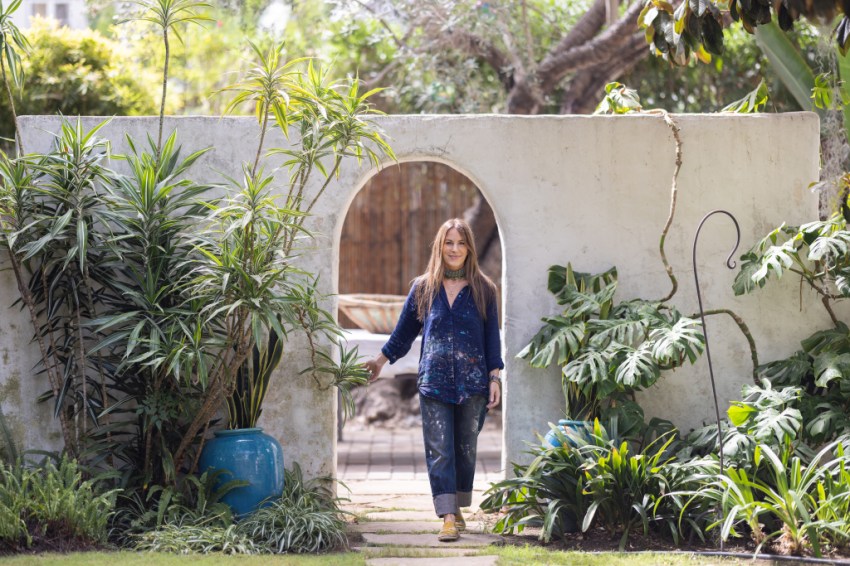
Spending time with Cassandria in her studio, which is also her home, deepened my appreciation of her both as an artist and as a person. Behind the gates, the place feels like a veritable oasis, its garden peppered with her artwork and sculpture collection. She apologizes for the untidiness, explaining that she has been helping her daughter Leona prepare to leave for the Rhode Island School of Design, where she will major in film. A piano sits in the center of the workspace. Her 22-year-old son, Orion, practices on it; he is a writer and illustrator who works at the Santa Barbara Museum of Art.
Her father, Glenn Blackmore, was born in England. Her grandfather, Johnny Utley, was an American serving in Europe during World War II when he got Marjorie Blackmore pregnant. They never married, and Johnny died in the war. Glenn had read about the hippie movement in the United States and came to San Diego in 1968. Her mother, Jacqueline, was a go-go dancer. Glenn went to see her perform, and they fell in love. “They were bohemians,” Cassandria said. “They started managing rock bands.” She was born in San Diego in 1968.
The young family moved to Berkeley, where they opened a bead shop. When Cassandria was around 7, her parents bought a school bus and moved to Oregon to live off the land. They settled in the Willamette Valley before it became wine country. They lived in a barn with no indoor plumbing or running water, with an outhouse and a wood stove. They spun their own wool, and her mother made their clothes. She recalls both of her parents being creative. Her mother made sandals decorated with beads, and she encouraged a young Cassandria to study art.
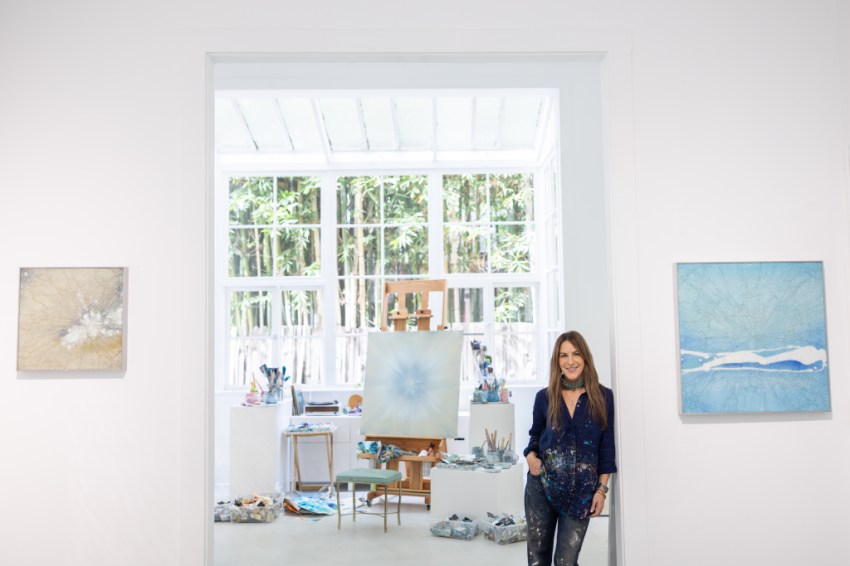
Growing up on a farm instilled in her a strong work ethic. After high school, Cassandria worked for four years waiting tables and working in retail. In 1989, she attended the Pacific Northwest College of Art in Portland, a very rigid fine arts school. She took it very seriously because she was paying for it herself. She wrote her thesis on the Minoan culture of Ancient Greece — artistically known for vibrant wall frescoes showing nature, bull-leaping, and athletics, alongside delicate pottery and metalwork.
She recalls that her commencement speaker warned the graduating class that within 10 years, only about seven of the 300 students in her class would still be working in the arts. She knew she would succeed. “It’s not about being great,” she says. “It’s about discipline. When you don’t practice, you get in your head and become intimidated and self-doubt can set in. I knew better. I was going to persevere.”
While at school, she also studied sculpture and started to be interested in glass — which was not something that was taught. “I noticed that works with glass did not deteriorate,” she said. “It felt like a permanent way of working. An art that doesn’t deteriorate.”
After getting her degree she moved to Seattle. Fortunately, by then she had already gotten her first public art commission — the Lincoln City Library on the Oregon coast asked her to create a glass mosaic doorway titled “Doorway to Wisdom.”
She held several jobs while continuing to pursue her artistic goals. In the late ’90s, during the grunge scene, she met her future husband, Jon, at Mama’s Mexican Kitchen, the legendary restaurant in Seattle’s Belltown neighborhood that served as a central hub for many of the city’s most famous musicians during the late 1980s and 1990s. “He was my server,” she remembers. “I left a note with my tip. He was a musician.” They opened a gallery showcasing her work on East Pike Street 30 years ago, and Jon runs her business. About 10 years ago, they opened galleries in San Francisco and Carmel. The latter was forced to close during the pandemic. Blackmore is represented by art dealers across the country and one in Belgium.

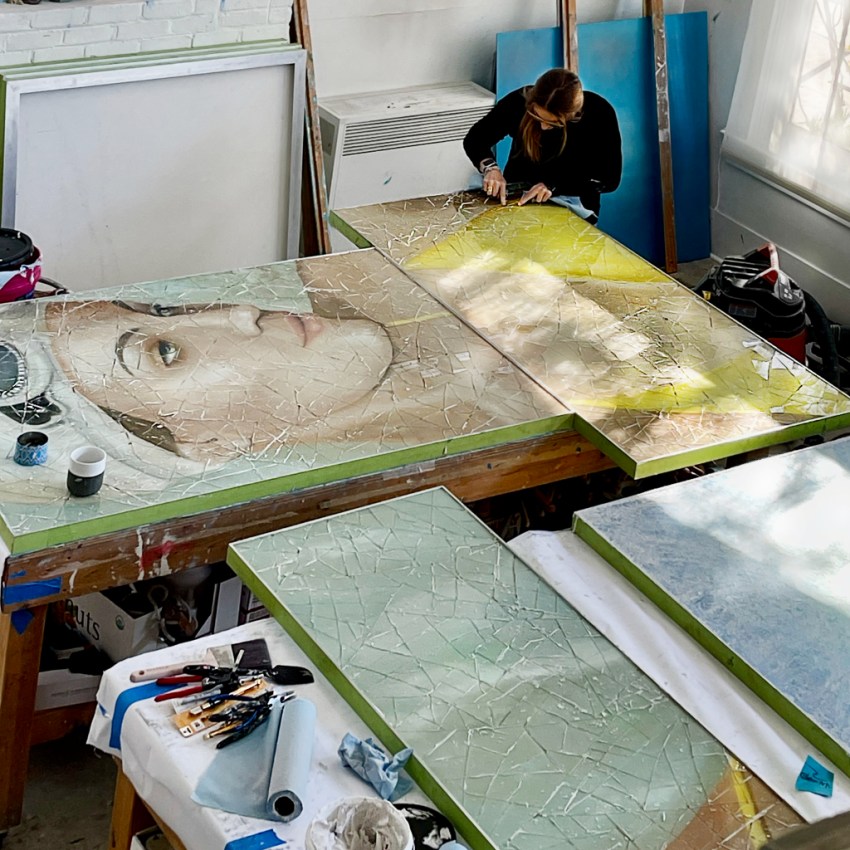
“The conceptual aspect of my work is very much interwoven into the physicality of the work and how it is created,” she says, describing her reverse glass painting technique to me. “The glass is pigmented from the reverse side. This process takes many layers and a lot of patience. The glass is heated to a high temperature and then cooled rapidly, which causes stress and vulnerability in the glass. It is then shattered and reassembled.”
She has two distinct styles in her work — abstract and figurative. “One is emotionally charged,” she explains. “The other is more methodical and literal.” The abstract paintings on glass are heated to a high level and cooled off fast, creating stress on the glass that is shattered with a single strike. In advance, she plans where the strike is to take place — whether it will be off-center or on the horizon line, etc. In her figurative art, the glass is cooled down slower. It is more deliberate. The cuts or breaks are done by hand and then reassembled. As she’s putting it together, the glass is expanding. It has to be broken evenly. Her signature is signed in reverse in the figurative work. She does not sign her abstract paintings.
In 2008, because of her son’s autoimmune issues, they left Seattle and started living in an RV. A doctor had suggested that a change of environment would be good for him. They started driving south. She points out the irony that her parents moved north, and that she found herself moving south with her family. “If you can make a living as an artist, you can live anywhere,” she says.
Thirteen years ago, they made it to Santa Barbara. “Just as my work is about reflecting light, Santa Barbara to me is also about light,” she says. “As soon as I experienced the south-facing coastline and the way it glows, I was mesmerized. There is a different quality to the light here. The warmth of it envelops you even when it is diffused by a marine layer. Just as light dances across the Santa Barbara sea, so does light glisten across the surface of shattered glass.”

They found their home on Craigslist. The building, which includes four apartments, was once the studio founded by the legendary husband-and-wife photography team Carolyn and Edwin Gledhill. They positioned their studio just one block away from the luxurious oceanfront Potter Hotel to attract wealthy, prominent tourists and local luminaries. Diego Rivera painted his iconic 1941 self-portrait here. That very painting would later appear on Mexico’s 500-peso banknote, paired with Frida Kahlo on the reverse side.
On Sunday, October 25, Cassandria is hosting a dinner open to the public where she will share ghost stories celebrating the remarkable artists who inhabited this legendary space for the past 120 years. The event is a fundraiser for the Museum of Contemporary Art Santa Barbara, where she is the vice president of the Board of Directors. (See tinyurl.com/yeyxfpm6 for details.)
“Inspiration can come to me at any moment, and just through a doorway from my living space is a working space,” she says about her home in Santa Barbara. “For me to have access to my studio effortlessly day or night is such a privilege, especially when my children were young. I don’t really see a difference between life and work. I am an artist; it’s who I am, not what I do. Therefore, the line is completely blurred.”
Cassandria Blackmore will be a special featured guest artist on October 2 when, as part of the first-ever Santa Ynez Art Walk, she will appear at Artiste Winery & Gallery (1095-A Edison St., Santa Ynez) for a special exhibition of her reverse paintings on glass from 4-7 p.m. See tinyurl.com/3925kj97




You must be logged in to post a comment.