
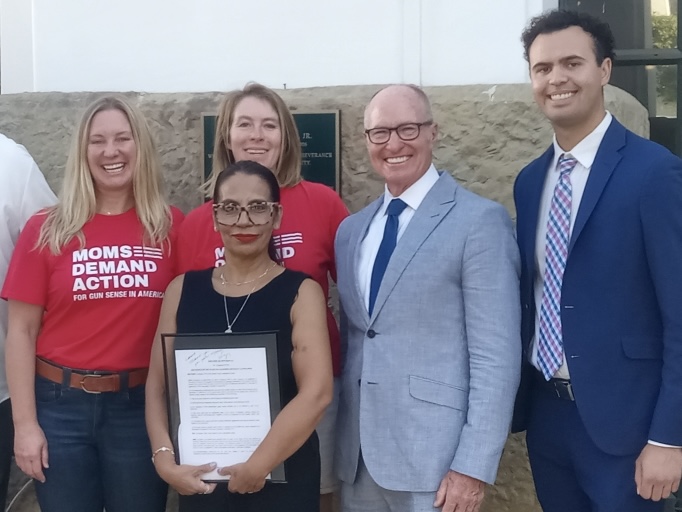
Laura Piña works as a teacher and academic counselor at Allan Hancock College and Santa Barbara City College. Her job, in effect, is to make other people’s dreams come true. Ten years ago this month, Laura Piña got married. Whatever her own dream might have been did not come true. In June 2024, Piña filed legal papers for divorce. On July 9, Piña’s husband shot her. One of Piña’s doctors told her to research the type of ammo he used. It’s called a “RIP round” she said.
“It’s like they combined eight bullets tied up as one,” she said.
It ripped up her spleen, gall bladder, and other internal organs. Piña’s mother and two daughters got the call that she’d been rushed to the hospital. The next 30 days or so, she spent under the care of one medical establishment or another. At a press conference this Monday morning, she thanked her mom and kids for getting her back. They never left her side, she said. Aside from a small, puckered dimple on her left elbow, no one would have a clue what she’d been through.
October is Domestic Violence Awareness month. State Assemblymember Gregg Hart called attention to the moment by celebrating the key role Piña played in getting a bill passed, making it easier for victims of domestic violence to cut the legal ties that bind the abused and abuser together. The bill passed unanimously in both houses before being signed by the governor.
The press conference was held outside the District Attorney’s Office and across the street from the courthouse where Piña first filed her divorce papers. Piña’s two daughters were on hand. Hart, Piña, and DA John Savrnoch all spoke. Domestic violence cases, Savrnoch stated, made up his office’s most prevalent caseload he stated.
The bill, better known as AB 1875, abolished California’s law requiring a six-month cooling-off period before divorce papers can be finalized. Texas, Hart said, required only a 60-day cooling-off period.
“It’s not often we look to Texas for inspiration for our legislative agenda,” he joked.
For Piña, the six-month requirement was a big deal.
“We couldn’t find him to serve him papers,” she explained. The six-month clock wouldn’t begin ticking until he got served. “That meant I had to pay an attorney to be looking all over for him.”
Her husband would not be served, Piña noted, until the month after he shot her. The FBI arrested him in Seattle. He’s been in custody since.
Psychologically, she said, the cooling-off requirement is a big deal, too. Victims of abuse have so much they need to deal with. Then there’s the gauntlet of medical bills to be navigated, a whole new bureaucracy to learn. There’s a tendency to isolate, a sense of shame to combat.
Even with her husband behind bars, Piña says she still doesn’t feel safe. She’s not sure when she will. It takes time for the physical numbness from where the bullet went in to go away. Even after all the surgery, Piña said she discovered she still had a part of the bullet just under her skin. She squeezed it out herself.
Late last September, Piña reached out by text to Ethan Bertrand, Assemblymember Gregg Hart’s right-hand man, whom she had known from her volunteer work on criminal-justice reform. Bertrand called Piña right back. They got together, and she told him her story. She wanted some legislative action. She wanted the six-month waiting period deep-sixed. Bertrand researched the hell out of it. In no time at all, a bill was drafted. There was no opposition: 13 members of the state legislature co-sponsored it; two were Republicans. The bill gives judges the discretion to waive the six-month requirement if there’s a threat of domestic violence or if both parties agree.
From introduction to the governor’s signature, Piña’s bill took just seven months and two weeks. By Sacramento standards, that’s lightning fast. “I feel a sense of accomplishment,” Piña said. “But I never felt this would happen to me.”
But even with this bill being passed, Piña’s marriage is not yet dissolved. “I’m still married,” she said with a shrug. The criminal case now proceeding against the man who shot her, she said, is interfering with her divorce.
Related Posts



Premier Events
Sat, Oct 10
9:00 AM
Santa Barbara
Treble Clef Chorus Fall Treasure Sale

Sun, Oct 11
5:00 PM
Santa Barbara
Trinity Choir: Choral Evensong
Thu, Oct 08
7:00 PM
Santa Barbara
“A Night of Blues” with Morganfield Burnett

Fri, Oct 09
7:00 PM
Santa Barbara
Paseo Nuevo Spooky Movie Nights

Sat, Oct 10
9:00 AM
Santa Barbara
SBNC 1st Annual Health & Wellness Fair

Sat, Oct 10
1:30 PM
Goleta
🌴 Another Day in Paradise at S.B’s Premier Ice Rink

Sun, Oct 11
7:00 AM
Ojai
Flamenco Guitarist Tony Ybarra

Sun, Oct 11
10:00 AM
Santa Barbara
18th Annual Domestic Violence Solutions Brunch

Sun, Oct 11
10:00 AM
Santa Barbara
Free Community Day at S.B. Botanic Garden

Sun, Oct 11
10:00 AM
Santa Barbara
Downtown Classic Car Show Santa Barbara

Sun, Oct 11
11:00 AM
Santa Barbara
Raíces y Sueños: Bilingual Storytime at Santa Barbara Museum of Art

Sun, Oct 11
2:00 PM
Santa Barbara
The Theatre Group at SBCC Presents: “CLUE”
Sat, Oct 10 9:00 AM
Santa Barbara
Treble Clef Chorus Fall Treasure Sale
Sun, Oct 11 5:00 PM
Santa Barbara
Trinity Choir: Choral Evensong
Thu, Oct 08 7:00 PM
Santa Barbara
“A Night of Blues” with Morganfield Burnett
Fri, Oct 09 7:00 PM
Santa Barbara
Paseo Nuevo Spooky Movie Nights
Sat, Oct 10 9:00 AM
Santa Barbara
SBNC 1st Annual Health & Wellness Fair
Sat, Oct 10 1:30 PM
Goleta
🌴 Another Day in Paradise at S.B’s Premier Ice Rink
Sun, Oct 11 7:00 AM
Ojai
Flamenco Guitarist Tony Ybarra
Sun, Oct 11 10:00 AM
Santa Barbara
18th Annual Domestic Violence Solutions Brunch
Sun, Oct 11 10:00 AM
Santa Barbara
Free Community Day at S.B. Botanic Garden
Sun, Oct 11 10:00 AM
Santa Barbara
Downtown Classic Car Show Santa Barbara
Sun, Oct 11 11:00 AM
Santa Barbara
Raíces y Sueños: Bilingual Storytime at Santa Barbara Museum of Art
Sun, Oct 11 2:00 PM
Santa Barbara

