
[Updated: Wed., Aug. 12, 2026, 9am]
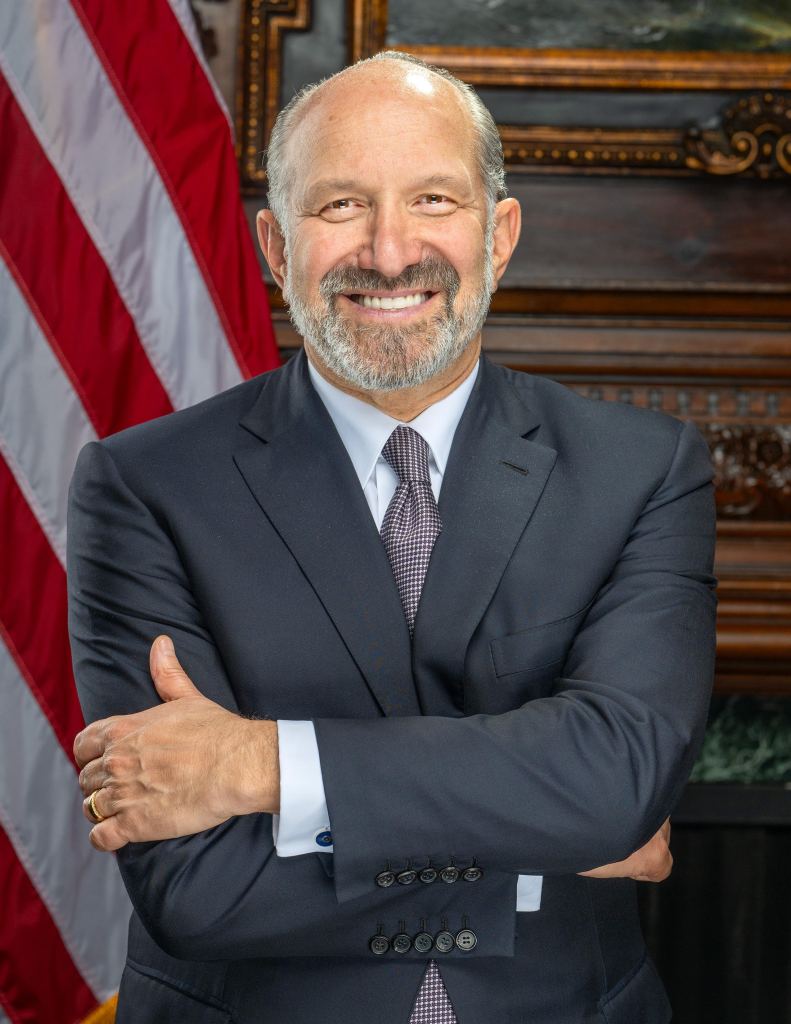
U.S. Secretary of Commerce Howard Lutnick celebrated the 50th birthday of California’s much-heralded and also much-reviled Coastal Act by throwing a cake squarely in the face of California Coastal Commission, whose job it is to carry out the act’s mission.
If all 50 candles were not blazing, they may as well have been. The actual party Lutnick threw took place this Monday afternoon at the Pacific Ballroom of the Hilton Santa Monica Hotel. It was a public hearing Lutnick initiated to explore the extent to which the California Coastal Commission had abused its role as stewards of the California coast by becoming, as Lutnick charged, “environmental extremists.”
An appointee of President Donald Trump, Lutnick was conspicuously not present for the festivities. Instead, the ballroom was packed with people who could not possibly have disagreed with him more. One after the next, they spoke passionately for four and a half hours, explaining how and why. Nine people from Santa Barbara were among the speakers. Every single one of the more than 100 speakers voiced vehement support for the mission of the Coastal Commission and decried the industrial desecration they charged the Trump White House was intent upon inflicting. Not a single speaker stood with Lutnick, who a month ago stated, “Obstructionist policies that delay critical infrastructure in the name of environmental extremism are unacceptable.”
By the time the meeting started, event organizers — federal employees with the National Oceanic and Atmospheric Administration (NOAA) — had reportedly received 10,000 written communications. It’s not known yet how and where the writers’ sympathies lie.
By way of necessary background, it was on September 24, 1976, that California’s then governor, Jerry Brown, signed the state’s now-historic Coastal Act, thus giving birth to the Coastal Commission as a permanent body charged with protecting the coast from overdevelopment. With all his celebratory solemnity, Governor Brown memorialized the moment, proclaiming, “The beaches are for all the people.”
Within two years, however, Brown’s relations with the Coastal Commission would sour considerably. Famously, he would lambast the commissioners as “bureaucratic thugs.” While Brown might remain violently ambivalent about the commission, he strongly supports its existence. Lutnick and the entire Trump administration, however, are troubled by no such mixed feelings. They regard the commission as a speed bump on the road to progress. In the past month, they have doped the Federal Register with documents detailing the staggering imagination of their intentions when it comes to coastal infrastructure and development.
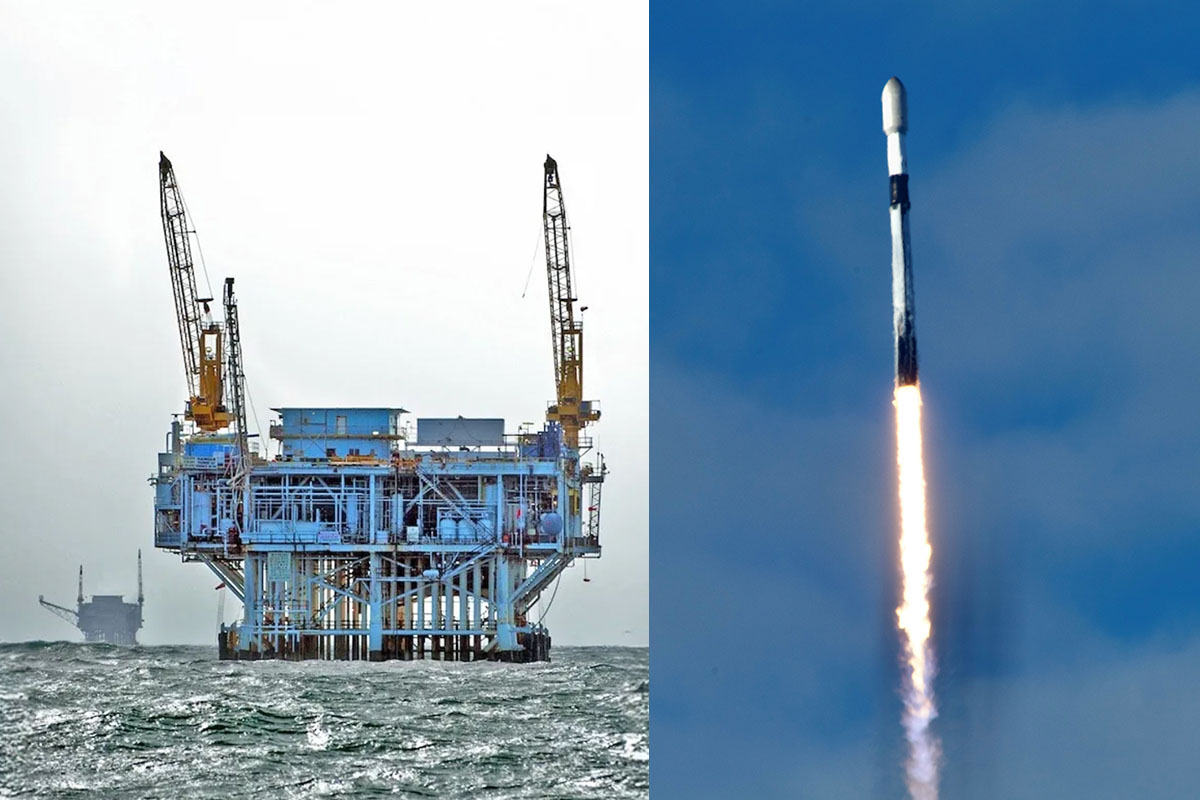
These documents envision a day when commercial rocket ships — think SpaceX and Vandenberg Space Force Base — could blast off from or land at one of the many old oil platforms running alongside California’s coast. The demand for launching space, it appears, is well-nigh infinite. And besides, such an arrangement would relieve the oil companies that own them of the considerable cost and logistical headache of removing the old rigs and hauling their carcasses away.
Likewise, there’s the possibility of approving underwater nuclear power plants off the coast. The cool salt water would obviate the need for the signature cooling towers that architecturally define nuclear power plants.
“While no commercial deployment on the Outer Continental Shelf is planned or approved at this time,” U.S. Marine Minerals Administration Acting Director Matt Giacona explained in a July 22 press statement, “it could greatly strengthen America’s energy security in the future.” The statement notes that the Outer Continental Shelf puts no fewer than 3.2 billion aquatic acres under federal jurisdiction.
At this writing, underwater nuclear power plants and rocket ships blasting off from repurposed oil platforms are at most exploratory musings and fact-finding inquiries. Less dramatic, the Trump administration is also contemplating the construction of desalination plants off the coast. And for the Secretary of Commerce — always on the prowl for strategically necessary minerals — there’s the possibility of sub-sea mining ventures.
But oil and gas development remains the old standby. On the first day of his second term, Trump declared an oil and gas state of emergency. According to the Coastal Commission, Trump has proposed opening up 104 million acres in the Outer Continental Shelf off the coast of California to new oil and leasing. Nothing of this magnitude has been contemplated in 40 years.
No one representing Commerce Secretary Lutnick or NOAA was on hand in the Hilton ballroom to explain how the Coastal Commission might obstruct such plans from bearing fruit.
Under another law passed by Congress and signed by Richard Nixon — also in the immediate wake of Santa Barbara’s historic oil spill of 1969 — all 36 states whose bodies of water butt up against federal bodies of water have the authority to determine whether uses contemplated by the federal government are “consistent” with state management plans for its own waterways.
In California, the state controls what happens in waters up to three miles off the coast. The feds call the shots in what happens past that three-mile limit. But only up to a limit. Under the Coastal Zone Management Act, the feds must subject projects proposed in their waters to the Coastal Commission for “consistency review.”
If it’s a project sponsored by the federal government itself — like the SpaceX rockets launched from Vandenberg Space Force Base — then the state’s authority, known as a “consistency objection,” is strictly advisory. But if the project in question is a private venture taking place on federal offshore lands — such as oil development — then the Coastal Commission wields partial veto power.
That veto power is formidable but not absolute. Private developers can appeal state objections to the Secretary of Commerce. And if the secretary were to conclude the development under review was in the U.S.’s national security interest or that its benefits outweighed its impacts, the secretary is empowered to override the commission’s objection.
This Monday’s hearing in the Hilton’s Pacific Ballroom was all about that — consistency review — and whether the Coastal Commission abused its privileges and engaged in what Lutnick described as “environmental extremism” and “obstructionism.” Should NOAA — the federal agency with immediate oversight — conclude it has, the Coastal Commission could be stripped of the $3 million it gets each year in federal funds. Coastal Commission staff say they can survive without the money, but they express fear they would be effectively neutered by the unstated but obvious threat of having their powers of consistency review decertified. And the coast would be wide open, they say, to whatever plans the Trump administration was inclined to permit.
Driving the commission’s spirit of suspicion and dread is the bureaucratic body language exhibited by Lutnick. According to commission staff, neither Lutnick nor NOAA have been forthcoming about the purpose of the review; they first heard about it in a press release Lutnick issued late this June.
The timing is highly unusual. Typically, NOAA reviews each of the 36 states covered by the Coastal Zone Management Act every five to 10 years. But only last year, the feds completed their most recent review of the Coastal Commission and provided the Coastal Commission a copy of the draft. It was written during the heyday of the Biden administration, which was far more friendly to the commission’s protectionist impulse. The draft document that commission staff said they saw was positive, glowing even. The Coastal Zone Management Act was being implanted and enforced in a satisfactory manner, the report concluded. More laudatory words — like “exceptional” — got thrown around, too. No issues, reportedly, were identified. When asked for clarification as to the status of that review — for the years 2019 to 2024 — they claim they were met with silence.
It’s a new administration with dramatically different coastal agendas. The Coastal Commission fined Sable Offshore $18 million for doing extensive repair work on its corroded underground pipeline despite multiple cease-and-desist orders issued by Coastal Commission Executive Director Kate Huckelbridge. The cease-and-desist work orders were issued because Sable had not secured — or applied for — the coastal development permits the commission said it needed. Sable disputed it needed to get any such permit, and argued it was relying on language from a 1983 permit issued by the County of Santa Barbara to the pipeline company that first installed the pipeline in question.
To the extent the issue has been adjudicated, the Coastal Commission’s authority to require such permits has been upheld to date. But the Trump administration has weighed in aggressively on Sable’s behalf, invoking, among other things, the Defense Production Act of 1950 to order Sable to begin pumping oil through its pipelines. That is a government order Sable sought out and has complied with. That’s one of many steps undertaken by the Trump administration to clear bureaucratic hurdles out of Sable’s way. Given this backdrop, it takes little imagination to grasp how or why the Trump administration might regard the Coastal Commission’s enforcement efforts with naked hostility.
Inside the Hilton ballroom, it was strictly the sound of one hand clapping. Speakers — representing organizations such as the Audubon Society, Surfrider, the Sierra Club, the Coastal Conservancy, Heal the Bay, the Environmental Defense Center, and the Society of Fearless Grandmothers — outdid each other to stress how un-obstructionist the Coastal Commission actually was. In the past 50 years, the commission has processed 3,700 consistency reviews. Of those, they concurred with the federal government fully 97 percent of the time, said Commission Executive Director Huckelbridge. Out of 134 aerospace or rocket launch reviews, only two elicited objections.
In all those years, just 154 cases in the whole nation were ever appealed to the Secretary of Commerce; of those, just nine originated in California. Of those, three started out in Santa Barbara. Numbers like that, many speakers stressed, exposed just how intellectually bankrupt the charges of obstructionism are.
Changes were insisted upon along the way, many speakers said. The process gave members of the public a chance to weigh in on what was taking place in their own backyard. The process mandated the commissioners to balance the competing interests: development and preservation, public access and economics. As a result, they stressed, California’s beaches really do belong to everyone. And the state’s coastal economy — half a million jobs and $51 billion a year in revenues — thrives not in spite of it but because of it.
A recent survey — conducted by the Public Policy Institute of California — revealed that 82 percent of the respondents reported that the Coastal Commission was “mostly” doing a good job. Even though 90 percent reported thinking the price of gas was a problem or a major problem, 63 percent still opposed drilling off the coast.
Oil spills, many speakers noted, did not recognize any difference between state and federal waters.
They had their talking points down cold. Most expressed pessimism any of their testimony mattered. The whole endeavor was a pretext to allow the Trump administration to do what it wanted to do, they said. The word “retribution” was raised more than once. Still, they argued — as much to themselves as fellow occupants of the ballroom — that their presence was meaningful because it helped establish a robust legal record that could be relied upon when pursuing the litigation that they believed will inevitably follow.
But no one from the other side — not one person — was there to challenge them. Or to even try. There were no oil workers wearing DayGlo-green vests and hard hats to talk about all the grown-up jobs that could have been had. No oil company execs talked about donations they’d make to the local charities and Little League teams. And no one talked about the oil being produced under conditions much cleaner than obtained in faraway places such as Iraq.
To the extent another side was even alluded to — however faintly — it was Coastal Commission Chair (and Santa Barbara City Councilmember) Meagan Harmon who did the alluding. Harmon now lives in the City of Santa Barbara but grew up in Lompoc, a grittier blue-collar town where oil is not a four-letter word and company jobs meant financial security.
“Whether you’re working the rig or you’re an environmental advocate, or like me, you’re a mom who loves to take her kids to the beach, we deserve a public process that gives us a say on what happens to our coast,” she said. “That’s the heart of what this program has provided for nearly 50 years — and what I hope it will continue to provide for the next 50 and more.”
Related Posts


Premier Events

Mon, Sep 21
5:30 PM
Santa Barbara
S.B. Independent: Santa Barbara City Council District 6 Forum
Tue, Sep 22
1:00 PM
Santa Barbara
“The Lost Weekend” – The Photography of May Pang

Wed, Sep 23
7:30 PM
Ojai, CA
Laurie Anderson at the Libbey Bowl

Thu, Sep 24
5:30 PM
Santa Barbara
Book Talk and Reception: Annabelle Gurwitch on Her New Memoir
Thu, Sep 24
7:30 PM
Santa Barbara
SB Blues Society Presents Nick Moss Band w/guest

Fri, Sep 25
3:00 PM
Santa Barbara
Family Movie Night at the Eastside Library: “Encanto”
Fri, Sep 25
7:00 PM
Santa Barbara
Patio Sessions at Carr Winery Presents: The Genuine Article

Mon, Sep 28
5:30 PM
Santa Barbara
S.B. Independent: Santa Barbara City Council District 4 Forum
Tue, Sep 29
7:00 PM
Santa Barbara
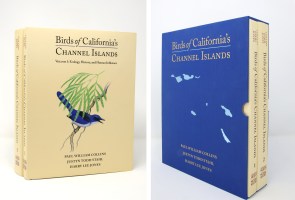
Birds of California’s Channel Islands – Lecture and Book Signing

Wed, Sep 30
12:00 PM
Santa Barbara
Origins of Fashion in France: Zoom Lunch & Learn
Mon, Sep 21 5:30 PM
Santa Barbara
S.B. Independent: Santa Barbara City Council District 6 Forum
Tue, Sep 22 1:00 PM
Santa Barbara
“The Lost Weekend” – The Photography of May Pang
Wed, Sep 23 7:30 PM
Ojai, CA
Laurie Anderson at the Libbey Bowl
Thu, Sep 24 5:30 PM
Santa Barbara
Book Talk and Reception: Annabelle Gurwitch on Her New Memoir
Thu, Sep 24 7:30 PM
Santa Barbara
SB Blues Society Presents Nick Moss Band w/guest
Fri, Sep 25 3:00 PM
Santa Barbara
Family Movie Night at the Eastside Library: “Encanto”
Fri, Sep 25 7:00 PM
Santa Barbara
Patio Sessions at Carr Winery Presents: The Genuine Article
Mon, Sep 28 5:30 PM
Santa Barbara
S.B. Independent: Santa Barbara City Council District 4 Forum
Tue, Sep 29 7:00 PM
Santa Barbara
Birds of California’s Channel Islands – Lecture and Book Signing
Wed, Sep 30 12:00 PM
Santa Barbara


You must be logged in to post a comment.