

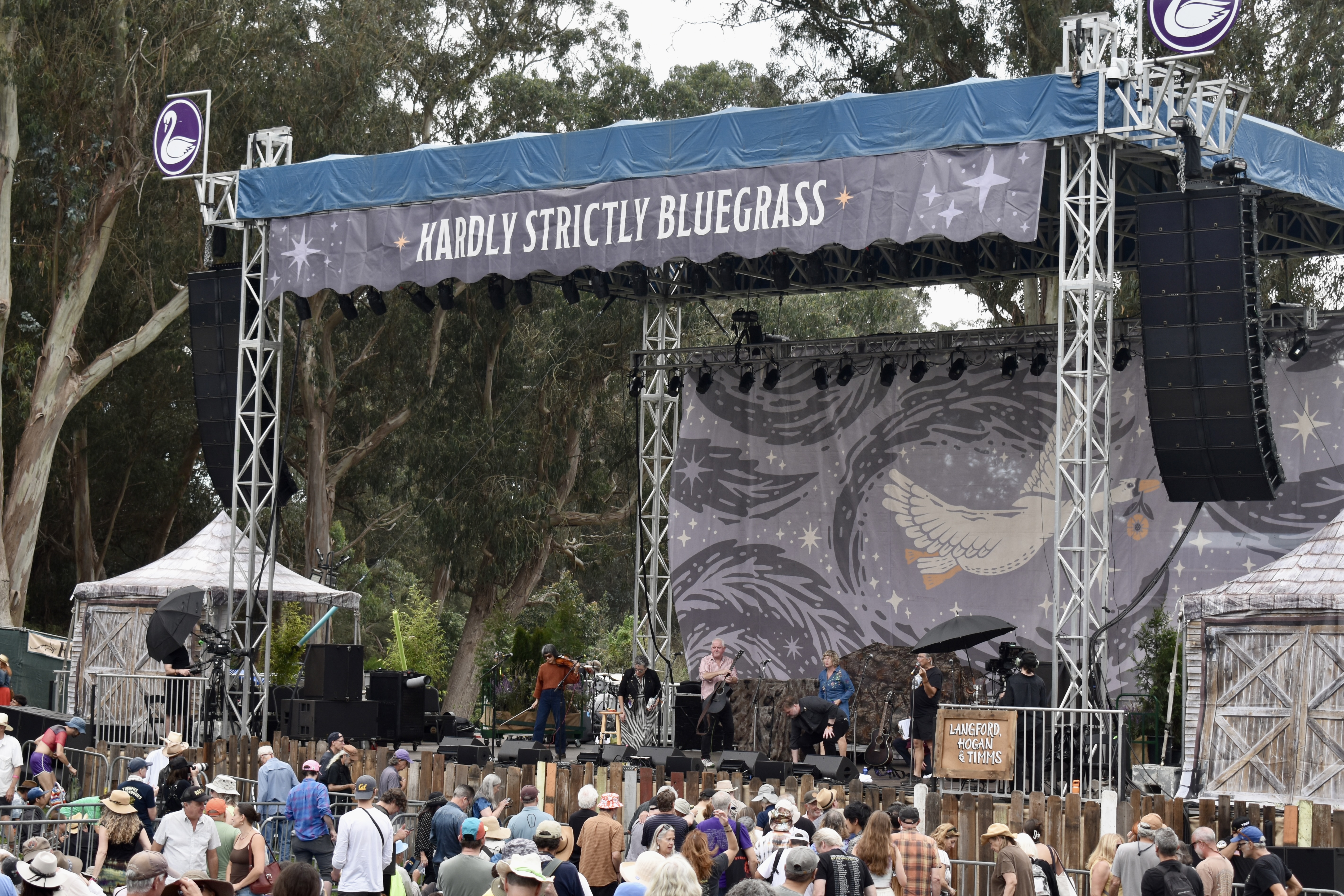
It was a cool, cloudy Sunday afternoon in San Francisco. Daisy chains hugged the wrists of hippies, toddlers sat kinglike on shoulders, and warm, bluesy notes rang through an Indian summer breeze.
Tens of thousands of people swayed shoulder to shoulder, anticipating, participating and waiting for the day’s coveted performance. They were all preparing for the same thing, or better yet, the same person: Robert Plant.
From Oct. 2-4, this year’s Hardly Strictly Bluegrass festival brought together genre-defying music, bluegrass legends, up-and-coming local artists and a blissful atmosphere to pair.
The annual, three-day event has hosted artists ranging from Bob Weir and Patti Smith to Dolly Parton and Emmylou Harris, cementing its place as one of San Francisco’s most beloved traditions for many reasons, not least of which is that it’s completely free.
This year, however, things were a little different. After Alison Krauss withdrew from the lineup to rest her voice, Plant was a late addition, but predictably, word got around fast — by Saturday night, overflowing attendance had prompted officials to temporarily close the entrance gates for the first time in the festival’s history.
But despite its size and stature, Hardly Strictly Bluegrass has maintained a laid-back atmosphere, one that has even been described as “lawless.”
Food vendors lined the fields, but festivalgoers were just as welcome to bring their own food, drinks, and even alcohol, while the lingering smell of marijuana drifted through the crowds and signs with huge lettering reading “Shrooms for sale” barely seemed to faze anyone.
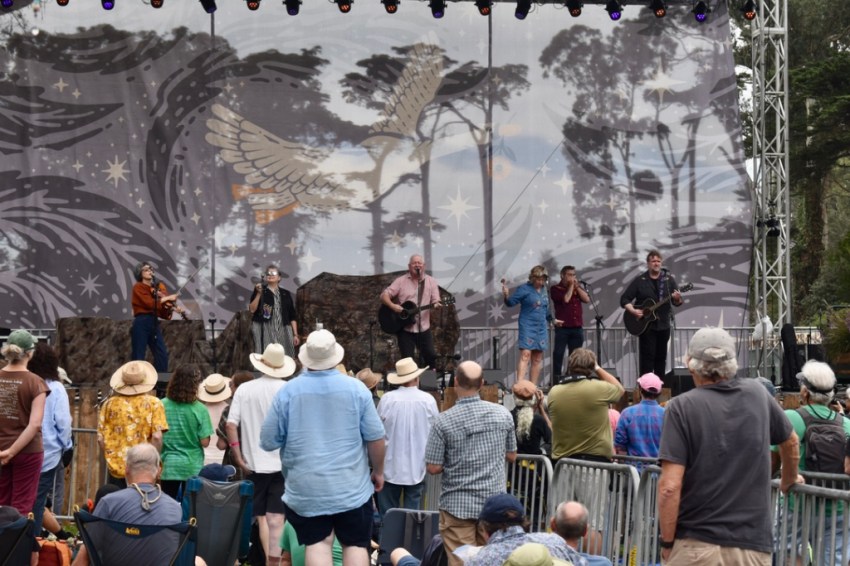
Thanks to private funding from the Hellman Foundation, what started as San Francisco financier Warren Hellman’s gift to the city has since grown into a massive freewheeling gathering that rivals the scale of Outside Lands, which, as we all know, is anything but free.
The demographic skewed older, as expected, but woven between the festival veterans were long, billowing skirts, flower crowns and a youthful glow accompanying swinging dances.
Blankets freckled the grass, joints passed between fingertips, and rainbow flags lined the skyline — It was the kind of quintessential San Francisco scene that people have come to love.
Before Plant took the stage at Towers of Gold, Jesse Welles turned topical folk songs about the Israel-Hamas war, immigration enforcement and even bugs into singalongs. At the Swan stage, Grammy-nominated folk singer Tift Merritt performed alongside Langford, Hogan & Timms and other musicians, reflecting on what it meant to gather in a place like this.
“This is the best festival in the world, and it reminds us to keep being human, to keep feeling,” Merritt said. “There is no more important time than now for messy human feelings.”
Plant is no stranger to San Francisco. The nearly 78-year-old musician has performed here many times, both with Led Zeppelin during the band’s heyday and through his later musical projects.
When he’s in town, he even makes a point of stopping for coffee at Caffè Trieste, the historic North Beach coffeehouse.

As the afternoon bled into evening, conversations about Plant’s impending performance floated through the crowd. Even those who weren’t necessarily devoted fans seemed to understand the magnitude of his appearance. Nearby, someone wondered aloud whether Led Zeppelin was still “alive” and food trucks picked up on the anticipation, too.
“Come get your plant-based tacos!” a vendor shouted.
An hour before the set, thousands squeezed into the area surrounding the Towers of Gold stage. The sun was just starting to burn off the morning fog, rays of light prismed through millions of bubbles.
San Francisco Mayor Daniel Lurie put weekend attendance at around 60,000 people, a number that looked and felt about right – It seemed as though the whole festival was packed into the cove-like field.
The grass was gone, and the only dimensions left were marked by the fans’ differing heights and colors of shirts. The audience breathed one big breath in, one big breath out, helplessly making room for newcomers.
Stage host Gordon Taylor welcomed the crowd and took the time to thank the city, the audience and most importantly, the music.
“Music is love, this music is healing and this festival sets an example for the world,” Taylor said. “An example of inclusivity, diversity, community, and love.”
He explained that executing an event of this size takes time and, in the spirit of time, encouraged the audience to pause and find a moment to offer one interaction of love.
“Every interaction you have offers the chance to leave someone a better person,” he said.

The crowd was puzzle-like, blankets Tetris-ed together as strangers found common ground. Feet overlapped, hands locked, bags stacked on top of one another, all in the hopes of making room for more people to see a revered legend in person, for free.
His iconic curly locks were now gray but wild nonetheless and the staple low-rise bell-bottoms had been replaced by an all-black suit, but it was Plant.
“I’m so blessed to be back in this ridiculous, beautiful place again,” he said.
Old concert merchandise clung to festivalgoers, including faded Led Zeppelin tour shirts. It seemed that for some, the afternoon seemed to offer a chance to revisit the music that had followed them for decades — and for others, it was an opportunity to see a musician whose influence has reached far beyond his prime.
Alongside Saving Grace, a project he started in 2019 that leans toward the more experimental side of rock, Plant performed “The Cuckoo,” a traditional folk song that has been covered countless times by other musicians.
Co-leader of the band, Suzi Dian, offered vocals that blended seamlessly with Plant’s.
Harmonious and captivating, she floated across the stage with a Stevie Nicks-like ease. Hands flew into the air in unison, cheers mixed with cries, and the scene felt just as one might have expected.
On Oct. 2, 1969, Led Zeppelin released “Ramble On,” a song that would become one of the band’s most recognizable recordings. Now nearly 57 years later, the notoriously fast-paced hard-rock anthem took on a bluesier sound as Plant’s echoing vocals brought the crowd back in time, back to the beginning of his fame.
That unexpected but welcomed addition to the performance paved the way for his next reinterpretation, “Babe, I’m Gonna Leave You,” which was punctuated by his infamous, drawn-out cries.

The performance was experimental at times, but that seemed to be part of the appeal. Plant has spent decades moving between musical styles, and with Saving Grace, he brought that same curiosity to a festival that has never been confined to one sound.
He seemed to photosynthesize in the sun — and when it came time to acknowledge the band, he presented Dian with a very fitting present: a potted plant.
Dolly Parton, a beloved Hardly Strictly Bluegrass performer, fellow musician and friend, died in August. Her cover of Led Zeppelin’s “Stairway to Heaven” has been described as one of Plant’s favorites.
“This is my song for Dolly,” Plant said. “This is my dedication to her and way back when we were dreaming in color.”
Another Zeppelin song, “Friends,” rang through the crowd and paid tribute to their friendship that extended far beyond their lives as performers.
As he waved goodbye, the energy settled. Almost as quickly as the crowd had flooded in, the audience picked up their belongings and drifted toward the Banjo stage to catch the end of Emmylou Harris’s performance.
The setting sun painted the field in shades of pink as Harris played waltzing, evocative songs. Groups mixed and danced hand in hand in circles. Some sat blissfully on the grass, watching and perhaps reminiscing, while others nursed their dancing shoes.
San Francisco is anything but passive, anything but stagnant. Plant has described the festival as having a “pulse,” and this weekend, full capacity or not, Plant or not, reminded natives and transplants alike what it means to embrace a city that people are known to leave their hearts in.
Related Posts
Premier Events
Fri, Oct 23
2:00 PM
Santa Barbara
Music & Meditation: Clarinetist Nancy Mathison & Pianist Antonio Artese

Mon, Oct 19
7:00 PM
Santa Barbara
PFLAG Santa Barbara October Meeting: “Schools and Inclusive Practices – What creates a safe and inclusive school?”

Tue, Oct 20
7:00 PM
Santa Barbara
Get Out the Vote Night @ SOHO, Music Performance by Loyal Defense Workers
Wed, Oct 21
6:30 PM
Santa Barbara
Teflon Comedy/Non-Schtick – Evening of Comedy

Thu, Oct 22
5:30 PM
Santa Barbara
Best Fest: A Celebration of the Best of Santa Barbara® Readers’ Poll 2026
Thu, Oct 22
6:00 PM
Santa Barbara
Chaucer’s Books Author Talk & Signing- Daniel M. Jaffe “Russian Silhouette: A Memoir of Activism and Identity”
Fri, Oct 23
5:30 PM
Solvang
Solvang Haunted House and Street Fair
Fri, Oct 23
7:00 PM
Santa Barbara
Beth Amine’s 20th Anniversary Wildcat Dance Variety Show
Fri, Oct 23
9:00 PM
Santa Barbara
Casa de la Raza Fundraiser: Brasscals! with DJ Darla Bea
Sat, Oct 24
10:30 AM
Santa Barbara
Picnic in the Cemetery: A Live Historical Event
Fri, Oct 23 2:00 PM
Santa Barbara
Music & Meditation: Clarinetist Nancy Mathison & Pianist Antonio Artese
Mon, Oct 19 7:00 PM
Santa Barbara
PFLAG Santa Barbara October Meeting: “Schools and Inclusive Practices – What creates a safe and inclusive school?”
Tue, Oct 20 7:00 PM
Santa Barbara
Get Out the Vote Night @ SOHO, Music Performance by Loyal Defense Workers
Wed, Oct 21 6:30 PM
Santa Barbara
Teflon Comedy/Non-Schtick – Evening of Comedy
Thu, Oct 22 5:30 PM
Santa Barbara
Best Fest: A Celebration of the Best of Santa Barbara® Readers’ Poll 2026
Thu, Oct 22 6:00 PM
Santa Barbara
Chaucer’s Books Author Talk & Signing- Daniel M. Jaffe “Russian Silhouette: A Memoir of Activism and Identity”
Fri, Oct 23 5:30 PM
Solvang
Solvang Haunted House and Street Fair
Fri, Oct 23 7:00 PM
Santa Barbara
Beth Amine’s 20th Anniversary Wildcat Dance Variety Show
Fri, Oct 23 9:00 PM
Santa Barbara
Casa de la Raza Fundraiser: Brasscals! with DJ Darla Bea
Sat, Oct 24 10:30 AM
Santa Barbara



You must be logged in to post a comment.