
What’s Worth Learning in an AI World?
Laguna Blanca’s New Teaching Framework
Prepares Students for an Uncertain Future
By Tyler Hayden | November 19, 2026
Read more from Schools of Thought 2026 here.
What should students learn to do for themselves when artificial intelligence can do more of their work for them? At Laguna Blanca School, that question reaches beyond rules about using chatbots to write essays. It touches on what an education means in the first place.
The school’s new Portrait of a Learner framework organizes its answer around three pillars: Inspired, Prepared, and Connected. Developed over two years with input from students, faculty, parents, and alumni, the framework emphasizes curiosity, adaptability, and the ability to work with others.
As for AI itself, the school’s approach calls for students to recognize when a tool can support their innate brainpower and when it takes over the thinking they need to practice.
In the following email Q&A, Anna Alldredge, Laguna Blanca’s Head of Upper School and Assistant Head of School for Academic Strategy, explains how “future-proofing” an education starts with fostering the enduring human skills that machines can’t replicate.
How does Laguna Blanca cultivate curiosity, adaptability, and connection in students’ everyday learning? Across EK-12, these qualities grow through the way students experience learning every day. Close relationships with teachers give students the confidence to ask questions, test ideas, and take risks. Learning is intentionally connected across disciplines and grounded in discussion, research, service, and real-world experiences, so students are constantly developing their own understanding and applying what they know rather than simply absorbing information. As they move through Laguna, they take on greater independence and responsibility, building the judgment, confidence, communication skills, and ability to work with others that ultimately shape how they approach learning.
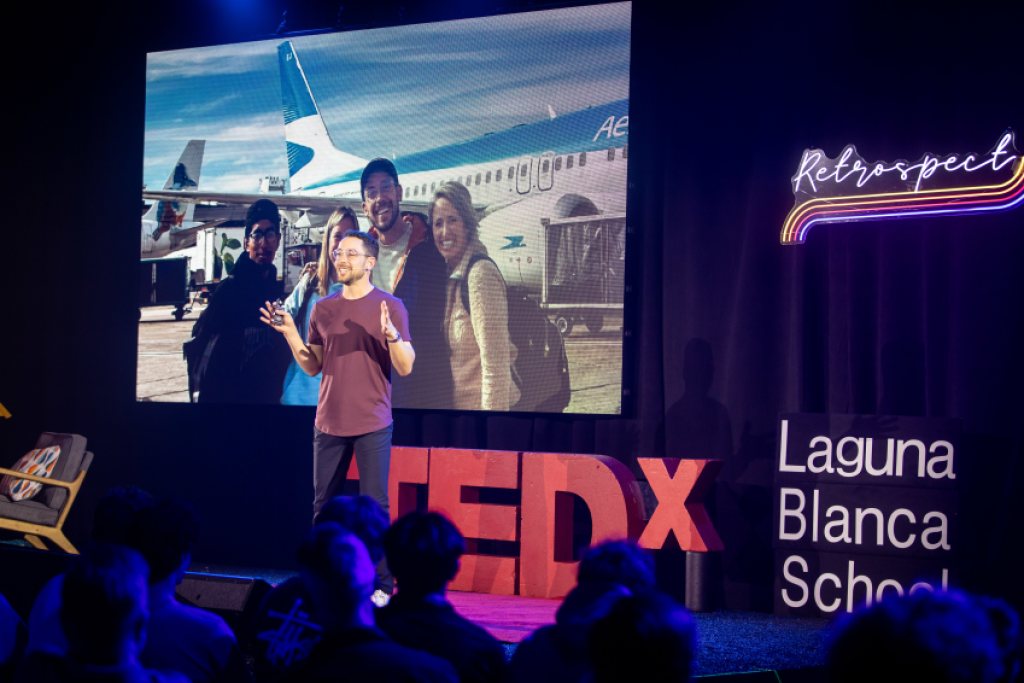
Could you please describe an assignment or project that captures the framework in practice? Our student-led TEDx program is a strong example. Students are responsible for designing and producing an entire TEDx event for the local community. They manage everything from shaping the theme and selecting speakers to managing logistics, fundraising, marketing, production, and the audience experience. The work requires them to collaborate, solve problems, communicate clearly, adapt when plans change, and take real ownership of a complex project. Just as importantly, they are creating something that connects Laguna with the broader community.
How are students learning to use AI, and to recognize when using it could undermine their learning? Part of learning to use AI responsibly is understanding when it can help, such as generating questions, organizing ideas, or offering feedback, and when using it would shortcut the very skill an assignment is meant to develop. If the goal is to strengthen a student’s writing, reasoning, and problem-solving, handing that work over to AI can undermine the learning. We want students to leave Laguna knowing how to use these tools thoughtfully, ethically, and with a clear sense of when to rely on their own minds.
The three pillars of Portrait of a Learner have long been goals of education. What is substantively different about how you’re teaching them now? What is changing is how intentionally we create opportunities for students to practice them in meaningful contexts. Faculty are encouraged to develop curriculum that extends learning beyond a single subject or traditional assignment through project-based learning, interdisciplinary connections, and real-world applications. Students might draw on science, writing, design, and mathematics to investigate one problem, such as in our 8th-grade Mission to Mars project. Then they collaborate in teams, revise their thinking, and communicate what they’ve learned to an authentic audience. The emphasis is less on simply mastering content and more on learning how to connect ideas, ask strong questions, solve problems, and apply knowledge in new situations.
See lagunablanca.org.




You must be logged in to post a comment.