
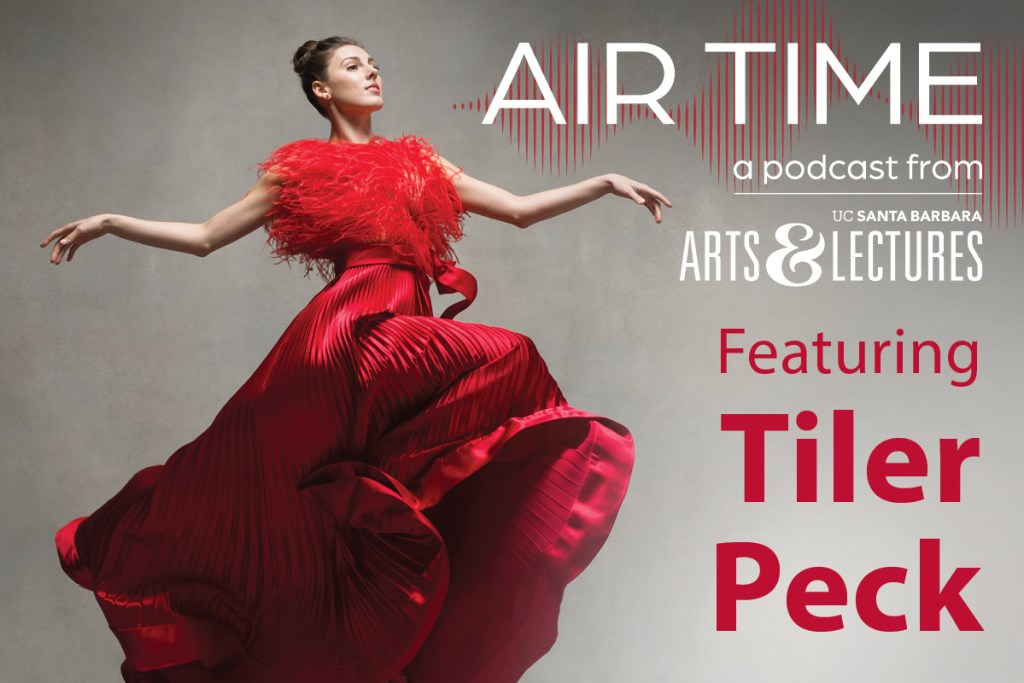
In this episode of Air Time, UCSB Arts & Lectures’ Charles Donelan speaks with Tiler Peck, principal dancer with the New York City Ballet and curator of Ballet Festival: Jerome Robbins, coming to Santa Barbara’s Granada Theatre for two distinct programs on March 3 and 4.
Peck reflects on the enduring influence of Jerome Robbins — the choreographer of West Side Story, Fiddler on the Roof, and some of the most intimate and revealing ballets in the repertory — and why his work feels especially urgent today. Having grown up dancing Robbins at NYCB, Peck describes how his choreography demands not just technical brilliance but vulnerability: “less, less, less,” she says, recalling the coaching style that emphasizes subtlety, stillness, and the courage simply to stand onstage and walk. In Robbins’ ballets, she explains, humanity replaces display, and audiences feel as though they are witnessing something as immediate as a rehearsal.
Peck discusses the honor of being invited by the Jerome Robbins Trust and The Joyce Theater to curate the original festival in New York, and how she shaped it to feel like a true festival rather than a gala — dancers from multiple companies sharing the stage in complete works, not isolated excerpts. The Santa Barbara engagement expands that vision into two evenings, allowing audiences to experience Robbins’ extraordinary range.
The first program features Four Bagatelles, the solo Suite of Dances (which Peck performs as the first female interpreter of the role), and the beloved ensemble masterwork Dances at a Gathering. The second includes Rondo, Concertino, Other Dances, and concludes with the romantic nocturne In the Night. Throughout, Peck emphasizes the importance of live music — piano, cello, and chamber ensemble — as essential to Robbins’ aesthetic and to the dancers’ experience.
In a wide-ranging conversation, Peck also reflects on Robbins’ dual legacy in Broadway and ballet, his partnership-era proximity to Balanchine, and the choreographer’s lasting impact on the art form. She speaks candidly about leadership, mentorship, and her growing interest in directing and curating projects that nurture younger dancers while honoring ballet’s lineage.
For Santa Barbara audiences — including those who remember Peck’s earlier visit with Turn It Out — this two-night celebration offers an unusually intimate encounter with one of the 20th century’s most influential choreographers, interpreted by an artist who has made his work central to her own evolving vision.
Air Time is the podcast of UCSB Arts & Lectures.
Charles Donelan
Welcome to Air Time, the podcast of UCSB Arts & Lectures. My guest today is Tiler Peck, principal dancer with the New York City Ballet and the curator and a dancer in the upcoming Ballet Festival: Jerome Robbins on Tuesday, March 3 and Wednesday March 4 at the Granada Theater in Santa Barbara. Welcome Tiler. Thanks for speaking with me today.
Hi Tiler! Did you perform last night?
Tiler Peck
Yeah, I had my Sleeping Beauty last night.
It is a big one. It feels like climbing Mount Everest, but the day after is always a relief, until you know, then you do it another time on Sunday. Thank you for having me.
Charles Donelan
What is it about Jerome Robbins that makes this festival so exciting to be presenting right now? And I’m going to ask you to talk about that in a couple of different ways. For you personally, why Jerome Robbins, at this moment in your career, for these dancers, this amazing cast that you put together, and then finally, for the world, for the audience, for the dance lovers?
Tiler Peck
I think Jerry’s ballets really had a big influence on me, kind of growing up in the company, I feel like you really learn a lot about yourself, because it brings in the humanity of the dancer, as opposed to, just like, you know, some of the Balanchine maybe more performative roles. His was always, or the way I was coached, it was always more understated. And sometimes he would say, you know, I hear like ‘Mark, baby,’ you know, like ‘Easy, easy, does it.’ And sometimes that’s the hardest thing to do, to just feel confident in standing on stage and not doing anything or just simply walking. And he really says so much in his ballets, with those types of subtle movements. And it really becomes about who you’re dancing with on the stage. It’s almost like the audience sort of disappears, in a way, and they just sort of happen to be sitting in on like a rehearsal type of feeling.
And so I really was so excited when they asked me to curate the evening, because I felt like, wow, not only is it interesting for the audience, I think, to get an up-close look at these ballets, and it really feel like a festival, because we get to do these ballets with different companies, but we never get to share the same stage with each other in the ballet. And so that was really important for me, that it didn’t just feel like a gala where it was just the different companies coming in and doing, you know, their pas de deux, but we really got to do them together. And so that’s what felt like the festival. That’s the meaning of a festival to me. And then with the cast, it was just, you know, some younger dancers that I feel like can really kind of grow in his roles. And it’s always fun to kind of put together, like your dream, kind of cast, you know.
Charles Donelan
I love this answer, and you’re kind of even on to a little bit of what I’m going to ask next. But I’m going to slow things down and just check on some things. First of all, when you say they asked me to curate, are you talking about the Jerome Robbins is it a foundation, or what is the organization that…?
Tiler Peck
Yeah, the Jerome Robbins foundation and they basically, I think they had the idea of putting together the Jerome Robbins shows with the Joyce, and then when they were talking about it, they thought, we need a dancer to kind of put it together. And so the Jerome Robbins foundation along with like, or the Jerome Robbins Trust, along with the Joyce, decided that I might be a good fit. And so when they asked me if I would want to, I remember the first thing I said was, well, does the Trust know? And he said, yes, of course. So that felt really like, I don’t know… It was just a huge honor. I was thrilled that they thought that I could be helpful in putting together the show.
Charles Donelan
And that’s right, what you brought up. That’s the key, the Joyce Theater. That’s where you originated this, and that’s where it premiered. I guess that was last August, or something like that.
Tiler Peck
Yeah, it’s wonderful. And it was, it was a little interesting, because the stage is smaller than some of the times that we dance these big ballets, and so it was kind of tricky, and figuring out what they wanted me to program, but I stuck with what I believed it should be. And I kind of had to to get them on my side, but I’m so happy that everybody was pleased in the end, because I wanted something like “Dances at a Gathering” to be on the program, because I wanted it, like I said, to have not just pas de deuxes and trios. I wanted to have this group feeling. And I said, “Dances” is the perfect thing, like when they first came to me, I was like, that has to be on it. And they said, ‘No, no, it’s too small of a stage.’ And I said, ‘No, no, we have to just lean into that.’ And how beautiful to be able to share these Jerome Robbins works in an intimate way like that.
Charles Donelan
Absolutely, and I think it’s going to be amazing in our wonderful Granada Theater.
Tiler Peck
Yes.
Charles Donelan
Maybe talk a little bit more about “Dances at a Gathering,” and also on the second night you’ve got another group work, “In the Night,” right?
Tiler Peck
Yeah. So the first evening is “Four Bagatelles,” a ballet that doesn’t go very often, which is something I wanted. It’s a very, very good ballet, and I don’t know why it doesn’t go very often. It’s quite hard. I danced it, but I knew that these two dancers would be exceptional in it, and we don’t do it at the New York City Ballet of late, so I wanted that to be on the program. Then it’s “Suite of Dances,” which I will dance. And that was a huge thing, because the Robbins Trust actually asked me, like, how would you feel about doing “Suite of Dances”? You’d be the first female and I was, like, excited, scared, all of the above feelings. And then we will close the program with “Dances at a Gathering.” Then the next evening is a pas de deux for two women called “Rondo.” Then it’ll be “Concertino,” which is a trio, then “Other Dances,” and then it will end with “In the Night.” So yeah, both programs end with a group, more of a group dance.
Charles Donelan
Fantastic. That’s so exciting. I’m getting a strong feeling, first of all, of your personal enthusiasm for this. I know you already touched a little bit on the way that you said it’s almost like watching a rehearsal or something, because the dancers have an opportunity to be with one another in a way that you feel is special and maybe even specific to Robbins in a way. What are some things? Let’s say that it’s somebody who doesn’t necessarily know Robbins’ work, could you give us a couple of ideas about certain things to look for, ways to sort of appreciate what’s special about this choreographer?
Tiler Peck
I think what’s amazing is his range, because I think you can see in something like “Suite of Dances” where, honestly, less is almost more. I mean, obviously between the movements. It builds, builds. But he does so much in the first little dance that is walking. It almost looks like you want to think the dancer is making it up as he’s going along, or as I’m going along, since I’m doing it this time, but that’s so many of the beautiful things he did on Misha. “Other Dances” was also made on Baryshnikov, and some of that with Makarova. It’s just simple walking, and it tells so much of a story and dances. There’s so much walking in “Dances at a Gathering,” but he’s able to sort of just capture those quiet moments so beautifully. So I think sometimes what our rep directors are constantly telling us is like, like, ‘less, less, less.’ And it’s not necessarily meaning you’re not dancing full out, but it’s just like trying to get those nerves all out and just feeling really relaxed and how you are, and feeling comfortable just like in yourself, which I think comes across and is why people are so moved by his works.
Charles Donelan
So interesting because I’m thinking now, and also I just want to say quickly for the listeners that “Other Dances,” that’s you and Roman, right?
Tiler Peck
Yes, yeah, it’s probably one of my favorite Jerome Robbins dances to do. It’s like the pas de deux that I’ve done now for many years. But every time I dance it, it’s different, and I find new things that I love about it. And, yeah, it’s just a wonderful vehicle for its dancers.
Charles Donelan
Now this question, I’m not sure how this is going to go. Well, that’s good, right?
Tiler Peck
Okay.
Charles Donelan
Robbins comes out of Broadway, out of the Broadway musical, and you know these wonderful, really American stories: “West Side Story,” “Fiddler on the Roof.” And then, you know, he comes into the ballet world, I guess, as a dancer originally. Do you think that having the Broadway, not just the experience but the success, right? Because those were hits. Do you think that gave him an edge as a choreographer? Did that allow him to have some more confidence about going his own way? I mean, or is that just, am I just making stuff up?
Tiler Peck
I think it definitely that’s what I meant by the range of his works, right, to put something like “Fancy Free” on our stage, and then to have something like very simple, like “Suite of Dances,” like you almost wouldn’t think that was done by the same person, but I think that him, coming from that Broadway world, and being a storyteller, he understands that it’s the power, I think, of those quiet moments, and how it’s it takes a lot of confidence, I think, to create works that require that from the audience, right? Not just getting flashy techniques, show stopping kind of things. I feel like he was so creative, and how he sort of took the audience along on this journey always in his ballets, like he’s able to grasp them. So I think his his range of works was definitely influenced. But I think it is interesting to think that the “West Side Story” choreographer can do the same thing as “Dances at a Gathering.”
Charles Donelan
I know!
Tiler Peck
Even if it’s just simple piano music and ten dancers.
Charles Donelan
And I also like to think that there’s some magic to New York and to the New York scene and to having come up through the theater. I think we’re kind of there on this question. So I hope it worked. Did he change ballet? I mean, did he have that kind of an impact, you know, to move the art form in a certain direction? Is that too big a claim or…?
Tiler Peck 21:50
No, I think it was [changed]. I think having the pioneers Balanchine and Robbins together creating at the same time [changed things]. I mean, then he created works like “The Cage,” which is something that is so incredible to watch. It’s like, you can’t even believe it’s on a ballet company, because it becomes this theatrical piece and things like the “Concert.” So I think it was really amazing that you had these two sort of just geniuses creating works at the same time. And I’m sure they each learned things from one another.
Charles Donelan 22:25
So when you last came here with “Turn it Out,” I’m going to kind of do a little pivot.
Tiler Peck
Okay.
Charles Donelan
That program was one night, and this time it’s two nights, two different programs. How does having a broader canvas of two nights to work with as a curator affect your approach to this project? To have two nights to work with?
Tiler Peck
I just felt like it could showcase more of his variety. I didn’t feel like we could really get that, like I wanted “Dances” and “In the Night” to go and really, if you do those two, you can’t do anything else, you know, because they’re too big of works and long. So I really felt like it needed to be two different things to really feel like a festival, to really be able to celebrate him in the proper way,
Charles Donelan
Because, you know, this has been so exciting for us. We love dance in this town, and this program has very fortunately, both through our preceding Executive Director, Celesta, who I’m sure you know well, and also the Arnholds, who have been so generous in helping us present dance here. But this really feels like we’re going to another level, in terms of educating the audience, giving people who are educated an opportunity to feel like you know they can sort of relax and really absorb a big lesson or a big concept. What do you hope people who come for both nights take away? What does that mean?
Tiler Peck
I think what also is important, and when I was figuring out the programs and thinking of like the journey for the audience and musically, what was going to sit, right? Because a lot of the things that he did create were for piano, right? So you couldn’t really put “Other Dances” and “Dances” on the same program, because that’s just a lot of piano. And I wanted there to be “Suite of Dances,” which then has the cellist. I wanted there to be “Concertino,” for which we have a quartet. And so I wanted it to not feel even at all. I wanted to also show the differences between his work. So I hope we grab their attention for the full two nights, because I feel like the dances are all very different, “Four Bagatelles” is very classical for Jerry. It’s one of his most classical things. You’ll see she’s in a tulle tutu, which he didn’t do many of those types of ballets. So to go from that to “Suite of Dances” into “Dances” already on that evening, you kind of are brought on a little journey. And then the second night, I think is even more so.
Charles Donelan
So we’re going to see the range of somebody for whom range is a thing. It’s a big deal.
Tiler Peck
I hope so. I mean, we could only do things – I only wanted to do stuff with live music. So we couldn’t bring in, like, you know, “Fancy Free,” or something like that, to show, like, really the range, but yeah, the live music aspect was a really important part for me. So that was kind of, it did slim down what ballets we could pick from.
Charles Donelan
As much as I love “Fancy Free,” I thank you for that decision.
Tiler Peck
Yeah, ha ha.
Charles Donelan
Because it definitely informs the aesthetic of this organization as well. Whenever we do dance, we really try to make sure that it’s live music. It just…
Tiler Peck
Yeah. It matters to the audience, and it matters to us dancers. You know, so much of what we do is because of the music, and so when it’s live, a live musician playing, it just adds so much more to the performance.
Charles Donelan
As a choreographer, how does Robbins affect your thinking or your work? Do you see him as somebody who’s inspired you? Are there things that you’ve picked up from dancing him?
Tiler Peck
I think it’s the human quality that I always love. And I when I do his works, like in “Dances at a Gathering,” there’s, I’m not dancing it in Santa Barbara, but there’s that pas de deux at the end of the scherzo where the pink girl and the purple boy are just sitting on the floor, and it’s like the most beautiful music, and they’re doing nothing, and it like just really gets me. And those are some of my favorite moments to dance. And I feel like I try to find those moments in my choreography, and I feel like I look more to maybe Balanchine’s, like structure and everything, but I do try to find those, like simple, very human moments. So I don’t know, I feel very lucky that I kind of get master classes every day with the best choreographers just by living in their works and getting to dance them. So I think they definitely all influence and sort of help me figure out what my choreographic voice is.
Charles Donelan
That’s a great answer, and I wish I had better words for it, because then I’d ask a better question, but I just want to say, from my experience of you as a performer, you have an exceptional ability to have a continuous human presence that whatever emotional or technical challenge that you’re facing in the role it always still, I see you and I feel you as a human being, it’s so important and so impressive.
Tiler Peck
Thank you. Those are some of my favorite dancers [who are going to be in “Dances at a Gathering”], and what I look for when I’m trying to find the people that I think should be in these roles. And so it was very much a part of me and Jean-Pierre Frohlich, who is a part of the committee of the Trust of the Robbins works. He’s the one who coaches all of us, and so we were definitely on the same page. I would say, ‘What about this person? I really think they’d be good in this role.” And he’d be like, ‘Okay, I like your idea.’ So that was nice.
Charles Donelan
Okay, we’ll see how this goes. I’m going to ask you to reflect on some kind of larger things right now. This is the second time you come to Santa Barbara with a project that’s, well, I guess this one, it’s you, and the Joyce. “Turn it Out” was kind of all you, but with Michelle [Dorrance], though.
Tiler Peck
Yeah
Charles Donelan
But I do feel like you know you’re working with other people’s choreography, yes, but this is really your vision. You know, as a curator, you chose the work, chose the dancers. Are these Tiler Peck productions, they’re growing in size, two nights, right?
Tiler Peck
Yeah.
Charles Donelan
How intentional is this aspect of your career right now?
Tiler Peck
I really love it. I love being able to, I guess I would say this, I feel like I have a lot to give. I’ve loved getting to dance and put other people’s ideas out as a dancer, and it’s really nice to have a lot of ideas and thoughts of my own, and to get to put them into practice. And I feel like I’ve always had a really great eye for the young talent and helping them sort of flourish. You know, it’s you kind of have to, I don’t know, like, help them in a way. And I feel like, with these programs, I’m kind of able to do that. All the things I normally would want to say, you know, that I’m not sure it’s really my place. And I love being able to see the growth within the dancers and helping, yeah, people reach, like, even new sides to their dancing, maybe that they didn’t know, because I really had a lot of help with that in my young career here. So yeah, I really love it, and we’ll see how it keeps going.
Charles Donelan
Well, I’m gonna throw out a word that I didn’t hear from you, but I feel it’s appropriate, which is leadership, you’re becoming a real leader. And we are so excited about Mira and Indiana and Emma and David and Chun. These are people that we’ve read about. Some of us have been to New York to see them, but to have them all here with us and to have two nights, it’s fantastic. This kind of follows on that question, and that was a great answer, by the way, what have you not had the opportunity to do? That you want to do? Are there things that you could do, you know, if you had the time and the resources?
Tiler Peck
Let’s see. I do feel like one day directing a company would be something that I feel like I would love to do. I don’t know how soon that would be, but I just feel like with these shows that I’ve been putting together, I do feel like I can confidently say that I’m able to run the room and lead in a way that I can tell the dancers really love, you know, like it’s like, we get our mini little company for whatever weeks it is, and then everybody’s so sad that it’s over. And when can we do the next one? So, um, yeah, I don’t know, maybe, maybe one day that will be where I eventually land. But for now, while I’m still dancing, putting together these shows is really, really fun and special for me.
Charles Donelan
Well, we are so happy to have this in our schedule, and the University of California, Santa Barbara loves you. The education stuff that you and your company do when you come has such an impact on the dance students here and on the program. Thank you so much for speaking with me today, Tiler Peck.
Tiler Peck
Thank you for having me.
Charles Donelan
Everyone in the audience. Tuesday, March 3 and Wednesday, March 4 at the Granada Theater Ballet Festival: Jerome Robbins with Tiler Peck and the dancers of the New York City Ballet and several other wonderful major companies. Thank you, Tiler. Take care. Have a great day, it’s Valentine’s Day tomorrow. And we will see you in a couple of weeks.









You must be logged in to post a comment.