
‘Welcome to Isla Vista‘ is a six-part podcast series. Listen to new episodes here or anywhere you get your podcasts.
I’m Christina McDermott, and this is Welcome to Isla Vista: Episode Six.
We’re just a little east of where we started this series, near the bluffs with Lisa Stratton.
Stratton is the director of ecosystem management at UCSB’s Cheadle Center for Biodiversity and Ecological Restoration. On a sunny day in July, she guided me around the restored wetland in front of Manzanita Village Residence Hall — land she and her team work to preserve. The path — which is open to the public — winds a few yards away from the bluff’s edge and is separated by a fence.
“Since we built this in 2005, we’ve probably lost like 25 feet of bluff. Especially right here: It’s a really hot zone,” Stratton said.
Isla Vista — and the land around it — is physically shrinking: an average of six inches per year, according to the Isla Vista Community Services District. That number appears in a Santa Barbara News-Press article as early as 1962.
Larry Gurrola is a consulting engineering geologist with 30 years of experience on cliff erosion in the area. Gurrola earned his PhD from UCSB, where he focused on determining how fast the plates that make up the Santa Barbara Coast are lifting up. He also studied faults in the region.
“It’s episodic erosion,” he said. “So there may be a number of years where it’s static, and then there’s a bluff loss of a few [or several] feet.”
The risk of chunks of cliff falling into the ocean can increase during rain events, storm surge, or rough surf, Gurolla said. In 2017, more than five feet collapsed into the ocean, taking a chunk of a balcony with it.
Fifty thousand years ago, all of I.V. was underwater. Isla Vista was actually an ancient marine beach.
“These are what we call late-Pleistocene marine terraces,” he said.
Today, Gurolla said, the sand deposits from that ancient underwater beach are typically five to 10 feet thick. And below that is something called the Sisquoc Formation — a layer of primarily shale and also something called diatomaceous mudstone. The Sisquoc Formation, Gurrola said, is a low-density, soft rock.
“It’s a little bit younger, and [in Isla Vista], it’s not as well-integrated, consolidated, cemented as the Monterey shale [formation],” Gurrola said.
The Monterey Formation is another layer of predominately shale with different kinds of mudstone that make it more resistant to erosion. Essentially, the rock that makes up I.V.’s bluffs erodes more easily than bluffs farther up and down the coast.
The bluffs erode because of the ocean’s relentless force.
“Direct wave attack is one of the main principle processes that cause erosion of the bluffs,” he said.
During direct wave attack, Gurrola said, the waves can create notches at the bluff’s base that undermine it, making the area above it highly unstable.
Gurrola said there are other, smaller ways the cliff erodes. Like “spring sapping,” for example. Think of it like this: People have lawns that sit on top of the sand of that ancient marine terrace. When it rains or when people water the lawns, the water sinks through the sand deposits.
“Then it hits the shale,” Gurrola said.
Which isn’t as permeable.
That layer is inclined toward the sea, so water travels toward the ocean. And some of the water that does get into the shale through fractures and creates a spring, leaking out on the lower part of the bluff, Gurrola said.
Back in 1963, the county passed an emergency setback ordinance. It required a 30-foot setback for properties on I.V. Of course, at an average of six inches per year lost, those 30 feet are gone.
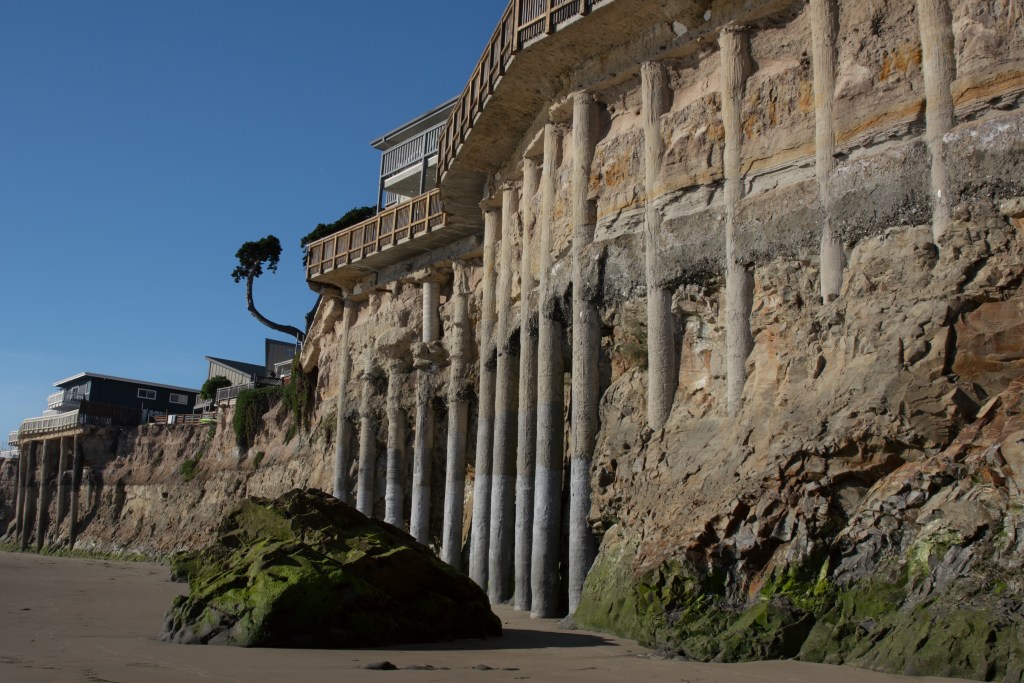
People have used pylons to try to stabilize the bluff, too. One 1993 article includes a quote from a landlord saying no one will be able to see the giant pillars of reinforced concrete in the cliffs.
I can’t vouch for that particular property, but if you walk the beach, you’ll see several pylons. They look like the carved remains of an ancient city.
Gurrola has inspected properties on Del Playa Drive for potential buyers. He said he remembers, at one point, he studied a property where a sea cave had formed below it. That meant the cliff was massively undercut and unstable.
“Looking above the cave, I saw that there was a lounge chair on the top of the bluff edge,” he said. “It was actually over the fence. I inspected above for any cracks on their patio, and I mentioned to them, I said, ‘Don’t go out there. Don’t even bother to get that chair. It’s just not safe. It’s undercut.’”
Today, 30 properties have either been cut back to protect them from the cliff’s edge or are in the process of being cut back. That’s well over a third of the properties on oceanside Del Playa.
One afternoon in October, Henry Sarria gave me a bike tour of Isla Vista. He arrived in I.V. in 1986.
“In 1986, I got sent up here for a skateboard contest by the company I used to be the team manager for, and I fell in love with the place,” he said.
A woman he was dating at the time recommended he move here. Sarria took her up on that. He eventually attended UCSB, where he earned degrees in electrical and mechanical engineering. And he made I.V. his home.
That day, we were on Del Playa Drive.
“You can see the balcony,” Sarria said as we stood at the top of the steps leading to the ocean. “But that balcony used to have fill underneath it. That fill used to go all the way to where those pylons are.”
Like other long-term residents, Sarria has seen the cliff come in.
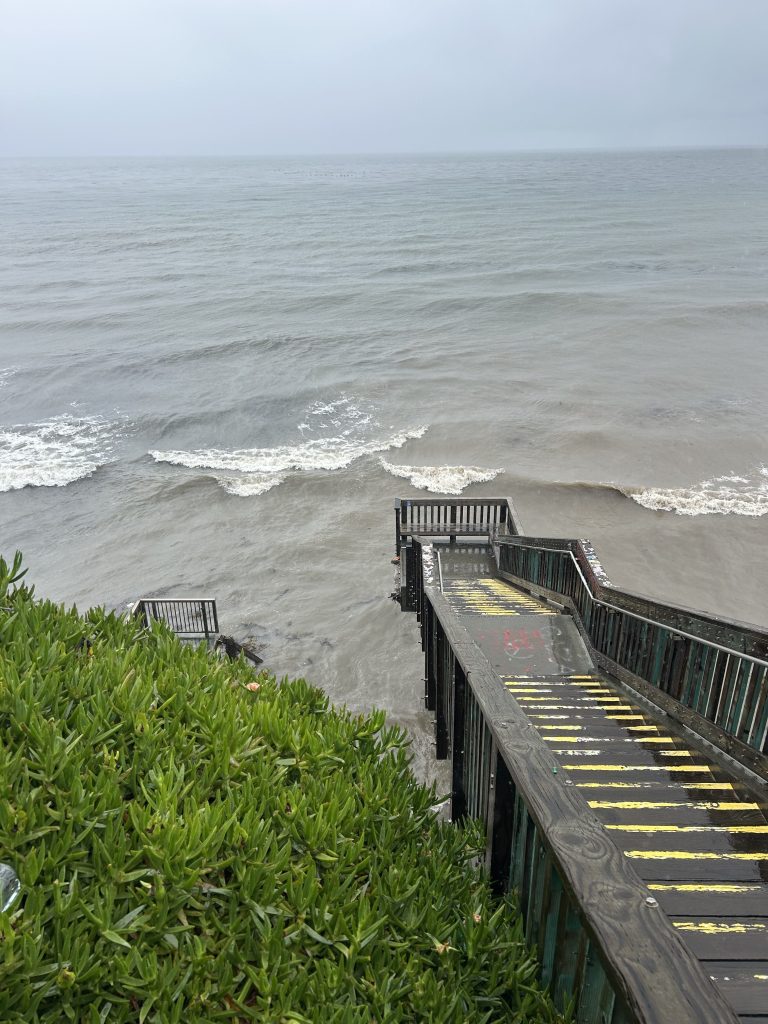
“In fact, it went out farther, because if you go around the corner, you’ll see that it curves around so that the cliff was actually way out there. Now it’s nonexistent,” he said.
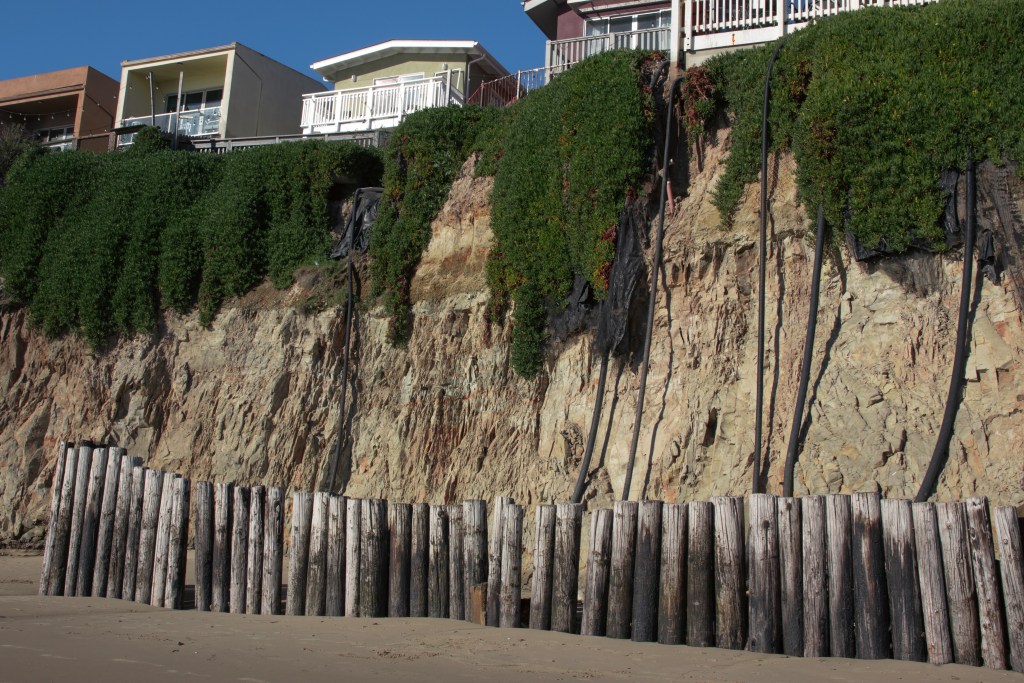
On part of the beach below, narrow wood poles create a small sea wall. There was actually years of debate on whether to build a more than 2,000-foot sea wall in the ’90s, but ultimately the California Coastal Commission rejected it. Opponents of the seawall said it wouldn’t work and it would destroy the beach.
Nothing, including those timber poles on the beach now, has stopped the cliff’s retreat.
“Nature is a force not to be reckoned with,” Sarria said. “You’ll never win against nature.”
That impacts the risk to Del Playa Drive’s housing. It affects everything from how easily property owners can insure their homes to the costs and risks as the very ground their investment sits on becomes unstable.
For decades — with newspaper articles dating at least as far back as 1966 — people have fallen from I.V.’s cliffs. Many have lost their lives or suffered critical injuries.
In 2023, Santa Barbara County’s Board of Supervisors voted to require six-foot fencing to try to keep people from the bluff’s edge. Supervisor Laura Capps, who represents Isla Vista along with Goleta and much of Santa Barbara, introduced the change as part of an eight-point safety plan. The plan came together after a 19-year-old Santa Barbara City College student, Benjamin Schurmer, fell from the cliff and lost his life.
“The erosion is no joke,” Capps said. “It’s real, and it’s just going to continue. And those properties are very precarious. They’re very precarious.”
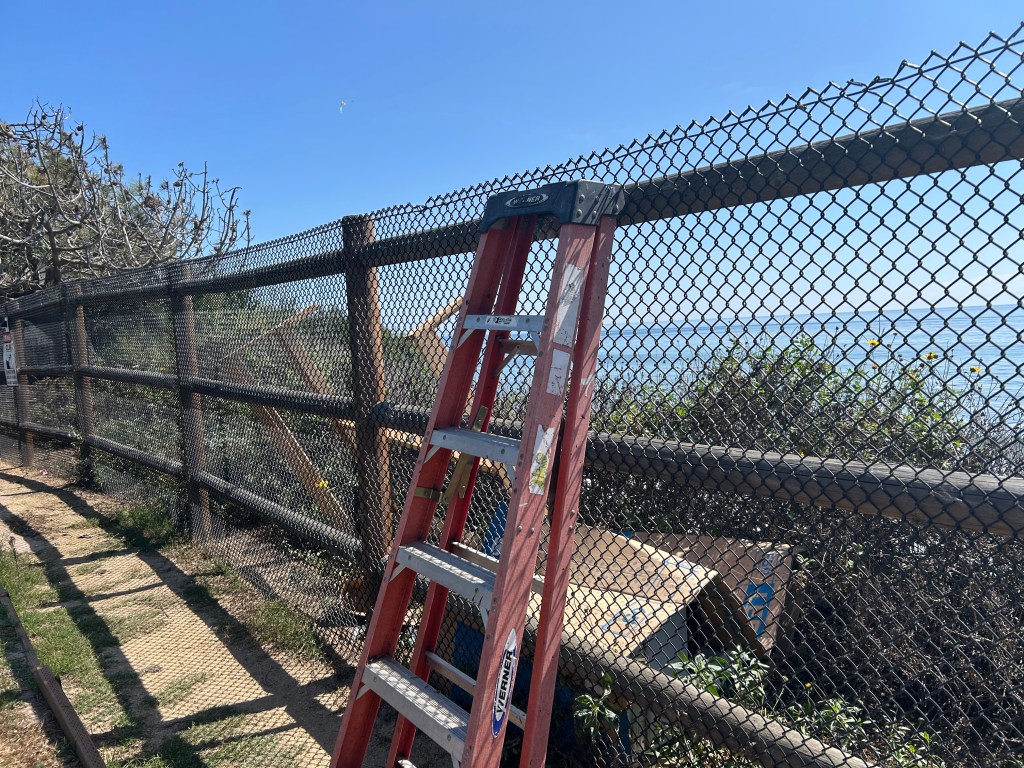
The county put in six-foot fences in all parks. For private properties, that six-foot fence height requirement is enforced if an owner applies for a building permit. Not all private properties have six-foot fencing.
People do hop the fences. Sarria and I saw someone sitting on the bluff’s edge while we were biking around.
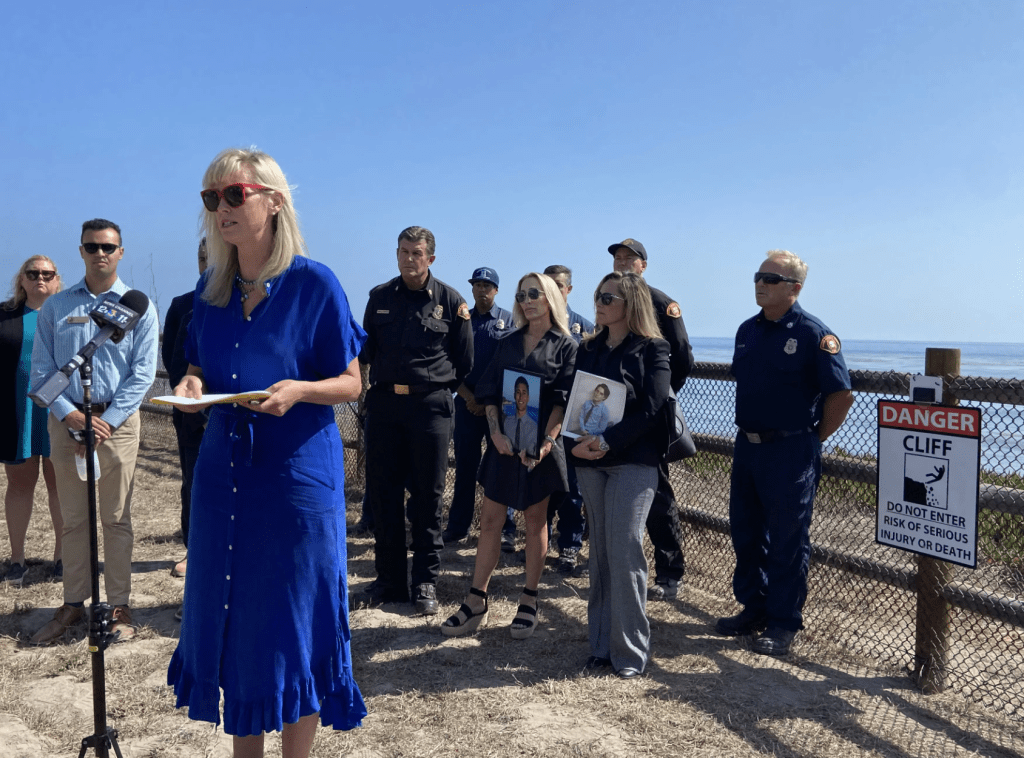
“The parks have fencing to keep you off the cliffs. The residences have fencing to keep you off the cliffs. Why are people jumping that?” Sarria said. “That’s a psychology issue. I’m an engineer, not a psychologist.”
In the past 30 years, 14 people have died by falling from the cliff. Although the deaths are not uniform in circumstance, Sarria said they are all a tragedy.
“I don’t think that any parent should survive their child,” he said. “That’s not the scheme of how it works. It’s not the general plan. It’s not the scheme of things. You see a lot of people, a lot of parents, losing kids with those cliffs.”
Del Playa Drive is also where Santa Barbara County’s preliminary rental inspection program started last summer. Supervisor Capps brought it forward. She said for her, the program is about establishing baseline safe conditions.
“You know, it doesn’t have to be this dire. It’s a college town. I don’t have unrealistic expectations that it’s going to be pristine and everything’s going to be in its place. It’s a college town, but it doesn’t have to be unsafe,” Capps said.
The rental inspection program, a year-long pilot, is specific to Isla Vista and funded with money UCSB paid to Santa Barbara County in a settlement after the county sued the university for failing to build the student housing they promised. When Capps introduced the program to her fellow supervisors in January of 2025, she said she and members of her office had seen dangerous housing conditions while walking DP — conditions like exposed electrical wiring, faulty plumbing, unsafe balconies, and more.
Generally, folks with housing health or safety issues in the unincorporated county submit a complaint online and a county-contracted inspector will check the property. The preliminary rental inspection program, Capps says, flips that process on its head.
“Your typical tenant doesn’t know that, especially if they’re younger, especially if they’re low-income,” she said. “And so what this process does is make that easier and bring the inspector to the rental unit.”
In May, when the program came before the board again, some students raised concerns that the program would leave people scrambling to find somewhere to live. The county said it was working with UCSB should tenants need to be displaced for the long term. When I reached out to UCSB, they said they were coordinating with the county should the need arise but did not have short-term housing on hand.
In August, a group of Isla Vista landlords sued the county over the inspection program, saying it broke state laws and forced the landlords to violate their tenants’ Fourth Amendment right: as a refresher, that’s protecting citizens from unreasonable searches. It also alleged the program violated property owners’ equal protection right and due process rights. The group filed a preliminary injunction — that means requesting action to stop the program. The courts denied this injunction in December.
As part of our email exchange, the Isla Vista Rental Property Owners Association said the following about the program:
“It is an example of ineffective legislation that wastes money, fails to solve the issues it claims to address, and infringes on residents’ privacy,” the association wrote. “The County could better target bad landlords by improving reporting pathways for health and safety issues. Instead, they are imposing inspections on all residents and thereby landlords, including those who follow the rules.”
Tenants do have permission to refuse the inspection. Daniel Fouchy is a fourth-year at UCSB who lives on Del Playa Drive. He’s also a member of the tenants’ union. When I spoke with him in October, he said he knew of houses that were inspected and of ones where tenants had refused.
“I know some who didn’t. I also know a lot of landlords were asking their tenants to sign, essentially, documents that don’t allow the rental inspection to happen, because if the tenants opt out from the program, then they won’t go to the house,” he said.
At a December Board of Supervisors meeting, the county’s planning department provided an update on the program’s status. The county reported 74 properties had completely refused inspection on Del Playa Drive, including 45 on oceanside Del Playa. Remember — these are properties, not landlords. The county also reported that of the 60 property inspections they completed, about a third required changes — mostly things like adding smoke detectors, making repairs to flooring or kitchen appliances, or addressing plumbing problems or pest infestations.
If you listened to Episode Five, you probably heard my metaphor about I.V.’s development as an ecosystem. The idea is that I.V.’s housing development connects to other parts of life: other infrastructure like roads and parking, sure, but also community and commercial development, too. How could we make I.V. a better housing “ecosystem”? Through work on this podcast, I heard plenty of ideas from folks who live here. For time’s sake, I’m going to focus on four: housing, parking, community, and commercial.
Let’s start with the basics. Many of I.V.’s buildings are aged past their life expectancy and overcrowded. More housing options could help.
“It’s just basic economic supply and demand,” said Makeila Wilson.
Wilson is a fourth-year at UCSB. And while she agreed more options generally could help, she said there’s an opportunity and responsibility from I.V. ‘s biggest and only direct neighbor, UCSB.
“If you give students housing, especially school housing, I think a lot of people would opt for that,” she said. “It is kind of the ideal situation, especially for parents who are anxious to rent and [get] involved, student housing is a really great solution, and there’s not enough of it.”
UCSB is building the housing it promised as part of its 2010 long-range development plan. But even with this housing, the university will only be able to provide housing for a little over half of its students. About 100 miles south of us, UCLA now offers housing for four years for its undergrads.
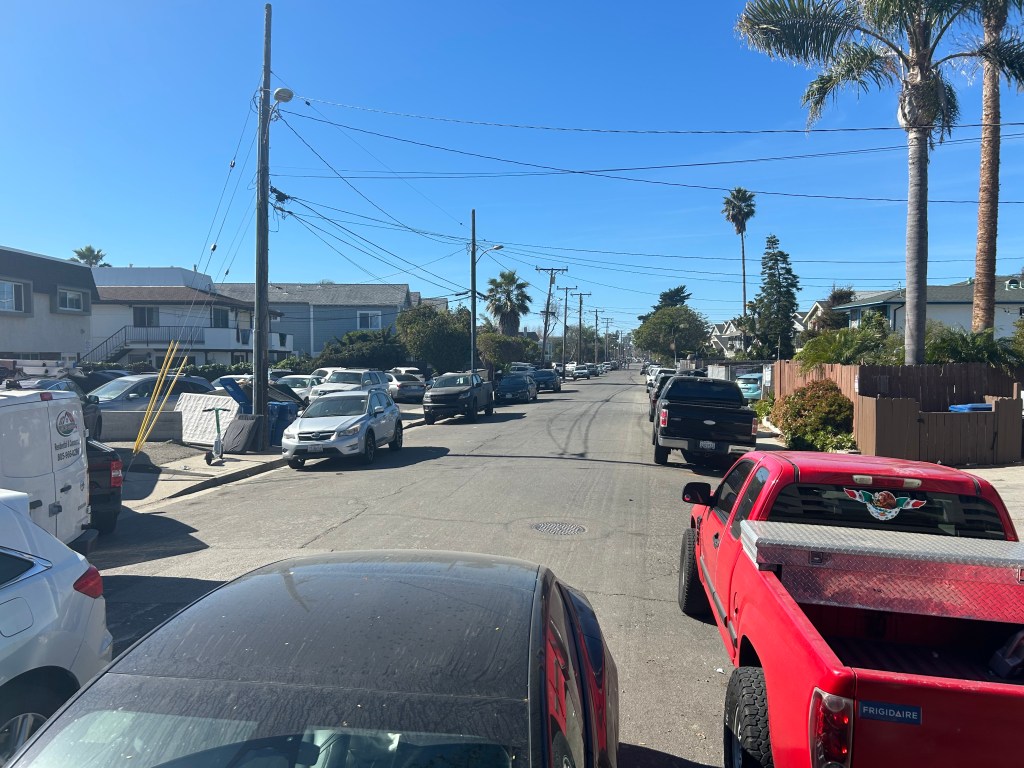
There’s a reason I bike into I.V. whenever I can. Cars frequently block driveways and line red curbs. It’s hard to find parking.
“One of the big things that we are working to tackle right now is parking,” Spencer Brandt said.

Brandt is a board member of the Isla Vista Community Services District. Brandt said that a traffic study found that street parking regularly exceeds capacity.
“It’s excessive, right?” He said. “What it means is that there’s major impacts to pedestrian and ADA accessibility. Try being a wheelchair user and going down Del Playa. It is next to impossible.”
He said the district is working to implement a parking program that would start with enforcement of existing laws.
I asked Brandt about any sort of permitting program.
“I think that a permit program is where we will have to go in the future,” Brandt said. “The reality is, we have so many vehicles in our community, and so many of them don’t move at all.”
There’s a reason free parking is a fun space on the Monopoly board. But, a permit program could help keep cars from sitting in the same place all semester for free, and it could generate revenue.
With state laws making it easier to bypass zoning restrictions for housing projects, developers are building again in I.V. But it also means more potential for vehicles lining the street. A state law says that developers building within a half-square mile of a major transit stop do not need to provide parking with their development. I.V. has bus stops throughout that fit that “major transit stop” requirement. That means much of the community falls under that no required parking rule.
Housing options and less congested streets would obviously help I.V.’s housing and parking crunch. But strengthening neighborhoods could give people more opportunity to be connected to their physical community. When I had the chance to speak with longtime resident Pegeen Soutar, she brought forward the idea of a neighborhood network.
“I always had this idea that we should have — like the dorms have residents, RAs. If the university just got a house on each block and put people in that house that were there for information, for help…,” she said.
These anchor houses could, she thought, host things like community potlucks.
Remember that document, the Trow report? It was created in 1970 by a team looking at I.V.’s problems. One of the problems it identified was a “homogeneous age population.” I.V.’s youth culture makes it unique, but without people staying for more than a few years, it’s hard to get a foothold of long-timers active in local politics to make a change.
I.V.’s youth culture is still true today. Creating the opportunity to add more long-term residents, whether through workforce housing or other means, would help create more anchors in the community.
Let’s end on I.V.’s commercial core. From interviewing Bob McDonald, the former owner of Sun and Earth restaurant, to meeting with Santa Barbara’s very own John Dickson, the Restaurant Guy, to listening to memories from folks who remembered seeing live bands in I.V. at a venue, I’ve started to think about I.V.’s commercial core.
What if I.V. had more? Sit-down restaurants and a live music venue, for example. Maybe another grocery store — one that could employ students and cut down on traffic to Goleta for food. To make I.V. more rounded — not just an increasing number of students and aging rentals — well, make it more rounded. Invest in a community hub.
I like to think this series covered a lot. But there’s so much more to cover — more voices to hear, more history to learn. What about I.V.’s Foot Patrol? What about its housing co-ops? The wonderful thing about communities like Isla Vista, to my mind, is that they constantly produce interesting stories from interesting people.
I wasn’t sure how to end this podcast. How do you land on a final word for a series about a place constantly in motion? So I went to the beach. I sat on the steps leading to the ocean below Del Playa as the tide came in. Waves rolled beneath me. To my right, a pylon had collapsed into the sea and rebar stuck up half-above a wave. In the distance, Santa Cruz Island looks painted in purple-blue watercolor.
My favorite part of making this series was listening to people tell me what they liked about Isla Vista. For a place designed more for profit than community, the area creates a sense of pride in place. Here are some of their voices.
Longtime resident Pegeen Soutar: “The open space all around it, the wildlife, the sense of fun and possibility is so prevalent here.”
Recent graduate Maya Johnson: “There’s actually a lot of good food in I.V. — I’ve realized this lately. Su’s Bowl is incredible. Zocalo: incredible. Sushiya: Incredible.”
Longtime Resident Henry Sarria: “There’s so many great people here. I love it. Everybody says, ‘Dude, are you ever gonna play in a band again?’ I said, ‘Sure. If somebody’s willing to have the old guy on guitar, you know, and singing.’ I’ll gladly do it.”
Recent graduate Ella Heydenfeldt: “We go fossil hunting. I don’t know. It was just so silly and childlike, but kind of in the best way.”
Isla Vista Community Services District Board Member Spencer Brandt: “This is a place where hundreds of thousands of people across time have come to live out some of the most formative experiences of their life. It’s a place where our community has been, in a lot of ways, the economic engine for Santa Barbara, for the City of Goleta, whether it’s the technology, [the] research that’s coming out of the university or whether it’s the cashier that’s checking you out at Target.”
Fourth-year student Daniel Fourchy: “It’s a very special place, and it’s kind of allowed this very authentic culture and spirit to form. That’s what I love about this place, and that’s why I’m gonna miss this so much.”
This is Welcome to Isla Vista.
That was Welcome to Isla Vista. Episode Six was written, fact-checked, recorded and produced by Christina McDermott. Episode Six’s script was edited by the Independent’s news editor, Jackson Friedman. The County Ordinance was voiced by Alisha Genetin. The landlord quote was voiced by Jon Bingaman. The cliff fall clip was used with permission from a KCLU news story by Lance Orasco. And you heard three songs in this episode: “Luna” by Dawn Patrol and the Devereux String Quartet, “Rockstar” by the Frogs and the final song is “Seasons” by the Bad Neighbors.
You can listen to this entire series on Spotify, Apple Podcasts and on the Independent’s website.











You must be logged in to post a comment.