Making Friends with Mushrooms
Santa Barbara Food Lovers Fight Mycophobia, One Chanterelle at a Time

Take a walk across City College campus, grazing at random on the wild growth, and you just might keel over, for hemlock, nightshade, and several other common greens are notoriously toxic. Yet scarcely a person anywhere suffers from a chronic fear of salads. But mycophobia, or the fear of mushrooms, grips America. Why?
“They’re odd things,” explained City College botany professor and fungus expert Bob Cummings. “They come up in dark places. They’re often ugly and sometimes phallic. They’re associated with the underworld, devilry, and witchcraft.”
And some, indeed, are drop-dead poisonous, so the notion that mushrooms can be dangerous is rooted firmly in reality. The most fearsome fungi are the destroying angel and the death cap, both beautiful monsters of the genus Amanita. A single substantial bite will dissolve one’s liver within hours of ingestion, with death almost certain to follow if a transplant is not available. In Santa Barbara when the rains begin to fall, these dire species can sprout in abundance, warned Cummings, and no amateur should ever eat an unidentified mushroom.
A few fungi, though, are simply delicious. Santa Barbara’s Slow Food chapter leader Laurence Hauben notes that Americans, while still relatively timid in their eating habits, are growing increasingly mushroom savvy. Wild seasonal fungi are a fast link to the fresh-and-local ideals of the slow food movement, and, in the eyes of activists like Hauben, a collective interest in such charismatic foods as mushrooms can mean great things culturally.
Unfortunately, the environment in which mushrooms grow may suffer. “In the past 10 years, I’ve really seen a change,” said Hauben. “There are more people out there gathering, but many of them don’t do it right, and, as a result, they hurt the forest floor. I’ve even seen people go out with rakes and gouge at the Earth.” For Hauben, born and raised in northern France, the worthiest of regional edibles is the rather obscure blewit, a bluish-purple, firm, and round-edged species that often sprouts in large “fairy rings” of several dozen mushrooms and bears a strong-by some opinions overpowering-earthy taste.
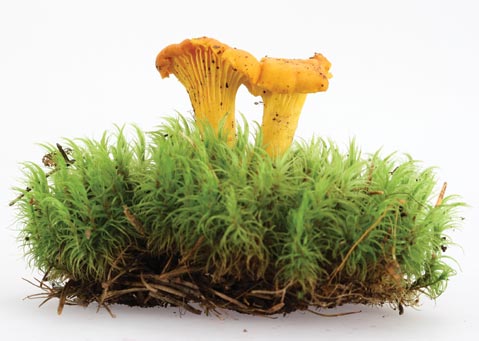
Santa Barbara caterer Michael Hutchings lived in France in the late 1970s, where he fell under the spell of wild mushrooms in the forests outside of Paris. Upon moving to Santa Barbara in 1981 to take a position as a chef, Hutchings made a happy discovery: California’s oak forests are prime chanterelle habitat. As a restaurateur, Hutchings would quickly become one of the innovators of this town’s commercial market for mushrooms, especially chanterelles. In 1983, he even went on a publicized hunt with the late legend Julia Child. It was
that same season that the chanterelles rose in armies.
“You could slide down a hill on a golden bank of mushrooms,” recalled Hutchings. “It was just phenomenal.” He supplemented his chef’s income that year by collecting. He secured a forager’s contract on a nearby ranch and gathered six tons of the delicacy in as many weeks. Since then, Hutchings has seen the public’s interest in mushrooms steadily accelerate.
John Downey, chef and owner at Downey’s, has also seen the public’s interest grow. Fresh chanterelles appear on Downey’s menu for much of the year, and he calls the delicacy “the royalty of all wild mushrooms.”
The bulbous and spectacular porcini is equally loved, though less common than the chanterelle in Santa Barbara County. Chef Renato Mosio, owner of Via Maestra 42, prefers porcinis dried, in which form the nutty flavor is highly enhanced. He, as well as Downey, has noticed that California porcinis have less flavor than their European counterparts. Mosio, a native of Piedmont, Italy, believes it’s simply a factor of terroir.
Hutchings has seen no chanterelle season of such caliber as the great winter of ’83-’84. While some chefs and collectors have reported a downward trending in the annual chanterelle yield, Hutchings believes large-scale environmental shifts, not people, have the greatest impact on wild mushrooms.
But Hauben believes it’s us. “People here don’t always respect the land,” she said. “Where I learned to pick mushrooms in France, people respected them and understood them. I was taught that if you find a mushroom patch, you always leave some to spawn. You never pick them all. That’s very bad manners.”
Those wishing to conquer their mycophobia with some foraging this winter should first consult an expert for identification tips or join a guided foray. The Los Angeles Mycological Society (lamushrooms.org) is an excellent source. In the woods, there await such edible fungi as the bear’s head, puffballs, and candy caps, an unusual sweet mushroom often baked into pastries. The brilliant gold sulfur shelf, or chicken-of-the-woods, is also abundant. Though delicious, this parasitic mushroom can be mildly toxic if growing from certain types of wood. Always consult an expert for positive identification of a specimen, and if in doubt, throw it out.
And for the sake of the forest, leave your rake at home.