• CREATE AN ACCOUNT
  • LOG.IN
  • CONTENTS
  • CLASSIFIEDS
  • ARCHIVE
  • INFO | ADVERTISING | CONTACT US

  • Home
  • News
    • News Main Page
    • NewsFlash
  • A&E
    • A&E Main Page
    • Movie Times
    • TV Listings
    • A&E Blog
    • Art Galleries
    • Best Bets
  • Opinion
    • Opinion Main Page
    • Endorsements
    • Blogs
    • Columns
    • Voices
    • Letters
    • In Memoriam
    • Obituaries
  • Events
    • Today
    • Search
    • Submit
    • Best Bets
  • Living
    • Living Main Page
    • Outdoors
    • Travel
    • Sports
    • Peeps
  • Food & Drink
    • Food & Drink Main Page
    • All Restaurants
    • Delivery
    • All Bars & Clubs
    • Drink Specials
    • Open Now
  • Sports
  • Outdoors
    • Outdoors Main Page
    • Outside Insider
    • Spotlight On
    • Features
  • Classifieds
    • Real Estate
    • Jobs
    • Autos
  • Obits

    Paul Wellman

    Shades of Green: Ironically, one sticking point in the drive to consensus is the question of how — or even if — to create more urban parks in a densely built cityscape.


    Changing the City Map

    Santa Barbara Wraps Up Talking, Looks Toward Doing

    Thursday, July 24, 2008
    By Martha Sadler
    Article Tools
    Print friendly
    E-mail story
    Tip Us Off
    iPod friendly
    Comments
    Bookmark This
    del.icio.us. del.icio.us.
    Digg! Digg!
    furl furl
    google google
    newsvine newsvine
    reddit reddit
    technorati technorati
    Facebook Facebook
    Yahoo! My Web 2.0 Yahoo!

    The final gathering for PlanSB saw less fighting than one might expect, though its undercurrents of tension will surely rise to the surface when push comes to shove and the City Planning Commission and City Council start hammering out the actual changes to Santa Barbara’s general plan. The city last undertook a massive reappraisal of its basic shape and direction — updating the land use and housing elements of its general plan — in 1989, and the result was Measure E, which limited commercial development to 3 million square feet, from a potential 100 million. Back then, it was slow-growth urban environmentalists squaring off against developers, and the environmentalists won.

    Now, the environmentalist camp has split into old guard slow-growth preservationists on one hand and the proponents of sustainability or “new urbanism” on the other. The latter camp advocates that, instead of outward sprawl, the city should embrace growth upward, with more 60-foot buildings downtown, and also inward, with multiple units on virtually every residential parcel in the vicinity of urban transit corridors. Some of the city’s most venerable and impressively credentialed environmentalists are among the sustainability group’s adherents, many of them concerned particularly with saving Gaviota from sprawl. But this time they are aligned with developers. Calling the tune are architects who envision a walkable, economically diverse city that creates a small ecological footprint, rather than the millionaires’ suburbia that Santa Barbara threatens to become.

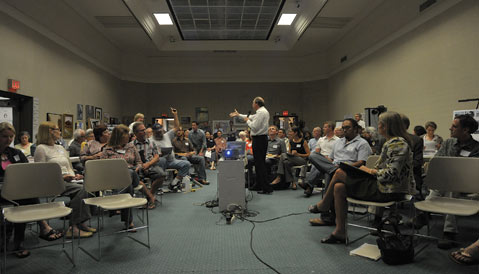
    At the penultimate public workshop, on July 17 in the downtown public library’s Faulkner Gallery, some 150 participants split into six groups, each with a map of the city. League of Women Voters rep Connie Hannah, who is spearheading a petition to reduce building height limits to 40 feet in El Pueblo Viejo and 45 feet in other downtown neighborhoods, found herself assigned to Group 4, outnumbered by new urbanists and seated opposite Mickey Flacks, a leader in the drive to build as much workforce housing as possible by any means necessary. Hannah spoke her mind on building heights as well as on less controversial points, such as the importance of preserving views from the San Roque neighborhood when that part of the map was under discussion. But the assertion of certain tenets of sustainable urbanism went largely unchallenged, including the desirability of “secondary units” behind houses in streets surrounding transit corridors. The pros and cons of other tenets were considered, with original and unconventional ideas tossed about, brainstorming-style.

    The air was thick throughout the evening with the architectural buzzword “form-based coding” — the notion that city planners should map out ahead of time what specific building shapes and heights go on which parcels. Housing advocates liked the idea of reducing the minimum size for residential units, and also somehow creating incentives for developers to build small units.

    “Parking drives everything,” said the city’s long-range planner, John Leadbetter. “The size, bulk, scale, and cost of units — it’s insane.”

    City planners talked about creating maximum parking requirements for some parcels — no more than one car per unit, for example — thereby standing on its head the tradition of demanding that developers provide a minimum number of off-street parking spaces. “Parking drives everything,” said the city’s long-range planner, John Leadbetter. “The size, bulk, scale, and cost of units — it’s insane.” He added, “Five years ago it might have seemed like science fiction, maybe, but more and more studies conclusively prove that when people live next to good transit they walk more and use their cars less.” Electric shuttles appealed to everybody — especially in comparison to diesel buses and specifically for their directness from point A to point B — but they are expensive, so the wording of that proposition switched to more “high quality” transit, between downtown and outer State Street for example.

    Whatever their differences — over building heights, parking requirements, and even urban open space — the old- and new-style environmentalists share a common desire to manage growth strictly. Missing in action so far has been Cars Are Basic, as well as others who are skeptical of attempts to lure people out of their cars and onto bike lanes, sidewalks, and public transit. Another unheard-from quarter is the public at large who did not choose to attend these rather cozy workshops. On July 22, the City Council directed staff to send out a survey to all city residents asking them to weigh in on some basic planning ideas. The next step is for the city Planning Commission in September to hear planning staff’s recommendation for what policies to pursue further; then the City Council will initiate in October an environmental impact report on the project description


    Related Links

    • Op-Ed: Why Old Lefty Tree Huggers Are Slow to Embrace the New Sustainability
    • youplansb.org
    Story Help (Click-ability)
    Double-clicking on any word or phrase in this story will open a reference window with definitions and links to other reference material.

    Comments

    Discussion Guidelines

    Unfortunately, there's nothing that the city of Santa Barbara does or will do that will affect the desirability of - and the zoning of - the County land along the Gaviota coast. The recently-approved 12,000+/- sq foot Ballantyne house shows that. The pending Naples development does also.

    "Environmentalists" who urge the buildup and densification of Santa Barbara should keep that in mind.

    Two different jurisdictions and the County wants development..... If the City does also, that is, if "the new urbanists" (not so "new", anymore, btw) do also, well, it'll be non-stop construction everywhere.

    Last night's gathering was not a discussion so much as a wish list for various neighborhoods and interest groups on an outline chosen by the Planning Staff. This is a staff-driven process, for better or worse.

    Readers say: Thumbs Up: 0 of 0 • Thumbs Down: 0 of 0

    at_large (anonymous profile)
    July 24, 2008 at 8:19 a.m. (Suggest removal)

    I was a part of the "group 3" discussion; there were about 25 in that group. Not a single person favored a reduction in current building height limits. The best idea I heard was to sell parking spaces separately from living spaces in condominium projects.
    If you are forced to buy a parking space (or 2) with a condominium, you are incentivized to have a car. A condominium without a parking space will certainly be more affordable. As for giving developers incentives to build smaller units, that's easy: don't give them a choice. R-3 zoning needs to be changed to limit unit sizes. This can be done with Floor Area Ratio (FAR) constraints, just as in R-1 zones. A 2BR unit in the R-3 zone currently requires 1800 sqft of land area; a 60% FAR would limit a 2BR unit to 1080 sqft of floor area. It's absurd to allow 3000 sqft 2BR condos in the R-3 zone.

    Readers say: Thumbs Up: 0 of 0 • Thumbs Down: 0 of 0

    Steve_Johnson (anonymous profile)
    July 24, 2008 at 11:26 a.m. (Suggest removal)

    Post a comment

    Username:
    Password: (Forgotten your password?)

    Comment:

    EVENT CALENDAR

    Previous Month | Next Month

    Today's Events Best Bets Submit an Event

    Local Weather

    Currently:
    Clear Sky
    Temperature:
    53.1°
    Wind:
    3 N

    Surf Report
    • Specials
    • InPrint
    • Top Emails
    • Best Of 2009
    • 2009 Election Coverage
    • Wedding Guide 2009
    • Blue Green Guide 2009
    • SBIFF 2009
    • Tea Fire 2008
    • Local Heroes 2008
    • Calendar of Fundraisers
    • Local Bands
    • Within the Syuxtun Story Circle
    • Camellia Sasanqua
    • Whole New Ballgame
    • Gratuitous Gore on Highway 154
    • Saul Williams Brings Afro-Punk Tour to Velvet Jones
    • Where There’s a Dill, There’s a Way
    1. Travis Armstrong Is Outta There
    2. S.B. Bank & Trust's Rocky Year
    3. UC Campuses Dominate Rankings
    4. What buildings did architect Julia Morgan design in Santa Barbara?
    5. Rattlesnake and San Roque Side of Jesusita Trails to Re-Open Friday
    6. Sexile
    • CREATE AN ACCOUNT
    • LOG.IN
    • CONTENTS
    • CLASSIFIEDS
    • ARCHIVE
    • INFO | ADVERTISING | CONTACT US
    Google
     
    Independent.com Web
    Copyright ©2009 Santa Barbara Independent, Inc. Reproduction of material from any Independent.com pages without written permission is strictly prohibited. If you believe an Independent.com user or any material appearing on Independent.com is copyrighted material used without proper permission, please click here.
    This is our Privacy Policy.