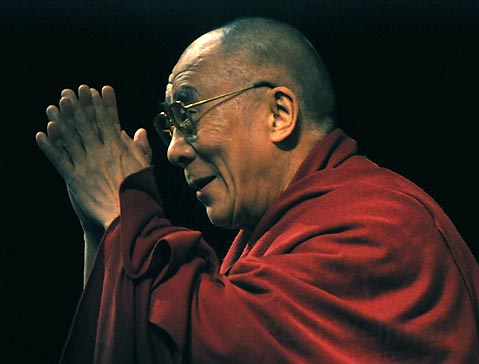
After delivering a challenging two-hour lecture on the intricacies of Buddhist philosophy and practice, the Dalai Lama switched gears Friday afternoon, holding a 1 p.m. press conference followed by a public talk on ethics. In both cases, the Tibetan leader spoke in lucid terms about the importance of compassion, values, and dialogue.
"Wherever I go, I always stress the importance of compassion," he told a group of about 30 assembled journalists. "I consider it the source of strength, and self-confidence." Throughout the afternoon, the Dalai Lama was clear to distinguish between secular and religious ethics, stating, "Some say there is no God; some say there is God. Big difference, eh? But that is not a problem." Ethics, he explained to a spellbound crowd of 6,000 during his afternoon lecture, is not a religious matter at all, but rather a matter of achieving a spirit of globalism - of rejecting an "us versus them" mentality, and focusing attention on our inner values. Speaking of his own life, including the loss of his country at the age of 24 and subsequently living for 50 years with little but heartbreaking news of his people's oppression, the Dalai Lama explained, "During that period, money failed to bring consolation." His favorite wristwatch, his dogs and cats, even his friends, he said, failed to provide him with inner peace. The key instead was "inner compassion, the spirit of forgiveness, and a realistic attitude."
The Dalai Lama is known for his sense of humor, including a predisposition for giggling, and despite a mild head cold he was on good form on Friday, laughing when a cell phone went off in the crowd and when his microphone temporarily malfunctioned, and showing boyish delight in the telling of personal anecdotes. In order to illustrate the importance of nurturing young children, the 74-year-old spoke of his own childhood in rural Tibet, where his illiterate, farm-working mother had showered him with affection. "I took advantage of it," he exclaimed, describing the way he would grab her ears and steer her around the farmyard when she carried him on her shoulders. Eyes wide, he guffawed at his own admission. "I bullied my own mother! But now I have a certain amount of compassion, and it comes from the seed of my mother."
While such stories - and the lessons they are meant to convey - can be interpreted as proof of the Dalai Lama's lack of political or intellectual sophistication, they are instead a mark of his ability to leave aside the distractions of scholarship and theory in order to communicate directly the heart of the matter. In this case, the man who has worked and waited for half a century for open and honest dialogue with Beijing spoke of the basis from which he believes justice and peace between nations arises. "A healthy society comes not from government, but from families, from individuals," he stated, reasoning that since a large portion of humanity today is not particularly religious, "We must find ways and means of reaching these people about the importance of moral ethics."
Whether his topic was the economic recession, relations between Tibet and the Chinese government, or advice for college students who want to work for social justice, the Dalai Lama pointed out opportunities to practice compassion, tolerance, and realism, suggesting that these in turn could only come from self-knowledge and healthy personal relationships. And though Tibetan Buddhists worldwide consider him the incarnation of the Buddha, though millions look to him for spiritual guidance and wisdom, the Dalai Lama made it clear in his talks that he sees himself as an ordinary monk. "I want to tell you - I am nothing special," he insisted Friday. "I am just another human being like you."
Related Links
Double-clicking on any word or phrase in this story will open a reference window with definitions and links to other reference material.

Print friendly
E-mail story
Tip Us Off
iPod friendly
Comments
Bookmark This
Previous Month


Comments
Discussion Guidelines
"I want to tell you - I am nothing special," he insisted Friday. "I am just another human being like you." Is the most honest this man has been with the public. Take him at his word and disregard the God_King hype as wishful thinking.
This lama excommunicated an entire Buddhist lineage on his whim a few months ago.
He has neither the authority nor the mandate of the Tibetan People. How could he? He represents only approximately 120,000 Tibetan refugees. The dedicated Tibetans reside in China_Tibet, where the Chinese have improved the common Tibetan's life to a level their grand parents never even dreamed possible, as they suffered in Servitude to the Dalia Lama Lineage as Serfs and Slaves for over 350 years.
The 'Serf Emmanciaption Day'. is equivalent to President Lincoln's 'Emmancipation Proclamation'.
One might look beyond one's endoctrination of the Cold War into the actual prism that exist as a new lease on life for the Tibetans living in Tibet.
Dalia Lama had over 2,000 Serfs in 1949 serving his every need. Just like old Jefferson Davis of the C.S.A. , why not revere him, he and Dalia shared the same views on Slavery and Servitude?
thomcanada (anonymous profile)
April 26, 2009 at 4:25 p.m. (Suggest removal)
China liberating the Tibetans from the Dalai Lama? Please! China has a communist government who tells their people what to say, what to do and how to do it. Tells them how many kids they can have and punishes people if they don't do what the're told.
Chinese people could not travel around in their own country until very recently and their government monitors and determines what they can watch on TV and what they can't.
Chinese men and women work 7 days a week and their living conditions are quite undesirable, as anyone who has been in China would be able to tell. Even as a tourist you get the impression that you've been watched.
When you ask questions about their way of living to random people on the street, at stores or in hotels, everyone gives you the "official version" that they've been given by the government, and only a few daring ones will give you more of a hint of what it really means to live in China.
A life of servitude could be understood when it is a choice and not an impossition by a totalitarian regime.
justice101 (anonymous profile)
April 26, 2009 at 10:19 p.m. (Suggest removal)
I think Elizabeth Schwyzer writes about as well as anyone I've read in the Independent. Thanks for your clarity.
maven12 (anonymous profile)
April 27, 2009 at 8:11 a.m. (Suggest removal)
Thomcanada,
We, Tibetans and in our buddhist culture, we do not have the practise of 'excommunication'. If you want to read more about the practise of Dorje Shugden, then do the research. The Dalai Lama has found the Dorje Shugden practise to be unbuddhist... the practise is coercive with fear, greed and hatred at the root of the practise. His instructions were simple. If you continue to practise Dorje Shugden, then do not look at the Dalai Lama as their guru. The fact that Dorje Shugden followers are able to maintain their practise and protest is a clear evidence of their freedom to practise. They cannot have it both ways. They cannot expect endorsement of the Dalai Lama. So get your facts right.
As for situation in Tibet, why does China feel the need to ban pictures of the Dalai Lama inside Tibet? Why does China feel the need to completely shut Tibet from independent media or individual travellers? What is China hiding inside Tibet? If Tibet has always been part of China, then why is China so sensitive and insecure about Tibet?
If you care so much about the Tibetans and Tibet, why not be equally concerned about the Chinese brutality and oppression in Tibet today.
Gyame Kyakpa So
Gyame_Kyaktsar (anonymous profile)
April 27, 2009 at 8:59 a.m. (Suggest removal)
Sorry, does not compute. There must be a 'good guy' and a 'bad guy'. It's not possible for both the Dalai Lama and China to be 'bad guys'. Let's toss a coin.
Rich (anonymous profile)
April 27, 2009 at 9:09 a.m. (Suggest removal)
maven12, I too am a fan of Schwyzer, more so in that she writes about stuff of which I have little interest yet she renders them interesting!
I'm just wondering if the Independent did enough stories on the Dalai Lama?
binky (anonymous profile)
April 27, 2009 at 11:42 a.m. (Suggest removal)
It is no longer a question of whether vajradhara is spirit or higher being. This issue is now a political issue. It is a matter of individaul right - pillar of any democratic society. If worshiping dorje shugden degenerates Buddhism , than same can be said about all the other protectors of four.
Every individual should be given right to practice what she/he feels right; so long as it does not harms other people. In india there are millions of different dieties. can you imagine prime minister or some Guru saying particular diety is unfit to worship! what would be the repercution?
The Tibetans never understand the Principles of our Founding Fathers of our Constitution or Bill Of Rights. They prefer to worship their former slave master as a God-King. How absurd to do you want to believe is your right. He has no rights to cause suffering of fellow Tibetans for believing as they wish. He has violated others freedom and right to believe as they choose. Pure and simple and the Simla High Courts will decide this September if Dalia lama and Samdung are guilty of the charges.
It is as I said, a question of one man has no right to tell others what to believe. He has no authority to tell anyone what to do. His history is proof in itself that he conquered Tibet with the Mongolian Cavarly and implemeted a policy of manipulation which Hitler greatly admired.His idea about serfs and slaves is now exhibited in the People's museum that is dedicated to revealing that Serfs were actually treated as chattlel and controlled by ruthless methods that we now see today used by the Taliaban and the Sharia Laws.
Mutilations, death by tossing off high walls or thrown as bags in rivers were how the Lamas got around taking human life.
We no longer require a tool of the CIA to preach morality to us. He was the servant that took the money.
The Chinese do not exhibit picutres of the Dalia Lama any more than we Americans allowed photos of Hitler to hang on walls during the reconstruction of Germany.
Why did the Dalia Lama not receive news of the American 'Emmancipation Procalmation' at the same time he was driving cars and listening to radios. He knew what was going on the the free world long before the Chinese libertated 95% of the Tibetans from suffering for hundreds of years under the terror tactics of the Dalia Lama Lineage.
I've known the Dalia Lama and his brothers since 1967-68. I know well the stories of their duplicitious ploys to enlist support from the Western Allies were all lies and deceit.
Look past the colors and giggles to the truth of the Charlatan.
thomcanada (anonymous profile)
April 27, 2009 at 4:28 p.m. (Suggest removal)
That is one of the best pics I've seen yet from Paul Wellman. Great light and nice expression with the gesture of the hands-he truly captured a moment. Informative article too. Thanks.
LRaf (anonymous profile)
April 28, 2009 at 8:25 a.m. (Suggest removal)
When Tsewang Gyumey grew up in Lhasa in the 1950s, he was one of the few students who were horse-led to elementary school.
His family was granted a noble title by Emperor Qianlong of the Qing Dynasty (1644-1911), but his grandfather Changlochen Sonam Gyalpo (1897-1972) was a rare intellectual who dreamed of Tibet's modernization.
His ideas about replacing the feudal serf system with democracy got him sent into exile to India where he delved deeper into the ideas of Karl Marx and Dr. Sun Yat-sen. His dream came true only after the peaceful liberation of Tibet in 1951.
In 1952, when the PLA invited renowned Tibetan scholars to teach Tibetan language and culture, Sonam Gyalpo was applauded heartily when he said the Han and Tibetan people had united. "It's like two wooden boards: to stick together, you need glue. When two men want to be friends, a language barrier may keep them apart.
"I'm old, my teeth have fallen out. But I'm still learning Chinese. When the Hans learn Tibetan and Tibetans learn the Han language, we will unite like milk and water, instead of (being like) butter that floats on water."
Tsewang remembers his grandfather more as a poet and playwright who penned a play on Princess Wencheng. It was the old man's literary achievements that inspired Tsewang to study and give lectures on Tibetan literature.
Though his family had to distribute its lands to herdsmen during Tibet's Democratic Reform in 1959, Tsewang whole-heartedly embraced the changes. Even when he was mistreated during the Cultural Revolution (1966-76), Tsewang never lost hope.
thomcanada (anonymous profile)
April 29, 2009 at 11:50 a.m. (Suggest removal)