Paperwork, Pain, and the Long Road Back
The Ins and Outs of the Post-Wildfire Insurance Tango

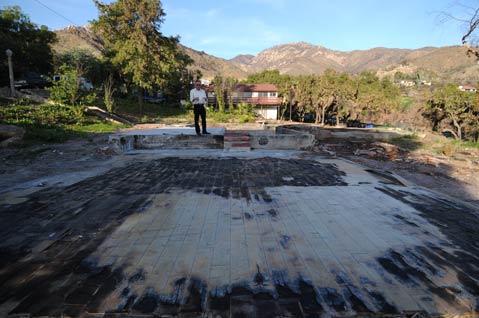
In the past 13 months, the foothills above Santa Barbara and Montecito have seen two ferocious fires tear through their countryside. Ravaging storied neighborhoods such as Mountain Drive, Coyote Road, and San Roque Canyon, the Tea and Jesusita fires carved out a path of destruction that left nearly 300 houses completely destroyed, and many more badly damaged. Today, hundreds of families are struggling along the harsh road of rebuilding, few armed with little more than the hope that their homeÂ-owners insurance policy will be enough to get them home.
Certainly there were even more unfortunate homeowners and renters who had no insurance-their fates a world of tragic hardship-but this is a story about the majority of the Tea and Jesusita victims; people who crossed their t’s and dotted their i’s on homeowners insurance policies from established companies, including Allstate, Liberty Mutual, State Farm, and California’s ubiquitous FAIR (Fair Access to Insurance Requirements) Plan program. They paid their premiums faithfully, in some cases for more than 40 years, and considered themselves protected should the worst-case scenario ever arrive. Now, standing in the ashes of their lives, they are realizing just how wrong they were. This is the story of their hard lessons learned.
Take a ride through the scorched hillsides of Mountain Drive today, and you’ll think you are witnessing a resurrection. Vibrant green chaparral now grow in the ashes, and signs from architectural firms, building contractors, and landscaping firms dot the scenery. All day long, you hear the sound of power tools and backhoes. But don’t let all this activity fool you; the road to recovery has been anything but easy, and, for most, it is anything but over. “You pay your bills and trust your policy is enough, but unfortunately, it takes a disaster to educate yourself about what your needs really are,” said Linda Harlin, who has lived on Coyote Road for 23 years. Despite a hard, unrelenting effort, her family is still in the earliest stage of rebuilding their home, a year after it was destroyed in the Tea Fire.
The Eastern Flank
“Basically, people are facing one of two problems,” explained Amy Bach, executive director of United Policyholders, a statewide advocacy organization that helps disaster victims navigate the insurance gauntlet. “You are either underinsured, as in, even if you get paid your full coverage, it won’t be enough,” she said, “or, the insurance company is lowballing you : that is, they aren’t offering you enough of your coverage.” Since hitting the ground here in Santa Barbara immediately after the Tea Fire, her group has found plenty of both problems, particularly in the Mountain Drive area.
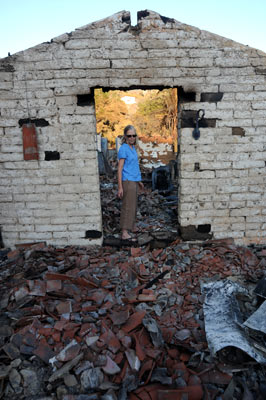
If ever there was a quintessential Mountain Drive home, it was the Neely clan’s handmade masterpiece in the lower Hyde Tract. A whimsical adobe built by the late Bill Neely, one of the original homesteaders of Mountain Drive’s artistic community, the house-which had survived the Coyote and Sycamore fires years ago-was burned to the ground in the Tea Fire. For decades, the Neely family bought insurance through the California FAIR Plan, a basic coverage program underwritten by an association of insurance companies specifically for properties in areas where most individual companies dared not tread. The Neelys, however, discovered that-despite updating their policy frequently to the maximum house value permitted under the FAIR Plan-they won’t be getting enough money to cover the varied costs of rebuilding. “It has been a mixed bag of good and bad,” said Bill’s son, Chris Neely, with a weariness in his voice that suggested more of the latter. “As it ends up, we are underinsured.” The problem the Neelys face is almost universal for victims of the Tea and Jesusita fires: The amount of money the insurance companies figured would be needed to rebuild a home is nowhere near the real cost. The common industry standard for most policies offers $100-$200 per square foot, which is, at best, half the amount of what it costs today to rebuild a home as it once was.
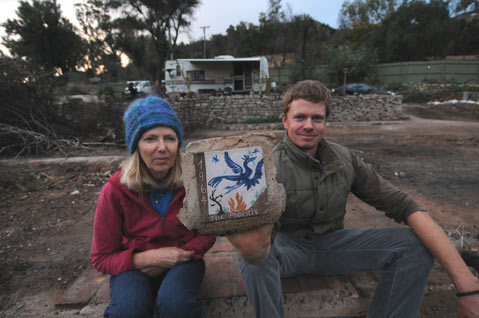
For folks on the FAIR Plan, there is the additional problem that all payments come in one lump sum, which must cover everything, including paying the contractors, architects, and engineers; permit and cleanup fees; landscaping, etc.; as well as all lost personal items. Further, you don’t actually get this money until you have the building permits in place (the check usually goes to your mortgage company to be held until needed). For the Neelys, and for many like them who had older homes built before the current, stricter codes were on the books, this can be a brutal catch-22. The Neelys need their insurance money to grade and widen their driveway before the county will issue building permits, but alas, the money won’t come through until they actually have the permits. “We are not being allowed to rebuild, and basically not being able to afford to rebuild,” Chris said. According to Bach, the average underinsured person who loses his/her home in a wildfire ends up being short anywhere from $100,000 to $500,000, with the bulk of folks right around $200,000. “I’d say what we are seeing in Santa Barbara [after these fires] is, unfortunately, pretty typical,” said Bach.
Not far from the Neelys, Trace Robinson, a landscape contractor, is struggling through both the “underinsured” and “lowballing” scenarios. “I hope nobody is having a worse experience than we are,” she said, laughing lightly. Insured by Allstate, Robinson painted a picture of trials and tribulations with her insurance company and adjusters that has her actively looking for a lawyer.
Insured with “good coverage, but certainly not the maximum,” Robinson’s downstairs and garage suffered total loss from smoke damage, and her guest house, where her daughter, Minka, was living with her fiancee-a bungalow designed by Minka’s grandfather, the legendary architect Frank Robinson-was burned to the ground. A perfect storm of troubles has followed, including inadequate square-footage rebuild money; the daunting process of documenting lost possessions, how much each item cost, and then debating with Allstate about how much each item was worth at the time it went up in flames; disputing what she was owed on the “additional living expense” option that covered her family’s stay in a hotel immediately after the fire; and the financial and legal peril she finds herself in after paying out-of-pocket for numerous repairs and having Allstate “drag their feet” about reimbursing her. Robinson estimates she has thus far received just over $200,000 on a policy she had thought would pay her upward of $1.5 million.
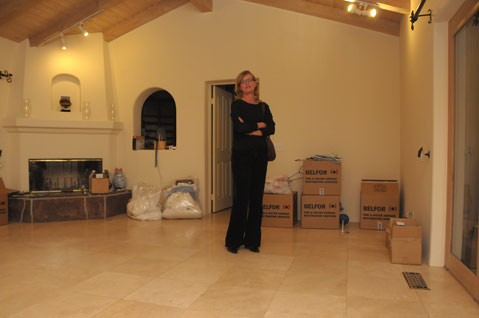
But the worst is that the insurance company is refusing to make any payment on the guest house, despite the fact that it was fully insured. In years past, the house had been a rental, and was covered via a wraparound plan-something that, for an additional premium, puts a structure under the homeowners’ insurance policy, despite the fact that it essentially is being used as a business (i.e., to generate income). According to Robinson, that changed in 2008 when the renters moved out and she decided to remodel the place. As a result, she changed her policy accordingly, dropped the wraparound coverage, and put it back on as a traditional “second structure.” This would have been fine except that in the months leading up to the Tea Fire, Robinson’s daughter and her fiance moved into the studio and, in an act that most future sons-in-law can relate to, the young man sent his future mother-in-law checks to help her cover family expenses. Saying that there was a “casual family lease,” Robinson explained the agreement more as the young couple’s contributing to their family property’s welfare than an actual rental situation. “I mean, come on, they are family,” Robinson said. Allstate, however, considered this payment to be a violation of the terms of the “second structure” policy, and, as a result, is refusing to pay. “I am already living on credit cards,” bemoaned Robinson, “and now I am looking at up to a million-dollar legal fight just to get the money they should have already paid me. It’s horrible.”
The Mission Canyon Situation
The folks who lost their homes in the Jesusita Fire are now encountering many of these same problems. “I’d say most of our residents were, at least somewhat, underinsured,” said Mission Canyon Association Boardmember Bill McCullough, who has helped organize community forums that included California Insurance Commissioner-and 2010 governor hopeful-Steve Poizner. As McCullough sees it, the problems in his neighborhood primarily are a result of increased property values and insurance policies that, for a variety of reasons, failed to keep up. “We have a lot of houses that might have cost $30,000 or $40,000 to build years ago, but today they are going to cost $1 million to replace,” he said. “The ones who are most underinsured are the ones who have been living here the longest.”
A prime example of this is the Schiffer family. “Simply put, we cannot rebuild the house we had,” said Howard Schiffer, who runs the international charity Vitamin Angels. The family had for years been covered by Allied Insurance, but just before the Tea Fire, they had their policy canceled due to the high fire risk in the Mission Canyon area. The Schiffers took the maximum house coverage available under the FAIR Plan in the coming months before the Jesusita Fire struck, and received the company’s pledge to pay that amount in full. Even so, Schiffer said the family is struggling to afford a new 2,000-square-foot home to replace the 2,800-square-foot house they lost in the fire. And, it is important to point out, their situation is actually better than most, thanks to a mortgage protection plan they took out years ago that helps them pay their mortgage for as many as two years in case of disaster-a protection most victims did not have.

In a painful process now being experienced by hundreds of Santa Barbara families, the Schiffers, after more than six months, still haven’t completed their personal property loss claims. Required to inventory all their lost belongings from couches and beds to teacups, toothbrushes, and family heirlooms, they must then document the replacement costs, submit that information to an adjuster, and then watch as any hope of replacement is whittled away by a depreciation factor. The paperwork and insurance deadlines can, at times, seem like a full-time job. Worse, as Schiffer put it, “it just brings up the pain and the loss again and again.” In a sentiment echoed by so many others currently entangled in the odyssey of seeking reimbursement, Schiffer said, “The process is flawed from the beginning. If they insure you for $300,000 for personal property loss and your house burns down and you lose everything, you would think they would just give you the full amount. Unfortunately, it doesn’t work that way.”
Fair or Unfair?
Roughly one-third of all homes lost in the Tea and Jesusita fires were insured under the California FAIR Plan. According to its representatives, the plan has paid out some $56 million in post-fire insurance claims in the Santa Barbara area. But many here and throughout the state are calling for reform. In fact, Poizner is releasing a full-scale report of the plan in the coming months, which his spokesperson characterized last week as “a big news event.”
Unexpectedly, the crux of the problem may turn out not to be the financial shortcomings of the FAIR Plan as much as the method by which people wind up on the plan. Formed in 1968, by an association of individual companies operating in California, the FAIR Plan was created, as spokesperson Michael Harris explained, “basically to spread the risk of fires so no one company winds up being overexposed.” As a result, an agent working for any company that is in the FAIR Plan association (and most insurance companies are) can either provide a policy to a prospective customer through his/her company, or if that company won’t cover the house because of neighborhood fire risk, brush clearance, building materials, or other factors, the agent can still earn a sales commission by putting the property on the FAIR Plan, thus discouraging the client from looking elsewhere for insurance. The end result is that many people, especially if they haven’t shopped around, wind up thinking the FAIR Plan-which Harris allows is “pretty basic” and does not provide the all-important additional living expenses coverage that most other policies offer as a way of providing folks with a home while their destroyed or damaged house gets rebuilt-is the only chance they have at getting insured. Again and again, in interviewing fire victims, The Independent was told by FAIR Plan customers that they thought it was their only option for a policy. Ironically, Chris Neely, who considered the FAIR Plan as his only option, is now insured by State Farm for what he describes as “about half the price and twice the coverage.” Others are now having similar experiences.
Harris insisted that the California FAIR Plan does not want business: “If all our policies in Santa Barbara left tomorrow, we would be happy. We would rather people got insurance through a member of our association.” But the FAIR Plan recently has implemented two policy changes meant to help clients recoup more of the necessary money to rebuild after a fire, and many of these changes are a result of lessons learned from the Tea Fire fallout. First, clients now are offered bonus coverage for rental fees incurred while their home is being rebuilt (in case of total loss), which will not be subtracted from their total payout. And secondly, additional money will be available to help cover building code upgrade/permit fees during the rebuild, which also won’t be subtracted from the overall payment. But even now, Harris said, people are not taking advantage of these new programs. “Ultimately, it is each person’s choice of what type of coverage they want,” Harris said. “But insurance is not something most people want to spend a lot of time or money on. : Nobody ever thinks they are going to lose everything.”
Lessons Learned
After talking at length with fire victims, insurance advocacy groups, and insurance agents, the following is a list of things you can do to make sure you and your home are better protected from an insurance standpoint before next fire season. After all, as Jesusita Fire victim Howard Schiffer put it recently, “Until you truly need your insurance plan, most of us have no idea what it is.”
• Shop Around: In the wake of the fires, many people have expressed frustration that they were misinformed about their eligibility for coverage other than the California FAIR Plan. A recent survey by The Independent of several local providers found that most, if not all, were currently willing to write policies on homes in the traditional high fire zones around town.
• Buy the Additional Living Expense Option: Not offered under the FAIR Plan, this option, all but universally available with other companies, gives extra funds to help make ends meet while you are without your home.
• Be Rebuild Conscious: Take the square footage of your home and multiply it by $400 (this is the industry standard for what it costs to build per square foot these days in sunny Santa Barbara), and then ask your agent if your plan will provide that amount of money. If it doesn’t, update it so it will. Better yet, if you can, get annual estimates on rebuild costs from a contractor and double-check with your agent that your policy will provide this.
• Get a Worst-Case Scenario Forecast: Ask your agent to explain the various things you will get money for in case you lose everything (i.e., landscaping, debris removal, building code upgrades, flood control, etc.). These expenses, though obviously smaller than your basic rebuild cost, can be brutal when your funds are otherwise tapped.
• Disaster Mortgage Insurance: Separate from your homeowners plan, this often overlooked option will, for a minimal fee, help you make mortgage payments for as many as two years after you lose your house. This can be huge in helping you free up as much money as you can for the rebuild process.
• Pick Up the FAIR Plan Options: In many cases, going on the FAIR Plan is unavoidable, but if you do, make sure you pay the extra amount for the bonus coverage in case of a total loss. Though not an ideal fix, this will ensure that you get more out of the program; in some cases, as much as $200,000 more to help you rebuild.
• Renters, Be Wary: If you rent a home or an apartment in the fire zone, consider getting renters’ insurance. You can often get it through your automobile insurance provider for not that much extra every month. Also, be sure to ask your landlords if your personal belongings are covered under their “wraparound” policy.