PUEBLO Forum Grills City Council Candidates
Questions Answered in One Minute or Less
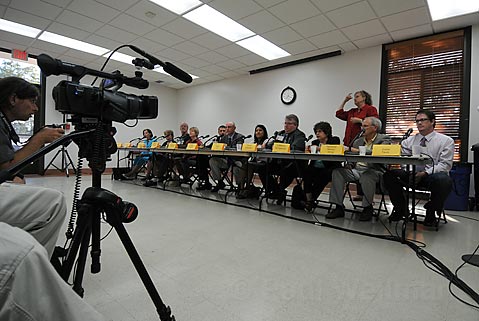
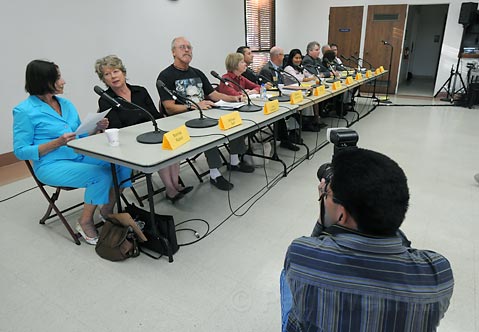
Eleven of the 12 candidates running for Santa Barbara City Council showed up for a forum organized by PUEBLO, at the Franklin Center on Thursday evening, July 23.
Each candidate was given no more than one minute to provide his or her best answer to each question asked by the community. Five of these questions were prepared beforehand by the organizers; the rest were asked by the audience.
Forum organizers hoped to focus on issues of affordable housing, public transportation, gang violence, immigration, and the voting privacy of the disabled. The candidates who attended were Catherine McCammon, David Pritchett, Dianne Channing, Grant House, Harwood “Bendy” White, John J. Thyne III, Justin Tevis, Lane Anderson, Michael Self, Olivia Uribe, and Bonnie Raisin. Frank Hotchkiss was the only no-show.
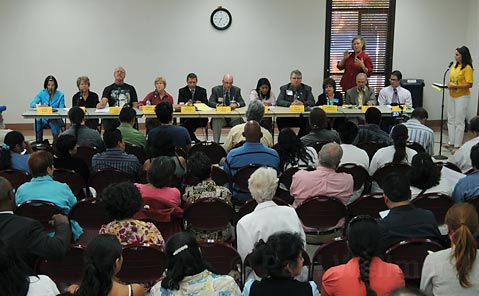
Right off the bat, a member of PUEBLO’s housing committee who identified herself as a single mother of two tackled the topic of affordable housing, asking what each candidate would do as a city councilmember to expand it. Pritchett said that it is most important now to protect and preserve the current rental housing stock. Also important, according to both Channing and Pritchett, would be to work on tenant protection and displacement, so that when affordable housing is converted into high-priced rental housing, or condos, the renters being displaced will have some protection.
An instantly popular topic among the candidates was the debate surrounding Measure B – a height initiative capping building height at 40 feet in El Pueblo Viejo and 45 feet elsewhere downtown, instead of the current 60-foot height limit. The initiative’s supporters outnumbered its opponents among the candidates, though not overwhelmingly. Uribe and House, who oppose the height initiative, said Santa Barbara should work with the Redevelopment Agency, and in partnership with the development community, to develop more affordable units while also preserving existing stock. Thyne spoke in strong opposition to the height limit, arguing that it would “interfere with provision of affordable housing,” and suggesting that Santa Barbara offer incentives for the creation of rental housing. Raisin and Anderson oppose the initiative as well; Anderson is in favor of giving city council the power to negotiate downtown housing for workers in return for flexible heights.
Others insisted that higher density would not necessarily translate into a significant number of more affordable units. It might just mean a greater number of expensive condos and those, in turn, could create a need for more service workers in need of housing. Tevis, a supporter of the initiative, explained that our city doesn’t need more density because the logistics of the situation is that Santa Barbara “can’t provide low-income housing for that many people.” Also supporting the height initiative were candidates Channing, McCammon, Pritchett, Self, and White.
After 11 minutes of housing discussion, the meeting moved on to questions about the expansion and affordability of public transportation. Both Anderson and Channing emphasized the importance of improving the biking systems and making it easier to travel safely in ways other than by personal automobile. Anderson suggested more bike-rack space on public buses. McCammon and Raisin recommended incorporating smaller buses in hopes of an increase in travel efficiency or access to more locations. Pritchett disagreed, explaining that smaller buses don’t pay for themselves. A few of the candidates voiced their support for commuter rail. Self said she believes bus service should be expanded, and she also said that the widening of the freeway will significantly help with current transportation issues.
Asked about gang violence, virtually all of the candidates opined that the strongest focus should be on prevention. They called for more mentoring, collaboration between police and communities, and involvement by parents of at-risk youth. House argued against gang injunctions, saying, “We need injunctions against ignorance.” Thyne, on the other hand, supported the idea of gang injunctions, saying he believed they have proven themselves effective in Los Angeles and Oxnard.
Self suggested parenting classes where parents can develop skills both for controlling their kids and making them feel loved. Tevis suggested consequences for parents who’s kids get in trouble, such as fines. Preventing problems while children are young is the most important step according to McCammon, something that can be improved upon through after-school programs, programs for parents, and mentoring programs. Family and individual mentoring was also a key goal from Raisin’s perspective.
The discussion then moved on to immigration and the degree to which candidates supported PUEBLO’s current initiatives, which were enumerated as family unity, worker protection, economic recovery, and national security. Each candidate noted that these topics were federal matters, though important issues needing attention.
A representative from the Independent Living Resource Center followed the immigration comments with an inquiry about the ability of the blind to vote privately. His problem was with mail-in ballots, and the lack of an alternative to them. Blind citizens need assistance with such ballots, decreasing the privacy that is a key component of the American voting process. None of the candidates had a basic answer or solution to the problem, but many suggested working with various organizations to create a way for the disabled to still have their privacy when voting.