Paul Wellman
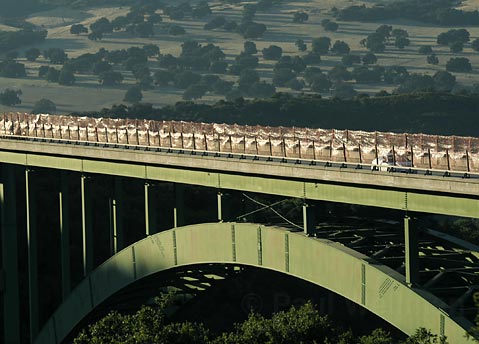
STARTED AND STOPPED: Construction on a suicide barrier at Cold Spring Bridge has been suspended due to a judge’s decision. The judge, responding to a lawsuit from a citizen group, determined Caltrans didn’t properly follow state law in circulating an environmental impact report on the project.
Suicide Barrier Hits Stumbling Block
Judge Halts Work on Cold Spring Bridge
Thursday, July 15, 2010
Years of protesting, writing op-eds, showing up to public meetings on stilts, walking along Cold Spring Canyon Bridge, trumpet in hand, and other attention-getting antics by retired UCSB professor Marc McGinnes, fueled by his opposition to a suicide barrier on the bridge, often fell upon deaf ears, especially those of elected officials.
Tuesday, finally, someone listened — and that someone was a judge.
Judge Thomas Anderle halted construction of the suicide barrier being built by Caltrans, saying the Environmental Impact Report (EIR) prepared by Caltrans didn’t comply with the California Environmental Quality Act (CEQA).
While the move likely doesn’t mean the end of the project, it is a small victory for McGinnes and his Friends of the Cold Spring Canyon Bridge group after years of being shot down by both local and state officials, who have worked hard and forcefully to get this project through. The judge — while clarifying that he was only ruling on Caltrans’s failure to properly follow CEQA protocol, not whether the barrier should or should not be installed, or if it will be down the line — indicated Caltrans had failed to follow procedural requirements by not including mitigation measures to reduce impacts of the bridge until after the public was able to comment on the measures; the measures weren’t introduced until the final EIR stage rather than the draft EIR stage. It was a basic point of environmental law, but still a point missed by Caltrans and other officials, which means Caltrans has to step back a few squares.
By Paul Wellman
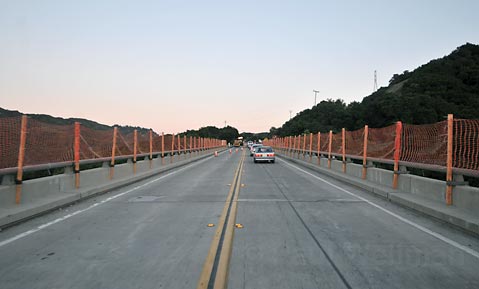
Construction on a suicide barrier at Cold Spring Bridge has been suspended due to a judge’s decision.
Per Anderle, the state transportation division must prepare, circulate, and certify an EIR — expected to look a lot like the current one — that complies with CEQA, allowing the public to see it, review it, and comment on everything (mitigation measures included) before the project moves forward. “The judge validated our concern that Caltrans had taken on a process that excluded the public from environmental review,” said Marc Chytilo, attorney for Friends of the Bridge.
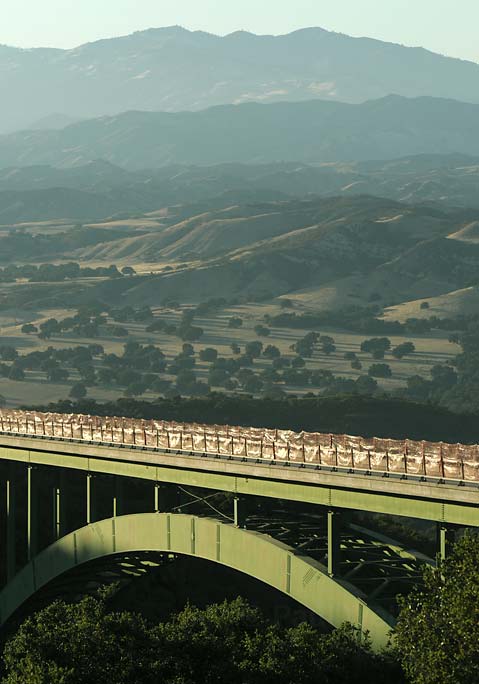
The highly controversial project was to erect a wire-fence barrier nearly 10 feet high on both sides of the bridge on Highway 154. The bridge has been the site of 53 suicide jumps since it was built in 1963.
Construction on the project — which has been in the works for four or so years — began a few weeks ago and was expected to be done in September. The cost of the actual construction was slated to be roughly $778,000, part of a total $3-million price tag. The stalled construction is expected to cost Caltrans even more money, as are the legal costs.
The price tag was just one reason opponents like Friends of the Bridge, led by their fearless — and often goofy-acting, but persistent — leader McGinnes, sprang to action. The other was the belief that the barrier really wouldn’t do much to deter those who wanted to commit suicide. Chytilo took the occasion of the court hearing to point to a recent study in Toronto after a barrier was installed at a bridge there, the site of the world’s second-highest rate of suicide by jumping, only behind San Francisco’s Golden Gate Bridge. The rate of suicides by jumping in Toronto as a whole remained unchanged, though they did go down at that particular bridge. The study concluded barriers “may not alter absolute rates of suicides.”
Paul Wellman
Construction on a suicide barrier at Cold Spring Bridge has been suspended due to a judge’s decision.
McGinnes said he is hopeful that the Santa Barbara County Association of Governments (SBCAG), a board that gave the project its blessing and comprises the five county supervisors and a representative from each county jurisdiction, will take another look at the project and allow for an alternative to the barrier — higher, four-foot-tall guard rails, a call box, closed circuit cameras, an interactive PA system, and a net — which he believes is a more viable option. Regardless of what SBCAG members decide to do, and it’s unlikely they’ll do anything different outside the EIR issue, it is ultimately Caltrans’s call for what happens on the bridge, though SBCAG has put a lot of money toward the project. That money could be better spent, argues McGinnes, on other dangerous highway spots in the county.
So now Caltrans heads back to the drawing board, sort of. Though they believe they fulfilled all CEQA requirements, they’re suspending construction while they reproduce and recirculate a small portion of the environmental document, according to spokesman Jim Shivers, though it’s unclear what state the bridge — already under construction — will be left in. The plan is to return to court on August 24, at which time Caltrans is hopeful they get the go-ahead to continue work on the bridge. “We are confident that we will meet the additional requirements of the court which will allow Caltrans to resume work and complete this project, which will prevent suicides on the bridge,” he said.
Related Links
Comments
This is part of the reason why California is having financial problems. Not only will it be an eye sore on a beautiful bridge, but I highly doubt it'll accomplish much of anything when it comes to suicide. Basically it just takes that 'suicide option' off the table. And before anybody jumps (ha!) down my throat let me also say that I don't support suicide (sad that I need to even mention that). What a waste of money! Take that money and put it into a mental health program instead. Can you imagine if suicide barriers were put up on the beautiful cathedrals, temples, towers...etc, etc.?
Gaijin (anonymous profile)
July 15, 2010 at 1:01 p.m. (Suggest removal)
Caltrans' statement that their fence "will prevent suicides on the bridge" is not necessarilly true.
A few years back, amid great controversy, a similar fence was built on the beautiful Arroyo Seco Bridge in Pasadena, also an historical landmark. Within a year, two people found a way to climb over the fence and jump to their deaths.
The pro-barrier folks, driven by their emotional need to feel good, like to ignore that reality.
zorro (anonymous profile)
July 15, 2010 at 1:43 p.m. (Suggest removal)
The Toronto study cited by Chytilo determined that a barrier DID stop suicides on the particular bridge under study.
tabatha (anonymous profile)
July 15, 2010 at 6:16 p.m. (Suggest removal)
How about clearing the area beneath the bridge of trees and such and installing a big rubber bouncy mat!? That will be easier to clean up that way. Ridiculous. Let the people jump!
micaelm (anonymous profile)
July 16, 2010 at 12:54 a.m. (Suggest removal)
One of my fondest memories is the first time I drove over the bridge and what did my eyes behold....the most breathtaking view! What a shame that would be lost forever with this eyesore.
my2cents (anonymous profile)
July 16, 2010 at 8:51 a.m. (Suggest removal)
What an ugly piece of $#!7
I hope it is taken down for good, what a joke this is.
tabatha, did that study happen to find if the barrier prevented SUICIDES?? Who cares if a barrier prevents people from jumping off, the fact is that I really can't see that factor in somebody's decision to kill themselves.
loonpt (anonymous profile)
July 16, 2010 at 9:12 a.m. (Suggest removal)
The ongoing stupidity of all this continues to amaze me.
Marc, I and many others have participated in this "process" for years, and it became clear early on that the physical barrier (fence-cage) was a foregone conclusion, and the environmental review and other public processes were only hurdles to be surmounted. Caltrans dismissed the "soft barriers" approach as infeasible, thereby eliminating it from serious consideration during the hurdles race. All of this could have been avoided had they, and their supporters, early on agreed to try the soft barriers approach--it would have cost relatively little, and had a chance to demonstrate its efficacy or lack thereof by now. But noooo, they have to BUILD something, a something that won't prevent suicides overall but merely re-direct them somewhere else.
Let's call it the "LePetomaine Memorial Bridge Cage," and if you don't understand the reference, watch "Blazing Saddles."
GregMohr (anonymous profile)
July 16, 2010 at 10:12 a.m. (Suggest removal)
Responding to Tabatha - Caltrans relied heavily on the Bloor Street Viaduct suicide barrier results as support for their contention that the barrier here, like there, would reduce suicides. Earlier this month physicians associated with the University of Toronto released a study of suicide rates after the barrier there was constructed in 2003. Their conclusion: the Bloor Street Viaduct barrier had no effect whatsoever on regional suicide rates - it simply shifted the location to other buildings and bridges. It did conclude suicides at Bloor Street were reduced, so a local project would address the officer safety issue, however that issue can also be addressed with a heightened rail that does not involve the significant impacts of the mesh barrier.
Marc_Chytilo (Marc Chytilo)
July 16, 2010 at 11:18 a.m. (Suggest removal)
>>"Chytilo took the occasion of the court hearing to point to a recent study in Toronto after a barrier was installed at a bridge there, the site of the world’s second-highest rate of suicide by jumping, only behind San Francisco’s Golden Gate Bridge. The rate of suicides by jumping in Toronto as a whole remained unchanged, though they did go down at that particular bridge. The study concluded barriers “may not alter absolute rates of suicides.”"<<
This is exactly what Professor Glasgow's report to Caltrans demonstrated 2 years ago. Caltrans ignored this evidence and kept pushing for the barrier.
Pinatubo (anonymous profile)
July 16, 2010 at 1:12 p.m. (Suggest removal)
Marc, you don't accurately portray the UToronto paper...
Toronto suicide rate prior to Bloor Barrier: 253.4/(1993 pop)
Toronto suicide rate after Bloor Barrier: 225.4/(1993 pop)
There was most definitely a *decrease* in suicide rate of 28 per 1993 population after installation of the Bloor Barrier.
I know you, you're a fair person, can't imagine why you would not point out the *decrease* in total suicide rates in Toronto before and after the Bloor Barrier.
To be fair, the rate of suicide *by jumping off bridges*
in Toronto *did* increase after the Bloor Barrier (after the barrier, those jumps occurred off of other bridges):
http://www.bmj.com/cgi/content/full/3...
The increase is significant... however, it does appear that the Bloor Street Barrier did save lives: prior to the barrier, 9.3 suicides/1993 population occurred off Bloor Street, but after the Barrier, the increase in other bridge suicides was 5.5 suicides/1993 population. So it looks like the Bloor Street Barrier saved 3.8 suicides/1993 population.
To be fair, the authors speculate as to whether those 3.8/year moved to buildings, but the overall building suicide rate is so high (40/year or so) that statistically one cannot tell.
But the bottom line here is that the total suicide rate in Toronto *DID DECLINE AFTER INTRODUCTION OF THE BLOOR STREET BARRIER*. By a lot.
Oh... one other nice fact in the U Toronto: All six of the six Golden Gate Bridge jump survivors support barriers on bridges.
sevendolphins (anonymous profile)
July 16, 2010 at 1:39 p.m. (Suggest removal)
LOL. You must think we are illiterate or something. They explain that suicides went down in all of Ontario during the study, not just in Toronto.
Also, here are some quotes from that study that say exactly what Professor Glasgow said 2 years ago:
>>"No study has shown a statistical drop in overall rates of suicide after the construction of a barrier on a bridge."
>>"It is unclear whether barriers prevent suicides or simply result in people substituting one bridge for another or attempting suicide by other means."
But nice try, Annie.
Pinatubo (anonymous profile)
July 16, 2010 at 7:17 p.m. (Suggest removal)
Why does Marc Chytilo say above: ``the Bloor Street Viaduct barrier had no effect whatsoever on regional suicide rates'', even though both Toronto and Ontario suicide rates went *down* after introduction of the Bloor Street Viaduct barrier: Toronto was down by 28 suicides per year and Ontario down by 83.9 suicides per year.
His statement is at odds with the hard numbers.
Suicide by bridge jumping rates in Toronto went down from 9.3 to 5.5 per year after introduction of the introduction of the Bloor Street Viaduct barrier, a decline of 3.8 suicides per year.
Prevention of 3.8 suicides per year is at HUGE deal.
The Toronto study's hard numbers thus strongly support construction of a barrier on the Cold Spring Bridge.
Spinning words, laughing out loud, or shouting to intimidate SBCAG doesn't cover up the hard numbers.
sevendolphins (anonymous profile)
July 16, 2010 at 10:40 p.m. (Suggest removal)
>>"Although the barrier prevented suicides at Bloor Street Viaduct, the rate of suicide by jumping in Toronto remained unchanged."
http://www.bmj.com/cgi/content/full/3...
Please stop creating this fantasy world. It's not helping you, and it won't bring her back.
Pinatubo (anonymous profile)
July 16, 2010 at 11:46 p.m. (Suggest removal)
`By jumping' is non-sequitur
The category is `jumping off bridges'.
You are changing the goal posts to bias the results, which is very poor statistical research. Maybe that is why Prof. Glasgow can't get his work published anywhere.
The total suicide rate in Toronto and in the province of Ontario declined after introduction of the Bloor Street Viaduct barrier; for some reason Marc Chytilo misrepresented that fact.
The rate in Toronto of jumping off bridges declined after introduction fo the Bloor Street Viaduct Barrier.
Good evidence that the Cold Spring barrier will save lives.
Remember six out of six surviving Golden Gate Bridge jump survivors support barriers. That address the standard criticism of Seiden, on two counts: those 6 were sufficiently serious, and, further, they've not gone on to commit suicide by a new method. Although, to be fair (try it some time Pinatubo) I know of 2 Golden Gate Bridge jump survivors who went back and jumped a second time off the Golden Gate Bridge and died after the second jump.
The U Toronto supports a certain amount of displacement, but also the saving of 3.8 lives per year. Be fair and agree to that.
sevendolphins (anonymous profile)
July 17, 2010 at 7:08 a.m. (Suggest removal)
Anne, you're getting desperate now. The published study you're referring to explicitly says there is no evidence that the barrier saved lives. Just give it up.
Pinatubo (anonymous profile)
July 17, 2010 at 9:58 a.m. (Suggest removal)
"Let's call it the 'LePetomaine Memorial Bridge Cage,' and if you don't understand the reference, watch 'Blazing Saddles.' "
What will they think of next?
billclausen (anonymous profile)
July 17, 2010 at 2:44 p.m. (Suggest removal)
Does this "study" reflect at all the state of the economy at the time? Jobless rates? Just because a barrier went up doesn't mean IT had an impact on the rates at all. To many other factors are in play. Don't be so blind.
805RunningCrew (anonymous profile)
July 17, 2010 at 2:47 p.m. (Suggest removal)
The U Toronto study's numbers strongly support the conclusion that the barrier on the Bloor Street Viaduct reduced Toronto's rate of suicides from bridges.
Numerically, there were 3.8 fewer suicides per year in Toronto from bridges after the Bloor Street Viaduct was built.
Anti-barrier folks are changing their tune now: although Garrett Glasgow's original paper...
http://www.polsci.ucsb.edu/faculty/gl...
solely considers suicides off *bridges*, now the anti-barrier people want to enlarge the `jumping' category to include all forms of jumping: off buildings, out of trees, off a stepladder, etc. This is unscientific switching ex post facto.
Once again, 6 Golden Gate Bridge jump survivors all endorse bridge barriers. This evidence addresses one of the anti-barriers criticisms of the Seiden study: namely, that the 94% of several hundred potential bridge jumpers found on the Golden Gate Bridge and who did not go on to commit suicide via another were not serious about jumpers.
The 6 Golden Gate Bridge jumpers were certainly serious! And they all support bridge barriers.
The Cold Spring barrier will save lives, case closed!
sevendolphins (anonymous profile)
July 17, 2010 at 2:51 p.m. (Suggest removal)
Here's a quote from the conclusions from the study. I've linked the study in one of my previous posts so that anyone interested can read it for themselves.
>>"No study has shown a statistical drop in overall rates of suicide after the construction of a barrier on a bridge. It is unclear whether barriers prevent suicides or simply result in people substituting one bridge for another or attempting suicide by other means. ... Therefore barriers may not decrease suicide rates when comparable locations are available."
I'll leave it as an exercise for the reader to determine the honesty and scientific literacy of the above post.
Pinatubo (anonymous profile)
July 17, 2010 at 3:03 p.m. (Suggest removal)
After building the Bloor Street Viaduct Barrier, according to the following table in the U Toronto paper:
http://www.bmj.com/cgi/content/full/3...
1)The overall suicide rate for Toronto dropped by 28 suicides per year, from 253.4 per year to 225.4 per year
2)The overall suicide rate for the province of Ontario dropped by 83.9 suicides per year, from 836.4 per year to 752.5 per year.
3)The overall rate of suicide by jumping off bridges dropped by 3.7 suicides per year, from 17.9 per year to 14.2 per year. (Differs from 3.8 stated previously due to rounding)
It is honest to look at the numbers, and honest to use the same categories from the beginning of a discussion to the end. Garrett Glasgow defined suicide by jumping *off bridges* in his study, so let's stick with that, and not suddenly add jumping off other structures and objects at the last minute.
I'm make no hypothesis why the authors of the study did not comment on the numbers in their own table.
They did point out that 6 Golden Gate Bridge jump survivors all support barriers on bridges, which directly addresses a claimed flaw in the Seiden study that supported barriers as well.
Sure would be nice if instead of ad hominem attacks, someone anti-barrier would actually use the numbers and the science.
sevendolphins (anonymous profile)
July 17, 2010 at 4:12 p.m. (Suggest removal)
For those of you who haven't been up there since the work began the structure so far is just plastic netting which wouldn't support someone if they crawled on it.
billclausen (anonymous profile)
July 17, 2010 at 7:10 p.m. (Suggest removal)
Annie, I really do think you should seek out some professional help.
Pinatubo (anonymous profile)
July 17, 2010 at 7:12 p.m. (Suggest removal)
>>"For those of you who haven't been up there since the work began the structure so far is just plastic netting which wouldn't support someone if they crawled on it."
Someone else said the netting was intact. Did the guy just jump from the bluffs near the bridge?
Pinatubo (anonymous profile)
July 17, 2010 at 7:25 p.m. (Suggest removal)
>>"Garrett Glasgow defined suicide by jumping *off bridges* in his study"
What? He was reviewing the evidence that suicide barriers reduced the suicide rate. He never limited things to just bridges. Neither did this recent study. You're blatantly making things up to avoid having to admit the obvious.
She was a stepdaughter, right?
Pinatubo (anonymous profile)
July 17, 2010 at 8:38 p.m. (Suggest removal)
Read starting at page 5 in Glasgow's opus:
http://www.polsci.ucsb.edu/faculty/gl...
He limited himself to bridges.
sevendolphins (anonymous profile)
July 17, 2010 at 11:27 p.m. (Suggest removal)
"Someone else said the netting was intact. Did the guy just jump from the bluffs near the bridge?"
I don't know. I was heading toward Santa Barbara and only could get a good look at the netting in my lane and tried to see what was on the other side of the bridge but couldn't see any damage to the netting. Maybe the person pulled the underside of the netting--I just don't know.
billclausen (anonymous profile)
July 18, 2010 at 3:10 a.m. (Suggest removal)
Annie, that study looks at whether tall bridges without suicide barriers increase the *total* suicide rate. The study isn't limited to just suicides from bridges. You made the same mistake with this most recent study. You're just confused here.
Pinatubo (anonymous profile)
July 18, 2010 at 11:07 a.m. (Suggest removal)
Buildings and other jumping locations are omitted from the Glasgow's correlation study, looks like with both agree; only tall bridges were included by Glasgow.
The *total* suicide rate *decreased* in both Toronto and Ontario after introduction of the Bloor Street Viaduct barrier; looks like by Glasgow's own criteria, that barrier is correlated with a decrease in suicide rate.
sevendolphins (anonymous profile)
July 18, 2010 at 9:52 p.m. (Suggest removal)
The authors of that study don't share your optimism. Why should we believe your interpretation of this study over that of the people that wrote it?
Pinatubo (anonymous profile)
July 18, 2010 at 11:04 p.m. (Suggest removal)
Maybe there should be a compromise: Erect a barrier on one side of the bridge, but leave the other open. I'd bet there would be fewer people jumping off from the blocked side. . . .
A problem with 'barriers', is that they encourage defeating their purpose. A different idea: build sloping "wings" (ramps) along the sides, so instead of jumping being an all-or-nothing plan, the potential jumper would feel like they were going to slide off, with no control--kind of like being on a steeply pitched roof, if you had the experience. It tends to make one decidedly *not* want to go over the edge. Last-minute handholds could be added, so that there's a way to catch oneself and climb back to the top. [Also note, that the downward sloping wings would also allow the view to remain unimpeded.]
Of course, some people will be determined to go anyway, but those are also the same people who would persist in their efforts, no matter what. You simply cannot save everyone, all of the time--even if it's noble to try.
equus_posteriori (anonymous profile)
July 19, 2010 at 7:06 a.m. (Suggest removal)
The U Toronto authors of the study most definitely point out that local overall suicide rates decreased after introduction of the Bloor Street Viaduct barrier:
"Both the overall rate of suicides in Toronto and the rate of suicides by means other than jumping decreased by 28 suicides per year in the period after the barrier (all Toronto suicides per year: 253.4 v 225.4, P=0.05... The decrease in overall rate of suicide in Toronto bordered on statistical significance...
The overall annual rate of suicides in Ontario (excluding Toronto) also decreased significantly in the period after the barrier (836.4 v 752.5, P=0.01)."
Perhaps many suicidal people throughout Toronto and Ontario became aware of the great concern for suicide and the via the public discussions that led to the Bloor Street Viaduct barrier, and subsequently sought counseling, and thus the overall suicide rate in the region declined.
sevendolphins (anonymous profile)
July 19, 2010 at 7:48 a.m. (Suggest removal)
Reject the null hypothesis that the 95% confidence interval is statistically significant
SBLoc (anonymous profile)
July 19, 2010 at 9:40 a.m. (Suggest removal)
sevendolphins, you didn't answer my question.
The authors of this study conclude: "It is unclear whether barriers prevent suicides or simply result in people substituting one bridge for another or attempting suicide by other means."
Why should we believe your interpretation of these results over that of the people that wrote the study?
Pinatubo (anonymous profile)
July 19, 2010 at 11:20 a.m. (Suggest removal)
Everyone should believe what the authors point out: the overall suicide rate went down in both Toronto and Ontario after installation of the Bloor Street Viaduct barrier.
I can't imagine how substituting one bridge for another causes a reduction in the overall suicide rate.
sevendolphins (anonymous profile)
July 19, 2010 at 12:09 p.m. (Suggest removal)
Because, as it says in the study, people also substituted tall buildings.
Are you going to answer my question?
Pinatubo (anonymous profile)
July 19, 2010 at 12:19 p.m. (Suggest removal)
Substituting tall buildings does not cause any reduction in the overall Toronto and Ontario suicide rates.
The BMJ authors explicitly note a significant reduction in overall Toronto and Ontario rates after completion of the Bloor Street Viaduct barrier.
I most certainly have answered your questions.
sevendolphins (anonymous profile)
July 19, 2010 at 12:46 p.m. (Suggest removal)
Annie, my question is why we should believe you, when the authors explicitly state that suicide barriers aren't proven to save lives.
Pinatubo (anonymous profile)
July 19, 2010 at 1:07 p.m. (Suggest removal)
OK, rather that waste more time arguing with an automaton, I'll just post a link to the study and let others read it for themselves. Compare this to the description that Anne Trent (sevendolphins) provides for this study, and you'll see just how dishonest the barrier supporters can be.
http://www.bmj.com/cgi/content/full/3...
Pinatubo (anonymous profile)
July 19, 2010 at 1:11 p.m. (Suggest removal)
Show me where the authors say `suicide barriers aren't proven to save lives'.
Just look at the first two lines of this table in the U Toronto study:
http://www.bmj.com/cgi/content/full/3...
It is very clear from those two lines that a significant reduction in Toronto and Ontario suicide rates occurred after construction of the Bloor Street Viaduct barrier.
Line 5 shows the rate of jumping off bridges in Toronto went down by 3.7 suicides per year. Almost 4 saved lives a year is a big, big deal!
It is true that certain aggregations of suicide methods did *not* show a decline, like, jumping off of stepladders + jumping out of trees + jumping off of toilet seats + jumping off of balconies + jumping off buildings. That aggregation is chosen in an ex post facto manner, and is biased therefore.
I am not Annie Trent. More ad hominem (actually, ad feminem) discussions, which is the usual nature of the anti-barrier people. Just remember Marc McGinnes shouting at SBCAG and getting ejected from a public meeting:
http://www.independent.com/news/2009/...
Bullying is unfortunately a technique the anti-barrier people employ.
sevendolphins (anonymous profile)
July 19, 2010 at 1:36 p.m. (Suggest removal)
Whoops, links got truncated:
http://www.bmj.com/cgi/content/full/3...
http://www.independent.com/news/2009/...
sevendolphins (anonymous profile)
July 19, 2010 at 1:42 p.m. (Suggest removal)
You posted an identical post in another thread, so I won't reply here. All I'll tell people to do is read the study and see for themselves.
Pinatubo (anonymous profile)
July 19, 2010 at 1:48 p.m. (Suggest removal)
Perhaps suggest that Marcs Chytilo and McGinnes stop their own interpretations too, and just encourage folks to read the studies themselves.
sevendolphins (anonymous profile)
July 19, 2010 at 1:50 p.m. (Suggest removal)
And as people argue about the barrier the sense of desperation which drives people to jump off this bridge grows.
billclausen (anonymous profile)
July 19, 2010 at 5:54 p.m. (Suggest removal)
I agree with everything Pinatubo, sevendolphins, and eightdolphins are saying.
sixdolphins (anonymous profile)
July 19, 2010 at 6:19 p.m. (Suggest removal)
The only way to settle questions of an ideological nature or controversial issues among the people is by the democratic method, the method of discussion, of criticism, of persuasion and education, and not by the method of coercion or repression.
eleventysevendolphins (anonymous profile)
July 20, 2010 at 10:42 a.m. (Suggest removal)
Eleventysevendolphins makes a good point. A logical conclusion is more likely to result from a free market of ideas since the competition of those ideas will yield the best result.
I think it's fair to ask whether or not the money allocated for the construction of the barrier is going straight into the said construction or if it is being siphoned off into people's pockets and/or into some deferred maintenance boondoggle.
sixdolphins (anonymous profile)
July 21, 2010 at 1:30 a.m. (Suggest removal)
By the way, I call upon eleventysevendolphins, sevendolphins, and eightdolphins NOT to communicate in the high-pitched sonor which only we can hear but to blog in English so that the humans can understand us. Thank you, and good night.
sixdolphins (anonymous profile)
July 21, 2010 at 1:32 a.m. (Suggest removal)
Drove across the bridge over the weekend and that orange barrier is terribly distracting while driving across... it should go down until the judge makes a final decision because it grabs the eye and makes it harder to focus on oncoming traffic.
When we drove over it must have been soon after the person who jumped had been discovered, police were going through his car. Maybe the Independent will provide more info about the man, maybe we will learn he had a terminal illness and he didn't want to go through it, maybe he wanted to be the one in control of how he died.
My father was very sick and often spoke of ending his life on his own terms. One of his friends who had the same disease opted to jump off of Cold Springs bridge. My father was envious, felt that he would be too afraid to do that. In the end, my father died a slow and horrifying death, losing the ability to move his muscles one by one and getting to a point of being a conscious corpse for the last few months of his life. Sometimes I wish that he had chosen to fly, although it would have been sad, he would not have suffered for as long and as intensely as he did.
Who are we to decide that people cannot take control of how they die? We push our feelings onto them and tell them what we want is more important... why can't our dying be personal? I guess that I have a different perspective now after seeing the human suffering that can happen...
santabarbarasand (anonymous profile)
July 21, 2010 at 7:47 a.m. (Suggest removal)