When Prisoners Are Patients
Jail Provides Last-Resort Mental Health Services
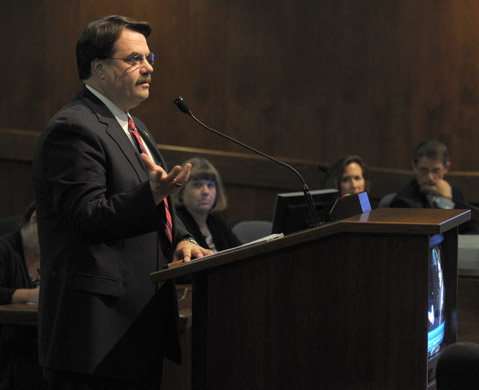
in front of the Board of Supervisors Tuesday for the work it’s been doing in the S.B. County Jail with the mentally ill.
A systemic problem has made it difficult to get the mentally ill the care they need, leading to more sick people ending up in the wrong place — the Santa Barbara County Jail. The facility, supposed to be home to the county’s worst offenders, is instead a “de facto institution for the mentally ill,” Sheriff Bill Brown said Tuesday.
But until something changes, that’s the way it will be. County resources are extremely limited, and there are no plans for increasing the number of dedicated psychiatric beds in the county, a number that is already dismally tiny. “I cannot see any realistic alternative at this point,” said Mental Health Commissioner Ann Eldridge.
So the jail must accommodate the mentally ill accused of committing crimes, and for the last two years it has been using Prison Health Services (PHS) — the country’s largest for-profit provider of prisoner medical care — for the job. And it’s done a good one, according to Brown, given the limited resources available. “The PHS staff is doing an outstanding job with the resources we’re giving them,” Brown said.
PHS has a team of two licensed master’s-level mental health professionals, as well as a registered nurse, working full-time at the jail, and a half-time, on-call psychiatrist, all of whom evaluate 70 to 90 new cases per month. The company has begun quarterly training for all deputies working in the jails and is essentially establishing a 24/7 service for the mentally ill.
But all is not hunky-dory for PHS, which has also garnered some notoriety for problems with the populations it oversees. Some of those issues, it seems, extend to Santa Barbara County’s jail. The Grand Jury has been responding to complaints about the handling of cases in the jail, while there have been several stories of mentally ill people in jail not receiving their medication in a timely manner, if at all. In Santa Barbara County alone, PHS has been the defendant in at least six lawsuits.
And there have been stories, like that of one woman who was taking multiple medications for various ailments but was denied her meds when taken to jail. She warned of her need for the medications but wasn’t given any. She wound up blacking out and hitting her head. In another instance, reportedly, one man who was dually diagnosed (he had a drug problem and mental illness) was on medication for anxiety but didn’t get his medication for at least seven days. His brain function was practically gone at the end of the ordeal, and his mother was completely distraught, said Suzanne Riordan, the coordinator of Families ACT!, which has been working throughout the county on behalf of the mentally ill. “Our experience has been different,” Riordan said, contrasting these and other examples she’s heard with Brown’s rosy characterization of PHS’s efforts.
As the program works, when a person is brought to the jail, they are asked a series of medical questions, including questions about medications. If the officer recognizes the person’s mental health to be an issue, a nurse is called.
Mental health evaluations are supposed to be made within seven to 10 days, but the timeliness of care can be a problem. It is usually in that period that inmates are making their most frequent visits to court, and because of the jail’s overcrowding, many of the inmates are released before they can be evaluated. The average population of the jail these days is about 940 people, hundreds more than its capacity. Additionally, mental health services are only available in the South County, meaning inmates in the Santa Maria Jail must either wait to be shipped down to Goleta or make a special trip if it is an emergency.
But all the issues at the jail regarding the mentally ill simply underscore the greater issue at hand: “The jails are not good for the mentally ill, and the mentally ill are not good for the jails,” Brown said.