Hot Tips to Keep Critters Cool
Keep Your Pets Safe During the Dog Days of Summer
With the official start of summer just around the corner, you may find yourself spending more time outdoors and planning family vacations. Many of these activities can be enjoyed with your pets in tow, but there are precautions that should be taken. Here are some tips on how you can safely participate in summer activities with your pets.
Hot Weather
· Never leave a pet in a car on a hot day. On an 85-degree day, the temperature inside your car can reach 102 degrees in 10 minutes. According to veterinarians, a pet can only withstand a higher body temperature for a very short time before suffering irreparable brain damage or even death. Cracking windows on a hot day isn’t enough to keep your pet cool.
· Be safe at the beach. Not only can dogs get overheated in hot cars, but also on steamy summer days. Make sure your pet stays cool outside by always providing shade and cool water. The ASPCA says you should be especially careful with dogs that have short, pushed-in faces (e.g., bulldogs, pugs, and Boston terriers), puppies, and elderly pets. Experts warn that you should be cautious of pets with light-colored noses, ears, or fur as they are especially vulnerable to sunburn and skin cancer. Talk to your veterinarian about choosing a sunscreen.
· Adjust your pet’s exercise routine. On very hot days, exercise should be limited to early morning or evening hours. Also, be aware that asphalt gets very hot and can burn your pet’s paws.
· Watch for heat stroke. According to the American Red Cross, an overheated dog can suffer brain and organ damage after only 15 minutes. Some signs of heatstroke include excessive panting, bright-red tongue and gums, vomiting, diarrhea, lethargy, and body temperature of 105-110 degrees. If your pet gets overheated, you can give immediate first aid by getting him out of the heat, laying him on cool shaded grass, and pouring cool water over him. You can also give small amounts of water or ice cubes. Call your veterinarian immediately.
Water Safety
Never leave pets unsupervised around a pool. Contrary to popular belief, not all dogs are good swimmers. Make sure to introduce your pet to the water gradually. Keep in mind that supervision is required even for dogs who know how to swim, as they may jump in a pool and not know how to get out. This is especially true if you have a covered pool. Also, try not to let your dog drink pool water. Chlorine and other chemicals in swimming pools can cause an upset stomach.
· Practice safety on boats. Experts recommend that all pets wear flotation devices on boats. Additionally, dogs should be rinsed off after swimming in the ocean.
Backyard Safety
· Be cautious of chemicals in your backyard. People tend to fertilize their lawn during the summer months and certain fertilizers can be fatal if ingested by your pet. In addition, plant food and insecticides can be dangerous if your pet consumes them. Citronella candles may keep away pests, but they contain a chemical that could be harmful if swallowed.
· Don’t allow your pet to partake in parties. Just because you’re enjoying a backyard barbecue or party, doesn’t mean your pet should suffer. Human food and drink aren’t always fit for pets to consume. Alcoholic beverages can cause depression, comas, or even death. Certain foods such as avocados, chocolate, garlic, and onions can also be poisonous.
· Make sure your windows are secured. The ASPCA states that there is an increase in injured animals as a result of “high-rise syndrome,” which occurs when pets fall out of windows and are seriously injured. Since people tend to open windows more in warm weather, make sure to check all your window screens to ensure they are properly secured.
Riding in Cars
· Secure your pet while traveling by car. Pets should always be placed in a carrier while traveling in a vehicle. If this isn’t possible, harnesses can be purchased to ensure your pet stays safe while you drive.
· Don’t allow your dog to ride in the bed of a pickup truck. If you travel with your dog in the open bed of a pickup truck, not only are you putting your dog at risk, but you’re endangering the lives of other motorists. The State of California prohibits unsecured animals from traveling in an open truck. If you must travel with your dog in your pickup truck, you can secure him in a crate in the truck bed or secure him to a crosstie in the open truck bed so that the dog can’t reach the sides of the truck. It is my belief that if a dog doesn’t fit inside your car, they should stay at home.
Traveling with Your Pet
· If you decide to bring your pet with you on your travels, you will need all necessary supplies—food, treats, toys, bed, cold water, and bowls for the road. Make sure to check out hotels ahead of time to see if they allow pets. Here’s a great Web site to look for listings: petswelcome.com.
· Make sure your pet is healthy. If your pet hasn’t had a health check recently, you may want to make an appointment with your veterinarian before you begin your journey. While you’re there, update your pet on any vaccinations that are needed.
· Don’t schedule air flights during peak hours. Peak periods typically mean delays and stopovers, which means your pet will be in a crate for a longer period of time. You should also try to choose early morning or evening flights when the sun isn’t as hot.
If you follow these tips, you can enjoy the summer months with family and friends along with your pet by your side.
Announcements
Time is running out!! Special Cat Adoption Fees for the Month of June!
Animal Shelter Assistance Programoffers $30 discount on adoptions. Through June 30, adopters can bring home two bundles of joy for the price of one—only $65! (Don’t worry: you can still adopt a single cat or kitten). From now until the end of June, cat adoption fees are only $35 for one cat or kitten. That’s a $30 discount off the regular price of $65. Included in the adoption fee at ASAP is:
* Spay or neuter surgery
* Flea treatment
* Vaccinations
* Microchipping
* Health evaluation, including testing for feline leukemia (FeLV) and feline immunodeficiency virus (FIV). Cats thought to be 10 years or older receive a full blood panel evaluation, thus assuring that the cat is indeed healthy and adoptable.
* Medical and drug coverage through ASAP’s vet for two weeks beyond adoption, if necessary
* Temperament evaluation
* Cat carrier (you can save the county money by bringing your own)
ASAP is located at the Santa Barbara County Animal Shelter, 5473 Overpass Road, Santa Barbara. Adoption hours are Monday-Friday, 9 a.m.-4:45 p.m.; Saturday, 10 a.m.-4 p.m. For more information, visit asapcats.org.
RESQCATS has many cats and kittens waiting for a permanent home. Call RESQCATS at 563-9424 for an adoption appointment. All cats and kittens at RESQCATS receive:
* A full veterinary exam
* Spay or neuter surgery
* Age-appropriate vaccinations and worming medication
* Feline leukemia testing
* Microchipping
RESQCATS is a nonprofit sanctuary dedicated to the rescue, care and adoption of abandoned cats and kittens in Santa Barbara. For more information, visit resqcats.org.
Santa Barbara Humane Society is offering reduced adoption fees for cats during the month of June. During Adopt-A-Cat Month, the adoption fee for cats is only $44 and includes all of the following:
* Spay/neuter surgery
* Current vaccinations
* Complete health screening
* Temperament evaluation
* Background/personality history
* Starter packet of food
* Booklet on cat care
* Cardboard cat carrier
To adopt a cat, visit the Santa Barbara Humane Society at 5399 Overpass Rd. For more information, call 964-4777. Shelter hours are Monday-Saturday, 10 a.m.-5 p.m.
Adoptable Pet of the Week
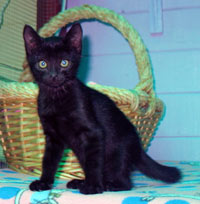
Cinders is a perfect name for this little eight-week-old male kitty. His shiny black fur and big green eyes make him quite adorable. And he has the personality to go right along with his “handsome-ness.” He has heard all the stories of why people don’t want a black kitten, but he doesn’t believe a single one of them.
Cinders would like someone to love him, care for him, and even consider taking him home with one of his siblings, Cinderella or Soot. His bag is packed and ready to go with his toys, blanket, food, and all his health records. In return for a lifetime commitment to him, he promises to love you unconditionally, entertain you for hours, make you laugh, and bring you joy for many years to come.
Cinders received his vet exam, was tested for Felv/FIV, is wormed, got his first FVRCP vaccination, is neutered, and micro-chipped.
Please call RESQCATS at 563-9424 for an adoption appointment. All kittens and cats have had a full veterinary exam and been vaccinated, wormed, spayed or neutered and tested for leukemia and microchipped. RESQCATS is a nonprofit sanctuary dedicated to the rescue, care and adoption of abandoned cats and kittens in Santa Barbara.
For more information, visit www.resqcats.org