Remember the “unitary executive”? You’re not unusual if you don’t. This phrase was part of a short-lived debate during the Bush presidency about the proper scope of presidential authority. Even though the debate was short-lived, the policies weren’t and Vice President Cheney revealed in his recent book that expanding the power of the presidency was perhaps his most important mission while he was in office.
The unitary executive is a catchphrase that encompasses the idea that the executive branch should enjoy significantly more power than it currently does in our established system of checks and balances. President Obama seems to share this philosophy, judging by his recent actions if not his words.
The recent killing of Anwar Al-Awlaki, an American citizen living in Yemen and recruiter for Al Qaeda, has prompted a small but growing debate that has similar contours to the debate about the unitary executive under President Bush – if not accompanied by the same vehemence from the left.
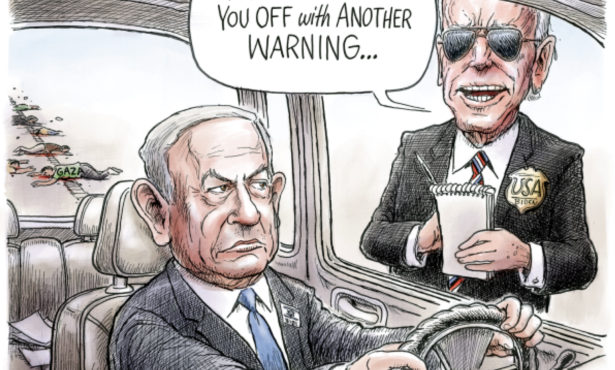
In fact, there is a profound lack of vehemence, on the left or the right, about the actions that Obama has taken that, if taken by Bush, would surely have led to massive protests about the misuse of our power abroad. It is clear now, to anyone who cares to pay attention, that Obama is following Bush’s lead on most foreign policy issues – and in some cases taking an even more aggressive tack than his predecessor.
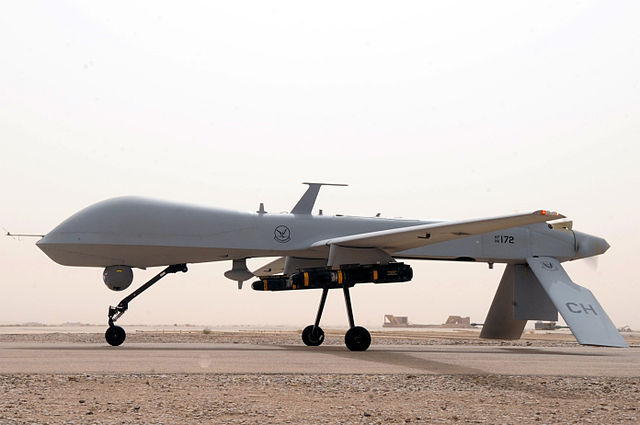
The killing of Awlaki, which may be accurately called an assassination, was not a surprise. An earlier attempt, also using unmanned drones armed with missiles, failed in May, 2011. This was the first strike in Yemen after a year because the Yemeni government had withdrawn permission for the strikes after a botched strike in May, 2010, that missed its target but succeeded in killing a Yemeni official and a number of civilians. (Close observers will recall that the very first U.S. drone strike, at least the first one we know of from public accounts, was in Yemen in 2002).
U.S. officials made the argument that Awlaki had “gone operational,” but presented no evidence to support their case. When pressed, “officials” admitted the evidence was “patchy,” according to Reuters. The editor of the Yemeni Post denied that Awlaki had an operational role, stating: “[This strike] will not be a blow to Al-Qaeda in the Arabian Peninsula from any perspective. We don’t feel they will suffer, because [Awlaki] did not have any real role in [the organization].”
So was Awlaki just a recruiter or was he operational? I don’t know, and nor does anyone else outside the executive branch – and apparently they don’t really know either. The question is: Do we blindly believe our government on these types of issues, even as we get burned time and time again as the truth is later revealed? Does patriotism demand blind faith? No. Patriotism (and good journalism) demands that we be highly critical of unsubstantiated claims that form the basis for the unprecedented assassination of our own citizens. Let’s not forget that the U.S. did, for the first time in its history, consciously target a U.S. citizen with an unmanned drone, in a foreign country thousands of miles from our shores, with zero public due process.
This type of action, and the evidence it is allegedly based on, has to be scrutinized very closely.
There was an attempt at outside scrutiny by Awlaki’s own father, with the assistance of the ACLU. Awlaki brought a legal challenge against the federal government after he first learned that his son had been placed on a capture or kill list maintained by the White House. The ACLU argued on his behalf that “the United States is not at war in Yemen, and the government doesn’t have a blank check to kill terrorism suspects wherever they are in the world. Among the arguments we’ll be making is that, outside actual war zones, the authority to use lethal force is narrowly circumscribed, and preserving the rule of law depends on keeping this authority narrow.”
Exactly.
Unfortunately, when the lawsuit was filed the court threw it out by sidestepping the issue as a “political question.” There is some precedent for this in U.S. jurisprudence and all first-year constitutional law students learn about it (including yours truly years ago). However, I’m personally ashamed that in our advanced democracy we have a legal system that won’t even address due process concerns for its own citizens on a kill list in a foreign country, based purely on assertions made by the White House. This does not seem like democracy to me.
The U.S. drone program more generally should be a source of real concern. Obama has expanded the program dramatically and we now apparently have about 7,000 drones in operation around the world.
U.S. officials recently had the audacity to suggest that the drone program had gone a year with zero civilian casualties. When questioned about this striking claim, officials claimed that, well, there was no “credible evidence” of civilian casualties. When pressed further, it was revealed that it is generally not U.S. policy to inspect strike sites after the fact for civilian casualties. QED. The Orwellian nature of this argument should be lost on no one – but it is lost, unfortunately, on a regular basis.
The left in this country seems to be still in a daze when it comes to foreign policy under Obama because, well, he’s a good guy, right? Wrong. Every U.S. president has pursued an aggressive and highly-damaging foreign policy, particularly when judged from the point of view of our victims. There is one major difference, however, that I have detected between Democratic and Republican presidencies on foreign policy, after 20 years of observing and reading. This is the degree to which Democrats are far less likely to start unilateral foreign wars. In fact, judging by the 14 unilateral regime changes examined in Stephen Kinzer’s excellent book, Overthrow, only one such regime change was initiated by a Democratic president: Kennedy (Ngo Dinh Diem in Vietnam, much to his later regret). Democratic presidents are, however, happy to continue or escalate wars started by their Republican predecessors, or to join in unjust multilateral wars – like Libya (a topic for a different essay).
So why don’t Americans care about foreign policy? I have some ideas, but don’t know for sure. Judging from my friends, family, and what I see and read, most people just don’t have the bandwidth in their lives to pay attention enough to care. A recent book about civilian deaths at U.S. hands around the world, The Deaths of Others, by John Tirman, a scientist at MIT, makes a similar claim, among others.
I hope that most people would in fact care about the effects of our foreign policies on unwitting civilians (and now our own citizens in some circumstances) around the world if they knew what our actions lead to. I do have faith in human goodness. But education about what’s going on is the first step. And when our economy is mired in recession; the presidential race absorbs half the news for two years out of every four years; Facebook and video games, TV, magazines and dating sites, another major chunk of our time; oh, and hanging out with friends and creating families; there’s not much left over for most people to get up to speed on what’s really happening in our foreign policy.
It also seems that when U.S. citizens are the victims of our aggressive actions that more Americans should start to wake up. I applaud Ron Paul for his principled criticism of the Awlaki assassination and other U.S. foreign policy actions.
My hope is that the Arab Spring and movements like the Occupy Wall Street protests in the United States, both heavily involved with social media in terms of information and organization, will continue the Sunshine Revolution here at home. The long-term trend toward more and more open democracy, and increased human rights and living standards around the world, does seem clear. That, in itself, is encouraging. And, eventually, we may actually hold our leaders to account for their actions abroad as well as at home.

Related Links
Tam Hunt is a lawyer and a renewable energy consultant who also teaches part-time at UCSB's Bren School of Environmental Science & Management.


Print friendly
E-mail story
Tip Us Off
Comments
Share Article
Myspace


Previous Month


Comments
Tam, and this will be the last column of yours that I read and comment on, you're still drinking your own Kool-Aid.
Although I think you are sincere, your conclusions are pretty scary. The Democrats overwhelmingly supported Bush's idiotic invasion of Iraq. Look at the vote tally.
Most Americans, even naturalized Americans like me, do care about foreign policy, we just don't agree with your conclusions. Whether you feel this is because we are less enlightened and less evolved is irrelevant; we do care and we hold a reasoned alternative view.
Arab Spring and those democracy loving Arabs is really working out as they institute Sharia Law in place of societies that allowed women to prosper. I suspect you think that the Muslim Brotherhood is just a mad cap group of men out for a good time; kind of a "poker night" while also getting to kill Christians and take away the rights of females.
Your continual mixing up of philosophy and science is usually reserved by people that either believe their own excrement has no odor or a covert agenda. Throw in a political agenda and the fun really begins.
To wit, and from someone with a primary degree in Ancient Rhetoric who is now a physician that does research all over the world:
Philosophy deals with questions than CANNOT be answered by observation and/or experimentation.
Science is a systematic method of acquiring knowledge based UPON observation and experimentation.
Whether you are a practitioner of reductionism or a proponent of a systems approach, the rules don't change just because you say so.
Mixing disciplines makes fun cocktail banter but it scares me when people cannot distinguish between the two; from either the Right or the Left.
italiansurg (anonymous profile)
October 31, 2011 at 6:04 a.m. (Suggest removal)
Tam, I found your article thoughtful and thought-provoking. However, I believe that terrorism is a form of warfare used by people who do not have the power and resources to fight any other way. Therefore, terrorists who declare themselves such and call for attack by use of terrorism are combatants in a war regardless of where they are. Self-declared combatants are fair game for drone strikes or late night visits from special forces troops. Going to war entails risks of getting killed. You don't get it both ways, i.e., declaring war and then hiding behind legal rights to due process.
Eckermann (anonymous profile)
October 31, 2011 at 8:09 a.m. (Suggest removal)
Eckermann, let me ask you two questions: 1) what was the evidence that Awlaki was operational and not merely saying bad things about America? 2) do you believe in the rule of law as a foundational value for our democracy?
TamHunt (anonymous profile)
October 31, 2011 at 8:26 a.m. (Suggest removal)
Tam,
1). The term "operational" is ambiguous when it comes to terrorism. I would say that any person who advocates terrorist attacks is an operational terrorist. The Germans who were working in the factories of Hamburg in July of 1943 were not combatants per se, but they were contributing to the war effort and were therefore valid targets of bombing. So I would say that Awlaki's own words advocating terrorism made him "operational," and, therefore, a valid target.
2). I believe that the rule of law is a foundational value. However, I also believe that anyone who declares war on a society that is governed by the rule of law is no longer entitled to due process of law. The nasty thing about war is that there are no (or not very many) rules. War is the ultimate "might makes right" solution to foreign policy. It is a bad thing, but one that humans have so far been unable to purge from our soicial behavior. I am all for doing away with war, but it only takes a small minority to engage in war to drag the rest of humanity into the madness.
Eckermann (anonymous profile)
October 31, 2011 at 9:26 a.m. (Suggest removal)
Eckermann, what if Awlaki lived in the US? Would his advocacy of attacks on the US government warrant his execution with zero due process? This is my point: there was no due process and for our government to summarily execute a citizen with no due process should be considered the height of depravity by all people who care about justice.
As for the rule of law versus might makes right, war does in fact have a vast system of law that is supposed to determine how it is conducted - starting with the UN Charter, which is US law because it's a signed treaty. Might makes right is the opposite of the rule of law. The whole point of the "rule of law" is that might does not make right.
Let me ask you: on what basis can you condemn (if you do) the alleged Iranian plot to kill a Saudi ambassador on US soil if you are so sanguine about the US killing its own citizens abroad, with zero due process, in a sovereign country? Because we're the good guys and the Iranians are the bad buys?
Again, the entire point of the rule of law, based on the UN Charter, which the US itself created after WWII in order to stop the depravities of that era, is to distinguish between legitimate use of force by states and illegitimate use of force.
TamHunt (anonymous profile)
October 31, 2011 at 2:13 p.m. (Suggest removal)
italiansurg, post your comments in the appropriate column comments and I'll be happy to respond further.
TamHunt (anonymous profile)
October 31, 2011 at 2:14 p.m. (Suggest removal)
Tam,
All your points are well taken and well argued. The problem with terrorism is and the rules of war is that terrorists do not sign treatys and therefore are not protected by them. In fact, you are valid target of terrorists by the simple fact that you are a U.S. citizen (or even resident). I care a great deal about justice. However, terrorists have removed themselves from the social contract that would entitle them to justice. They deserve none. Another problem with terrorism as warfare is that the field of battle itself is indistinct. This makes it very difficult to determine if a terrorist act is an act of war or a domestic crime. I would say that if a person declares war on a nation then wherever that person is would be considered the field of battle and that person would be subject to lethal attack. All soldiers are subject to attack on the field of battle. As I said before, the terrorist considers you a valid target in your home in Santa Barbara. Terrorism vastly expands the field of battle.
I am not sure that the Iranian plot was an act of war or a crime. The Iranians have not declared war on either the United States or Saudi Arabia. This seems more like a gangland murder plot. But the line between terrorism to further criminal gang activities and terrorism as an act of war can be fuzzy.
Finally, I fully agree with you that might does not make right. However, history as shown that the righteous do not fair well unless they match the violence of evil with might of their own. We cannot fight terrorism with law. We must meet it on the field of battle, wherever that is.
Eckermann (anonymous profile)
October 31, 2011 at 5:02 p.m. (Suggest removal)
Anwar Al-Awlaki did get due process. He got the process of an unmanned drone firing a guided missile at him, and killing him. That was the only process he was due as an enemy combatant. And, no. He doesn't even have to touch a weapon to be considered an enemy combatant. Most of the terrorists in leadership never pick up a weapon, except for the odd photo op here and there.
"what if Awlaki lived in the US? Would his advocacy of attacks on the US government warrant his execution with zero due process?"
The problem for him was that he wasn't in the US. If we're fighting a war, and a US citizen goes off to join the enemy, historically, that person is treated no different than any other enemy combatant. And, why shouldn't they? I would say that when someone does such a thing, they're pretty much telling us that they are renouncing their US citizenship. Al-Alawki knew exactly what could happen to him when he went over there to join the other side. In WWII, if a US citizen joined the German Army, and it did happen, during a firefight, I don't think anyone would stop to ask if any of them were American citizens, so they can make sure they don't shoot them, so they can later be given "due process".
waz (anonymous profile)
November 1, 2011 at 9:33 a.m. (Suggest removal)
Clarification: None of my arguments in this post assume a value judgment of "good guys" and "bad guys." Such judgments are made by history (and usually by the victors), are tainted by the emotionalism of patriotism, and are far too ambiguous to address in the few lines of a blog post. My point is that people who declare war on other people (as the terrorists have done) have put themselves on the field of battle where they are subject to lethal attack. I sort of like my peaceful and unexciting life (subject to the rule of law), but I understand that some people can get worked up with righteous indignation and feel that they have to go to war to perserve their values. If they choose to travel down that path they must accept the risks associated with their choice. In biology, when an organism is put under pressure in its niche it has three choices: adapt, move away, or die. Mr, Al-Alawki chose death.
Eckermann (anonymous profile)
November 1, 2011 at 7:49 p.m. (Suggest removal)
Eckermann, let me quote Glenn Greenwald (a columnist for Salon) on what is going on here with respect to targeting of alleged terrorist targets in the undeclared and apparently open-ended "war on terror":
"The Executive Branch decided it has the authority to target U.S. citizens for death without due process, but told nobody (until it was leaked) and refuses to identify the principles that guide these decisions. It then concluded in a secret legal memo that Awlaki specifically could be killed, but refuses to disclose what it ruled or in which principles this ruling was grounded. And although the Obama administration repeatedly accused Awlaki of having an “operational role” in Terrorist plots, it has — as Davidson put it — “so far kept the evidence for that to itself.”"
If this had been done under Bush would you really be okay with this? Would you really be okay with trusting your government to meet in secret and compile secret lists of enemies that may be killed, in secret, with zero due process and zero accountability to the American public?
Let me extend this a bit further. You may not know, because it was barely noted in US media, that two weeks after Awlaki's execution, US drones also killed in the same manner Awlaki's 16 year old American son, a 17 year old friend and a number of Yemenis, all of whom the US claims were Al Qaeda in the Arabian Peninsula members. But, of course, no evidence is presented to substantiate this claim and the US apparently believed (or lied) that the son was 21, not 16.
Are you ok with this? US drones executing children and who knows how many civilians from the air in foreign countries with zero due process and zero accountability?
TamHunt (anonymous profile)
November 1, 2011 at 9:58 p.m. (Suggest removal)
More broadly, Eckermann, what is your definition of "terrorism"?
You've probably heard that "one man's terrorist is another man's freedom fighter." Beware the use of trigger terms like "terrorist" because they are designed to deflect thought or criticism.
There are many shades of gray in between advocating violent acts against US targets and justly criticizing US foreign policy.
I actually haven't listened to anything Awlaki said or read anything he wrote (I'd be probably be put on some FBI list if I did...), and I suspect you haven't either. So what exactly did he say or do that makes him a terrorist worthy of execution with zero due process?
As I mentioned in my essay: Obama won't tell us what he did that made him "operational." But there are many public statements by Awlaki, so I'm curious if you can point to any actual statements or actual deeds by Awlaki that you think rise to the point of warranting execution with zero due process.
This is the point of due process: it provides an airing of evidence.
Another general point: the war paradigm is the wrong paradigm for dealing with terrorist groups who threaten real harm to the US (and if they don't threaten real harm we should just ignore them). The law enforcement paradigm, long advocated by our European partners, is far more appropriate and smarter than waging hot wars, like Bush, or waging shadowy robot wars around the globe, like Obama.
The law enforcement paradigm, using our partners' internal ability to project force in a measured way, or groups like Interpol, or US ground troops where absolutely necessary (without violating the sovereignty of other nations), uses a scalpel where a scalpel is appropriate and not a machete. Using force smartly avoids backlashes and creating whole new generations of new enemies.
TamHunt (anonymous profile)
November 1, 2011 at 10:08 p.m. (Suggest removal)
The guy was an enemy of the United States of America. He needed to be killed, and Obama had him killed. It's that simple. Due process, my behind.
waz (anonymous profile)
November 2, 2011 at 8:30 a.m. (Suggest removal)
Tam, “terrorism” is form of asymmetrical warfare practiced by antagonists who normally resort to terrorism because they lack the material or numbers to prevail against a larger or more well-equipped force. It is usually characterized by the use of methods that specifically target civilians. Acts of surreptitious warfare (such as commando attacks and snipers) are not terrorism because they target known combatants. Terrorism has been around as a warfare strategy for a long time. Malraux refers to it in his novel Man’s Fate about the 1925 uprising in China. A “freedom fighter” terrorist is still a combatant who has placed himself or herself on the field of battle in harm’s way, no due process necessary.
My knowledge of Awlaki is third hand from press reports that reported that he advocated the use of terrorism as part of Jihad against the United States and other Western nations. As I said before, the term “operational” when it comes to terrorism, is ambiguous. Any person who advocates this use of terrorism against any person or persons, is an operational terrorist. It is ok to hate the collective citizenry of a country. However, to advocated the violent overthrow of that country is to declare war on them. I disagree that the war we are engaged in with terrorists is undeclared and should be handle as crime instead of warfare. The terrorists themselves have declared war on us if very unambiguous terms. Giving terrorists the benefit of due process would give them a strategic advantage in their political and violent struggle against us. Treating their acts as warfare places them on the field of battle, from which they would prefer to hide (being at an asymmetrical power disadvantage).
With regard to 16 year old combatants, sadly, history is rife with 16 year old combatants. I wish it weren’t so. With regard to collateral death from aerial bombing, this is a moral issue that we have faced ever since we began dropping bombs from airplanes. Supposedly, this moral issue can be addressed by precision, but I am doubtful that we will ever fully address the issue unless we completely abandon bombing as a tool of war.
Finally, I am not ok with any of this. War of any kind is tragic waste of human life, energy, and resources. I would prefer that people settle their differences in a more civilized and peaceful manner. Alas, to our sorrow as a species we don’t seem able to eschew war as an arbiter of dispute.
Eckermann (anonymous profile)
November 2, 2011 at 9:19 a.m. (Suggest removal)
Tam lives in imaginary happy land where good intentions of progressives like himself are all that is required for the world to be wonderful. Its a happy place like Disneyland where the ineffectual UN resolves all of our differences peacefully. Too bad Al Qaeda doesn't belong to the UN.
Unfortunately, this happy place bears zero resemblance to the the actual dangerous world in which we have to live. This is doctrinaire left wing talking points from the idealistic and unrealistic well intentioned but clueless left.
Thankfully, these hopelessly childlike views of the world are limited to dreamy columns like this and academia. Fortunately, people actually responsible for protecting our country have a little more clarity as to the dangers we face. Even a leftist like Obama managed to figure it out. Maybe there is hope.
CommonSenseSB (anonymous profile)
November 2, 2011 at 11:07 p.m. (Suggest removal)
It seems that some live in a dark and dreary land, un-inhabitable for children, where bad intentions of conservatives are all that is tolerated. Its a bad place like hell where the old and dying try desperately to grip on to the material things and ignore truth and reality.
Fortunately, this bad place bears no resemblance to the wonderfull world that we live in where we are allowed a dream every now and then as well as an education from people who know something. Unfortunately, those in charge of 'protecting' our country have been on offense for the past decade killing hundreds of thousands, maybe more ? who knows? who's stats do you trust? all the while, we have lost more than we lost on that day that started this whole mess. Rule of law has been absent for some time for the higher ups.
spacey (anonymous profile)
November 3, 2011 at 12:51 p.m. (Suggest removal)
very cleaver. Unfortunately intellectually and factually void
CommonSenseSB (anonymous profile)
November 3, 2011 at 3:50 p.m. (Suggest removal)
"Treason against the United States, shall consist only in levying War against them, or in adhering to their enemies, giving them Aid and Comfort. No Person shall be convicted of Treason unless on the Testimony of two Witnesses to the same overt Act, or on Confession in open Court.
"The Congress shall have Power to declare the Punishment of Treason, but no Attainder of Treason shall work Corruption of Blood, or Forfeiture except during the Life of the Person Attainted." _US Constitution, Article III, Section 3.
Apparently, he should have had a trial to declare him a traitor, and then Game On!
Sidenote: @TamHunt and @Eckermann
The "Rule of Law" is something of a philosophical concept, while "Might Makes Right" is something of 'natural order'. The catch is in that, in practice, laws are upheld by might!
equus_posteriori (anonymous profile)
November 4, 2011 at 3:23 p.m. (Suggest removal)
I have similar concerns as Tam Hunt. But in context I am not as concerned. And I don't think that is dangerous because I don't give Obama a pass on everything he does.
Recall either or both the incompetence and malfeasance of the Bush Administration, which was much more horrifying. And the Bush Administration policy it seemed was for an ongoing push for broadened "unitary executive."
And if criticism diminished for the al-Awlaki killing it was because the Obama Administration was revealed to have deliberated extensively this killing, explained, and further information for justification was revealed and reported on in a 'leaked' memo. Again Obama is not pushing for expanded powers. Again the Bush administration was pushing people over the edge in its' effort for more expanded presidential powers.
DonMcDermott (anonymous profile)
November 6, 2011 at 9:51 a.m. (Suggest removal)
http://www.youtube.com/watch?feature=...
CommonSenseSB (anonymous profile)
November 13, 2011 at 7:06 p.m. (Suggest removal)