Tajiguas Landfill: Prettiest and Most Expensive
New Survey Shows Santa Barbara Dump Priciest in Tri-Counties
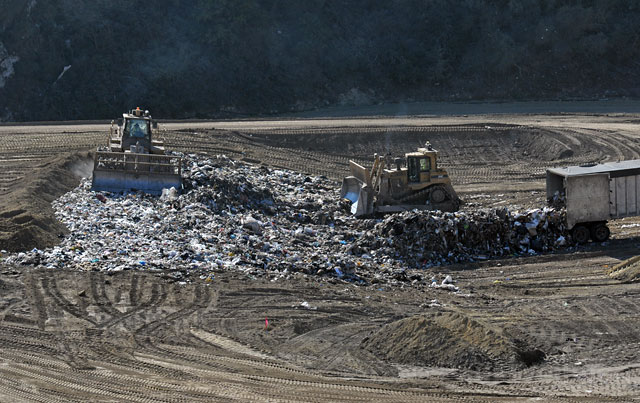
Of all 29 garbage dumps throughout Santa Barbara, Ventura, and San Luis Obispo counties, the Tajiguas Landfill — located on the Gaviota Coast overlooking the Pacific Ocean — is no doubt the most visually spectacular. It also happens to be the most expensive, according to a survey just released by the Ventura County Public Works Department.
The Tajiguas Landfill now costs $77 a ton, and Santa Barbara County solid waste planners are aggressively pursuing ambitious long-range developments that would push the number to $97. By contrast, the new-and-improved landfill slated to open in Santa Maria will charge $70 a ton. A little further afield, the Simi Valley Landfill and the Chiquita Canyon Landfill in Castaic charge $58 and $59 a ton, respectively.
The release of these figures could prove illuminating — or inflammatory — given the sticker shock some major landfill users have expressed at the rate increase needed to cover the costs of building a major Materials Recovery Facility (MRF) at Tajiguas so that recyclables and compostables can be extracted from the waste stream. In addition, county trash planners are proposing to build a vast, industrial-scale anaerobic digester that can trap the methane and other biofuels. This whole enterprise is projected to cost around $75 million and would extend the licensed lifespan of the landfill — set to expire in 10 years — by an additional 10 years.
The City of Santa Barbara, which contributes about 70,000 of the 170,000 tons of trash dumped at Tajiguas each year, has been less than enthusiastic about the county’s high-tech, high-priced plans to extend the life of its landfill. While city trash planners have not contemplated any go-it-alone strategy, Santa Barbara might be able to save as much as $2.5 million a year in tipping fees by hauling its trash to the Simi Valley or Chiquita landfills instead of signing up for the county’s MRF and Digester plan.
County trash czar Leslie Wells estimated that once transportation costs are factored in, the difference in tipping fees would shrink to $15 a ton, coincidentally the same amount the average resident generates a year in trash. “That’s $1.20 a month,” she said. For that same amount, Wells said, trash customers could support a much-improved program that recycles 25 percent of what’s now sent to the landfill and generates enough energy — via biofuel mining — to keep the equivalent of 22,000 cars off the road per year.
As for why Tajiguas costs so much even without the major changes on the drawing board, Wells said the expansion of the site now taking place — with new pits and new linings — is very expensive. Likewise, the county has to set aside enough money to ensure the site poses no environmental threat 30 years after it closes. And finally, she speculated, it could be because of the trained falcons kept on site to chase the seagulls away so the gulls don’t poop on the beach and contaminate nearby creeks. “The falcons aren’t cheap,” she said.