When Pigs Walk
Carl's Jr.'s Sows Freed from Crates


As Americans’ attitudes about the food we eat continues changing, so too has our awareness about farm animals—who they are, how they suffer, and what it means to help them.
This month, Carpinteria-based CKE Restaurants, operator of the Carl’s Jr. and Hardee’s chain and a company which has been admirably open to discussion and collaboration, took steps to improve the lives of pigs in a significant way. The company announced that it would ensure that its pork comes from pigs who have been spared from some of the abysmal treatment inflicted on most breeding pigs in the industry these days. I say, good for CKE.

At question is the common practice of confining mother pigs every moment of their four-month pregnancy in gestation crates, cages roughly the same size as the animals’ bodies, preventing them from even turning around. The pigs are then placed into another crate to give birth, re-impregnated, and put back into a gestation crate. This happens pregnancy after pregnancy for their entire lives, adding up to years of virtual immobilization. These controversial cages and the misery they cause have come under fire from farmers, animal scientists, and consumers.
Naturally most people are aghast to learn about this extreme confinement of billions of animals. I grew up in rural New Hampshire, in a small town with bucolic pastures, rolling hills, and streams. Our neighbors had horses and their pens stretched over fields to where our property began. Several of my friends’ families raised chickens, who took dust baths and darted around their yard chasing insects. For the most part, they lived relatively free lives until their final day.
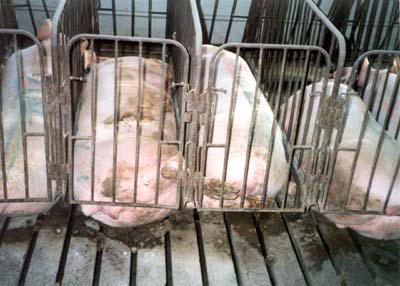
But that is not the norm for farm animals in America these days. The vast majority of the nine billion animals raised for meat, milk, and eggs are confined on factory farms, where some of the most everyday agricultural practices are often the most abusive. Confining pregnant pigs in gestation crates has come to exemplify all that is wrong and backwards with industrial animal agribusiness.
I was 16 years old when I first learned what a gestation crate was. What I saw was nothing like the version of a farm I was used to. Acres of pigs confined in these crates didn’t even approximate what any reasonable person would call a “farm.” Then and there I decided that I would try to make a career out of working to improve conditions for animals in the meat industry – as well as the egg and dairy industries.
That decision eventually led me to the field of corporate communications. In this country, one area where real change is driven is the marketplace. So for the last decade, I’ve been working with major food companies – the meat producers themselves, as well as fast-food chains, grocery chains, food-service providers, and any other corporate entity with a stake in animal agribusiness.

In addition to working with businesses, The Humane Society of the United States has a long tradition of advocacy for laws and regulations to protect animals, including farm animals. For example, in 1958, we were instrumental in passing the Humane Methods of Livestock Slaughter Act. In 2008, we helped California voters usher in Proposition 2, which made California the fifth state in the country to ban gestation crates for pigs grown here. And currently, we have joined with a former adversary, the United Egg Producers, in seeking Congressional approval of an amendment to the Egg Products Inspection Act that would give laying hens more space and more humane conditions.
Together, our laws, our corporate standards, and our consumer demands make a powerful, interlocking combination that is adding up to better conditions for farm animals.
Just this year, with the help of The Humane Society of the United States, industry giants like McDonald’s, Wendy’s, Burger King, Denny’s, Safeway, Kroger, Oscar Mayer, Cracker Barrel, Sonic Drive-In and others have responded to this shift in public consciousness and committed to phasing gestation crates out of their pork supply chain. This month, CKE Restaurants joined those ranks.
We can look forward to the day when gestation crates will be obsolete thanks to the forward-thinking of companies like CKE. There is still a long ways to go before farm animals, on the whole, live decent lives, but getting gestation crates out of every American pig breeding facility will be a huge step toward a more humane society.