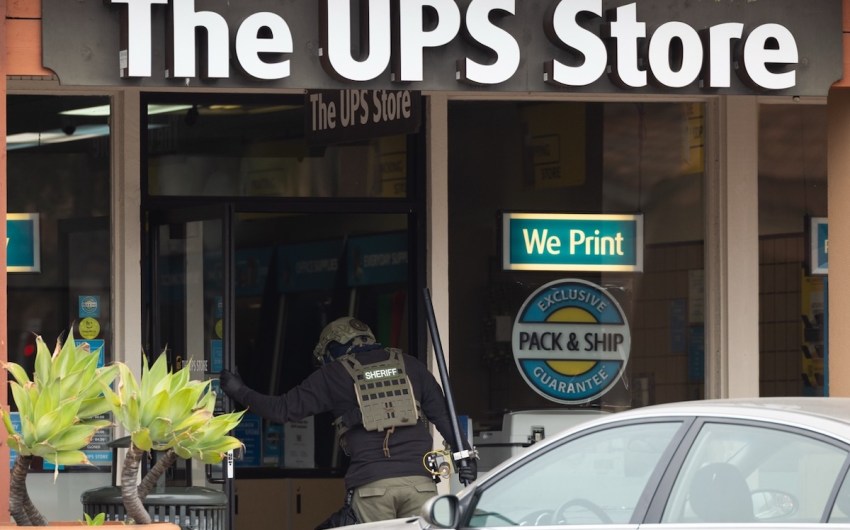
The Santa Barbara County Sheriff’s Office thwarted an elaborate phone scam targeting a 77-year-old woman in Goleta who was nearly scammed out of $30,000 on Monday, August 4.
The Goleta resident had received a call from a person pretending to be from Amazon. The caller, who claimed there were unauthorized charges and fake bank accounts in the victim’s name, transferred her to a supposed Federal Trade Commission agent, according to the Santa Barbara County Sheriff’s Office. The “agent” then instructed her to withdraw $30,000 in cash from her bank. The scammer stayed on the phone, coaching the victim on how to deceive bank tellers, and demanding photos of the cash, receipts, and a sealed box containing the money.
Becoming suspicious due to misspellings in an email from the “agent,” the victim contacted the Sheriff’s Office while still on the call with the scammer. In a coordinated operation, deputies and detectives observed a woman, later identified as Caihong Lei, waiting near the victim’s home near the 500 block of Pine Avenue in Goleta. They arrested her after she retrieved the box of money, the Sheriff’s Office stated. Officers then helped the victim return the money to her bank account.
Lei was booked into Santa Barbara County Jail on charges of grand theft by false pretense and conspiracy to commit fraud. A judge set her bail at $500,000. The Criminal Investigations Division is currently investigating whether Lei is connected to a larger scam network, said the Sheriff’s Office.
Lei will be arraigned on August 8, facing a felony complaint filed by the District Attorney’s office that alleges a conspiracy to commit theft from an elderly adult, misrepresented themselves as employees of the Federal Trade Commission, sending a fraudulent document about a fake money laundering investigation, and taking a package from the victim’s property. Lei is also charged with misdemeanor prowling.
Telephone and text scams are a persistent problem. On July 24, the Federal Trade Commission issued a warning specifically about fake Amazon scams that utilize text. To avoid falling victim to these schemes, the Federal Trade Commission offered the following advice:
- Don’t click links in unexpected texts, and don’t respond to them. If you think the message could be legitimate, contact the company using a phone number, email, or website you know is real — not the info from the text.
- Check your Amazon account. If you’re worried, log in through the Amazon website or app — don’t use the link in the text — to see if there’s a problem with or recall on anything you’ve ordered.
- Suspicious text messages can be sent to 7726 (SPAM) or via a cell phone’s “report junk” option, which go to the carrier. After you’ve reported it, delete the message.