


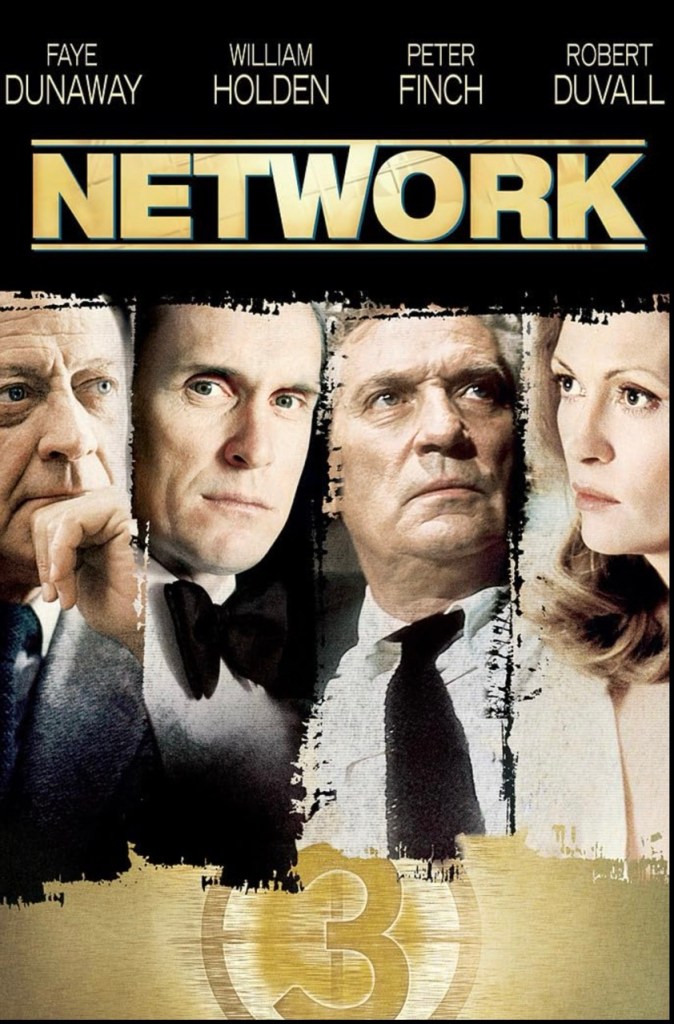
By lucky accident, I watched the 1976 movie Network the other day. It had been many years since I first watched it, but as with a good book, the passage of time can make a second take a different experience, and often a richer one.
For those who don’t know, Network is about UBS, a fictitious broadcast network, and one of its top anchors, Howard Beale, played by Peter Finch. Finch’s performance won him an Oscar. On the verge of a mental breakdown for reciting what he considers lies and propaganda, Beale threatens to kill himself on air. Instead of ending Beale’s career, the threat reignites it. UBS executives, led by Frank Hackett (Robert Duvall), are hungry for programming that will grab public attention and boost sagging ad revenues. Instead of taking Beale off the air, Hackett keeps him on, hoping to capitalize on Beale’s anger and his signature call, “I’m mad as hell, and I’m not going to take this anymore.”
The screenplay by Paddy Chayefsky also won an Oscar. As a piece of dark satirical writing, it’s a masterpiece, and as with all effective satire, its anger and cynicism speak to real underlying problems with the news media and society. Faye Dunaway, whose performance as Diana Christensen earned her a Best Actress award, represents the network’s obsessive search for programming. In the same way that Frank Hackett sees everything through the lens of profit, Christensen cares only for potential stories, characters, conflicts, and irresistible tensions. Right or wrong, moral or immoral, true or false, all that matters is ratings.
While Chayefsky is definitely commenting on the lengths corporations will go to turn a profit, he also castigates a viewing public all too happy to follow a story, no matter how insane it becomes. It was this latter point that struck me as most emblematic of our time and political moment. Eleven years after Network premiered, Neil Postman published his seminal and prophetic book, Amusing Ourselves to Death. Subtitled, Public Discourse in the Age of Show Business, Postman warned that technology threatened to erode our willingness to think and reason. The trend Postman identified became the norm: sensational and tawdry stories, murders, salacious sex scandals, the “if it bleeds, it leads” model of television journalism.
The era when the news divisions of the Big Three television networks were allowed to operate at a loss was over; they had to become profit centers. In the decade that followed, television networks were sold to multinational corporations. The 90s saw the rise of conservative radio, the FOX network, and personalities like Rush Limbaugh, Glenn Beck, and Bill O’Reilly, all of whom mastered the “mad as hell” ethos that for a brief moment made Howard Beale the mad prophet of the airwaves.

Network captured something else about the American zeitgeist. In a small but important role, Arthur Jensen, portrayed by the incomparable Ned Beatty, delivers an epic oration to an enthralled Howard Beale in the dimly lit UBS boardroom. With the fire and certainty of an Old Testament prophet, Jensen explains how the quest for profit is the foundational principle of the universe, the highest ideal, and the purpose of existence. By the time Jensen has finished, Beale is convinced he has seen the face of God. It’s an intense and powerful scene. I couldn’t help but think of the American oligarchs who today believe their vast fortunes entitle them to impose their convictions on the rest of us.
Click here to see the famous “mad as hell” scene from Network.







You must be logged in to post a comment.