
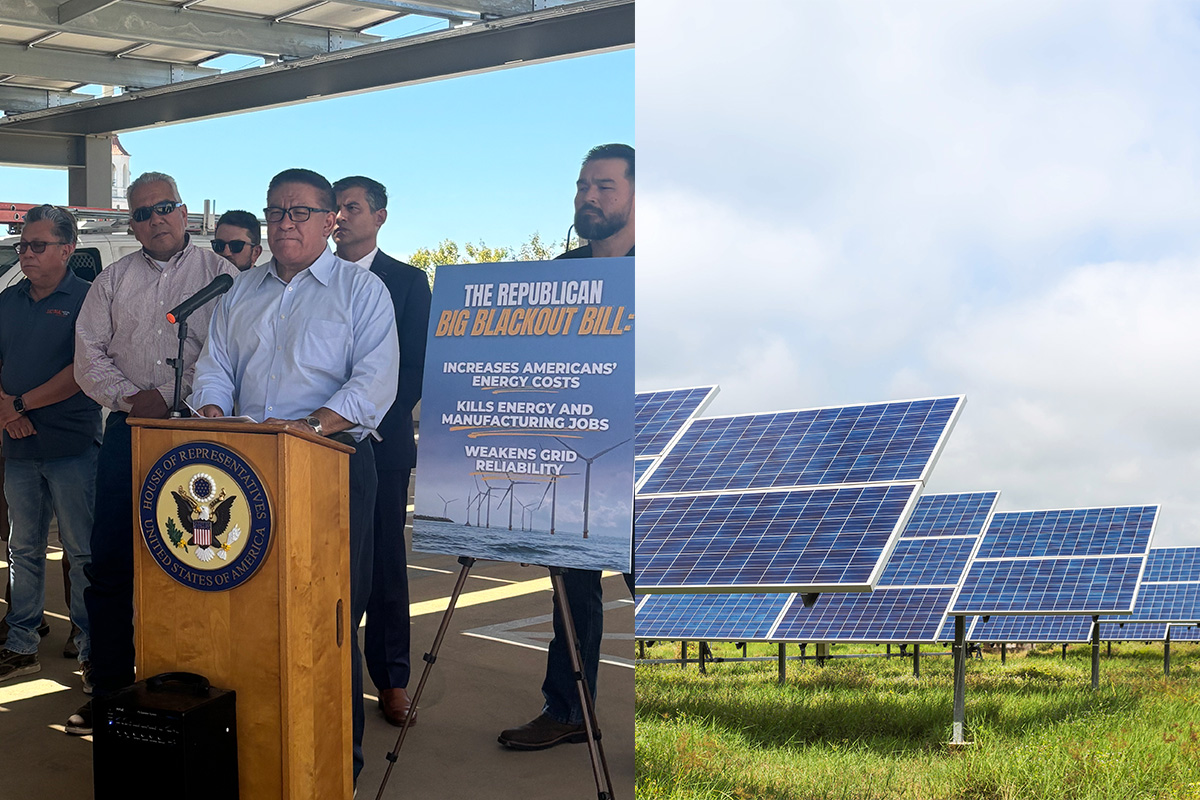
In the shade of the Granada Garage’s solar panels, Santa Barbara congressmember Salud Carbajal and other clean-energy proponents criticized the Trump administration’s “big bad ugly bill” (a dysphemism for the One Big Beautiful Bill Act) and its impacts on clean energy on Thursday.
“Our year-round sunshine and active coastal waters aren’t just scenic treasures; they’re the foundation of a clean-energy future that’s already taking shape throughout the country,” Carbajal said. “[Trump’s] reckless legislation guts clean-energy investments, raises energy costs, and wipes out high-quality jobs.”
The congressmember was joined by representatives of multiple industries and labor groups, such as iron workers. He said thousands of jobs are at risk if tri-county clean-energy projects lose funding and do not move forward. Additionally, he said, starting next year, households can be expected to pay $110 more in electricity bills annually, which could skyrocket to $400 in increased costs in just a few years.
Offshore wind, Carbajal noted, is in big trouble — if not effectively dead in the water. Federal tax credits and incentives for wind energy, along with other clean-energy projects, will vanish by the end of the year.
That’s in addition to Interior’s Bureau of Ocean Energy Management (BOEM) announcement earlier this month that the U.S. government is “de-designating over 3.5 million acres of unleased federal waters previously targeted for offshore wind development” across multiple regions, including California.
On the Central Coast, the Morro Bay Wind Energy Project is in limbo. Although the giant wind farm, about 20 miles offshore of Morro Bay, already secured its leases, it’s “pretty much stopped operations,” after “so much work” had already gone into it, said Carbajal, an outspoken supporter of the project. It has the potential to produce more than 4.5 gigawatts to power over 1.5 million homes, but it’s attracted multiple opponents. Some fishermen, public officials, and residents worry about the loss of coastline to industrialization and what Trump once called “big, ugly windmills” that “ruin your neighborhood.”
Nevertheless, the project’s progression has stalled and investors are skittish, Carbajal lamented. As previously reported by CalMatters, capturing offshore wind energy is considered essential to achieving California’s ambitious goal of electrifying its grid with 100 percent zero-carbon energy by 2045 and reducing greenhouse gas emissions.
Former 1st District supervisor Das Williams also spoke, in his new role as a senior advisor for Central Coast Community Energy (3CE). He warned of impending expiration dates for clean-energy and electric-vehicle tax credits and incentives. For clean energy, that’s at the end of the year; for electric vehicles, it’s September 30.
“For those who have ever heard me say anything about anything, there is always something that you can do about this. There is always a way to strike back,” Williams said. “Go out and make those improvements to your home and business before the end of the year, or go out and get an EV, which, again, is the best way and fastest way you can reduce carbon emissions.”
Jefferson Litten, Energy and Climate Division manager for the City of Santa Barbara, used the Granada Garage’s microgrid as an example of the benefits of clean energy. “We are standing beneath 425 kilowatts of solar which are tied to a battery providing enough energy to power 150 homes,” he started.

He pointed out the surrounding EV chargers that power peoples’ cars on sunshine and noted that the facility is able to run on its own in a power outage, all while saving the city money. It took six months to complete and created multiple jobs across many trades, from crane operators to planners to plumbers and iron workers.
The Community Environmental Council’s Em Johnson added that “the Central Coast is on the front lines of climate chaos, from devastating wildfires to extreme heat events.”
If we do not reduce emissions, coastal communities, including Santa Barbara, will endure over a month of extreme heat annually, in addition to suffering more intense fires like the Madre and Gifford fires experienced on the Central Coast in just the last month, she said.
Johnson closed out her statement with a call to action: “We can convert public angst into collective action.”
At the end, Carbajal acknowledged the Central Coast’s position as a pioneer in clean-energy projects grappling with a persistent, oily past. He said that the oil and gas industry still has a place in the transition to renewable energy. “We need to make sure that those jobs are protected and thought of as we transition,” he said. “Too often as we talk about the transition to renewable energy, we don’t talk enough about the workers, day in and day out, who are also contributing to their families and their livelihoods, and we need to make sure that we don’t leave any worker behind.”
“But we do need to transition, and we do need to augment our energy supplies, so that we have a broad portfolio — not just going back into the dark ages of depending only on fossil fuels. We know the way of the future. It’s clean. It’s clean for our air. It’s clean energy. And that’s really where we need to go.”
Related Posts



Premier Events

Sat, Mar 14
7:00 PM
Santa Barbara
Red, White, & Blues II: The American Songbook
Sun, Mar 15
3:00 PM
Santa Barbara
Red, White, & Blues II: The American Songbook
Sat, Mar 28
7:15 PM
Santa Barbara
Santa Barbara Stargazing Tour

Sun, Mar 15
3:00 PM
Santa Barbara
Oscars 2026 Watch Party & VIP Reception

Tue, Mar 17
5:30 PM
Santa Barbara
SB Independent’s Annual St. Patrick’s Day Stroll 2026
Thu, Mar 19
6:00 PM
Santa Barbara
Chaucer’s Book Talk & Signing: Elizabeth Gilchrist

Sat, Mar 28
All day
Santa Barbara
Coffee Culture Fest

Sat, Apr 18
11:30 AM
Goleta
The Santa Barbara Independent Backyard Brunch
Sat, Mar 14 7:00 PM
Santa Barbara
Red, White, & Blues II: The American Songbook
Sun, Mar 15 3:00 PM
Santa Barbara
Red, White, & Blues II: The American Songbook
Sat, Mar 28 7:15 PM
Santa Barbara
Santa Barbara Stargazing Tour
Sun, Mar 15 3:00 PM
Santa Barbara
Oscars 2026 Watch Party & VIP Reception
Tue, Mar 17 5:30 PM
Santa Barbara
SB Independent’s Annual St. Patrick’s Day Stroll 2026
Thu, Mar 19 6:00 PM
Santa Barbara
Chaucer’s Book Talk & Signing: Elizabeth Gilchrist
Sat, Mar 28 All day
Santa Barbara
Coffee Culture Fest
Sat, Apr 18 11:30 AM
Goleta


You must be logged in to post a comment.