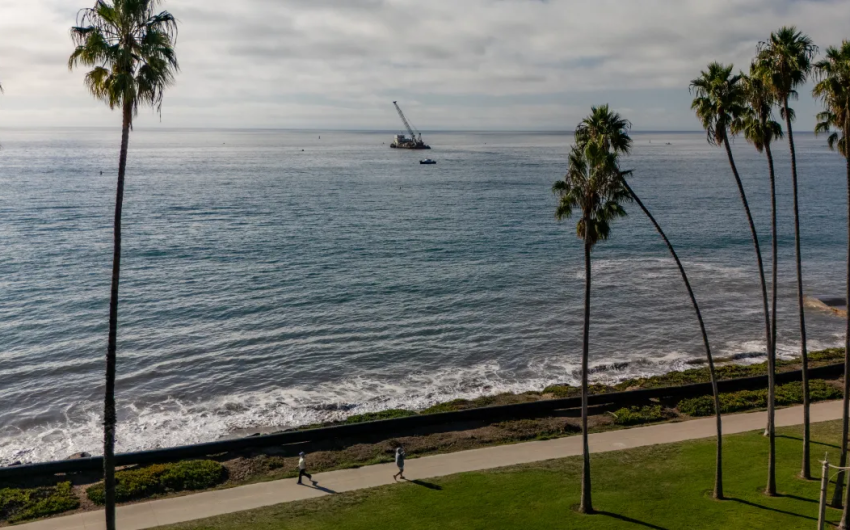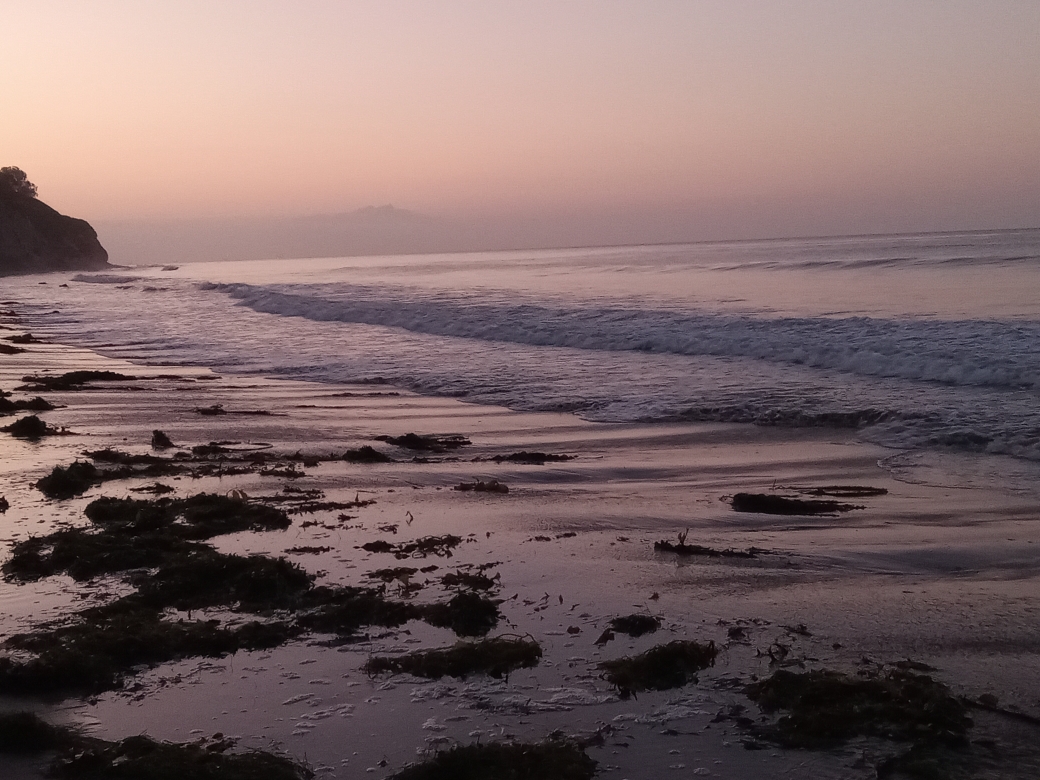
EARLY BIRD BLUES: As I looked out at the ocean, the stars sparkled overhead; dawn had not yet cracked. Day had not broken. And the waves were trying to calm me.
It almost worked. Then my brain kicked in.
Far to my left, I saw a line of five oil platforms twinkling almost as the stars. To my right, toward Goleta, the red lights of the airport towers blinked and the massive luminescence from UCSB glowed.
Normally, I’m a sucker for all this blinking and twinkling. But this morning, my brain was distracted with thoughts of Sable Offshore oil and its threatened big power play. What my brain saw — instead of this tranquil tableau — was 75 years of nonstop, bitter conflict between oil and Santa Barbara — both succinctly encapsulated right there.
UCSB and the airport were all part of a master plan launched way back in the early 1950s by the Santa Barbara’s business and political elites — rock-ribbed Republicans and a handful of prominent, if token, Democrats — to make the South Coast a regional powerhouse for a new smokeless Research and Development industry.
Back then, this was some serious visionary shit. The key word is “smokeless.” Translated, that meant “no offshore oil.” To this end, that same elite — names available upon request — convened a special meeting in Santa Barbara of the California Senate subcommittee with oversight on offshore oil development. The state senators were wined and dined and shown the sights. Very quickly, a bill was passed and signed by the governor banning any new offshore oil development in state waters along Santa Barbara’s coast.
My point here is that concern about offshore oil predates the now fabled Oil Spill of 1969 by about 15 years. It predates the infamous spill off the Gaviota Coast in 2015 by about 60 years. So, yes, oil is very much woven into Santa Barbara’s past. But so too is opposition to it.
Sable Offshore — a brand-new oil company run by very smart guys who seem intent on stepping on as many toes as possible — are now threatening to build a massive storage, processing, loading, and transport facility way out in federal waters if the myriad state agencies don’t hop to and give them what they want. That would be the permits needed to reactivate their three offshore platforms and the pipeline needed to get that oil to market. In some quarters, this is known as “the nuclear option.”
Given the current occupants of the White House, there’s little doubt Trump and company would jump at the chance. This, in turn, would force Governor Gavin Newsom off the sidelines, where he’s been since the battle over Sable began, to start supporting the state’s regulatory authority and to a lesser extent, the county of S.B.
My hunch is that Sable’s threat is an empty one. The cost of building such a facility — the environmental concerns being air pollution, tanker traffic, and the prospect of uncontrollable oil spills on the high seas — would be enormous. And it would push Sable’s optimistic production deadlines well past the breaking point.
Sable can moan about the political fix being in, but when the local DA files 21 criminal charges against you for doing work without permits, and a state agency fines you $18 million for being a dick, you might want to look in the mirror.
What mystifies me most about the company’s brass-knuckle approach is just how adroitly the executives now running Sable — Steve Rusch and Jim Flores, who were then working for a company called PXP — successfully negotiated an exceptionally controversial deal with local environmentalists back in 2008 to endorse an even more controversial plan to allow new drilling in state waters off the coast of Vandenberg.
A coalition of 40 enviro organizations held a press conference — I covered it — and announced that they were affirmatively endorsing the oil proposal. Why? Because PXP, through Rusch and Flores, promised to put 3,700 acres of undeveloped land into a preservation easement, set aside 200 acres of Gaviota Coast for public use, and to spend untold dollars on carbon-emission-control technology, such as low carbon public transportation buses. And they agreed to a drop-dead date to shut down oil drilling: 2022.
That proposal, it should be noted, blew up in everyone’s faces. The State Lands Commission torpedoed the plan, arguing the drop-dead date — perhaps the lynchpin to the deal — was not legally enforceable.
Things have changed. Climate change is no longer merely a theoretical threat; it’s right here, right now, chomping our collective asses. No sweeteners Sable offered would ever have won over Santa Barbara’s environmentally minded community. Accordingly, Sable made a strategic decision not to engage.
Understandable but wrong. The company still needed to convince us that the old, pitted, corroded pipeline could be repaired to a safe level, that future spills could be much better contained, and that the company had deep enough pockets to clean up any messes that will inevitably ensue.
Sable left all that to the State Fire Marshal, who famously engages with the public even less than Sable.
Bad call.
When I got back from the beach that morning, I looked up the word “sable.” If I got it right, “sable” is French for “black” — as in the color of some furs. It alludes in some indirect fashion to lots of dead animals, killed in the harvesting of fur.
Black? Dead animals?
Dawn cracks. The day breaks. And the stars will always sparkle. But who chooses a name like that for an oil company?