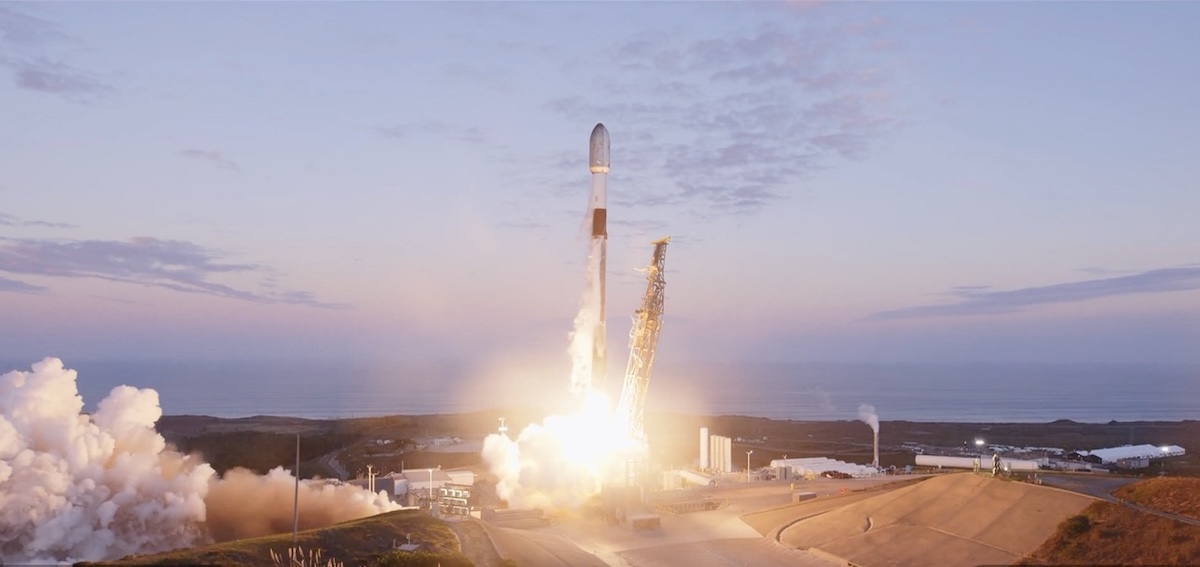
Over the objections of state regulators, the Department of the Air Force has approved SpaceX’s proposal to double its launch rate at Vandenberg Space Force Base from 50 launches a year to 100 and begin using a second launch pad for the company’s hulking Falcon Heavy rockets.
The newly announced record of decision (ROD) came after the Air Force released a final environmental impact statement about SpaceX’s proposed ramp-up of activities at Vandenberg. The Federal Aviation Administration, which licenses commercial launches, will now conduct its own analysis and issue “an independent ROD based on its conclusions,” Air Force officials said.
The Falcon Heavy, one of the world’s most powerful rockets, is composed of three reusable nine-engine cores that generate more than 5 million pounds of thrust at liftoff, equal to about eighteen 747 passenger planes. By mass, it is approximately three times larger than SpaceX’s Falcon 9 rockets that have been used at Vandenberg thus far.
The Air Force concluded that noise from launches and sonic booms “may cause annoyance to building occupants” in Lompoc — the community closest to the launch sites — but said the disruption would not have “significant impacts.”
The federal approval overrides opposition from the California Coastal Commission, which voted in August against the doubling of launches. “The commission lacks critical information necessary to determine whether the proposed project would be consistent with the enforceable policies of the [California Coastal Management Program] focused on the protection of sensitive marine and terrestrial species and habitats,” the commission’s staff report stated.
The Coastal Commission’s resistance, however, was all for not as the Air Force argued that launch operations at Vandenberg are a federal activity exempt from state oversight. State officials counter that the majority of SpaceX launches are commercial missions, including Starlink deployments for the private space company.