

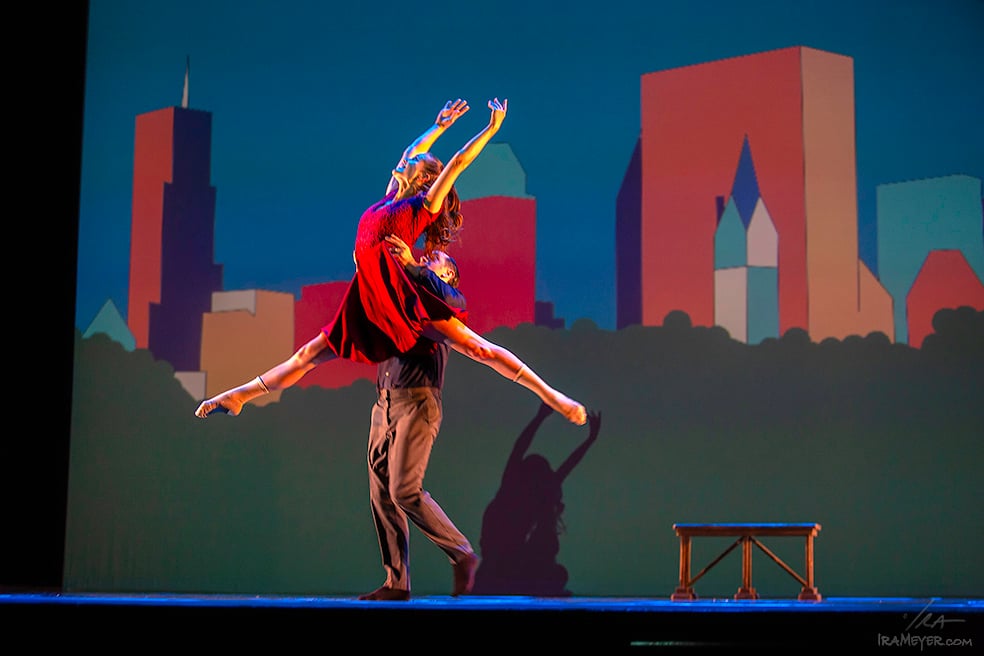
Inspired by Charles Dickens’ short story, “The Child’s Story,” about one man’s journey through his own life from childhood through old age, Humanity is a living gallery of one young woman’s journey as she dances her way through famous places in New York City, meeting the characters who inhabit each one.
Choreographed by Chloé Roberts and presented by Nebula Lab , Humanity is intended to be “an exploration of living one’s truth, being present, and celebrating our differences,” as described on their website. To me, it was simply a delightful excursion through various places in New York that I, as a native New Yorker, remember. I loved every scene, every nuance, and every clever twist in the show.
The sets were striking and playful, giving a hint of the neighborhoods in a very broad brush, cartoon-like, almost satirical way. I could recognize Grand Central Station, Times Square at Broadway and 7th Avenue, Little Italy, Central Park, and of course the Subway.
Rachyl Pines, who danced the leading role of the Girl in the Red Dress through the various New York neighborhoods, was nothing short of spectacular. As lovely as she was as the younger Malena in the recent Tango-Contemporary collaboration between Nomad Tango and Selah Dance Collective at the Lobero (see my review), in Humanity Pines showed her tremendous technical range. From her high extensions, to her flawless triple pirouettes, to her flexible and strong floor work and stunning lifts — always smiling too — she made it all look effortless. And who knew that she is also an expert on the silks! As Pines danced her way through the various neighborhoods of New York, the company met her with style, grace, and humor.
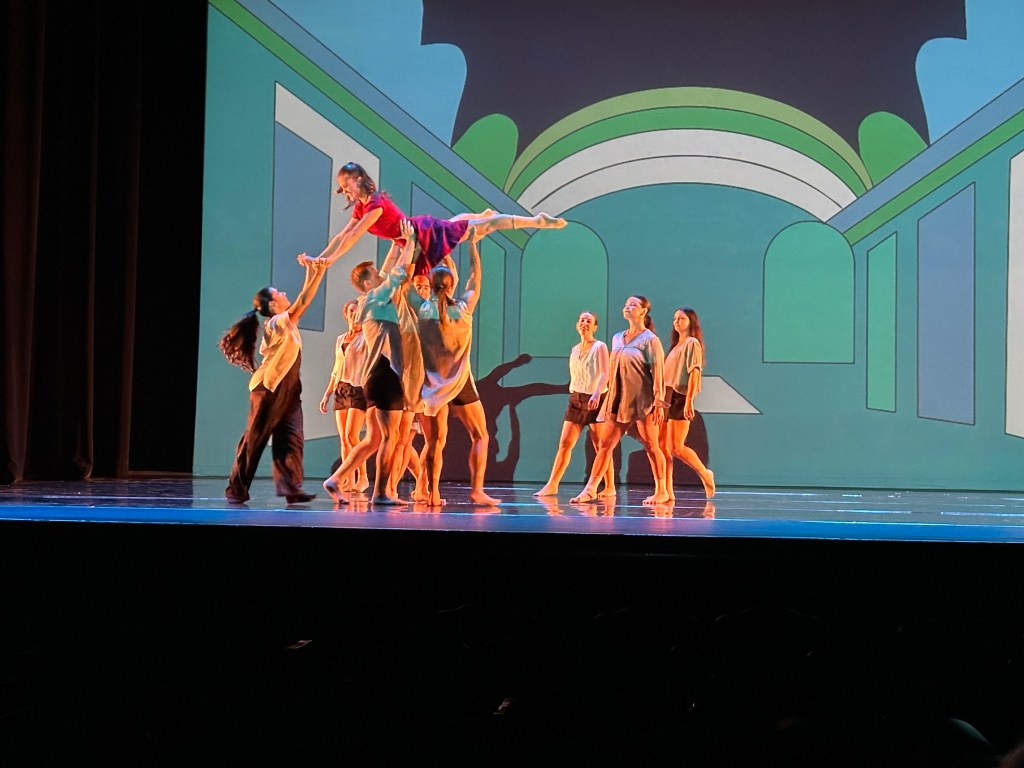
The music for Humanity provided a delightful soundscape which emphasized the various neighborhoods our heroine visited. The show opened in the iconic Grand Central Station, accompanied by George Gershwin’s luscious “Rhapsody in Blue.” Those drawn out opening notes of the clarinet remind me of waking up after a long night in the city that never sleeps, as the sun comes up over the East River.
In the next vignette we (the audience) find ourselves somewhere in Manhattan. To me the view looked like Park Avenue, south of Grand Central, looking north (uptown) towards the towering Pan Am building. The music for this scene was Ella Fitzgerald’s languid rendition of “Manhattan” from the 1956 Rodgers and Hart Song Book.
Next we hear the rumble of the subway (recorded live!) against a black backdrop, as the Girl in the Red Dress dives underground. From the viewpoint of someone from Santa Barbara, who did not grow up with the subway, it must seem strange to travel underground, but for New Yorkers it is the most natural and obvious way to get from place to place.
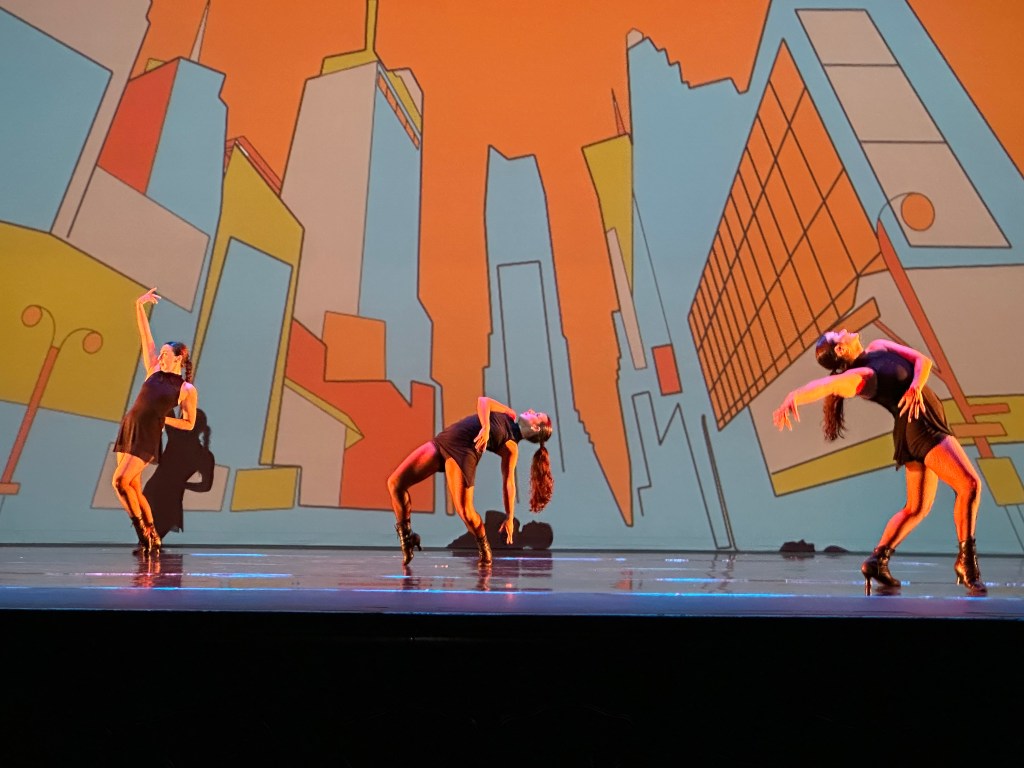
When Pines emerges from the dark subway tunnel, she finds herself in Little Italy. New York was home to various immigrant cultures from Eastern and Southern Europe in the late 1800’s and early 1900’s, who arrived at Ellis Island. My grandparents came from Ukraine and Poland during that time, settling in the Lower East Side of Manhattan. Immigrants settled in communities of people from similar regions; Little Italy was one such ethnic community which still survives today.
When The Girl in the Red Dress arrives in Little Italy, she is met by a company of playful, sexy servers in an Italian restaurant, accompanied by Aurelio Fierro’s delightful song, “A Pizza.” The flirtatious glances of the dancers, at each other and at the audience, while executing naughty hip circles, among other moves, made for a most charming and humorous piece.
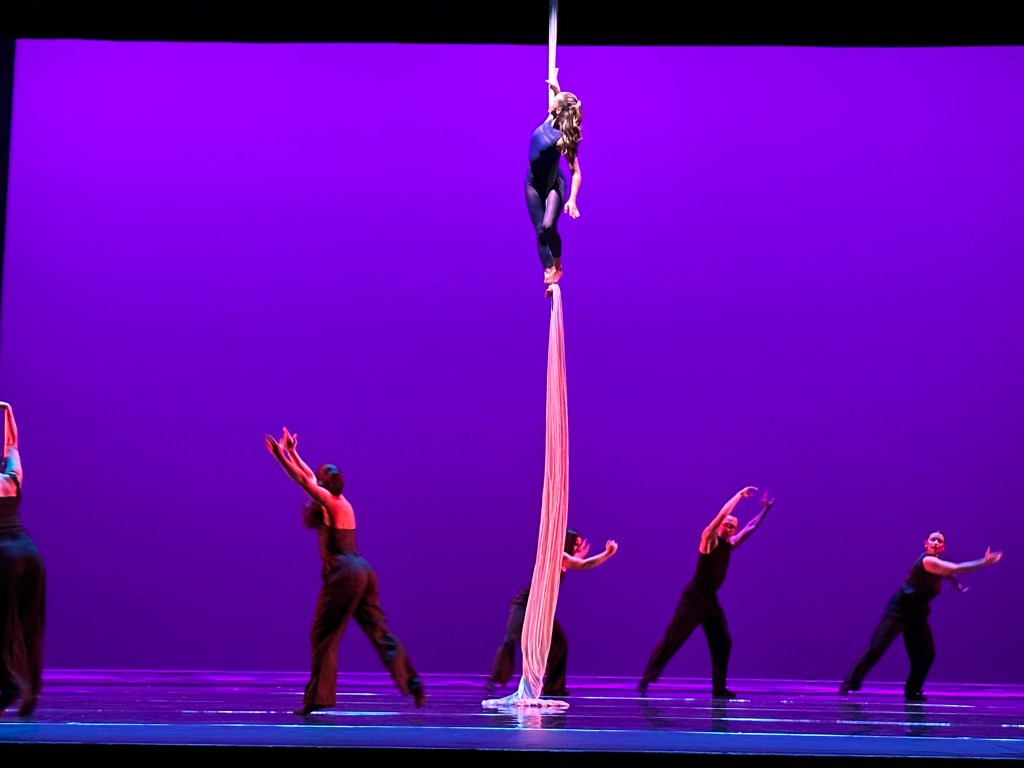
Among the highlights of the whole show was a surprise aerial performance by Pines set to a haunting, electronic-sounding piece called “New York” by Rufus du Sol. The whole company participated in this piece on the ground, while Pines climbed high above them, executing sudden, breathtaking drops, and climbing higher again.
Another highlight for me was the vignette Central Park. I spent many afternoons and weekends in the Park as a kid. Danced oh-so-sweetly by Pines and Nathan Burdine-Ortega to “The Man I Love” by George Gershwin, this section really captured the heart-space that Central Park holds for New Yorkers. In the midst of the bustling and deafeningly-loud Manhattan, where everyone is always in a hurry, taxi drivers constantly honk at pedestrians and other taxis, and the rumble of the subway shakes the avenues, the Park is a remarkably calm green zone where time stops, and one can truly escape the frenetic pace of the rest of the City. Roberts’ choreography for this charming pas de deux captured the essence of young love in the Park on a sunny, peaceful afternoon.
Deven Duex, Founder and Artistic Director of Nebula Dance Lab, explained that it was founded in 2010 to “provide an incubator for creative art in motion,” creating the opportunity for modern and contemporary artists to “experiment, push boundaries, and create new language in dance through physical exploration.” Nebula is a bicoastal company, with dancers and choreographers based in New York and Santa Barbara, who come together on one coast or the other to create works. Soon, she explained, most of the company will be relocating to New York, though she and three of the principal dancers will (thankfully!) still be based in Santa Barbara.

And if their dancing alone was not sufficiently spectacular, Nebula is a company after my own arts-and-sciences heart, with an astrophysics connection! Nebulae (plural of nebula) are vast regions of gas, mostly hydrogen, and dust in our galaxy, where new stars are forming. Nebulae don’t have clearly defined boundaries. The vast clouds are constantly evolving in response to gravitational and electrostatic forces and temperature gradients, as new stars are born. Duex chose to name her company Nebula Lab because of its intention not to be defined by boundaries, and to incubate new dance stars. I love it!
But, wait: There is more detail to their arts-science connection!
For eight years Nebula has produced a three-day festival called “HHII” in which they bring together professional companies and student artists from across California to present new work. I was curious about the name, because the term “H II” (H followed by Roman numeral II) refers specifically to star-forming nebulae rich in ionized hydrogen, which glow a characteristic magenta color (think Orion Nebula ).
Duex explained that HH stands for Herbig-Haro objects. Brilliant! Herbig-Haro objects, named for the first astronomers to study these objects in detail, are knots of gas and dust ejected at high speeds along the rotation axes of fast-spinning baby stars, colliding with the interstellar gas and dust. HH objects are sites where we can point to active baby stars that are having a measurable effect on their environments! Duex explained that she chose the name “HH 11” (eleven, not Roman numeral II) for the five HH objects labeled HH 7-11 located in the nebula NGC 1333.
One of Nebula Lab’s main objectives is to encourage and strengthen dance education in Santa Barbara. The company performed two matinees at the Lobero for busloads of school children, on the same day as their evening performance, free of charge. They also invited the senior student company from Santa Barbara Dance Arts to open the show with a new work, Headlock, choreographed by Roberts. The kids were tremendous. I was quite impressed with their professionalism.

We are so fortunate in Santa Barbara that, not only do we have so many opportunities to see professional dance companies, but there are numerous rich opportunities to nurture the next generation of performing artists. I am reminded of a quote from Cecily MacDougall, Executive Director of State Street Ballet regarding their Young Artists’ program: “To integrate emerging talent into a fully realized production [is] an essential bridge between learning and artistry.”
And, it was a real treat for the audience to have the Selah Dance Collective open the show, performing some of my favorite excerpts from Palermo!, by director/choreographer/scholar Meredith Ventura. Selah is one of the most interesting companies in Santa Barbara. Ventura’s work sits firmly at the crossroads of dance, history, and social commentary. If you have not yet gone up to UCSB to see her current exhibit, “Slide on the Razor,” highlighting her research into the rise of the Radical Cabaret in the early 20th Century, you absolutely must.
We wish Devyn Duex, Chloé Roberts and the artists of Nebula Lab great success and “merde” on their move to New York, the Dance Capital of the US. Be sure to follow them at nebuladance.org.
Related Posts





Premier Events

Mon, Mar 09
6:00 PM
Santa Barbara
ART 4 GRIEF Support Group

Sat, Mar 14
7:00 PM
Santa Barbara
Red, White, & Blues II: The American Songbook
Sun, Mar 15
3:00 PM
Santa Barbara
Red, White, & Blues II: The American Songbook
Sat, Mar 28
7:15 PM
Santa Barbara
Santa Barbara Stargazing Tour

Sat, Mar 14
1:00 PM
SANTA BARBARA
SBCC’s Science Discovery Day

Sat, Mar 14
1:00 PM
Santa Barbara
St. Patrick’s Day Irish Firedance

Sat, Mar 14
3:00 PM
435 State St, Santa Barbara, CA 93101
☘️ Santa Barbara St Patrick’s Day Bar Crawl & Block Party
Sat, Mar 14
7:00 PM
Santa Barbara
The Vada Draw
Sat, Mar 14
7:00 PM
Santa Barbara
Lights Up! Presents: “The Addams Family”
Sat, Mar 14
8:00 PM
Santa Barbara
Two-Prov Comedy Show!

Sat, Mar 14
8:00 PM
Santa Barbara
Soul Majestic and Selecta 7 Plus KnoLij Tafari

Sun, Mar 15
3:00 PM
Santa Barbara
Oscars 2026 Watch Party & VIP Reception

Tue, Mar 17
5:30 PM
Santa Barbara
SB Independent’s Annual St. Patrick’s Day Stroll 2026
Thu, Mar 19
6:00 PM
Santa Barbara
Chaucer’s Book Talk & Signing: Elizabeth Gilchrist
Mon, Mar 09 6:00 PM
Santa Barbara
ART 4 GRIEF Support Group
Sat, Mar 14 7:00 PM
Santa Barbara
Red, White, & Blues II: The American Songbook
Sun, Mar 15 3:00 PM
Santa Barbara
Red, White, & Blues II: The American Songbook
Sat, Mar 28 7:15 PM
Santa Barbara
Santa Barbara Stargazing Tour
Sat, Mar 14 1:00 PM
SANTA BARBARA
SBCC’s Science Discovery Day
Sat, Mar 14 1:00 PM
Santa Barbara
St. Patrick’s Day Irish Firedance
Sat, Mar 14 3:00 PM
435 State St, Santa Barbara, CA 93101
☘️ Santa Barbara St Patrick’s Day Bar Crawl & Block Party
Sat, Mar 14 7:00 PM
Santa Barbara
The Vada Draw
Sat, Mar 14 7:00 PM
Santa Barbara
Lights Up! Presents: “The Addams Family”
Sat, Mar 14 8:00 PM
Santa Barbara
Two-Prov Comedy Show!
Sat, Mar 14 8:00 PM
Santa Barbara
Soul Majestic and Selecta 7 Plus KnoLij Tafari
Sun, Mar 15 3:00 PM
Santa Barbara
Oscars 2026 Watch Party & VIP Reception
Tue, Mar 17 5:30 PM
Santa Barbara
SB Independent’s Annual St. Patrick’s Day Stroll 2026
Thu, Mar 19 6:00 PM
Santa Barbara



You must be logged in to post a comment.