


Lending a personal and present tense touch to last week’s screening of the famous/infamous 1976 film Heaven’s Gate at the Arlington Theatre, Jeff Bridges showed up for a pithy introduction, joined by his wife Susan. A decent size crowd took cover from the rain to soak in Michael Cimino’s epic neo-western — uncut and the way the auteur intended it — and also to catch a public sighting of the Montecito-based “dude,” who was 30 at the time of the film’s shooting.
The Bridges kept the intro short. Susan urged folks to visit her fascinating photography exhibition in the nearby Tamsen Gallery, with artful images shot on location during the production, and noted that this is “a very timely film,” given its theme of extreme xenophobia and cruelty to immigrants. Jeff commented, “I’m not going to talk about the film. That’s the way I like to see a movie — without knowing anything about it beforehand and just letting it wash over me.”
There is much to wash over with Heaven’s Gate, in which appreciation of its filmic virtues — of which there are many — can be clouded over by its reputation as an indulgent disaster gone way over budget while tanking at the box office and with critics. A prevailing sentiment was that Cimino, given relative carte blanche after the success of his masterpiece Deer Hunter, let his massive ego write checks that the presumably bloated movie could never cash.
More grandly, the film is also considered partly responsible for sinking his studio sponsor United Artists and closing the door on artist-powered creativity versus the old school studio system. As a film, Heaven’s Gate has fared much better in time and especially in the uncut version, but it can be amusing to revisit reviews from the time of its release. As New York Times writer Vincent Canby quipped, “Nothing in the movie works properly. For all of the time and money that went into it, it’s jerry-built, a ship that slides straight to the bottom at its christening.”
But enough about the backstory and bad juju surrounding the film. What we saw in the Arlington was a flawed but idiosyncratically original and effectively atmospheric film, perhaps a kinfolk to the rustic historical texture of McCabe and Mrs. Miller, with a lot more violence and screen time and less artistic focus.
Cimino’s epic is loosely based on the late 20th century, tragically true saga of the “Johnson County War,” in which Wyoming landowners and cattle barons abused and even pursued death sentences for and declared war on immigrant homesteaders. In the film’s impressionistic purview, the bowler-hatted Bridges plays a saloon keep, Isabelle Huppert is a brothel keep, and Kris Kristofferson plays the day-saving hero to Sam Waterston’s despicable villain.
For a film so unshy about the wanton display of violence, in brief bursts and then a long carnage-filled battle scene at the end, Heaven’s Gate is surprisingly lyrical. That quality enhances the sense of languid pacing: The film takes its time and draws the willing among us into its tempo. (Not that it can be compared to a time-elasticizing classic like the supra-minimalist Chantal Akerman’s four-hour Jeanne Dielman, 23 Quai du Commerce, 1080 Bruxelles — deemed the “greatest film of all time” in the latest Sight & Sound list.)
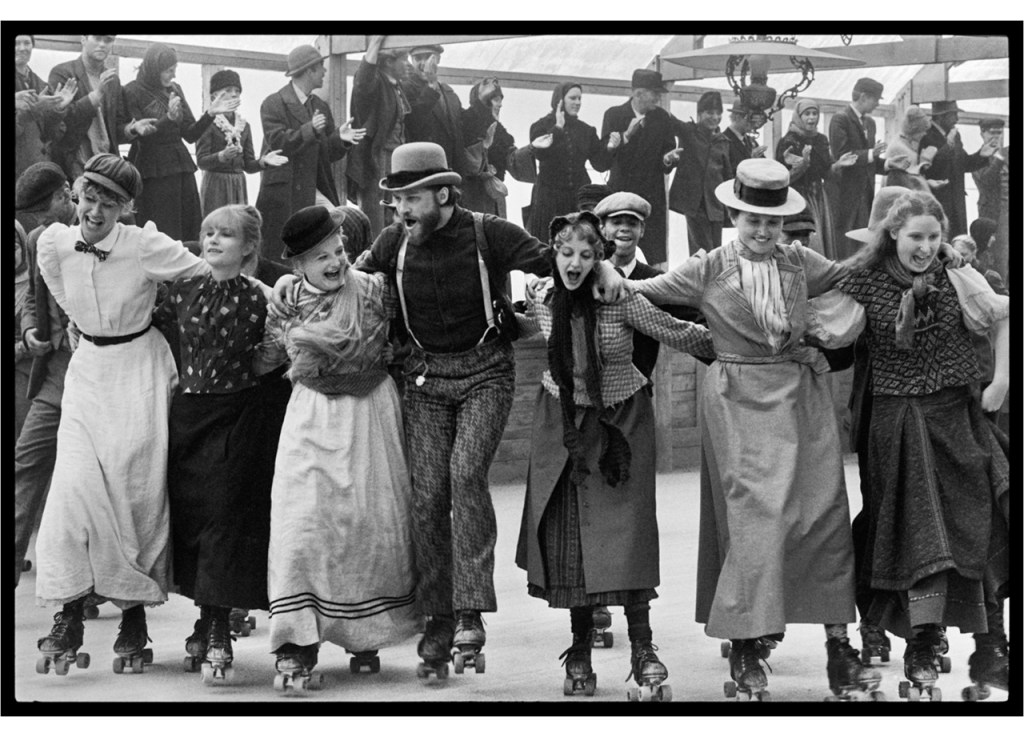
With Heaven’s Gate, what lingers in the memory are such tender elements as the romantic three-way equation between the free-spirited Huppert, Kristofferson, and Christopher Walken — the latter two with laconic personalities to suit the film’s leisurely pace. Other treasured moments occur in the ballroom/meetin’ room — actually called “Heaven’s Gate,” in reality and on film — where the town folk gleefully dance to David Mansfield’s contra dance band (with the late Stephen Bruton and T-Bone Burnett in the mix), and the dreamy slow waltz on roller skates in an emptied room by Huppert and Kristofferson. (How is Kristofferson’s acting? Let’s just say he’s an excellent songwriter.)
In a way, the most effectively engaging passage of the film arrives in its earliest moment, with the cinematic, sensorial sweep of a Harvard graduation circa 1870. It’s a telling preamble to the horror show which would unfold once these starry-eyed graduates land in a real and turbulent world and a troubled frontier decades later, as they wrestle with, as the reverend doctor played by Joseph Cotten describes as, “contact of the culture with the uncultured.” Culture and civilization become fragile, semi-doomed concepts.
After taking in the full measure of Heaven’s Gate, it was especially rewarding to then saunter a few doors down State Street to appreciate Susan Bridges’ fascinating current exhibition, Inside Heaven’s Gate: Behind the Scenes. She was a student photographer, with an obviously keen and sharp eye for portraiture and photographic “scene painting” when she visited the storied film set in Wallace, Idaho in 1979.
Decades later, her negatives survived the Northridge earthquake — after which the Bridges family emigrated up the highway to Montecito — and the Thomas fire and debris flow, which had a devastating impact on the family estate.
Fittingly for the grand expanse of the location and filmic theme, she used a Widelux panoramic camera for some images, such as a large photo of the lavishly-rebuilt and period-specific town of Wallace, and the spacious ambience of “Ghost Walkers in Heaven’s Gate.” That reimagined space, actually run by Jeff’s ancestor John Bridges in the 19th century, comes to life with its vision of the roller-skating fiddler Mansfield. In another image, Jeff is flanked by a row of female dancer-skaters in the room.
Her portraits glow with a sensitive eye for detail and character — with subjects as themselves as “in character.” “The Lovely Huppert” speaks truth with its title, and she evokes an authentic-ish still life period piece vignette with “Jarlath Conroy, the man in the New Suit.” Bridges also asserts sympatico with the film’s camera wielders, especially the legendary cinematographer Vilmos Zsigmond. And look, there’s a shot of Jeff as horseback-ridin’, rifle-totin’ and, elsewhere, buddying up with his virtual lookalike Kristofferson, suggesting they are brothers from other mothers.
Another family connection shows up with an overhead overview shot of the “Hog Ranch,” the log cabin brothel presided over by Huppert’s character. The actual “ranch” buildings were gifted to the Bridges by Cimino, dismantled and rebuilt on their own property. They live there today, a slice of history both genuine and movie-magical.
Ditto, Heaven’s Gate, available in the in-home streaming world and, on special occasions, in the deserved limelight of a big screen, uncut outing.
Info on the Tamsen Gallery here.
Related Posts

Premier Events

Fri, Mar 06
2:00 PM
Santa Barbara
Music & Meditation SB – Concert March 6, 2026

Sat, Mar 07
9:00 AM
Carpinteria
El Carro Park Cannabis Career Fair – Carpinteria

Sat, Mar 07
10:00 AM
Santa Barbara
2-Day Expressive Painting Creative Workshop

Sun, Mar 08
6:30 PM
Santa Barbara
6th Eco Hero Award Brock Dolman & Kate Lundquist

Mon, Mar 09
6:00 PM
Santa Barbara
ART 4 GRIEF Support Group
Fri, Mar 06
7:30 PM
Santa Barbara
An Evening with Steep Canyon Rangers

Fri, Mar 06
8:00 PM
Santa Ynez
Funk Band Kool & The Gang at Chumash

Mon, Mar 09
6:30 PM
Santa Barbara
Science Pub: Cyborg Jellies Exploring Our Oceans

Sat, Mar 28
All day
Santa Barbara
Coffee Culture Fest
Fri, Mar 06 2:00 PM
Santa Barbara
Music & Meditation SB – Concert March 6, 2026
Sat, Mar 07 9:00 AM
Carpinteria
El Carro Park Cannabis Career Fair – Carpinteria
Sat, Mar 07 10:00 AM
Santa Barbara
2-Day Expressive Painting Creative Workshop
Sun, Mar 08 6:30 PM
Santa Barbara
6th Eco Hero Award Brock Dolman & Kate Lundquist
Mon, Mar 09 6:00 PM
Santa Barbara
ART 4 GRIEF Support Group
Fri, Mar 06 7:30 PM
Santa Barbara
An Evening with Steep Canyon Rangers
Fri, Mar 06 8:00 PM
Santa Ynez
Funk Band Kool & The Gang at Chumash
Mon, Mar 09 6:30 PM
Santa Barbara
Science Pub: Cyborg Jellies Exploring Our Oceans
Sat, Mar 28 All day
Santa Barbara


You must be logged in to post a comment.