Floods, fires, debris flows, and sea-level rise were on the minds of the Board of Supervisors on Tuesday. In a 3-2 vote, the board adopted a resolution to support the California Polluters Pay Climate Superfund Act, which calls on fossil fuel companies to foot the bill for climate damages.
Oil and gas operations produced more than one billion tons of greenhouse gas pollution in California between 1990 and 2024, according to the Center for Biological Diversity, one of the bill’s sponsors. These emissions trap heat in the atmosphere, raising global temperatures and resulting in various consequences, including more frequent and intense natural disasters.
Supervisor Joan Hartmann noted during the hearing that disaster losses average out to about $150 billion a year in the United States. The county needs to start thinking about the price tag on community resilience, she said.
“These are huge, huge costs,” she continued. In Santa Barbara County, she added, “We’ve gotta protect harbors, wastewater plants, and low-lying roads … it’s not cheap. We need to find a way that these costs aren’t just thrown onto the public and local government.”
The two bills associated with the Superfund Act — Senate Bill 684 and Assembly Bill 1243 — would require fossil fuel companies to provide relief to taxpayers, especially those in areas affected by recent natural disasters.
Approximately 40 percent of funds collected through the act would go to communities disproportionately affected by climate change, according to the advocacy group Climate First: Replacing Oil & Gas.
Santa Barbara County residents and environmental advocates filled the board room with messages in support of the resolution. They recounted the county’s history of disasters — wildfires, floods, oil spills — which have taken lives and mucked up the environment. They warned that the risk of wildfires, extreme weather, and sea-level rise are only growing, nurtured by the climate crisis and likely to result in more lives lost and billions in damages.
Under the act, the state would calculate climate damages through 2045 and assess compensatory fees from producers and refiners, which would be proportional to their greenhouse-gas emissions over the last 35 years. Fees would go into a new fund for remedying climate-driven disasters.
Many speakers during Tuesday’s hearing emphasized that fossil fuel companies should have to use some of their profits to mitigate these past, present, and future impacts.
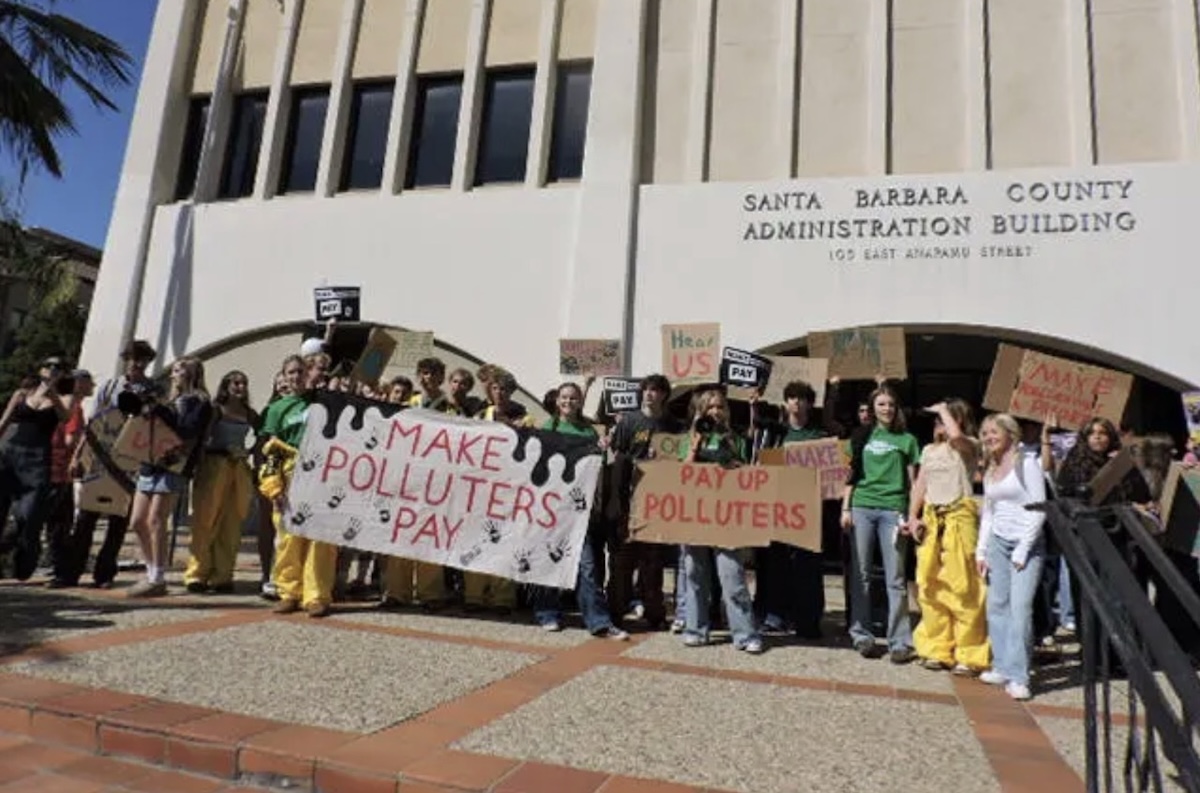
In November, more than 60 Santa Barbara High School students walked out of class in support of the Climate Superfund, to “make polluters pay” and “give us back our future,” as the students chanted that day. Some students spoke at Tuesday’s meeting. “Among our chants … was one I want to highlight; ‘We are unstoppable; a better future is possible,’” reiterated Ethan Maday, the student who organized the walkout.
The board voted 3-2 in favor of the resolution— with supervisors Bob Nelson and Steve Lavagnino voting “no.” Lavagnino noted that the county, starting in 1987 and up until last year, had a history of offshore oil producers paying into a fund to help the county buy and preserve coastal lands, called the Coastal Resources Mitigation Fund. He questioned the idea of retroactively charging the oil industry for past actions that were permitted and legal at the time they did them.
Senate and Assembly representatives need to vote on SB 684 and AB 1243 by January 2026. If that does not happen, the bills may be reintroduced by the authors in the next legislative session.
With Tuesday’s resolution, Santa Barbara County joins more than 20 other local governments in showing support for the legislation.