
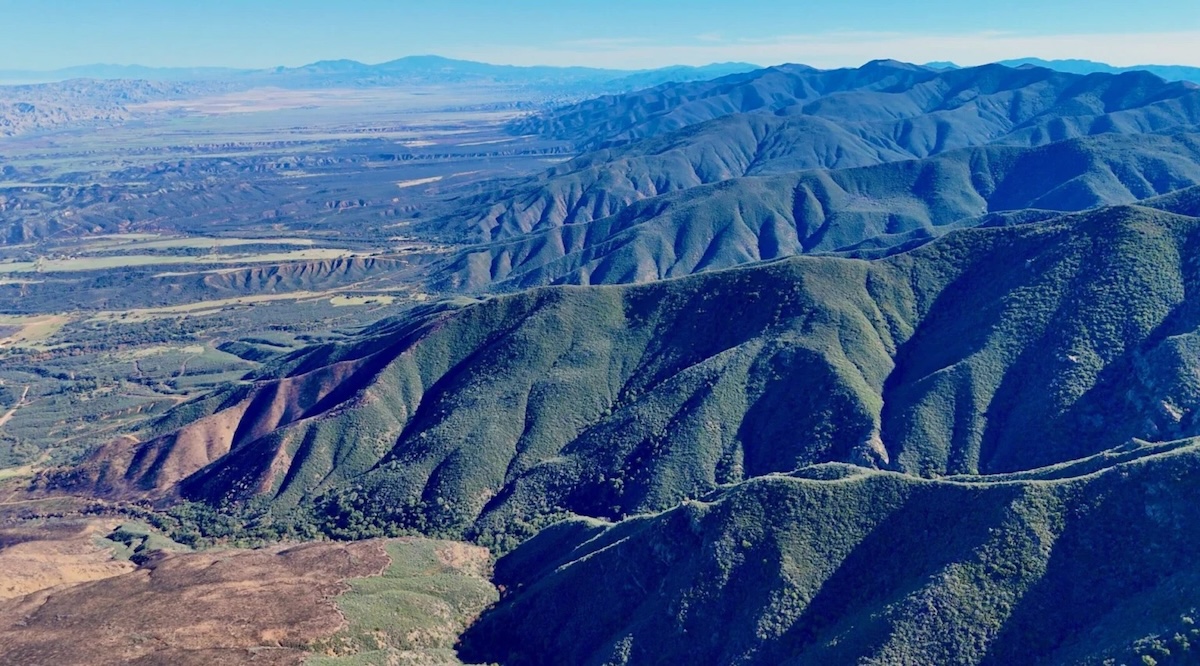
The Bureau of Land Management (BLM) is proposing to open roughly 850,000 acres across Central California to new oil drilling and fracking, nearly half of which are public lands, including parks, beaches, and wildlife habitat, the agency announced this month.
Environmental groups were quick to bang the war drum, warning that sensitive areas are in the line of fire. Among them are a 40-acre parcel located within 2,000 feet of Cate School in Carpinteria, a 42-acre public park in Lompoc, and land bordering Lake Cachuma.
The outcry follows the BLM’s release of an updated study — a Draft Supplemental Environmental Impact Statement (SEIS) — which maps out where oil and gas development could occur and assesses its potential impacts.
With the SEIS now released, the BLM is on track to approve its drilling and fracking plan later this year. Public input is being accepted during a limited comment period, which closes March 6.
Potential Impacts
According to the BLM, new oil and gas development would do no significant harm to the environment.
Environmental groups, however, beg to differ. Drilling negatively impacts air quality, pollutes drinking water, gunks up the environment, and when close to populated areas, can lead to birth defects, asthma, and cancer, they note.
“Of course they [the BLM] say there’s no impact, because they’ve never really taken a serious look,” at related risks, said Benjamin Pitterle, director of advocacy with Los Padres ForestWatch.
He charged that the agency has not analyzed what new drilling could do to water supplies or how it could fragment wildlife habitat. It also neglected the potential climate consequences of “locking in fossil fuel development when California is trying to phase out oil and gas.”
“At some point,” he continued, “this starts looking like a rubber stamp for turning public lands into private industrial sites.”
The BLM’s proposal itself — to open Central California to new drilling — is now more than a decade old, but it has been repeatedly challenged and suspended over the years.
Conservationists argued in court that the original proposal did not sufficiently analyze the impacts of fracking activities. They successfully sidelined the project, but it was revived during Trump’s first term in office. It was then legally challenged again, including in a lawsuit by the State of California, which again resulted in the requirement for a more comprehensive analysis.
After remaining dormant during the Biden administration, the Trump administration released the updated SEIS last week, attempting to push the proposal forward once again to expand oil development as part of an agenda to “Unleash American Energy.”
The BLM said it supports the president’s call to increase energy exploration and production on federal lands “in an affordable and reliable manner.”
However, for the third time in a row, BLM came back with the exact same proposal, with a laundry list of insufficiencies, Pitterle said.
“Even today, with the release of this new document, the BLM has never seriously evaluated a single alternative that would reduce the footprint of oil development to minimize impacts to public health and the environment,” Pitterle said.
It also undermines progress made by the state of California to ban and restrict new oil and gas development and move toward cleaner energy sources, he noted.
To bolster Trump’s efforts, the federal Department of Justice filed a complaint challenging California’s 2022 health buffer zone law, SB 1137, which prevents new oil drilling within 3,200 feet of sensitive areas, including schools, homes, hospitals, and churches.
Environmental groups are calling it the latest tactic to further Trump’s “Drill Baby Drill” agenda.
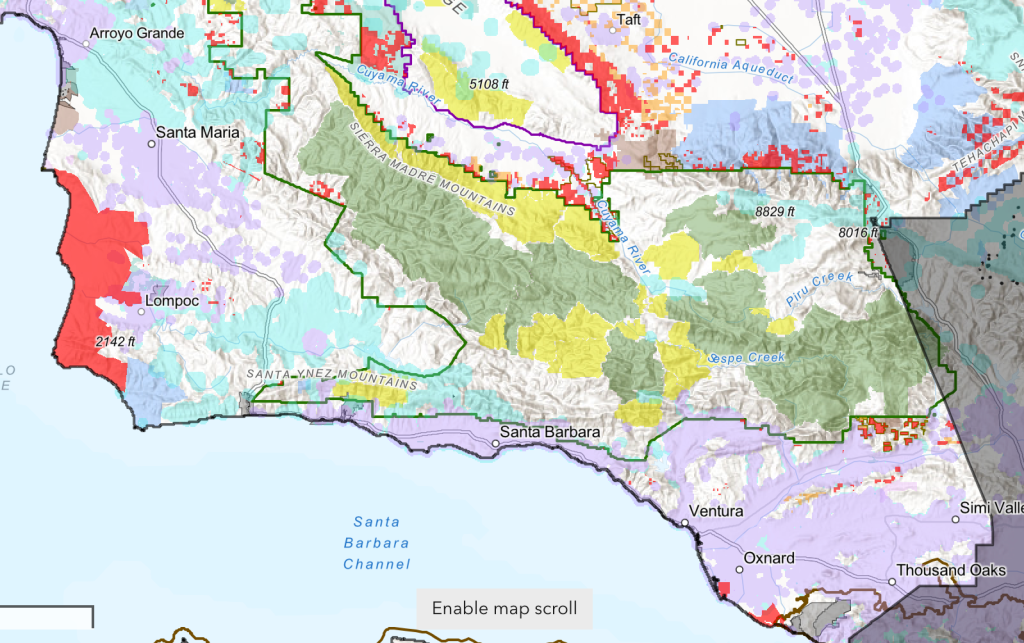
ForestWatch released a map showing exactly where the BLM’s proposed lands for new oil and gas leasing directly overlaps with verified health protection zones — those homes, schools, and hospitals. For reference, the City of Santa Barbara, in its entirety, is considered one of these zones.
Across California, there are 40,000 acres of health protection zones at risk of new oil and gas development.
In Santa Barbara County, that includes a large swath of land near the Santa Ynez River in Lompoc, as well as spaces in Carpinteria and further south in the Sea Cliff neighborhood.
Environmental groups have vowed to fight to protect the law. They have done so in the past, beating back attempts by oil companies in 2024 to reverse the law with a failed referendum.
“Attempting to block the law that protects the air we breathe and the water we drink from oil industry pollution is the Trump administration’s latest attack on our state,” said Kassie Siegel, director of the Center for Biological Diversity’s Climate Law Institute, in a statement.
“This is a last-ditch attempt to overturn the law’s critical health protections. I’m confident this historic law will stand.”
Old Oil
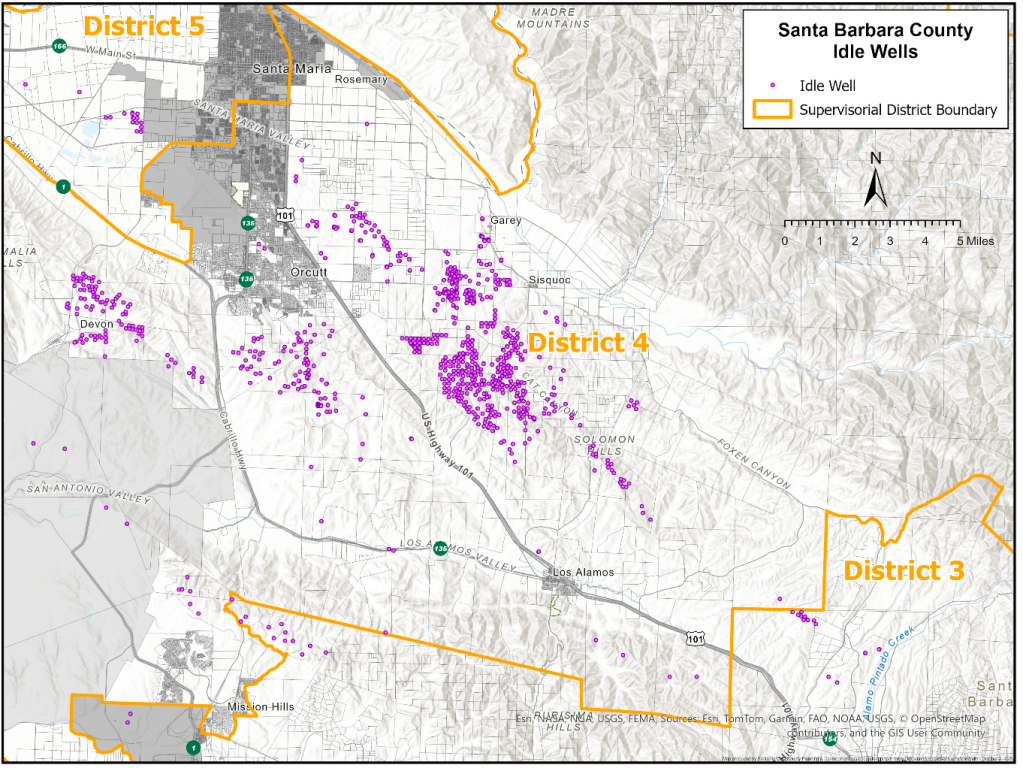
Meanwhile, idle oil wells already litter the county’s landscape. While some have been properly plugged and abandoned — as in sealed off and closed — others are “orphaned,” meaning they have no active operator to take responsibility for cleaning them up.
Countywide, 1,039 wells are active and 1,221 are inactive, and 3,663 older wells have already been plugged and abandoned.
Idle and orphan wells can leak oil, emit greenhouse gases, and pose physical hazards, the county said in an October report to the Board of Supervisors. And if a well is not properly sealed and closed, its contaminants can pollute drinking water.
New legislation, authored by Assemblymember Gregg Hart of Santa Barbara, was passed in 2024 to help deal with the unkempt leftovers of California’s oil legacy.
Building on stricter idle well cleanup regulations created by the California Geologic Energy Management Division (CalGEM) in 2019, Assembly Bill 1866 required operators to prioritize wells for cleanup based on their age and risks to public health and the environment. It also increased abandonment requirements and annual penalty fees for wells left idle and unplugged.
However, CalGEM reported that about 1,085 operators statewide failed to pay fees or submit valid Idle Well Management Plans — a commitment to gradually eliminate inactive wells — by last year’s deadline, making them noncompliant with AB 1866, including several in Santa Barbara County.
Countywide, 32 operators are responsible for the region’s idle wells. Of those, 11 have approved Idle Well Management Plans covering 472 wells, with 114 scheduled for abandonment within the next eight years. The remaining 22 operators are presumed noncompliant with AB 1866.
And of the county’s orphan wells, which are overseen by CalGEM’s Oil and Gas Well Abandonment Program, 172 have been formally abandoned to date, with the state prioritizing those that are at higher risk of leaking or are located near sensitive areas.
But 189 orphans are still waiting to be sealed. These are tied to HVI Cat Canyon, a bankrupt former Greka subsidiary, and Angel Petroleum, a non-responsive operator.
Only 82 of those wells have financially solvent former operators — Chevron and California Resources Corporation — who could be required to reimburse the state for cleanup costs. But the remaining 107 will need to be abandoned by CalGEM when funding becomes available.
Those wells are included in the state’s Abandonment Expenditure Plan and will be addressed as funds allow, said Errin Briggs, the county’s deputy director of Energy Minerals & Compliance. Although the county bears no legal or financial responsibility for orphan wells, the County Petroleum Unit inspects them annually for health and safety.
Roughly 85 percent of idle wells are located in Santa Barbara County Supervisor Bob Nelson’s district, which covers Vandenberg Space Force Base, Santa Maria, Orcutt, and surrounding areas stretching into Los Padres National Forest. Nelson said last week that one well in Santa Maria was being capped and that crews are close to sealing the remaining two wells in Orcutt.
Nelson supports removing leaky old wells from sensitive areas but noted that in some cases, oil fields predated nearby development, so oil companies should not shoulder all the blame.
He advocated for local solutions, including working with oil companies to plug old wells, potentially in exchange for permission to drill new ones. One new well, he suggested, could replace four or five older wells, reducing environmental risks while preserving jobs. The rest of the board was reportedly not receptive to that approach.
“Hopefully new tech will one day solve some of this, but it’s still a big part of my economy right now — it’s giving people jobs,” he said. “It’s part of my community that I’m trying to protect.”.
State budget documents estimate that plugging a single idle well in California costs between $220,000 and $900,000. A 2023 Carbon Tracker report put the total cost of cleaning up all the state’s oil sites at as much as $21.5 billion. Meanwhile, oil production in California has declined more than 70 percent since 1985.
“We’re still dealing with the legacy of historic oil development that’s never been fully cleaned up,” Pitterle said. “And they [the BLM] want to open up almost a million acres on new land.”
The agency will receive public comments on the proposed management updates until March 6, and a public hearing will be held on February 3. Click here to register for the hearing, and see forestwatch.org/stop-oil for information on how to submit public comments.
Related Posts







Premier Events

Mon, Mar 09
6:00 PM
Santa Barbara
ART 4 GRIEF Support Group

Sat, Mar 14
7:00 PM
Santa Barbara
Red, White, & Blues II: The American Songbook
Sun, Mar 15
3:00 PM
Santa Barbara
Red, White, & Blues II: The American Songbook

Mon, Mar 09
6:30 PM
Santa Barbara
Science Pub: Cyborg Jellies Exploring Our Oceans

Thu, Mar 12
6:00 PM
Santa Barbara
Poetry, Typewriters, and Collage Workshop

Thu, Mar 12
6:30 PM
Santa Barbara
An Evening of Wild Hope: PBS Film Screenings

Thu, Mar 12
7:00 PM
Santa Barbara
Lights Up! Presents: “The Addams Family”

Fri, Mar 13
6:00 PM
Santa Barbara
GLOW X: A High-Definition Neon Experience

Fri, Mar 13
7:00 PM
Goleta
Peace Event
Sat, Mar 14
7:00 PM
Santa Barbara
The Vada Draw
Sat, Mar 14
7:00 PM
Santa Barbara
Lights Up! Presents: “The Addams Family”

Sat, Mar 28
All day
Santa Barbara
Coffee Culture Fest
Mon, Mar 09 6:00 PM
Santa Barbara
ART 4 GRIEF Support Group
Sat, Mar 14 7:00 PM
Santa Barbara
Red, White, & Blues II: The American Songbook
Sun, Mar 15 3:00 PM
Santa Barbara
Red, White, & Blues II: The American Songbook
Mon, Mar 09 6:30 PM
Santa Barbara
Science Pub: Cyborg Jellies Exploring Our Oceans
Thu, Mar 12 6:00 PM
Santa Barbara
Poetry, Typewriters, and Collage Workshop
Thu, Mar 12 6:30 PM
Santa Barbara
An Evening of Wild Hope: PBS Film Screenings
Thu, Mar 12 7:00 PM
Santa Barbara
Lights Up! Presents: “The Addams Family”
Fri, Mar 13 6:00 PM
Santa Barbara
GLOW X: A High-Definition Neon Experience
Fri, Mar 13 7:00 PM
Goleta
Peace Event
Sat, Mar 14 7:00 PM
Santa Barbara
The Vada Draw
Sat, Mar 14 7:00 PM
Santa Barbara
Lights Up! Presents: “The Addams Family”
Sat, Mar 28 All day
Santa Barbara


You must be logged in to post a comment.