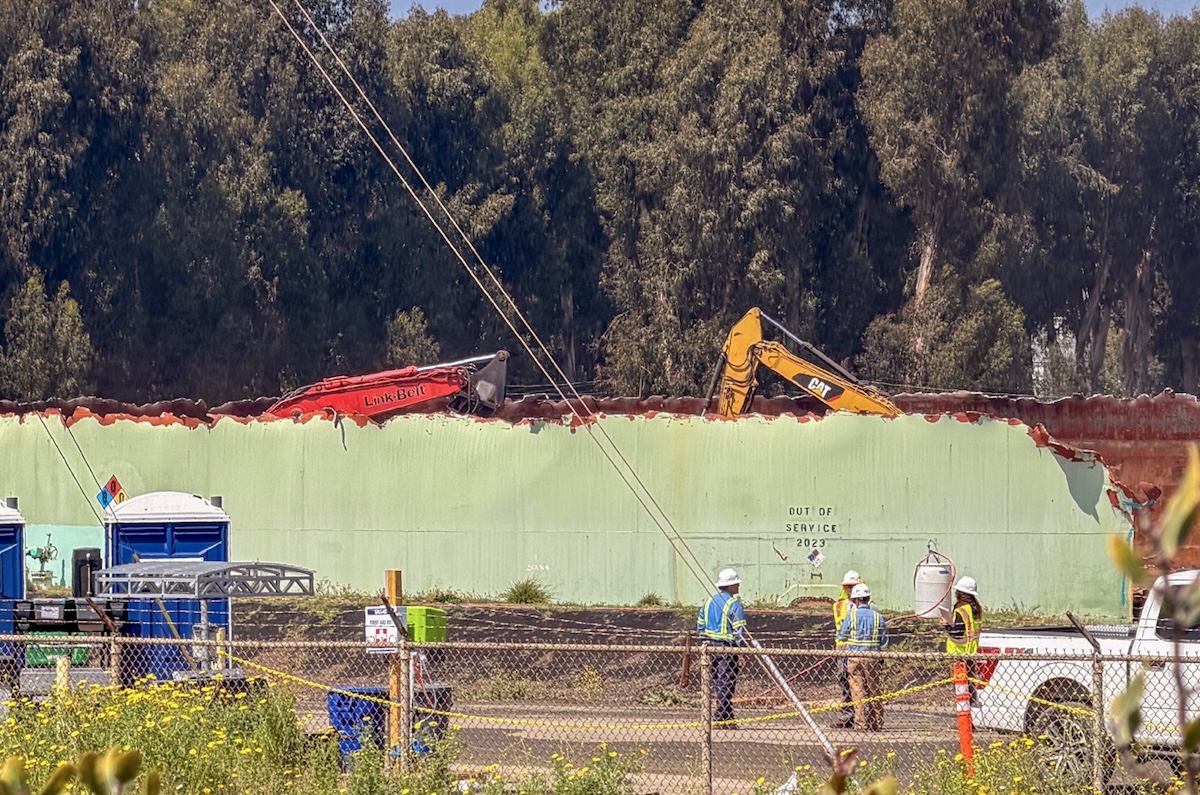
After about six years of permitting and paperwork, Chevron is in the process of decommissioning the Carpinteria Processing Facility, which has been standing since the 1960s. Over the course of about three years, the inactive oil and gas infrastructure will be removed, and the land will be restored to a residential standard.
Originally, the facility received oil from platforms Hilda, Hazel, Hope, and Heidi (all decommissioned in 1996). In 1988, when Venoco acquired the leases, the plant also received oil from platforms Grace (decommissioned 1998) and Gail (currently plugged and abandoned). The plant once processed 4,602 barrels of oil and 3,700 thousand standard cubic feet of gas per day, according to the City of Carpinteria.
After 2015’s Refugio Oil Spill effectively shut down offshore oil production across Santa Barbara County, Venoco gave up their leases in 2017 and subsequently declared bankruptcy, leading Chevron to take back ownership of the property. In 2019, Chevron submitted their first draft application for decommissioning to the City of Carpinteria and got the go-ahead in January 2026 to start taking apart the facility.
The Carpinteria Processing Facility is surrounded by sensitive environments: to the north is City Hall; to the east is Tee Time Practice Center and a farm; to the south is the Carpinteria Seal Sanctuary, where seals come to give birth to their young; and to the west is a residential neighborhood, including a preschool. There is also a high likelihood that cultural Chumash artifacts will be found during the process of decommissioning.
“Balancing all these sensitive receptors and understanding how to operate safely and responsibly amongst all of that has been a pleasure for our team to do and execute,” said Mark Korte-Nahabedian, Chevron’s Corporate Affairs Advisor for the West Coast Decommissioning Program.
There is active air quality and sound monitoring in place, as well as around 1,600 soil probes installed to help to determine the best ways to restore the land.
The most dramatic demolition currently taking place is the removal of Tank 861. Standing at 50 feet tall and 189 feet in diameter, the tank is quickly being cut apart and the steel is being recycled.
Future plans for the site are still up in the air. The City of Carpinteria in their March 2026 draft Coastal Land Use Plan categorized the property as “Planned Unit Development,” which is defined as “underutilized parcels that are intended primarily for residential use but would also be appropriate for recreation, limited commercial uses, and open space.”