
He was working the graveyard shift, patrolling the streets of Santa Barbara in the early 2000s when the call came in — an injury traffic collision. Dispatch said it was bad.
Three young adults, around 20. The driver had been drinking. The car had been traveling at least one hundred miles an hour toward the intersection of Modoc Road and Las Positas when he lost control. It rolled. And rolled. And kept rolling.
Traffic collisions are among Sergeant Mike McGrew’s least favorite calls. They are, as he puts it, “chaos — one we are meant to bring order to,” despite the fact that officers arrive with little more than basic first-aid kits in the trunks of their patrol cars.
When he reached the wreckage, he saw an arm hanging from the rear door of what was left of the vehicle. The passenger in the front seat was dying. “I just knew he was dying,” McGrew said. “He died right there.”
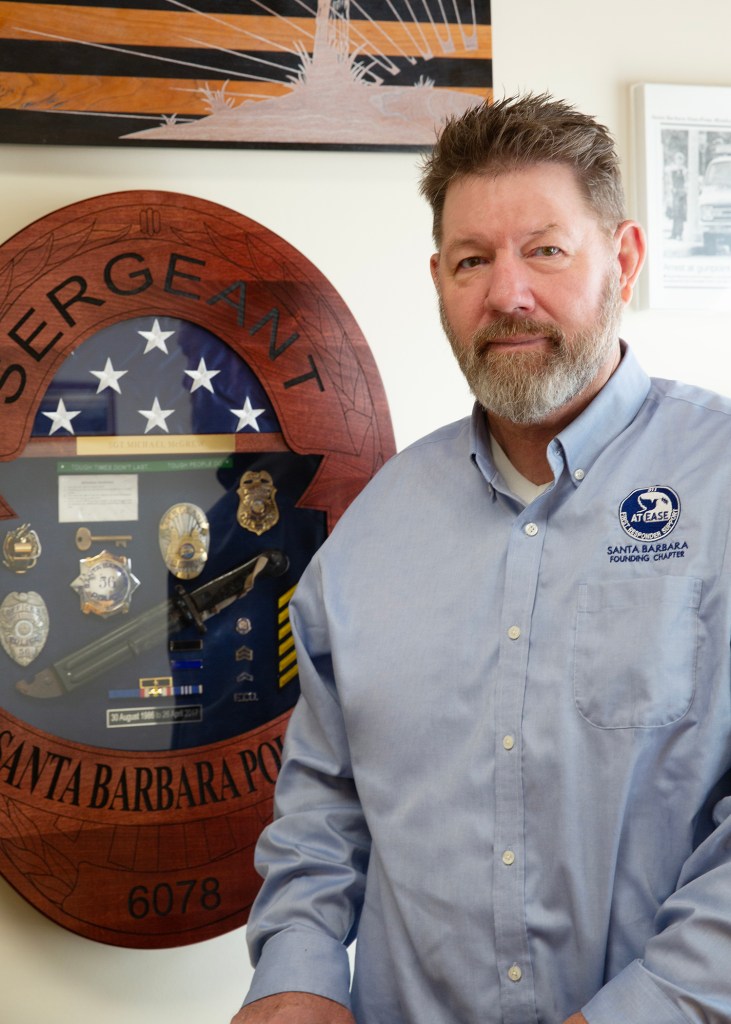
Working alongside firefighters, McGrew helped load another young man — the one with the mangled arm — into an ambulance bound for the hospital. Then he turned to what he assumed would be the next task: locating the driver. Given the violence of the crash, McGrew believed he had likely been ejected.
He began searching the surrounding brush, scanning for blood, body parts, any sign of where the third occupant might have landed.
“As I was standing there, I got a call from dispatch,” he recalled. “Somebody had been hit by a semi-truck on the freeway.”
The driver had seen what had happened to his friends. He climbed the embankment to the overpass that bisects the intersection where the car had overturned. At the edge of the freeway, he placed his wallet on the shoulder and stepped into traffic. He struck the grill of the oncoming truck, locking eyes with the driver in the instant before impact. The truck driver managed to pull over. The young man survived.
“It doesn’t make sense when you get there,” McGrew said. “There’s just so much carnage. It’s so intense that you just function.”
He felt his body enter the familiar surge of fight-or-flight — the ancient physiological reflex that has carried human beings through danger for millennia. He has always chosen fight. He stays inside the moment, pushing forward through it, until the adrenaline gives way to tremors — the delayed aftermath of cortisol flooding his system.
The next call that came over the radio was for a barking dog.
Later that night, McGrew returned home. He may have had a drink; he may not have. Alcohol has long been the profession’s unofficial prescription for what the job deposits inside you. He remembered that the house was dark; everyone was still asleep.
He did not talk about what he had seen; he never did. Instead, he lay down and waited for darkness — “an exhaustion that just tears your body up and it tears your mind up,” he said. In a few hours, he would wake and do it again.
An industrial injury — one tied to the job itself — for first responders often takes the form of heart disease or cancer. This is because of the repeated cortisol surges — stress events — triggered by the body’s exposure to death, tragedy, or threats. The average person experiences less than five such events in a lifetime. For a police officer, the number can climb to around 200.
The first for Mike McGrew may have come at age 10, when he became convinced his father — then chief of the Santa Barbara Fire Department — had been killed battling a blaze at Vandenberg AFC. Four firefighters died. McGrew’s father was not among them.
Years later, McGrew would spend three decades in uniform himself, first in patrol and later investigating some of Santa Barbara’s most violent crimes. He would see what he calls “the worst of the worst” — shootings, stabbings, sexual assaults, abused children.
Those calls — the ones that, he said, “take a piece of your heart you know you’re never going to see again” — accumulate. In a culture long defined by the directive to “suck it up,” studies have found that suicide rates among first responder exceed line-of-duty deaths. Research also suggests higher-than average rates of divorce and alcohol use as means of coping.
McGrew spent decades as a dynamo — a magnetic Santa Barbara police officer who led the police union and regularly clashed with city officials. To a few he remains controversial; to many, his exploits carry the lore of heroism, including tackling a man armed with a samurai sword in his first year on the job.
But at home, McGrew went through multiple divorces. One son, who had battled cancer through adolescence, died by suicide at 18. Another later died of a drug overdose after years of addiction. Stress event after stress event. When McGrew himself was diagnosed with cancer a few years back, he said he later learned that the diagnosis was unsurprising.
Raised in what has been described as a multigenerational powerhouse of first responders — his grandfather also served as chief of the Los Angeles City Fire Department — McGrew began to see the fallout inside his own family. Grief counseling alone, he concluded, could not address what he recognized as something more enduring: the cumulative psychological injuries of multiple McGrew careers spent in proximity to violence and sudden death.
In 2014, McGrew helped launch what is now 911 At Ease International (911AEI), a Santa Barbara–born nonprofit that connects first responders and their families with therapists trained specifically in the culture and pressures of emergency work. The service is free and designed to be anonymous, shielding participants from the professional repercussions that historically discouraged many from seeking care.
Since its founding, the program has served more than 13,000 responders and family members nationwide.
Among the 911AEI team are McGrew’s own daughter, Taryn McGrew, who serves as program lead, and intake coordinator Kate West. Both understand the profession intimately. Both are daughters of police officers. Both know what it feels like to live with the constant question of whether a parent is dead or alive. Both remember the subtle signals of a “quiet day.”
When a first responder reaches out, West is often the first voice they hear. She assures callers the service is confidential and free. “We’re here,” she tells them. “We want to get you support.”
Most participants attend about 10 counseling sessions, though there is no fixed limit. West matches callers with one of roughly 275 therapists nationwide who have experience working with first-responder populations.
From the jump, McGrew said, At Ease demonstrated its place within the first-responder ecosystem. After the Thomas Fire and the 2018 Montecito debris flow, local departments turned to the program as firefighters, deputies, and medical workers confronted widespread destruction and loss.
Department leaders later told him they had expected to lose personnel to trauma-related burnout — a common outcome after major disasters. Instead, he said, staffing levels held steady.
Since then, 911AEI has assisted responders following crises across the country, from wildfires to officer-involved shootings. The program also extends services to emergency-room staff, paramedics, and family members.
“[Among first responders] there’s a lot of marital problems; the children are affected,” McGrew said. “It’s the whole unit.”
Children of first responders can carry their own secondary burdens: anxiety about a parent’s safety, social stigma in communities where attitudes toward law enforcement have grown more polarized, or the strain of family disruption tied to night shifts and long hours. West said many young clients who contact the nonprofit struggle with those dynamics.
“A lot of it is family counseling,” she said. “Trying to keep families together.”
For Taryn McGrew, the work is not only her family’s new legacy — it is also something that works for her family. “We get to do our own generational healing as well,” she said.
The goal, Mike McGrew said, is simple: get responders the help they need, then get them “back into the fight.” When someone calls 9-1-1, he added, the public expects the person who arrives to be fully present. Programs like this, he believes, help make that possible.
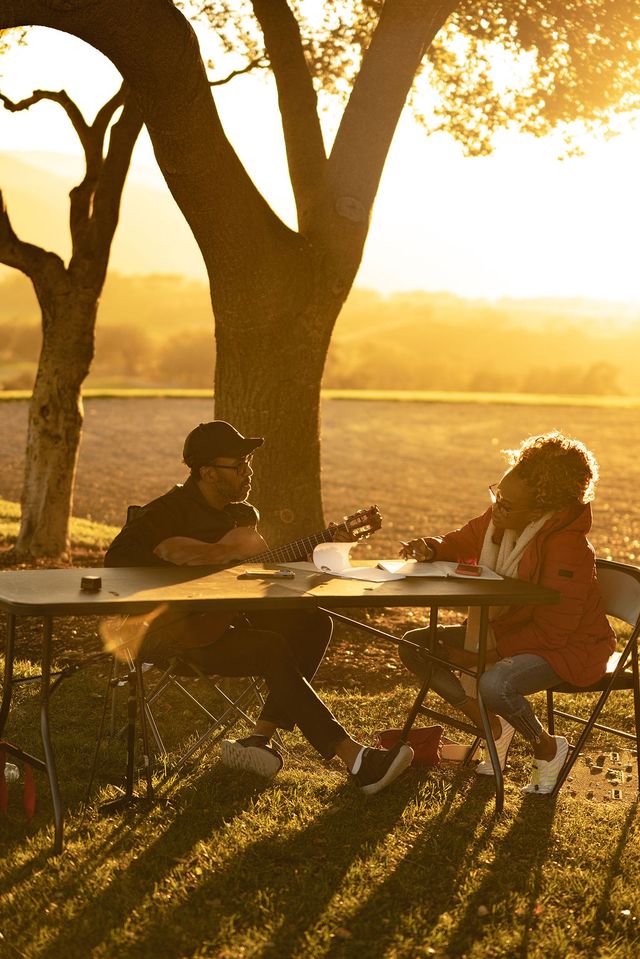
In recent years, 911AEI has expanded beyond traditional counseling. Its Project Harmony program, launched in 2023, pairs first responders with professional songwriters to translate trauma into original music — an alternative pathway for experiences that are often difficult to put into words.
The retreats, often held in places like the Santa Ynez Valley, offer space for expression outside the clinical setting. “The healing process is amazing,” McGrew said.
It is a stark contrast to the response he once received on the job.
“Hey, boss, taking that dead kid out of their mom’s arms messed me up yesterday,” he recalled telling a supervisor.
He was told to turn in his badge and gun while his fitness for duty was evaluated.
Years later, McGrew said he has tried to build something different — a system where first responders can speak without fear that honesty will be treated as liability.
Reflecting on his own experience, he added, “The traumas I’d seen … losing a child … I didn’t want to have to use the program. But I did. And I’m glad.”
Related Posts


Premier Events
Sat, Oct 03
9:00 AM
Goleta
Out of the Darkness Suicide Awareness Walk
Sat, Oct 03
10:00 AM
Santa Ynez
Chumash Intertribal Powwow Returns
Sat, Oct 03
10:00 AM
54th Santa Barbara Old -Time Fiddlers’ Festival

Sat, Oct 03
11:00 AM
Santa Barbara
OktoBEERfest at Dutch Garden Restaurant!
Sat, Oct 03
12:00 PM
Santa Barbara
Reclaim Your Radiance Fall 2026 Healing Arts Faire
Sat, Oct 03
12:00 PM
Santa Barbara
CWC Docs: “SURFILMUSIC” (2026)

Sat, Oct 03
2:00 PM
Santa Barbara Public Library
S.B Voting Rights and Election Protection Forum: How You Can Get Involved

Sat, Oct 03
4:00 PM
Santa Barbara
42nd “Sips & Ships” Wine Tasting & Yacht Tour Fundraiser

Sun, Oct 04
11:00 AM
40th California Avocado Festival

Sun, Oct 04
1:30 PM
Goleta, CA
📚 Library Card Day
Sat, Oct 03 9:00 AM
Goleta
Out of the Darkness Suicide Awareness Walk
Sat, Oct 03 10:00 AM
Santa Ynez
Chumash Intertribal Powwow Returns
Sat, Oct 03 10:00 AM
54th Santa Barbara Old -Time Fiddlers’ Festival
Sat, Oct 03 11:00 AM
Santa Barbara
OktoBEERfest at Dutch Garden Restaurant!
Sat, Oct 03 12:00 PM
Santa Barbara
Reclaim Your Radiance Fall 2026 Healing Arts Faire
Sat, Oct 03 12:00 PM
Santa Barbara
CWC Docs: “SURFILMUSIC” (2026)
Sat, Oct 03 2:00 PM
Santa Barbara Public Library
S.B Voting Rights and Election Protection Forum: How You Can Get Involved
Sat, Oct 03 4:00 PM
Santa Barbara
42nd “Sips & Ships” Wine Tasting & Yacht Tour Fundraiser
Sun, Oct 04 11:00 AM
40th California Avocado Festival
Sun, Oct 04 1:30 PM
Goleta, CA


You must be logged in to post a comment.