At least 50 percent of the 20,000 students on the UC Santa Barbara campus commute by bicycle, which makes for a whole lot of bike tires running flat, developing holes, and ultimately being thrown away.
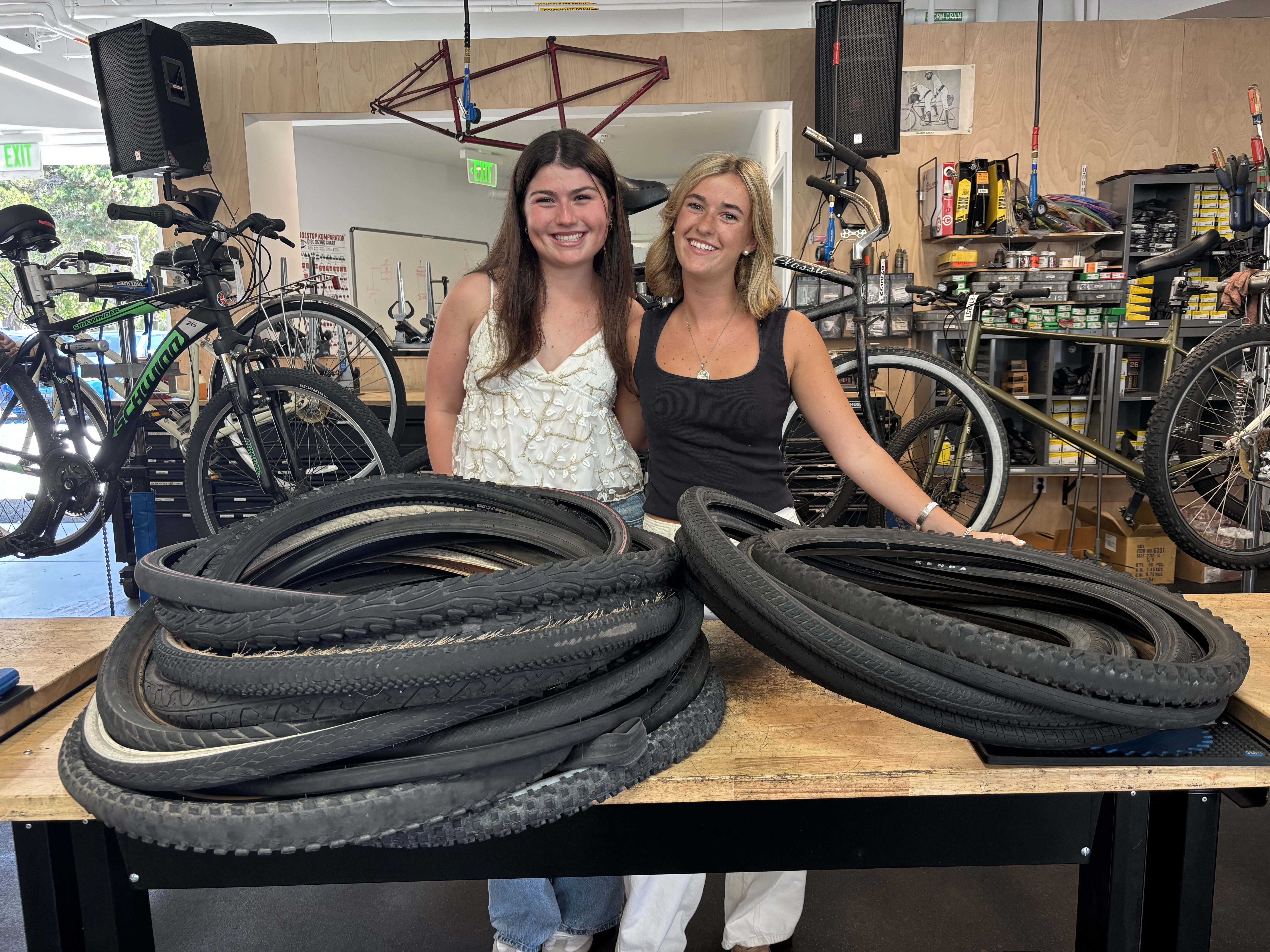
To manage the busted tires at the UCSB bike shop, Environmental Studies majors Sophia Long and Virginia Such launched TREAD, or the Tire Recovery Education and Diversion program.
“Our bike shop goes through an insane amount of tires and tubes because of our unique biking student population here,” said Such.
Long and Such are a part of the Environmental Leadership Incubator (ELI), a nine-month program dedicated to creating and implementing sustainability projects on campus. The two women reconnected in ELI, as they had previously known each other since preschool in Palo Alto. They started the project in fall 2025 and signed a contract at the end of winter quarter. The first pickup came over spring break — five boxes of old tubes and tires at the bike shop.
“Initially, I applied with this idea to make flip-flops out of bike tires,” said Such. “Sophie and I teamed up, and we discovered there was a way bigger problem than just trying to scrounge random resources — that we were not recycling any rubber from the bike shops.”
The two students talked with Adam Jahnke, the director of the Associated Students (AS) Bike Shop since 2014, who was eager to help with the creation of a recycling initiative at the shop. The bike shop has been run by students since 1975, but has thrown away tires for years. AS also helps manage the waste created at UCSB, which campus-wide has a 70 percent waste diversion rate.
Long had said the project started with outreach. They found Liberty Tire Recycling and were able to set up a contract. Liberty comes when the bike shop has at least five full boxes, or around 50-70 tires, with a pickup fee of $25. The tires are processed at Liberty’s facility in Los Angeles, where it is recycled into rubber mulch for playgrounds and athletic tracks, and into fuel for kilns and boilers. Such’s high school — Battle Ground Academy in Nashville, where her family had moved — gave the project a $5,000 external alumni grant that helped with the fees.
“Since we wrapped up our project earlier than expected, we have been doing college outreach. This week, I emailed about 70 college campuses that I know have some type of bike shop on campus,” said Such.
Multiple schools with a concentration of bikers are interested such as UC Davis, Colorado State University, and University of Washington. To initiate the program, the school has to be near a liberty recycling facility and have a type of student government willing to pay for the program.
In the future, they are hoping to calculate how much waste will be diverted with the implementation of this program. The variables will change throughout the academic quarters but they expect to keep recycling around 50-70 tires at a time.