

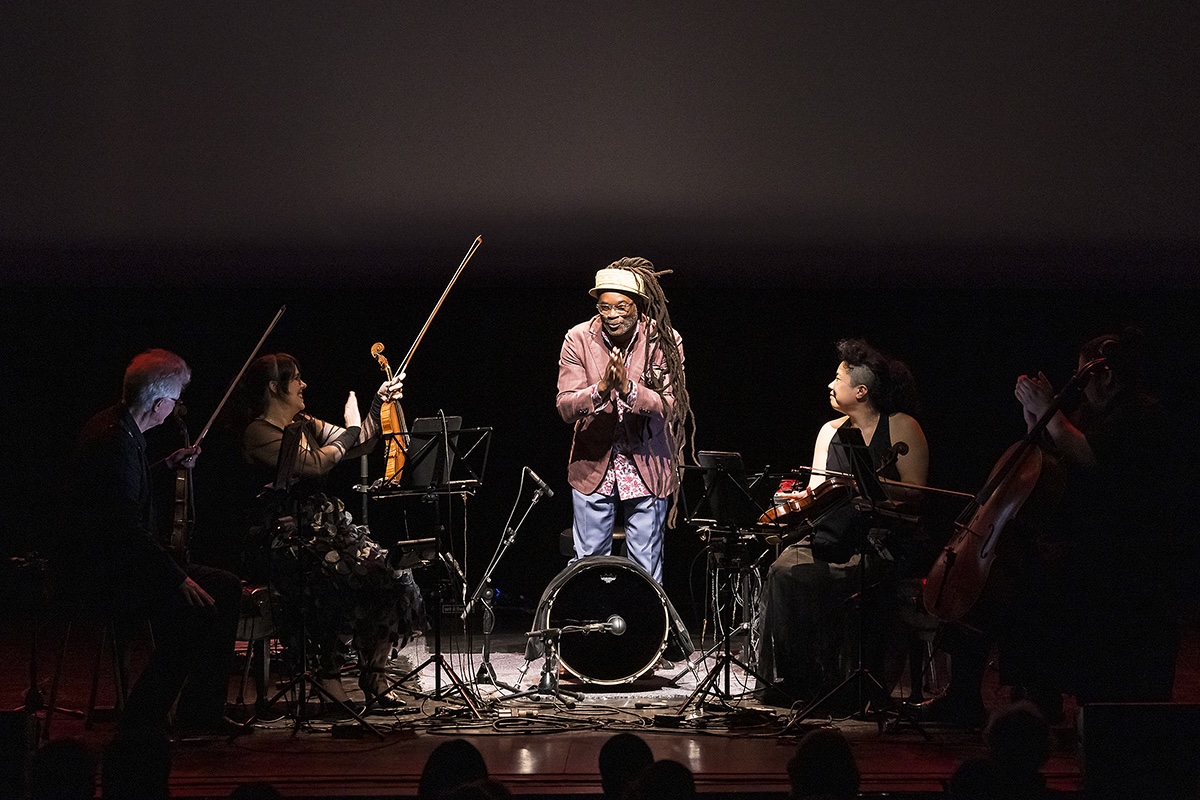
Over its remarkable half-century of a trailblazing and genre-expanding career (thus far), the Kronos Quartet has effectively reinvented string quartet culture. Part of its mission, achieved through an uncommon dedication to commissioning works from sources far and wide, has been to offer a window on music from around the world and from non-traditional pockets of American heritage.
In an illuminating way, Kronos’s most recent of countless concerts in Santa Barbara, at Campbell Hall last week, paid respects to deserving “other” pockets of American culture — just in time for the nation’s much-buzzed-about 250th birthday this July 4. Kronos’s three-part, three-hour project, Three Bones, was co-commissioned by UCSB Arts & Lectures and given its West Coast premiere here, fresh on the heels of its Carnegie Hall launch the week before.
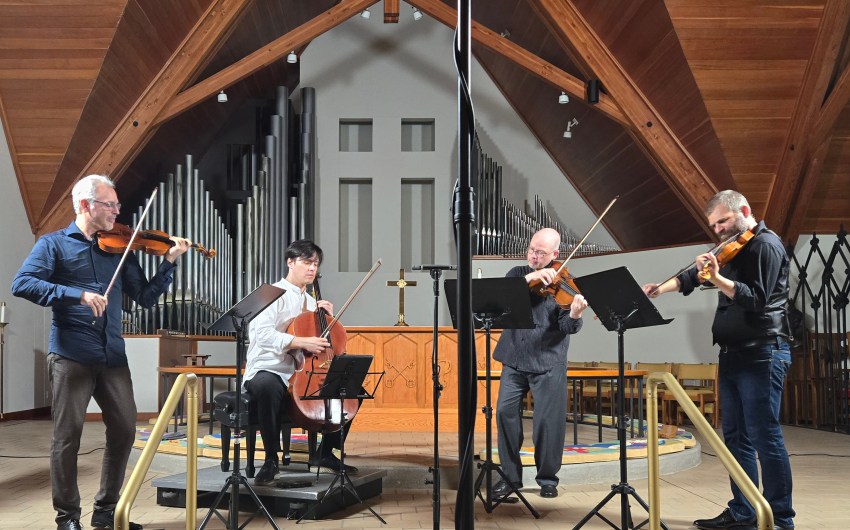
Kronos made news last year with another Campbell Hall appearance, which was both part of the group’s milestone 50th-anniversary celebration and officially the “retirement party” gig for longtime members Hank Dutt (violin) and violist John Sherba. Their chairs have been ably filled by the younger violinist Gabriela Diaz and the violist Ayane Kozasa, joining the already-in-place cellist Paul Wiancko.
Three Bones amounts to a uniquely moving live experience, steeped in social-historical consciousness and savory musical enticements. As with so many Kronos projects, this was not your father’s/grandfather’s string quartet outing.
First violinist, founder, and intrepid conceptualist David Harrington has pulled together a broad array of pieces to assemble the puzzle of Three Bones, as a kind of equal time tribute to groups of people of color, groups beyond the standard white-bread and Manifest Destiny-driven “all-American” narrative. The composite project variously pays tribute to Native American culture (in the opening part, called “Ground”), black culture, and, specifically, the unique Gullah Geechee culture (in “At the Sea Islands”), as well as Chinese-American life — and immigrant life more generally — in “Beyond the Golden Gate.”
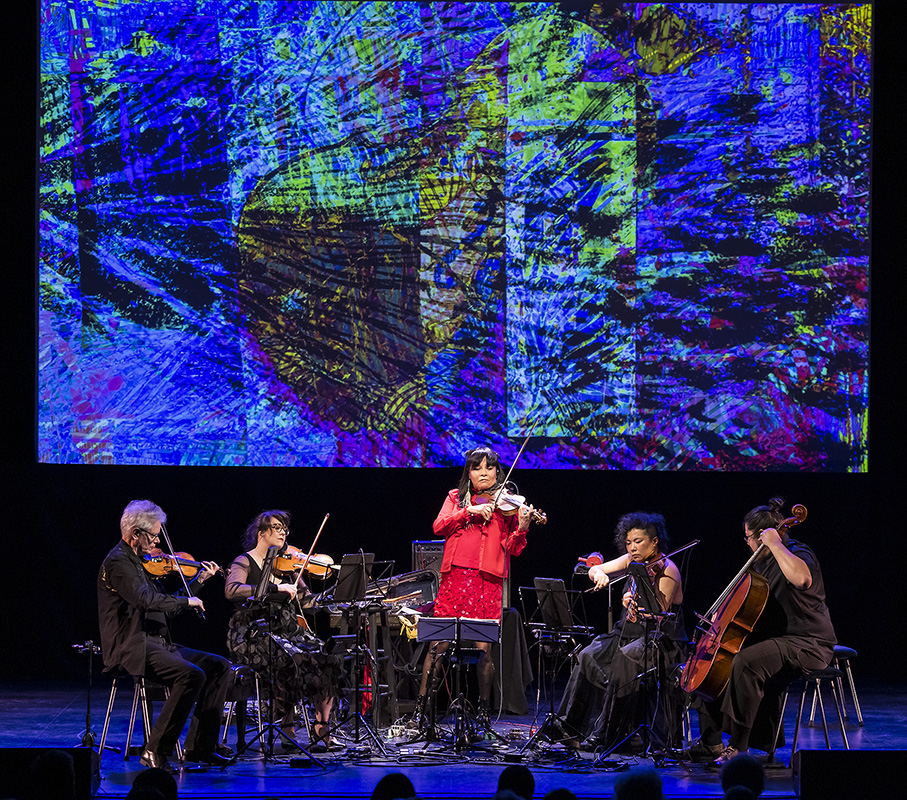
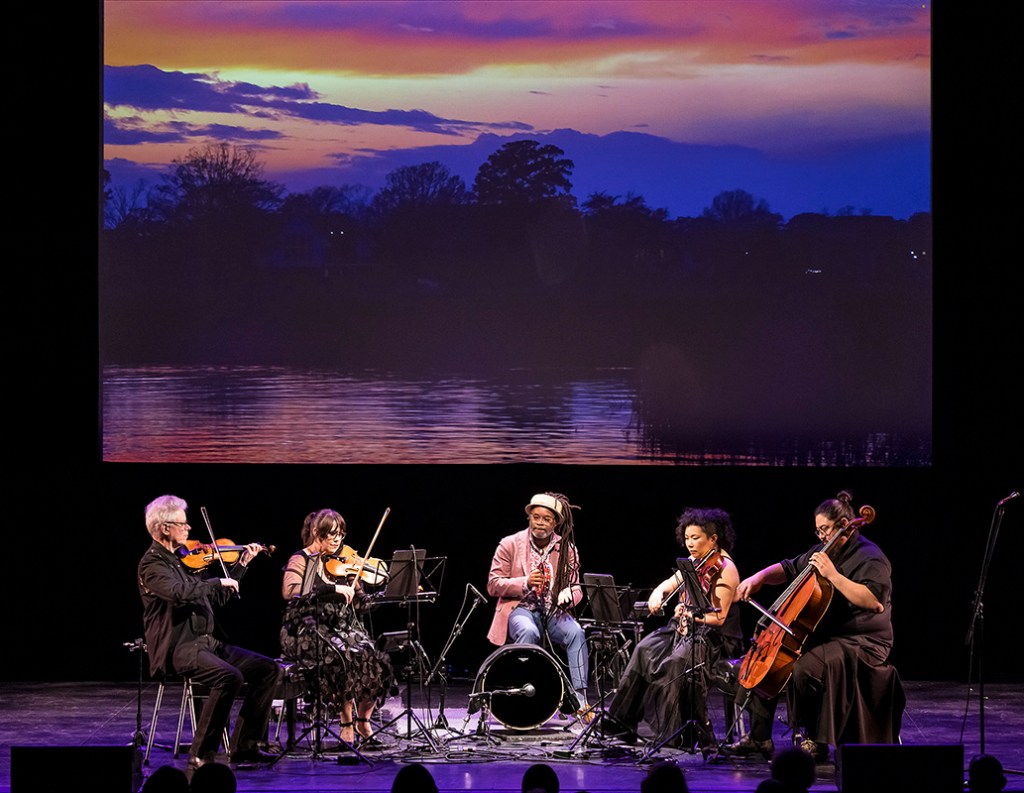
Special guests enlivened each section — Laura Ortman on Apache violin, voice, and more on “Ground,” Gullah percussionist Quentin Baxter on the second chapter, and, on the third, a frequent Kronos collaborator, Wu Man, master of the Chinese lute called the pi-pa. Sensorially, an integral component was the richly layered visual pageantry, including historical texts and background material, designed by Xuan Films (Windy Chien, Jeffrey Gibson, and Zach Reich).
A strong history-tapping intention began at the start, with the first of several archival recordings folded into the concert’s sonic fabric: a 1890 wax cylinder recording of “Song of Salutation,” sung by Noel Joseph, a member of the Maine-based Passamaquoddy tribe. The Native American portion ranged from Raven Chacon’s “The Journey of the Horizontal People” (commissioned for Kronos’s “Fifty for the Future” project of last year) to Jacob Garchik’s creative string quartet rethinking of bluesman Charley Patton’s “Down the Dirty Road” and the classic ‘50s Link Wray instrumental “Rumble.”
Guest Ortman quickly won over the stage and house of Campbell House with her diverse contributions, including her piece “Waves Carve the Sound.”
Interestingly, one of the musical touchstones of the Gullah Geechee was the familiar American tune “Kumbaya,” actually of Gullah origin. The song appeared in archival recordings, in a 1926 version by Henry Wylie, and in more elaborately staged contemporary arrangements by Trevor Weston towards the set’s end. Weston was also responsible for “Juba,” one of the evening’s pieces with a closer connection to tonally challenging contemporary classical rhetoric rather than folkloric materials.
Gospel singer royalty Mahalia Jackson (1911-1972) served as a posthumous guest in absentia on “Sometimes I Feel Like Motherless Child,” taken from Kronos’s fascinating latest album, Glorious Mahalia, in which Jackson’s recording voice joins the quartet in respectful treatments of her legacy.
Aside from its musical charms, the Chinese portion of the evening offered a surprising historical backdrop to the evolution of San Francisco’s Chinatown and important legal statutes regarding immigrants’ rights (a propitious topic in America just now). Musically, Man was a natural source of allure, as a player — including a solo improvisational interlude — and composer of the piece “Two Chinese Paintings.” Also worthy of attention were the short examples of prominent Chinese composer Tan Dun’s creative might — an excerpt from his acclaimed Ghost Opera and Dai Wei’s compositions and arrangements. Wei’s “Through the Narrow Gate II: A Wise Man in the Snow” interwove with an archival song captured on a 1902 wax-cylinder recording, an echo of the past airlifted into our 21st-century brains.
Historical-racial inclusivity, generous musical eclecticism, and culture-driven idealism richly converge in Three Bones. By the end, we feel enlightened, informed, and, not incidentally, entertained, a blissful trinity of sensations which the best Kronos projects over the years have given us. After all, Campbell Hall does double duty as a performance hall and classroom by day. Both functions were well-served on this special night.




You must be logged in to post a comment.