
The Man, the Myth,
the Tennis Centenarian
Henry Mealy Has Advice for Reaching 100:
Never Underestimate the Power of Good Company
By Tiana Molony | July 23, 2026
Read more from our 2026 Active Aging Guide here.
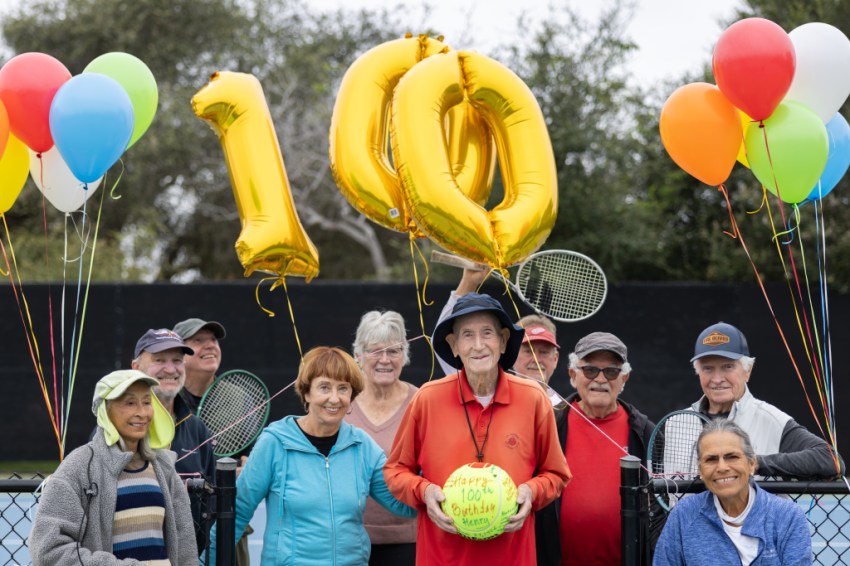
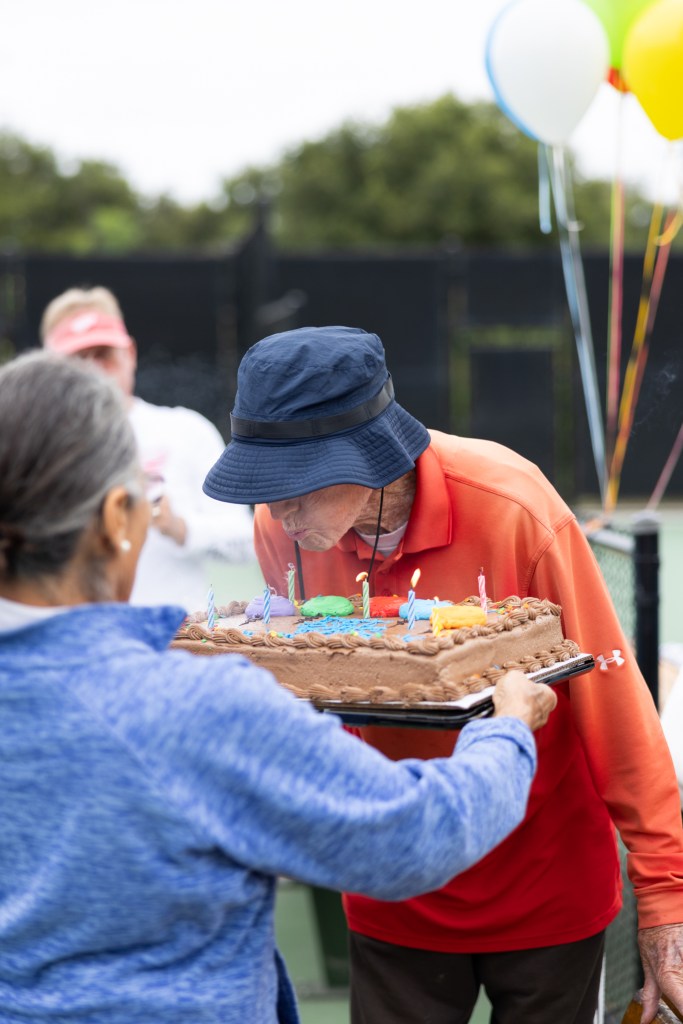
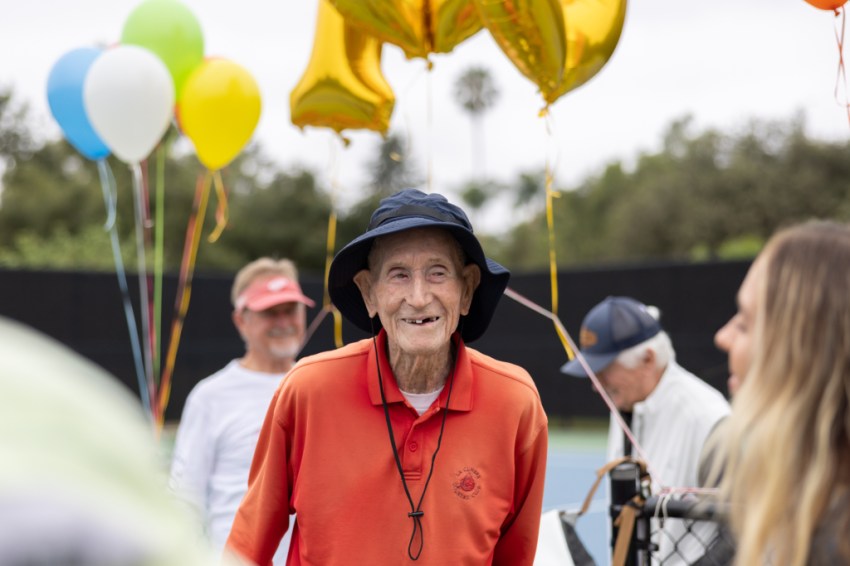
On a gray Friday morning at the Kellogg Tennis Courts in Goleta, nine players gathered for their weekly match. Balloons spelling “100” bobbed from a chain-link fence, and a chocolate cake waited on a nearby bench. Its icing read: Happy Birthday, Henry, Our Tennis Centenarian.
The courts were empty. No one played. Instead, they lingered along the fence, their eyes fixed on the opening where they expected their 10th player, Henry Mealy, to appear.
As they waited, the players traded stories about Henry. They marveled at his seemingly endless stamina and laughed about his quirks, especially his relentless trash talk.
“That’s why he’s still around,” one player mused. “He’s got such a potty mouth.”
Todd Smith recalled their first meeting five years earlier. Even then, he was impressed by Henry’s agility and remembers thinking, “not bad for a 94-year-old guy.”
Someone mentioned, rather matter-of-factly, that Henry still drove. Before I could ask another question, another described the bumper sticker on his SUV: “No nukes. Save the women and children.” I took it as evidence that Henry was not afraid to tell you exactly how he felt.
To this group, he was more than a teammate — more than a friend. He was an inspiration.
And, on this day, he was 99 years old. Tomorrow, June 27, he would turn 100.
Henry arrived.
“Wow, I made it,” he exclaimed, as if, going to bed the night before, he wasn’t entirely sure if he’d see today.
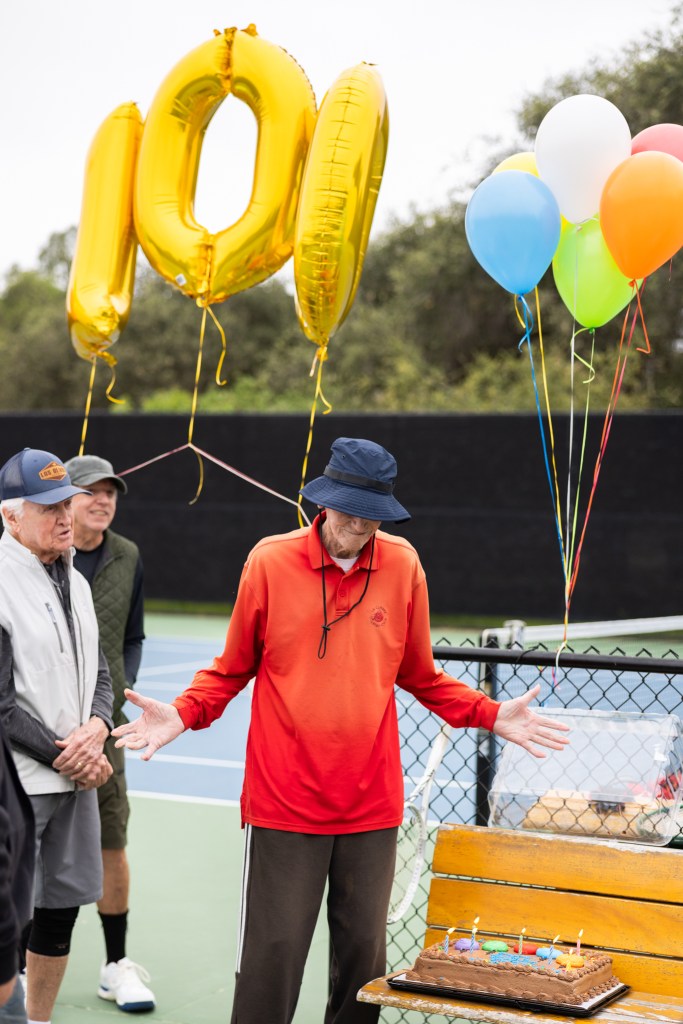
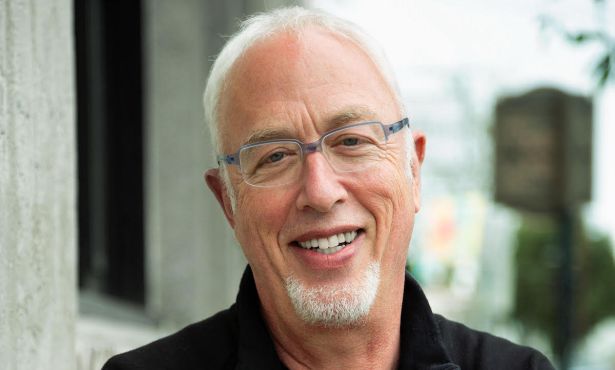
He wore black sweatpants and a red long-sleeved shirt. Atop his head sat a navy hat, given to him, he said, by some “envious pickleball players.” Someone pointed out his shoes: his new, white, scuff-free birthday shoes.
He moved like a wise turtle, the kind that learned to conserve its energy without surrendering its independence. Despite his age, he didn’t strike me as someone whose main purpose upon entering a room is to find the nearest chair.
He thanked his friends for showing up, for the cake, for the balloons. Players tossed back their thank-yous with words of encouragement:
“You put that ball away,” one of them shouted.
“You inspire us all,” someone behind me chimed.
Everyone gathered underneath the gold balloons for a group photo. Someone placed a hand on Henry’s shoulder. “Are you smiling, Henry?” they asked. “I think I am,” he laughed, revealing his missing teeth.
Henry stood at the center, clutching a giant tennis ball, which was covered with notes from another birthday party he had attended earlier that week.
“Henry,” one note signed by Jane read, “Playing tennis with you is my favorite way to start the week.”
The group teetered between whether cake or tennis should take precedence and ultimately settled on cake. They wondered aloud if they should sing “Happy Birthday,” but Henry exclaimed that we “didn’t need to do that”; he’d “heard that before — 100 times.”
Henry pleaded with us to pause the chitchat so he could play some tennis.
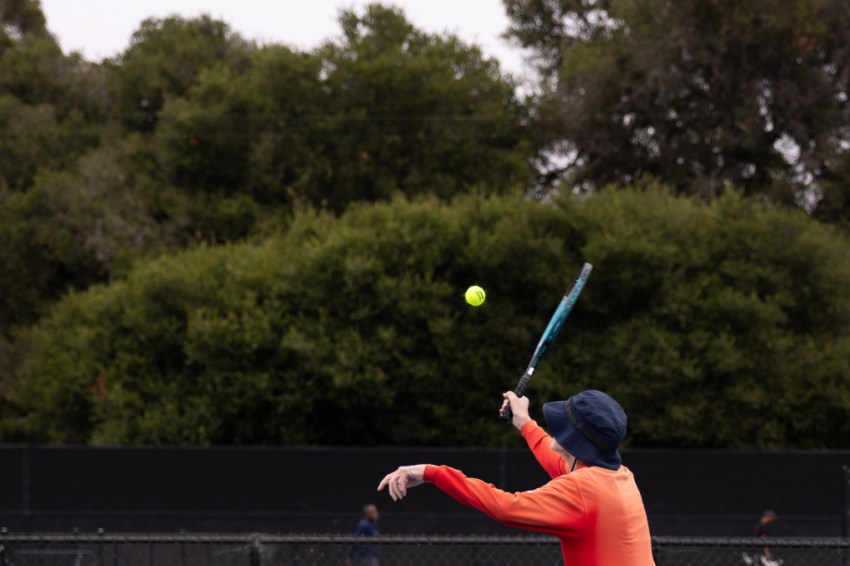
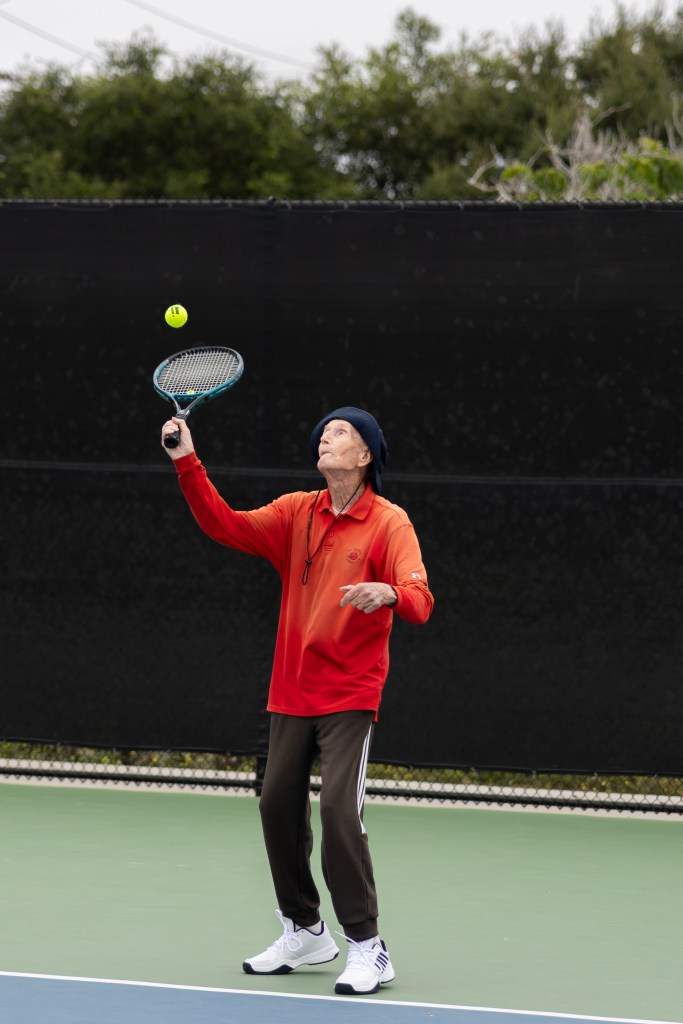
He strode onto the court, swinging his racquet back and forth, slicing through the air with the same effortlessness as Michael Phelps flapping his arms like a bird, preparing to enter Olympic waters.
One of the other players wondered aloud whether they should warm up more, to which Henry said they didn’t need to. A voice behind me yelled, “Henry was born ready!”
On the court, he moves like a gazelle, light on his feet, hitting the ball back at his opponents with a seasonedness, as if the movements came as naturally to him as breathing. He missed a few; he’s only human, after all, and at this, he playfully instructed Independent photographer Ingrid Bostrom not to “take a picture of that.”
Then it was his turn to serve, and a hush blanketed the court. Henry floated the ball high and slammed it down.
“Now,” he smirked, “how’d that look?”
At this, I leaned into the woman in the crimson-blue jacket standing next to me. She arrived with Henry, and I inquired about their relationship. Her name is Rebecca Stansberry, and she is Henry’s neighbor. She told me that Henry lived alone, but she cleaned his house, did his laundry, and checked in on him whenever she could.
The score was 15-love.
She said Henry introduced her to the Friday tennis group about three years ago and informed me that Henry does not just play tennis once, but three times a week. I asked her what I already knew: whether the community Henry has was probably the secret ingredient in his longevity, more so than the tennis.
“He told me yesterday,” she said. “We were having a conversation about how it’s the community that keeps him happy and moving forward.”
Watching Henry play, I couldn’t help but think of the centenarians in the Blue Zones, the five regions of the world where researchers have identified people living exceptionally long, healthy lives, often reaching age 100 at unusually high rates. These are Okinawa, Sardinia, Nicoya Peninsula, Icaria, and Loma Linda. In short, people in the Blue Zones reportedly lead slow, healthy lifestyles surrounded by good company. That last one took precedence.
I lost track of the score, but the other doubles team won. Everyone took a break to eat some cake. Henry finally sat down, and we all eagerly gathered around him, waiting for him to speak as one does when a baby prepares to say its first words. Someone — I don’t remember who — started the conversation by asking if he could recall the time he went to Indian Wells to watch the then-teenaged Williams sisters play.
Henry peered at the sky as if the memory was stored somewhere in the fog.
“They had pearls on their hair,” he said, smiling. “They were dropping on the court.”
I took this moment, while he was occupied with cake, to try, in a few minutes, to have him relay the last 100 years of his life. Here is what I found out:
Henry was born on June 27, 1926, in Baltimore, Maryland. During World War II, he served mostly in the Merchant Marine and then in the Navy toward the end of the war. He held a commission in the Navy but spent most of his service hauling troops and supplies to Europe — to places such as Cherbourg, Le Havre, and Plymouth along the English Channel — as part of large convoys.
“Queen Mary was the head of our convoy,” he said.
This made him think of his wife, Mary. She passed away 10 years ago, in her nineties. He described her as a “wonderful, blessed person who took good care of me.”
In 1950, after the war, he attended Johns Hopkins University, where he played on the tennis team.
“I played a little better than I do now,” he joked, in between bites of cake.
After college, he stayed in Baltimore before briefly moving to Frederick, Maryland, and, in 1961, to Santa Barbara. His brother served in the Air Force at the time, and “he talked me and my family of four into coming out in my Oldsmobile 98, with four kids and a dog.”
In Santa Barbara, he spent decades working as an accountant for the Santa Barbara School District and retired at 62.
“I had enough of it,” he said bluntly.
His old staff was holding a party for him the following day. He remembered intentionally hiring pretty women to work in his office.
“You forget one important thing about Henry: He flirts with all the pretty girls,” a woman behind me chimed in.
Henry agreed: “I get a lot more attention from the pretty girls now that I’m 100 than when I was younger.”
Everyone laughed.
Of all the joy that came with making it to the big 100, it was not lost on me, Henry, or any of the other players that the achievement simultaneously carried grief. The truth was, Henry had outlived three of his four children.
“It’s nice to be alive and to live so long,” he said, “but when you live that long, you have a lot of friends that don’t live that long, including your children.”
But classic Henry, he returned to optimism: “There were sad times, but they were outlived by the good times.”
He credited the group surrounding him as being responsible, in part, for the life he had lived, which was “more like a 100-year-old vacation enjoyed by the people here,” he said, gesturing to the crowd around him. “Annita, who organizes everything for me; Rebecca, who takes care of me. Good Todd; he’s always looking after me — I wish he’d arrange for me to win a little bit.”
I asked him to impart some wisdom to us. To grant us the secret formula to a long, healthy life. But I knew, deep down, there wasn’t one.
“I didn’t do anything special to live so long,” he revealed, “except,” he added, “I did play tennis…. You’re never going to live to be 100 unless you play tennis.”
Aside from tennis, he found community at Trinity Episcopal Church, where he had been active for 60 years. He also found pleasure in music and fishing.
After about 10 minutes, Henry asked me if those were all my questions. I got the sense he wanted to return to the court. Although I could have talked to him for hours, I let him go — but not before someone shared that Henry had a low heart rate, around 60 beats per minute.
This sparked a memory of a conversation I’d had the day before about how most mammals have a lifetime range of 1-1.5 billion heartbeats. How those heartbeats are spent is up to nature, yes, but also, to some extent, us.
I remembered something Henry had said earlier: “I lived a slow life,” he said. “I drove with low lights; I traveled with low lights, and because of that I was able to slow down and never hurry, and was able to slow go slow enough to enjoy all the people and all the surroundings around me; I always enjoyed — that’s why life is a vacation.”
I lingered a while longer, watching Henry play. He tried, with all his might, to coax me onto the court, but I insisted I was wearing the wrong shoes. Had I agreed, I’m sure he would have beaten me with ease. Before I left, I thanked him for his time and told him I might see him again the following Friday if I had a few more questions.
“I’ll probably be in your obituary,” he joked.
I left the courts, climbed into my car and, before putting it in drive, pulled up Google and searched for tennis lessons.
Read more from our 2026 Active Aging Guide here.


You must be logged in to post a comment.