
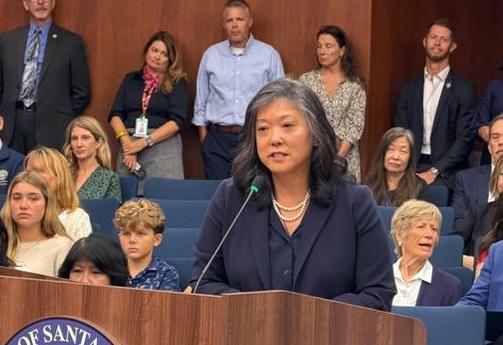
This Tuesday morning, Mona Miyasato found herself on the receiving end of a standing ovation, so loud and so insistent that it would have warranted an encore had she been a conductor of a symphony orchestra. But this was the Board of Supervisors’ chambers, where for nearly every Tuesday the past 13 years, Mona Miyasato — the county’s chief executive officer — might well have wielded a conductor’s baton.
In her case, the orchestra would have included not only the five county supervisors but also all 4,700 of the county’s employees who make up its 23 different departments. This Tuesday, August 18, would be Miyasato’s last Tuesday meeting. After 13 years, she was stepping down. She would miss the “pomp and circumstance” of the supervisors’ meetings, she said in an earlier interview. But she would definitely not miss having to sleep with the county phone right next to her bed.
Just in case.
This being Santa Barbara County, “just in case” tends to happen a lot. Forty-three times during Miyasato’s watch, the county declared a state of emergency. Floods and fires struck repeatedly. Sometimes one after the other. When the rampaging debris flow exploded above Montecito early in the January morning of 2018, it was in the wake of the Thomas Fire, then the biggest wildfire in state history. Horrifically, 23 people died. Of the 12 major fires during Miyasato’s tenure, more than half of them required evacuations.
Then there was the 2015 oil spill along the coast — from which the state, national, and local political worlds are still reeling. And of course, Santa Barbara’s never ending cannabis wars, and the fiscal bloodbaths that have bookended the beginning and the end of Miyasato’s career in Santa Barbara. Not to mention the years-long lockdown inflicted by COVID. One wonders how she survived so long.
So, why now?
“I needed new eyes,” she explained. “When you find yourself saying, ‘Oh, we already tried that,’ ” she said, “that’s a sign you should go.”
This Tuesday morning — and at the goodbye party of the previous night — the equivalent of Santa Barbara’s deep state exhausted themselves straining for superlatives with which to praise Miyasato: “unflappable,” “implacable,” “the smartest person in the room but confident enough not to broadcast it.”
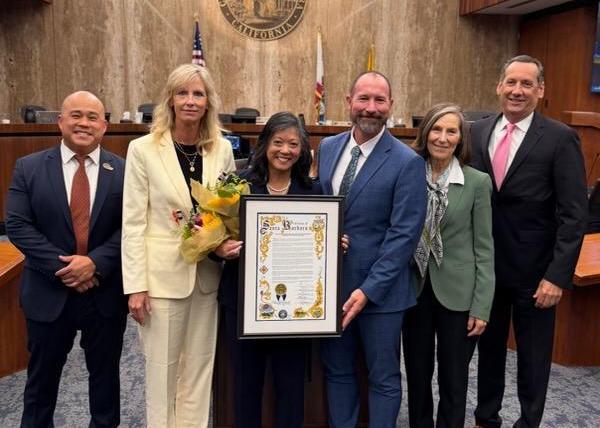
Former supervisor Gregg Hart, now a state assemblymember, swallowed a thesaurus before attempting to describe Miyasato in a free-form poem: “Grace. Kindness. Compassion. Massive intellect,” he said.
To listen to the supervisors who hired Miyasato in 2013, it was the single best decision they ever made. Congressmember Salud Carbajal, who was 1st District supervisor at the time, called it “a win-win-win” decision. Supervisor Steve Lavagnino, now about to retire after four terms, recalled the board’s first interview with Miyasato. She was totally relaxed and exuded such confidence, he explained. “We all just looked at each other,” he said. “ ‘Do not let her leave this building.’ ”
To listen to the supervisors, Miyasato is an administrative mastermind. She routinely herds cats. She gets people — even those who violently disagree — rowing in the same direction. Supervisor Laura Capps called Miyasato the single best thing that happened to county government in 13 years. Former supervisor Das Williams called her administration nothing less than “transformative.”
More than that, Miyasato has a great sense of humor. She’s genuinely funny.
It was generally agreed that Miyasato’s so-called “soft skills” changed the emotional chemistry of the county’s political and institutional leadership for the better. Her management style was strikingly unlike some of her predecessors — one of whom was famous for spraying and splattering people with his tirades, and another had such a gloomy view of the job that he likened his role as county executive to piloting a jet plane about to crash.
Traditionally, the supervisors themselves have been a fractious, fractured bunch, riven along intractable north-south county lines politically, economically, and culturally. Yet from the outside looking in, the county supervisors, for all their historical ideological baggage, have for the last 13 years adopted the model of good-faith bargaining rather than the grandstanding that characterizes so many other government bodies.
So, how did that happen? Supervisor Lavagnino recalls getting into it with Supervisor Carbajal on the dais early on in his tenure. Some of it was theater, Lavagnino admitted, but the underlying heat was real. Afterward, Lavagnino ran into Miyasato. “I’m not trying to tell you how to do your job,” she told him, “but that’s not the best thing for us. When we can get along, it makes a difference.” The message made an impact.
Yet Miyasato is hardly a pushover. “Sometimes the desire to be collegial can get in the way of good policy decisions,” she cautioned. “Consensus is the tool, not the destination.”
Money, of course, also helps. Miyasato is responsible for crafting the budget the supervisors have to vote on. According to former supervisor Das Williams, Miyasato recognizes the difference between which projects really delivered the goods and which ones are merely shiny political trophies. It was in that light, he said, he understood Miyasato’s much-quoted operating motto: “We can do anything,” she likes to say, “but we can’t do everything.”
Supervisor Lavagnino put it a bit more bluntly at the Monday-night goodbye party while pretending to explicate the text of Miyasato’s name. “Mona,” he said, is Japanese for “noble little one.” Miyasato, Lavagnino claimed, translated loosely into “I don’t give a shit, you’re not getting any more general fund money.”
Supervisor Joan Hartmann, herself a policy wonk’s policy wonk, highlighted Miyasato’s systems-based approach instead. When Miyasato arrived, Hartmann wrote, she confronted 23 independent departments — feudal fiefdoms — all pursuing independent agendas, several of which are run by elected officials who don’t answer to her.
But to make a dent in the county’s intractable homelessness issue, for example, at least four departments had to work together, hand in glove. The problem of homelessness remains, but under Miyasato — with strong board support and unprecedented state and federal funding — the county has partnered with DignityMoves, a private nonprofit, as well as Santa Maria’s preternaturally efficient Good Samaritan homeless shelter enterprise to create three new prefab tiny-home communities. A fourth community focused on families and veterans is on the way.
This multi-departmental, systems-based approach, Hartmann noted, has been on display as Miyasato addressed the issue of criminal justice reform, a political, trendy-sounding slogan perhaps, but a crushing fiscal burden on all county departments when the cost of running not one but two jails is factored in.
Miyasato recognized that she better have someone who understood how the parts were put together. She hired former undersheriff Barney Melekian to reform the criminal justice system. After Melekian went on to become interim police chief for the City of Santa Barbara, Miyasato hired former probation chief Tanja Heitman, herself a fountain of institutional knowledge about the criminal justice system. Heitman and Public Defender Tracy Macuga have teamed up and have worked closely with Behavioral Wellness, Public Health, and jail administrators.
And along the way, Miyasato launched an exhaustive top-to-bottom management audit of every county department to get a clear-eyed assessment of which department was accomplishing what, how efficiently, and what changes needed to be made. In addition, she asked front-line county workers for their thoughts on how the county could do better. Under Miyasato’s watch, Santa Barbara County achieved the much-coveted Triple A bond. And perhaps most astonishingly, the county’s Behavioral Wellness department — one of the two most prolific fiscal bleeders of all the departments — finally figured out how to staunch the flow.
Miyasato will say she had a great team; she had a lot to do with assembling that team. If and when the next disaster strikes, there are measures in place; the county has created a massive debris basin in Montecito from the remains of properties devastated during the debris flow. Perhaps more critically, under Miyasato’s watch, the county opened a new emergency responder communication center that integrates all the assets of all the first responder agencies onto one integrated chessboard.
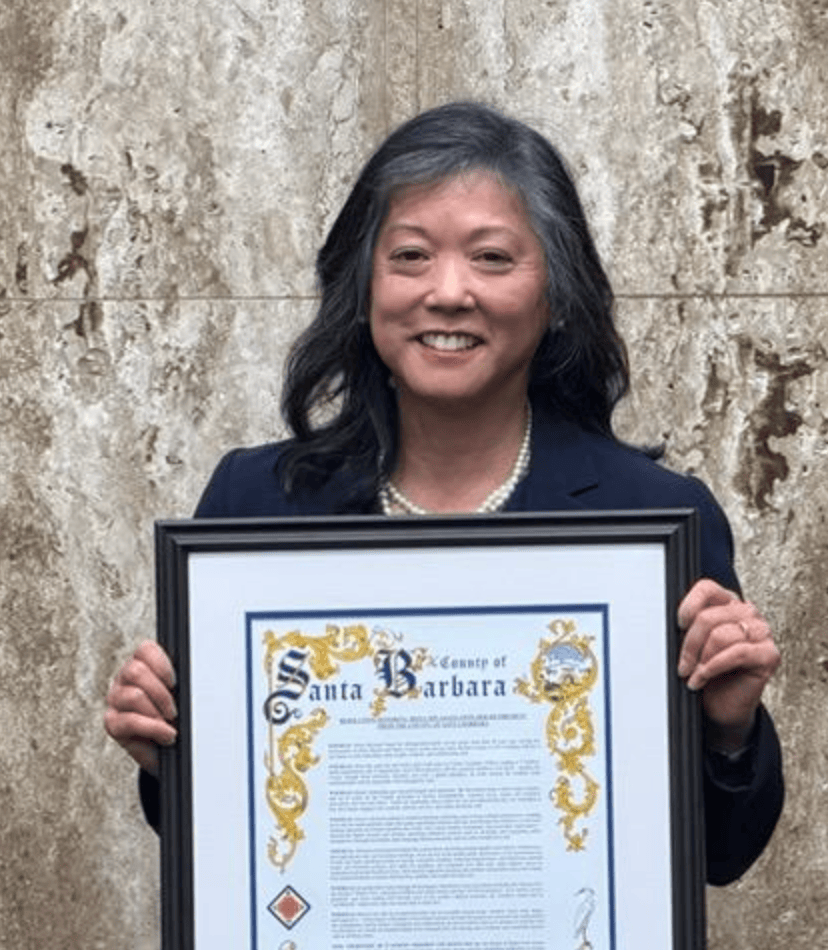
In sizing the expansion of the North County Jail, Miyasato and Sheriff Bill Brown — an independently elected official — butted heads over how many beds and how much money would be required. Brown has consistently insisted his department has needed more positions and has never been shy about pushing for more money. Miyasato has consistently pushed back, insisting on more administrative transparency over how the sheriffs’ money is being spent. This, in turn, gave rise to the recent audit of overtime spending by custody officers in the county jails, which has led to criminal charges being filed against two deputies. Despite this ongoing tension, Miyasato and Brown have managed to maintain cordial and genuinely respectful — if also mutually exasperated — relations.
At the Monday retirement party, Supervisor Steve Lavagnino — who is also retiring when his term expires at the end of the year — described a tiny voice that told him it was time to retire. Acting as emcee and all-around event roaster, Lavagnino looked at Sheriff Brown, who has been in office for 20 years, and called out, “Bill, are you hearing anything at all?”
Though this brought a huge laugh from the crowd, the number of high-level administrators leaving office soon is dramatic. Aside from Miyasato’s departure, Assistant County Administrator Tanja Heitman and Public Defender Tracy Macuga are both retiring at the end of this year. Between them are 46 years of high-octane, highly engaged leadership in the county’s criminal justice sector. Also retiring are Daniel Nielsen, director of the Department of Social Services; Harry Hagen, the tax collector for the past 30 years; Betsy Schaffer, the county’s auditor-controller; and Joseph Holland, the county’s clerk, recorder, and assessor of 42 years. All told, that’s 162 years of county leadership experience.
That’s a massive amount of turnover to be absorbed in a single hiccup. For newly arriving County Executive Jana Petersen, former manager of the City of Boulder, Colorado, that’s a whole lot of furniture to replace just as the much-anticipated impacts of Donald Trump’s Big Beautiful Budget Bill start to be felt in deadly earnest. To what extent will the safety net hold? What happens if it fails?
Even out the door, Miyasato can’t help but ponder the next natural disaster looming over the horizon. “We’re looking at the possibility of a really bad El Niño this year,” she noted. “FEMA — the Federal Emergency Management Administration — does not appear to like blue states.” Should the worst happen, such as violent coastal storms and the federal government declining to provide the help it normally does, the county should squirrel some funds away.
In the meantime, Miyasato is pondering the next chapter. She plans on coaching young future government executives to become better leaders. “I see so much anxiety and distress out there. People aren’t sure they want the job. I was at a conference recently, and no one said they wanted to be the Number One. They wanted to be Number Two.
“But you need people in government in these jobs. You can do really great work with wider ramification,” she said. “But you have to really want it — getting asked those tough questions, getting thrown in difficult, scary situations. That’s what reveals who you are. How often in life do we have a chance to be tested that way? That’s how I want to contribute.”
“What does somebody my age do when they retire?” she asked. “Take up golf? Pickleball? I’d sprain my ankle.”
Related Posts







Premier Events

Fri, Oct 23
2:00 PM
Santa Barbara
Music & Meditation: Clarinetist Nancy Mathison & Pianist Antonio Artese

Thu, Oct 22
5:30 PM
Santa Barbara
Best Fest: A Celebration of the Best of Santa Barbara® Readers’ Poll 2026 – Rain or Shine

Thu, Oct 22
6:00 PM
Santa Barbara
Chaucer’s Books Author Talk & Signing- Daniel M. Jaffe “Russian Silhouette: A Memoir of Activism and Identity”

Fri, Oct 23
5:30 PM
Solvang
Solvang Haunted House and Street Fair

Fri, Oct 23
7:00 PM
Santa Barbara
Beth Amine’s 20th Anniversary Wildcat Dance Variety Show

Fri, Oct 23
7:00 PM
Santa Barbara
This & That Performs at Roy

Fri, Oct 23
9:00 PM
Santa Barbara
Casa de la Raza Fundraiser: Brasscals! with DJ Darla Bea

Sat, Oct 24
10:30 AM
Santa Barbara
Picnic in the Cemetery: A Live Historical Event

Sat, Oct 24
11:00 AM
Goleta
2nd Annual Charger Cup to Benefit DP High Golfers

Sat, Oct 24
12:00 PM
Santa Barbara
Makers Hive Market

Sat, Oct 24
2:00 PM
Santa Barbara
Japanese Sacred Architecture: Shinto and Buddhism
Fri, Oct 23 2:00 PM
Santa Barbara
Music & Meditation: Clarinetist Nancy Mathison & Pianist Antonio Artese
Thu, Oct 22 5:30 PM
Santa Barbara
Best Fest: A Celebration of the Best of Santa Barbara® Readers’ Poll 2026 – Rain or Shine
Thu, Oct 22 6:00 PM
Santa Barbara
Chaucer’s Books Author Talk & Signing- Daniel M. Jaffe “Russian Silhouette: A Memoir of Activism and Identity”
Fri, Oct 23 5:30 PM
Solvang
Solvang Haunted House and Street Fair
Fri, Oct 23 7:00 PM
Santa Barbara
Beth Amine’s 20th Anniversary Wildcat Dance Variety Show
Fri, Oct 23 7:00 PM
Santa Barbara
This & That Performs at Roy
Fri, Oct 23 9:00 PM
Santa Barbara
Casa de la Raza Fundraiser: Brasscals! with DJ Darla Bea
Sat, Oct 24 10:30 AM
Santa Barbara
Picnic in the Cemetery: A Live Historical Event
Sat, Oct 24 11:00 AM
Goleta
2nd Annual Charger Cup to Benefit DP High Golfers
Sat, Oct 24 12:00 PM
Santa Barbara
Makers Hive Market
Sat, Oct 24 2:00 PM
Santa Barbara


You must be logged in to post a comment.