

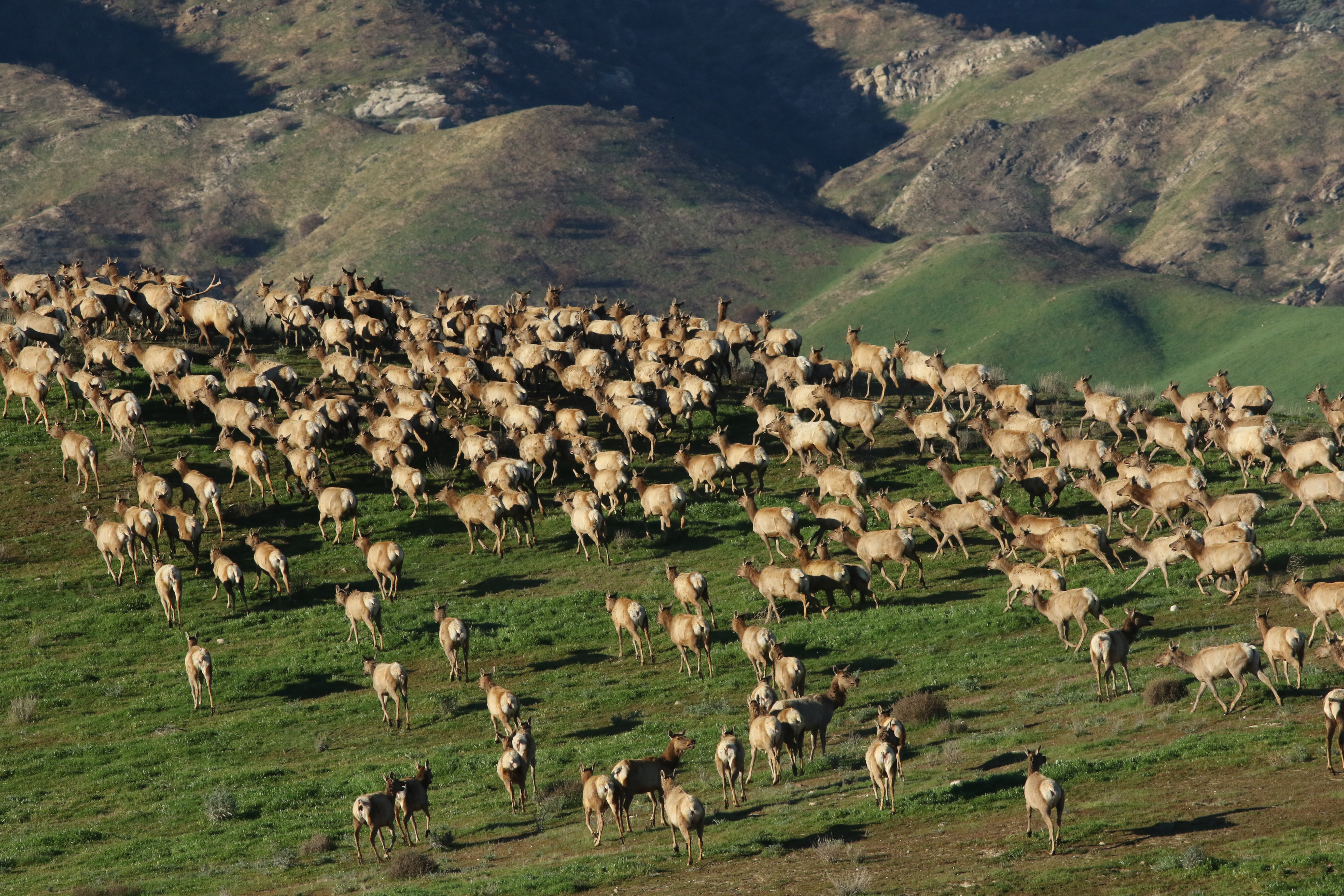
I could feel the soft alkali loam tremble beneath my feet, as roughly 300 tule elk rumbled out of the rolling foothills of the Caliente Mountains and across the sweeping expanse of the Carrizo Plain National Monument.
A pack of coyotes yelped near the western fringe of the massive herd, forcing the cows to keep their calves within the protective middle of these majestic grassland browsers. They kicked up a large plume of dust as they continued moving eastward into the center of the 250,000-acre plain. The haze from the dust wafted skyward, concealing the herd huddling in dense thickets of saltbush near a series of salt-encrusted vernal pools, part of the diverse grassland ecosystem.
The tule elk had bounded through the burn area scorched by the Madre Fire in July 2025. That fire blackened 80,786 acres, including large swaths of the Carrizo Plain all the way to Soda Lake Road, the main route through the National Monument. That blaze was quickly followed by another larger fire in August. The Gifford Fire broke out on August 1, 2025, and the fast-moving fire torched 131,000 acres of Santa Barbara and San Luis Obispo counties.
Beaver Moon
It was difficult watching the fires burn portions of the Caliente Mountains and the semi-arid grasslands below. Visibility was poor, and the air quality was even worse. Initially, it looked bleak across the Carrizo Plain. Wildlife across the unique grassland environment is some of the rarest and most endangered in California, and I didn’t see much of anything following those wildfires. The jet-black burn scar was a constant reminder for several months.
However, there was some uplifting news while the habitat slowly recovered. Last November 2025, I was photographing the brilliantly bright Beaver Moon rising above the seemingly barren Temblor Range and salt-encrusted layer of Soda Lake. Suddenly, a white truck zoomed past me on Soda Lake Road, but it quickly came to a halt. The driver slowly backed up. It was Brandon Swanson, a wildlife biologist for California Department of Fish and Wildlife (CDFW). He was on his way to catch a helicopter. Swanson, along with others, were in the middle of performing wildlife surveys over the burn areas. According to Swanson, things were looking up for tule elk herds across the sweeping veld.
One of the silver linings after a major blaze is clear, open space. Several months following the Madre and Gifford Fires biologists were getting a good read on tule elk numbers across the rugged landscape. Before the fires, it was thought that the tule elk population stood at around 550 animals in the Carrizo Plain and surrounding areas such as the Chimeneas Ranch and La Panza Range. Following six helicopter surveys hovering over a massive black burn scar, the total number of tule elk has potentially tripled.
“Consensus is that the tule elk herd is steadily growing,” said Swanson. “Tule elk are really one of the best conservation stories out there, and we are lucky to have so much success in bringing them back from the edge of extinction.”

Grassland Natives
Tule elk are California’s only native species of elk. They once numbered more than 500,000 individuals spread across the entire state, but by 1870 that number had plummeted due to overhunting, habitat loss and disease. They were thought to be completely extinct, but in 1874 anywhere between two to 10 tule elk were discovered on a Bakersfield ranch. From that meager number, the tule elk population has gradually rebounded, and their numbers continue to climb.
Over the decades, there have been many attempts to translocate tule elk and reestablish herds throughout the state. By 1986, 22 populations had been returned to historic territories, numbering 2,000 elk. Some of those include regions of the Western and Eastern Sierra, Point Reyes National Seashore, Bitter Creek National Wildlife Refuge, Wind Wolves Preserve, Fort Hunter Liggett, Camp Roberts, and the Pozo-LaPanza herd that extends eastward to the Carrizo Plain. Forty years since, that number has doubled, with the herds in and around the Carrizo Plain becoming one of the fastest growing in all of California.
“Our minimum count for the monument was around 550,” continued Swanson, referring to the region in and around the Carrizo Plain National Monument. “Now, following the fires, it’s about 1,200 altogether including North Carrizo, Temblors and South Chimineas. There is plenty of room for the population to grow. Water is the biggest limiting factor for habitat utilization.”

After the Blaze
Both fires burned large portions of the Caliente and La Panza Mountains where overgrown vegetation hadn’t burned for decades. The rugged topography coupled with strong winds made it difficult to contain each fire. Still, a silver lining lay within the burn scar.
“The fires seem to have had no negative effect on the elk population and may have been a positive by encouraging new growth,” he explained. “Elk were seen utilizing the burn scar frequently.”
Another way to enhance their habitat has been the recent removal of unnecessary fencing, ranchland relics that can be found throughout the Carrizo Plain. Barbed wire has negative impacts on grassland species, so a lot of that fencing has been removed.
Where fencing is still needed, barbed wire has been replaced with exclusively wildlife-friendly wiring that is smooth, top and bottom, to allow safe passage, mainly for pronghorn antelope and tule elk.
“We plan on removing dilapidated and unnecessary fencing for the foreseeable future,” said Swanson. “There are miles of fence that we have identified for removal. Where fencing is still needed, we have switched to exclusively wildlife-friendly fencing with smooth top and bottom wire at the appropriate heights.”
Related Posts



Premier Events
Sat, Oct 10
9:00 AM
Santa Barbara
Treble Clef Chorus Fall Treasure Sale

Sun, Oct 11
5:00 PM
Santa Barbara
Trinity Choir: Choral Evensong

Thu, Oct 08
7:00 PM
Santa Barbara
“A Night of Blues” with Morganfield Burnett
Fri, Oct 09
7:00 PM
Santa Barbara
Paseo Nuevo Spooky Movie Nights

Sat, Oct 10
9:00 AM
Santa Barbara
SBNC 1st Annual Health & Wellness Fair

Sat, Oct 10
1:30 PM
Goleta
🌴 Another Day in Paradise at S.B’s Premier Ice Rink

Sun, Oct 11
7:00 AM
Ojai
Flamenco Guitarist Tony Ybarra

Sun, Oct 11
10:00 AM
Santa Barbara
18th Annual Domestic Violence Solutions Brunch
Sun, Oct 11
10:00 AM
Santa Barbara
Free Community Day at S.B. Botanic Garden

Sun, Oct 11
10:00 AM
Santa Barbara
Downtown Classic Car Show Santa Barbara

Sun, Oct 11
11:00 AM
Santa Barbara
Raíces y Sueños: Bilingual Storytime at Santa Barbara Museum of Art

Sun, Oct 11
2:00 PM
Santa Barbara
The Theatre Group at SBCC Presents: “CLUE”
Sat, Oct 10 9:00 AM
Santa Barbara
Treble Clef Chorus Fall Treasure Sale
Sun, Oct 11 5:00 PM
Santa Barbara
Trinity Choir: Choral Evensong
Thu, Oct 08 7:00 PM
Santa Barbara
“A Night of Blues” with Morganfield Burnett
Fri, Oct 09 7:00 PM
Santa Barbara
Paseo Nuevo Spooky Movie Nights
Sat, Oct 10 9:00 AM
Santa Barbara
SBNC 1st Annual Health & Wellness Fair
Sat, Oct 10 1:30 PM
Goleta
🌴 Another Day in Paradise at S.B’s Premier Ice Rink
Sun, Oct 11 7:00 AM
Ojai
Flamenco Guitarist Tony Ybarra
Sun, Oct 11 10:00 AM
Santa Barbara
18th Annual Domestic Violence Solutions Brunch
Sun, Oct 11 10:00 AM
Santa Barbara
Free Community Day at S.B. Botanic Garden
Sun, Oct 11 10:00 AM
Santa Barbara
Downtown Classic Car Show Santa Barbara
Sun, Oct 11 11:00 AM
Santa Barbara
Raíces y Sueños: Bilingual Storytime at Santa Barbara Museum of Art
Sun, Oct 11 2:00 PM
Santa Barbara



You must be logged in to post a comment.