
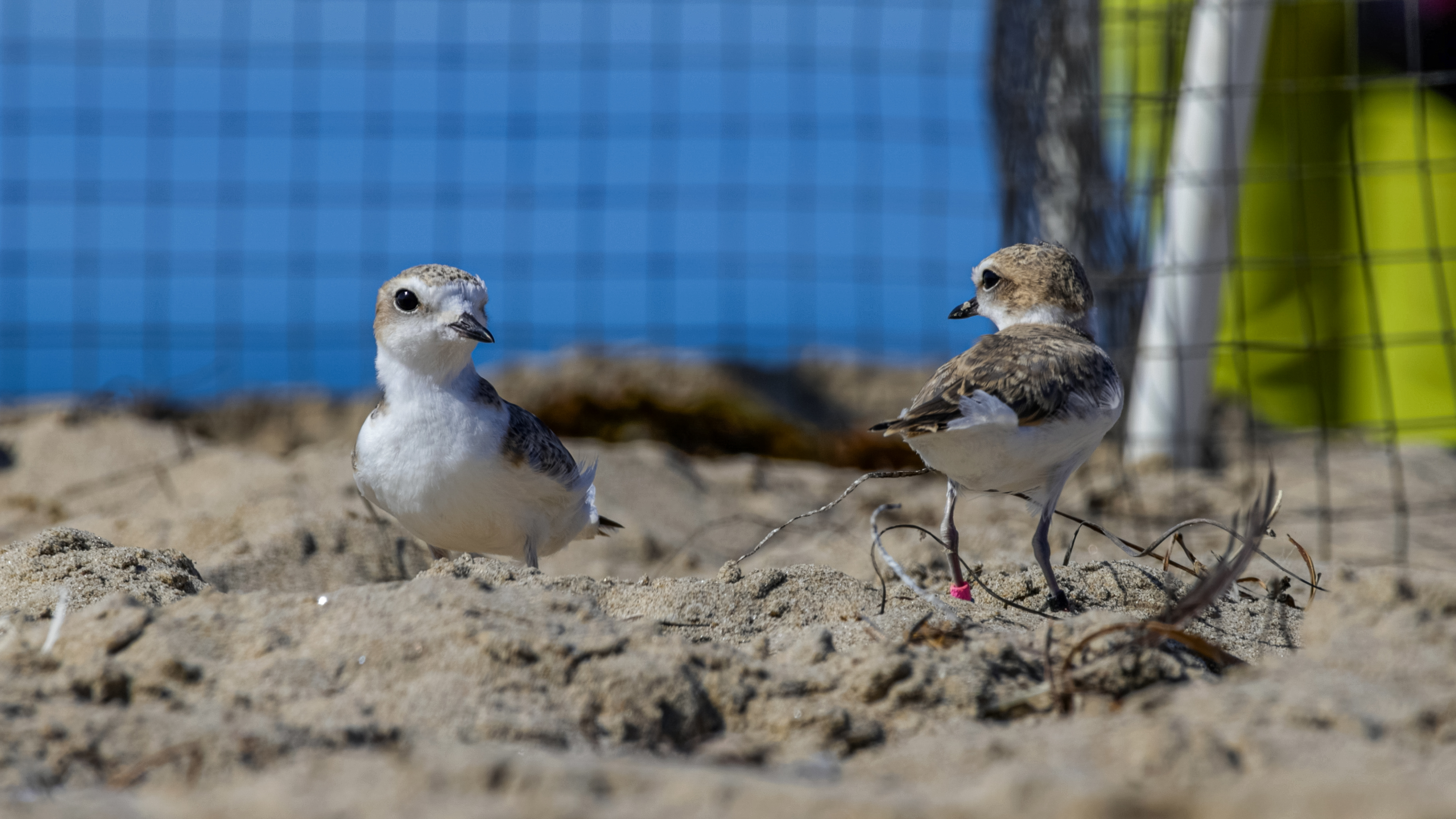
At Coal Oil Point Reserve in Isla Vista, dozens of Western snowy plovers flutter across the beach and watch over their eggs laid on the open sand. On Tuesday, 11 new plovers joined them, flashing colorful ankle bracelets.
They came from the Santa Barbara Zoo, which rescues eggs — and sometimes chicks — from abandoned nests on tri-county beaches, hatches them, rears them, and prepares them for life back in the wild.
Staff and volunteers looked on with pride as the tiny gray-and-white shorebirds stepped out of their makeshift cages onto the beach — some enthusiastically, others with much trepidation.
To fully breach the unknown, one bird in particular needed some gentle encouragement from Armando Aispuro, Coal Oil Point Reserve’s resource manager. None of these birds had ever set foot on the beach before, he noted.
This was the zoo’s final release of the season, in partnership with UC Santa Barbara and the U.S. Fish and Wildlife Service. It marked the release of more than 200 back into the wild since the program’s inception in 2016.
Because of habitat loss and human disturbance, plover numbers dropped significantly, and they were listed as “threatened” under the Endangered Species Act in 1993.
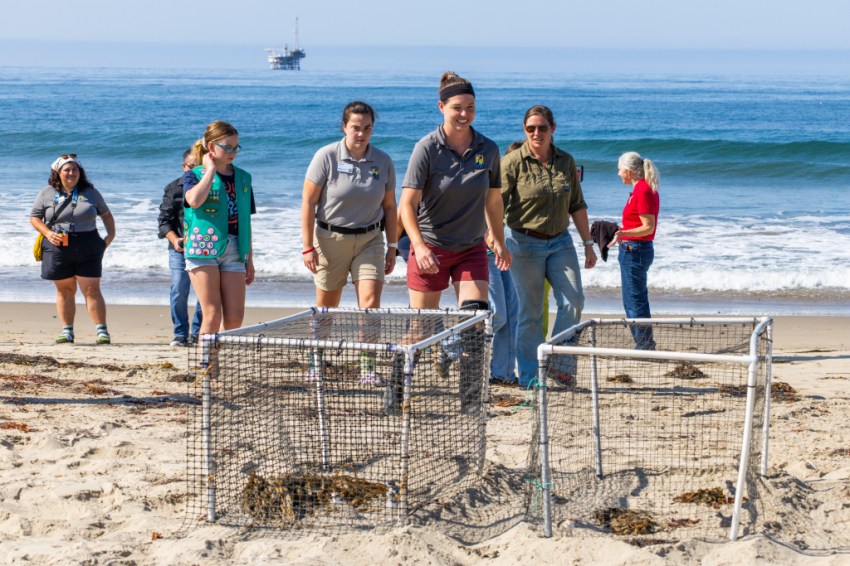
At Coal Oil Point, part of the UC Natural Reserve system, staff have been working with plovers since 2000. For decades, human activity discouraged plovers from nesting there. Two years of research identified the problem and informed the solution: fencing and a docent program.
“They immediately started nesting again after 40 years,” said Cristina Sandoval, the reserve’s director.
From there, conservation efforts grew into the current plover conservation program — informed by training from the Monterey Bay Aquarium — which is now a model for other beaches. It demonstrates how people and plovers can co-exist, as long as plovers have space and peace.
“We know that if we want to get the plovers off of the endangered species list, we need to recover more beaches,” Sandoval said. “It doesn’t need to close the beach — this is a very good example of sharing the beach.”
The partnership with the zoo allows them to “pump some plovers into the population,” she continued, which is very important in high-mortality years. This is one such year, because of the incoming El Niño, which often brings heavy rains to Southern California.
Human disturbance and weather events necessitate intervention, said Julie Barnes, vice president of animal care and health at the zoo. The goal is to intervene early and stabilize the population, she explained, supported by chicks reared at the zoo.
“We don’t want their numbers to keep declining to the point that they become endangered,” she said. “It’s much more difficult to recover a species once they’ve reached the endangered status than when they’re at the threatened stage.”
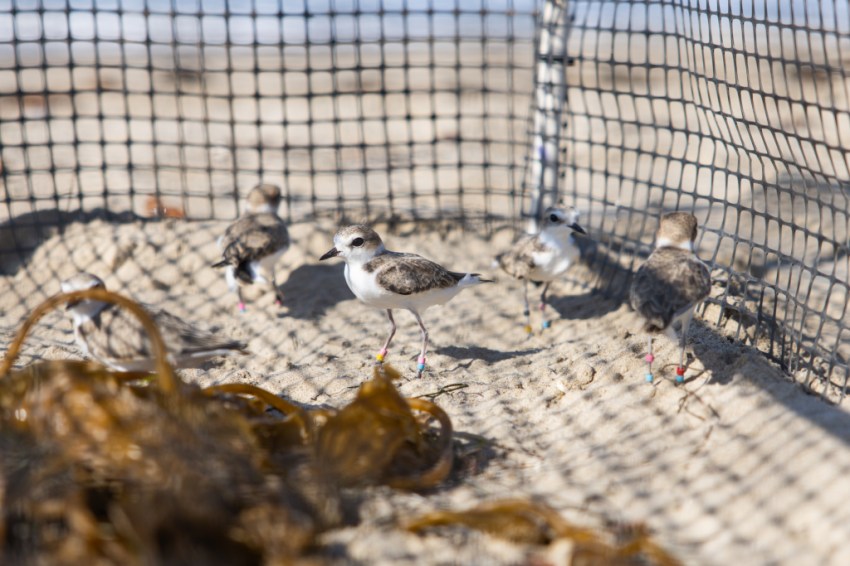
Oh, and the bird’s foot bling? Tracking bands. After being permitted to band the plovers last year, the zoo has banded all birds prior to release. This year, for the first time, they equipped them with 11 tracking devices that use radio and Bluetooth signals, making data collection for conservation efforts easier than ever.
Both devices can upload data to the Motus network, an international collaborative research network that tracks the movement and behavior of migratory animals.
It’s an upgrade from the analog method: relying on eagle-eyed birders to spot and report colored ankle bands the size of a grain of rice. But it has been successful: Through the zoo’s banding program, released birds have been observed nesting as far south as San Diego and have even been spotted as far north as the Oregon coast, the zoo said.
The new Motus tags could increase detection rates exponentially and give conservationists insights that were previously out of reach, the zoo said. It marks the first time rehabilitated plovers will be monitored using this technology after being released to the wild.
“Now, this allows us to understand movement and survivorship, and that…can directly go back and inform our management,” said Nadya Seal Faith, a conservation and science associate at the zoo.
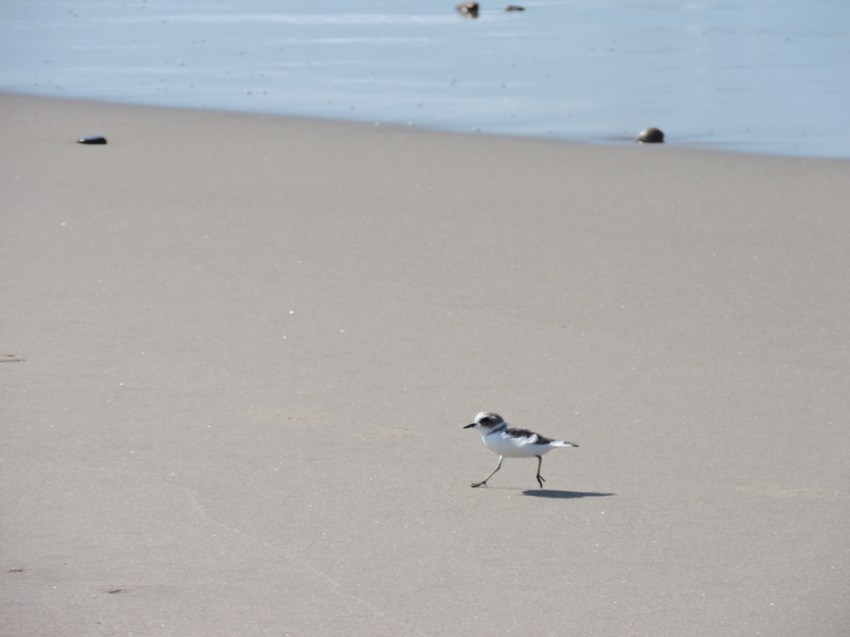
This year, the zoo took in 69 eggs and chicks and released 42 individuals. To date, the Santa Barbara Zoo has released 212 plovers back to the beach.
Some birds may ultimately stay at the beach, and some may move on to other beaches along Central and Southern California, or even the Channel Islands, Barnes explained. No matter where they end up, she said, it is incredibly rewarding to see them return to the wild.
“I mean, this is our mission,” Barnes said. “This is why we all work at the zoo.”
Beachgoers can help protect threatened western snowy plovers by:
● Staying outside roped-off nesting areas from March through September
● Keeping dogs leashed and using designated dog beaches
● Avoiding using kites and drones near plover nesting areas
● Packing out food scraps that can attract predators
Related Posts




Premier Events
Fri, Oct 23
2:00 PM
Santa Barbara
Music & Meditation: Clarinetist Nancy Mathison & Pianist Antonio Artese

Tue, Oct 20
7:00 PM
Santa Barbara
Get Out the Vote Night @ SOHO, Music Performance by Loyal Defense Workers

Wed, Oct 21
6:30 PM
Santa Barbara
Teflon Comedy/Non-Schtick – Evening of Comedy

Thu, Oct 22
5:30 PM
Santa Barbara
Best Fest: A Celebration of the Best of Santa Barbara® Readers’ Poll 2026

Thu, Oct 22
6:00 PM
Santa Barbara
Chaucer’s Books Author Talk & Signing- Daniel M. Jaffe “Russian Silhouette: A Memoir of Activism and Identity”

Fri, Oct 23
5:30 PM
Solvang
Solvang Haunted House and Street Fair

Fri, Oct 23
7:00 PM
Santa Barbara
Beth Amine’s 20th Anniversary Wildcat Dance Variety Show

Fri, Oct 23
9:00 PM
Santa Barbara
Casa de la Raza Fundraiser: Brasscals! with DJ Darla Bea

Sat, Oct 24
10:30 AM
Santa Barbara
Picnic in the Cemetery: A Live Historical Event

Sat, Oct 24
11:00 AM
Goleta
2nd Annual Charger Cup to Benefit DP High Golfers

Sat, Oct 24
12:00 PM
Santa Barbara
Makers Hive Market
Fri, Oct 23 2:00 PM
Santa Barbara
Music & Meditation: Clarinetist Nancy Mathison & Pianist Antonio Artese
Tue, Oct 20 7:00 PM
Santa Barbara
Get Out the Vote Night @ SOHO, Music Performance by Loyal Defense Workers
Wed, Oct 21 6:30 PM
Santa Barbara
Teflon Comedy/Non-Schtick – Evening of Comedy
Thu, Oct 22 5:30 PM
Santa Barbara
Best Fest: A Celebration of the Best of Santa Barbara® Readers’ Poll 2026
Thu, Oct 22 6:00 PM
Santa Barbara
Chaucer’s Books Author Talk & Signing- Daniel M. Jaffe “Russian Silhouette: A Memoir of Activism and Identity”
Fri, Oct 23 5:30 PM
Solvang
Solvang Haunted House and Street Fair
Fri, Oct 23 7:00 PM
Santa Barbara
Beth Amine’s 20th Anniversary Wildcat Dance Variety Show
Fri, Oct 23 9:00 PM
Santa Barbara
Casa de la Raza Fundraiser: Brasscals! with DJ Darla Bea
Sat, Oct 24 10:30 AM
Santa Barbara
Picnic in the Cemetery: A Live Historical Event
Sat, Oct 24 11:00 AM
Goleta
2nd Annual Charger Cup to Benefit DP High Golfers
Sat, Oct 24 12:00 PM
Santa Barbara


You must be logged in to post a comment.