

An artist and urban environmental idealist, the conceptual artist and environmental/landscape planner Bonnie Ora Sherk was not one to follow a prescribed life in art, or life. She was also not afraid to “go public” — beyond the generally enclosed quarters of the “art public.”
What comes across in Bonnie Ora Sherk: Life Frames Since 1970, the new exhibition kicking off the academic season at the UCSB Art, Design & Architecture Museum (AD&A), is a portrait of an artist and thinker who went her own way and made an impact, socially and artistically. She also had a maverick, absurdist sense of humor and an idealist’s vision as a driving undercurrent. At the root of her diverse work was the idea of “life framing,” framing life through art.
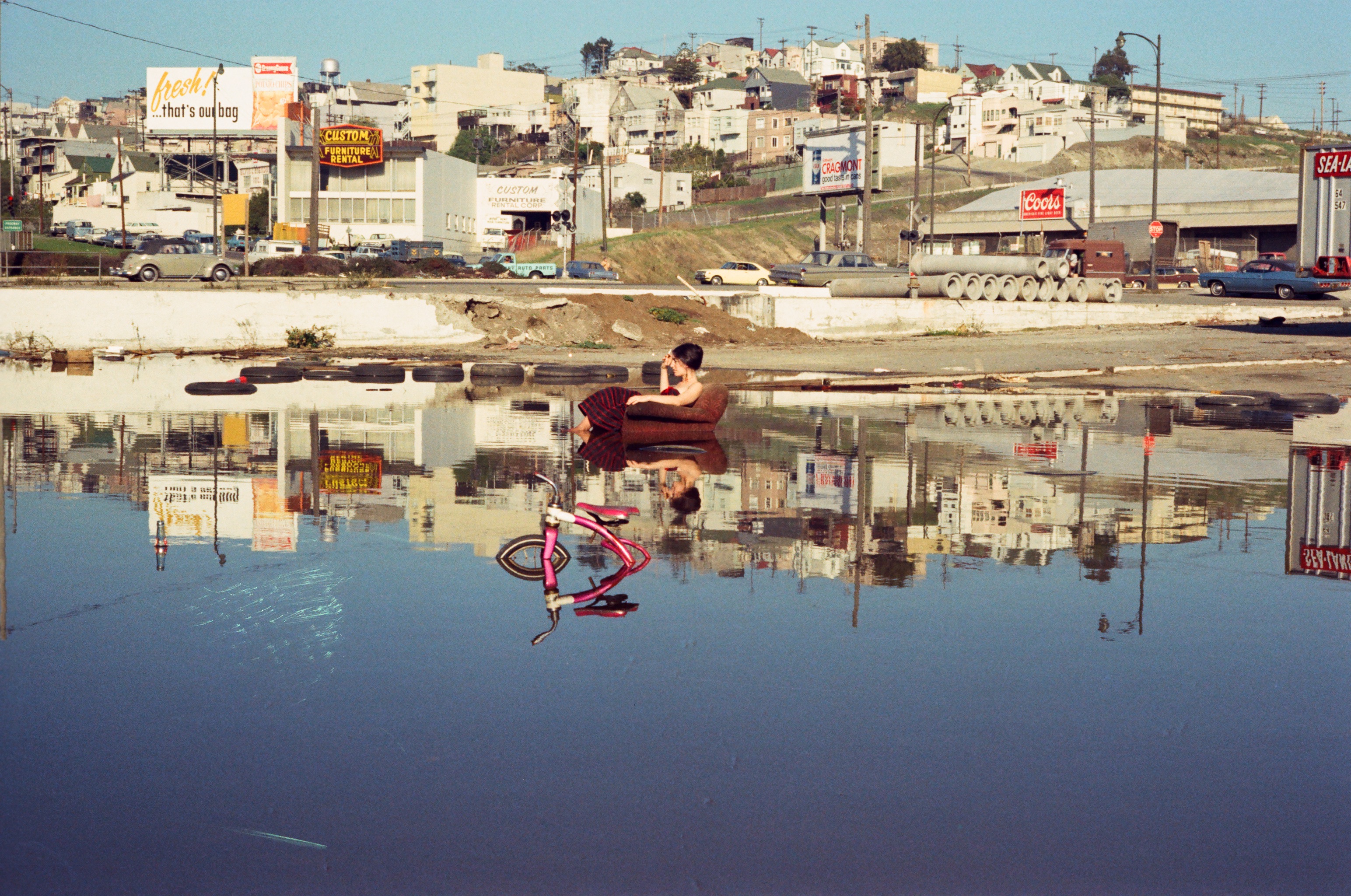
As we enter the museum’s main gallery, we are greeted by a large photo of the artist sitting comfortably in a categorically uncomfortable situation — slunk down in an easy chair half-submerged in a body of water adjacent to an urban interchange in San Francisco. This was near the site of a significant project on her résumé, the Crossroads Community, a k a “the Farm,” an alternative art space on Potrero hosting exhibitions, performance art happenings, and educational farming encounters for children. A bohemian-utopian dream, in other words. It existed for a few years until it became a punk palace in 1980, then was evicted in 1987.
Sherk, who was born in New Bedford in 1945 and died in her longtime adopted home of San Francisco in 2021, is getting the spotlight she deserves with this show, the first major survey of her work. Curated by Tanya Zimbardo for San Francisco’s Fort Mason Center for Arts & Culture and curated here by AD&A Assistant Director and Curator of Exhibitions Ana Briz, the show necessarily relies on photographic and video documentation to portray an artist whose work largely dealt with performance art, conceptual turns of thought, and actual on-site landscapes and gardens.
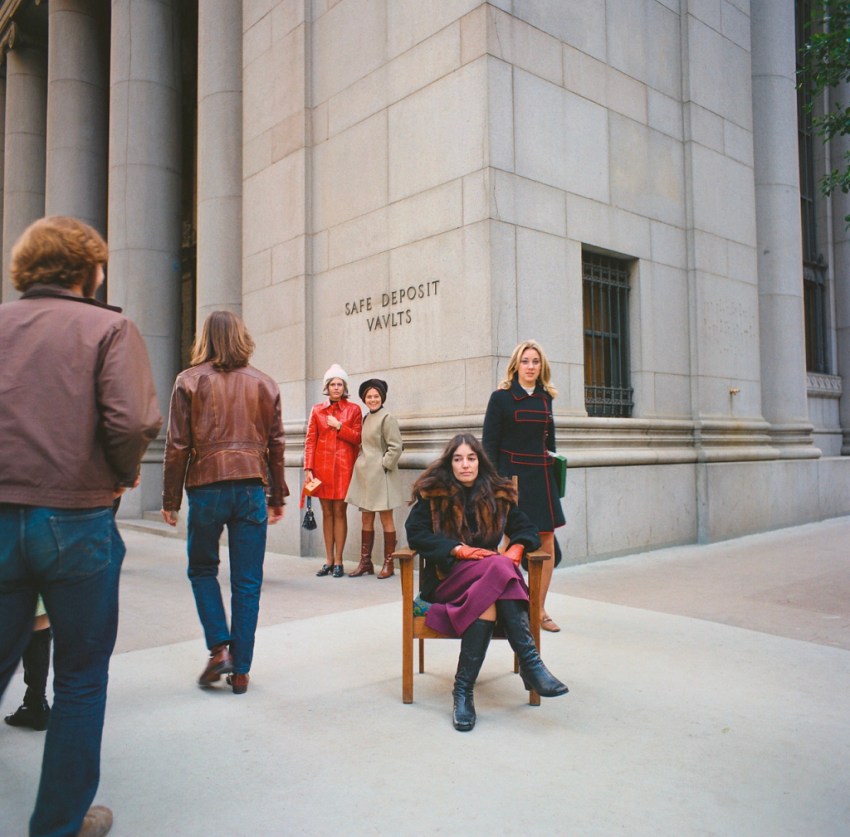
Among Sherk’s performance art pieces were “bucolic demonstrations,” such as one in the Portable Parks series: she brought a bland freeway median strip to life with a palm tree, a patch of sod grass, an actual cow, and an actual human (the artist). She used art to shake up the status quo, generating environmental transformation and reinventing what we assume are the rules of order.
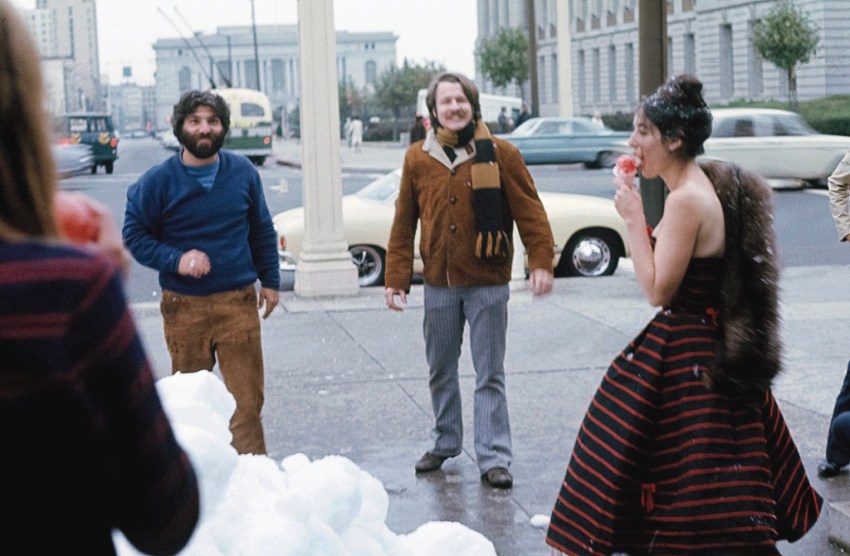
In “Snow Job,” 1970, elegantly dressed women delivered piles of fresh snow to select spots in San Francisco — including in front of the San Francisco Museum of Art — and handed out snow cones. The innately ephemeral, semi-Dadaist work ended with the melting of the snow, the liquidation of the art supplies. The artist also assumed a real-world identity as a waitress with a poofy, expanded hairdo in “The Waitress, Andy’s Donuts.”
She expressed sympathy for farm animals with works such as “Pig Sonata,” 1971, in which a musical piece with a recording of a pig eating — “pigging out” — and a live pig eating in a performance at the Museum of Conceptual Art (MOCA).
In a modest sample of living, moving documentation, the museum’s back gallery screens video examples of her performance pieces, including “Public Lunch,” in which the artist dines in refined style in the zoo cage/prison cell next to a lion. Elsewhere, she sits stoically in a zoo cage, in apparent numbed solidarity with her incarcerated animal neighbors. In another piece, she paces, to and fro, on a sidewalk next to a roadway (think the 101 underpass on State Street), embodying nervous, repetitive urban energy.
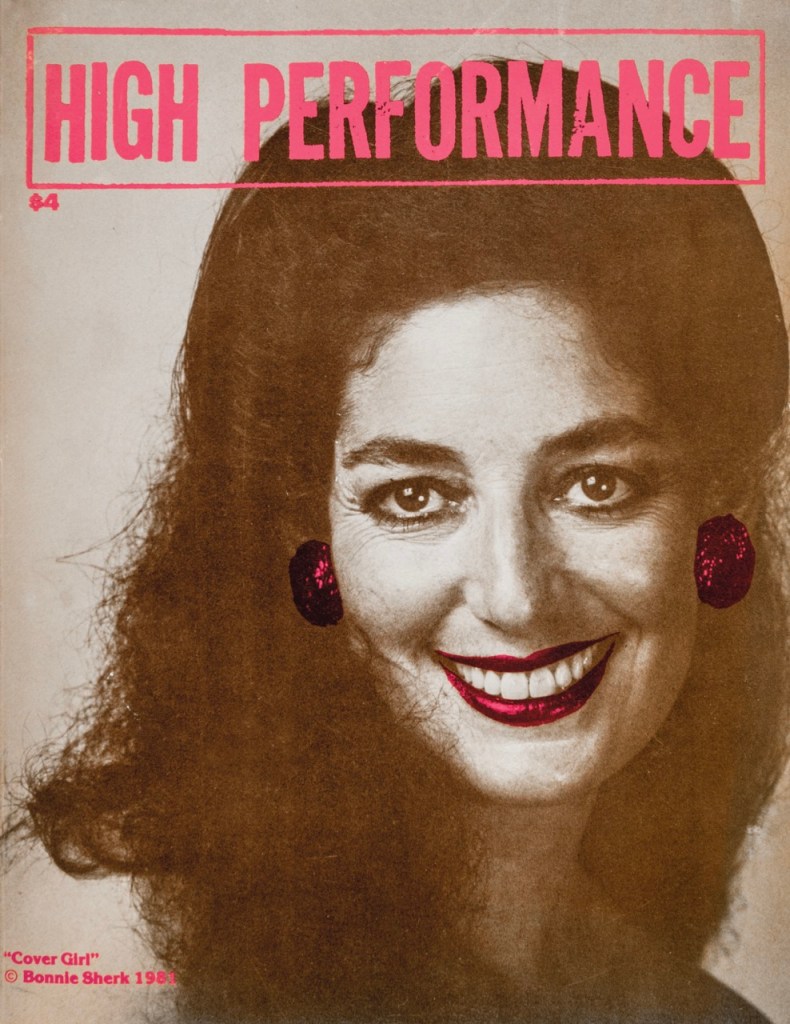
As a relevant side note, the AD&A show is configured as High Performance: A 2-Year Conference, shedding light on the influential, Los Angeles–launched magazine High Performance (1978-1997), which featured Sherk as a cover subject.
One telling physical artwork in the gallery is the reconfigured flag captured in the color photo piece “Ms. Liberty and her New Patriotic Flag” (1984), with the artist in a bright red dress and cheeseball crown, appearing ultra-smiley and garishly flaunting the flag. Said flag, in red, white and blue, features the text “Be disarming…choose life/Be disarming… choose art/Be disarming… create!”
On less openly political or provocative turf, in her later work, Sherk put considerable energy into creating the still-existing project, “A Living Library (ALL),” started in 1981 and with extant outposts in San Francisco and New York. “ALL” brought gardens and ecology-mindedness to urban sites, green and growing spaces in the city with an emphasis on encouraging youths to connect with nature, and to engage in a literally organic form of the flag’s imperative, to “create!”
Sherk had big ideas, and a wide lens through which to feed them. Her art can’t be easily packaged or presented on gallery walls or floors, but this show is an important reminder of the potentially lasting impact of inherently impermanent art actions.
One of Sherk’s repeatable works will come to life again on October 15, when snow arrives at the museum for a special performance and workshop of her “Snow Job,” from 12 p.m. to 2 p.m. Snow cones will be on hand for art’s sake.
Bonnie Ora Sherk: Life Frames Since 1970 is on display at UCSB’s AD&A Museum through November 29. For more information, see museum.ucsb.edu.
Related Posts

Premier Events
Sun, Oct 25
11:00 AM
Santa Barbara
Free Family Day: Día de los Muertos
Sun, Oct 25
12:00 PM
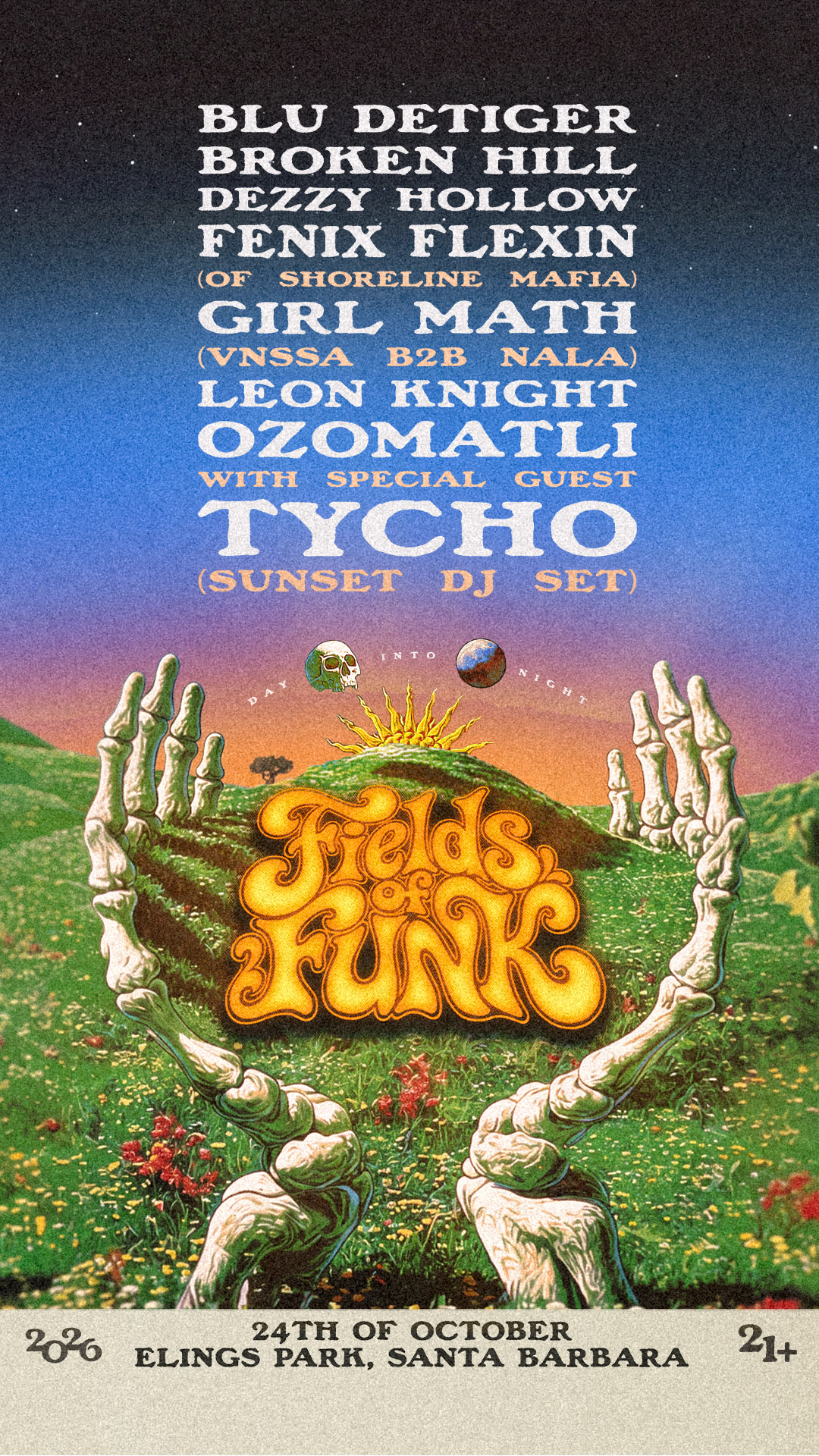
Fields of Funk
Sun, Oct 25
2:00 PM
Santa Barbara
Halloween Pooch Parade
Sun, Oct 25
3:30 PM
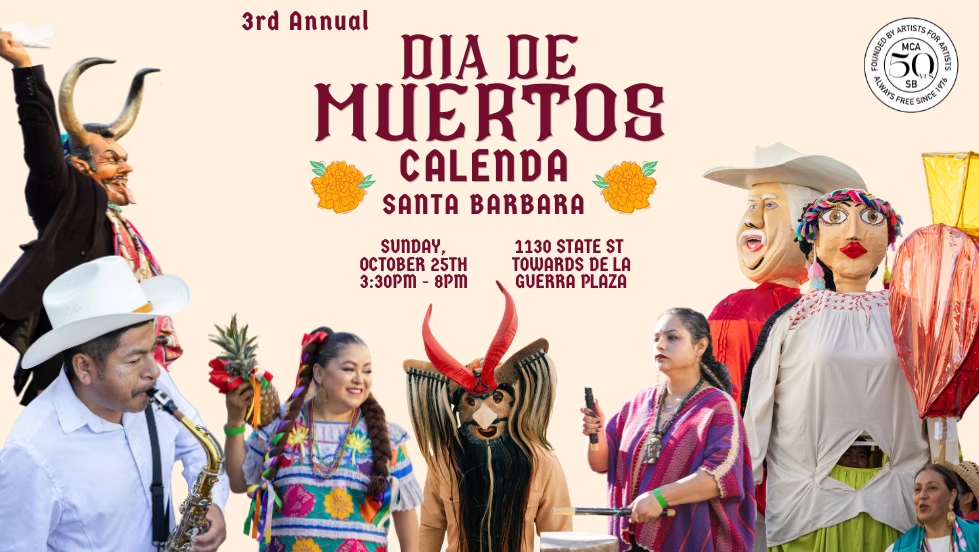
Dia de Muertos Calenda 2026
Sun, Oct 25
4:00 PM
Santa Barbara
S.B Revels Annual S.B Harbor Sing
Sun, Oct 25
7:30 PM
Santa Barbara
Comedy is a Drag Halloween Spooktacular
Mon, Oct 26
5:00 PM
Montecito
Halloween at The Speakeasy at San Ysidro Ranch
Mon, Oct 26
6:00 PM
Santa Barbara
Chaucer’s Book Talk & Signing with Jennifer Chassman Browne “See Us, Know Us: Profiles of Disability”

Wed, Oct 28
5:00 PM
Santa Barbara
Fundraiser for Domestic Violence Solutions

Wed, Oct 28
7:00 PM
Santa Barbara
Reel Rock 20 Climbing Film Tour
Sun, Oct 25 11:00 AM
Santa Barbara
Free Family Day: Día de los Muertos
Sun, Oct 25 12:00 PM
Fields of Funk
Sun, Oct 25 2:00 PM
Santa Barbara
Halloween Pooch Parade
Sun, Oct 25 3:30 PM
Dia de Muertos Calenda 2026
Sun, Oct 25 4:00 PM
Santa Barbara
S.B Revels Annual S.B Harbor Sing
Sun, Oct 25 7:30 PM
Santa Barbara
Comedy is a Drag Halloween Spooktacular
Mon, Oct 26 5:00 PM
Montecito
Halloween at The Speakeasy at San Ysidro Ranch
Mon, Oct 26 6:00 PM
Santa Barbara
Chaucer’s Book Talk & Signing with Jennifer Chassman Browne “See Us, Know Us: Profiles of Disability”
Wed, Oct 28 5:00 PM
Santa Barbara
Fundraiser for Domestic Violence Solutions
Wed, Oct 28 7:00 PM
Santa Barbara



You must be logged in to post a comment.