


At the Santa Barbara Botanic Garden, scientists are burning things.
It may sound counterintuitive, but it serves a purpose. Led by its bright-eyed new fire scientist, 29-year-old Kristina Fauss, the garden is testing native plants’ ability to withstand wildfires.
Using a combustion chamber, Fauss and her team can test a plant’s ability to resist ignition, and study how it burns, using hot plates and wires that reach up to 932 degrees Fahrenheit.
In Fauss’s words, the garden is “going fishing” for natives that don’t burn easily — aiming to reduce property loss from wildfire while conserving water and supporting biodiversity.
Santa Barbara County and its neighbors are prone to wildfires. Looking north, three Monterey County fires that broke out in August are still actively burning after charring nearly 60,000 acres.
County and state assessments show that wildfire hazards have increased significantly in the past 15 years, mainly due to warmer temperatures and drier fuels. Santa Barbara County has certainly felt the heat.
One past Central Coast fire led Fauss to change directions. She began her studies at the University of Virginia in civil engineering and coastal flooding but decided to head west around 2018 after learning about the devastating Thomas Fire spreading across the Central Coast.
“I decided to go west, towards wildfire,” she said. “There are just so many different ways to think about the problem of wildfire.”
She switched focus to wildfire hazard and ecology — looking at questions around plant flammability — and recently earned her doctorate in geography from UC Santa Barbara.
At UCSB, she scaled up the combustion lab run by Wildfire Specialist and Adjunct Professor Max Moritz. She implemented new ignition methods and led the lab for four years. During that time, she established a relationship with the Botanic Garden “very early on” to explore testing plants’ flammability before taking on her current role.
Their primary focus boils down to three components: ignitability, which is how easily a plant lights on fire; combustibility, which is how aggressively it burns; and sustainability, which is how long it burns.
One thing the garden is doing is testing oak trees to be used in fuel breaks, or the places where vegetation is carefully managed to slow a wildfire and reduce its intensity. Oak trees could interfere with wind and embers — and are one of the hardest species to light on fire. Leaving a fuel break entirely barren, Fauss noted, can contribute to other problems such as worsened erosion.
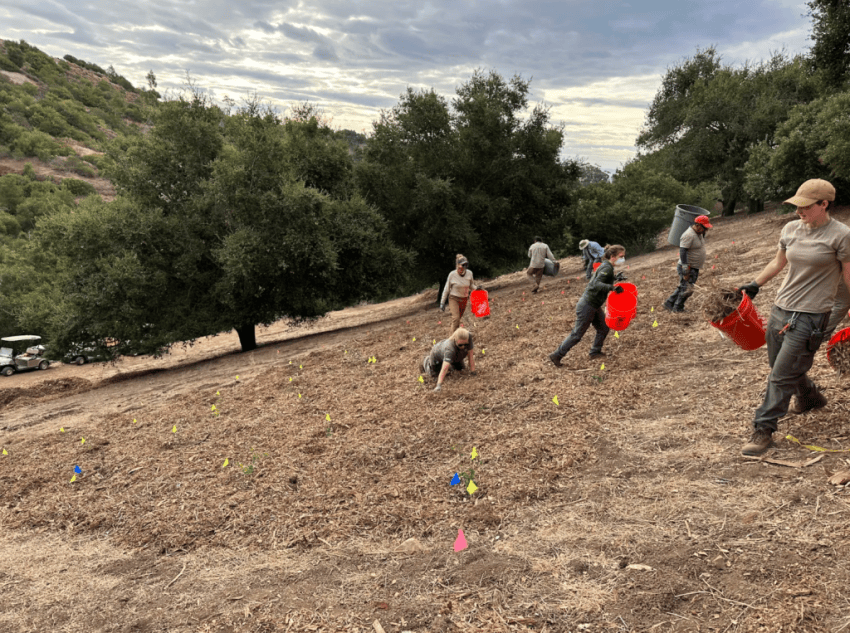
“Even just thinking about fuel break maintenance, establishing a traditional fuel break is really expensive, and it costs communities a lot of time and energy just to clear that piece of land over and over every year,” Fauss said.
Finding more fire-resistant, low-maintenance native plants could reduce that burden.
But there are a lot of questions scientists don’t have answers to, “because we haven’t actually done combustion testing on a lot of our common native species,” Fauss said.
For example, Santa Barbara experiences seasonal drought, but for many of the region’s plants, scientists are still figuring out how their flammability changes throughout the year in varying drought conditions, Fauss said.
Building on her PhD work, Fauss aims to begin finding answers. She will use the garden as a laboratory to identify species to recommend for fuel breaks and defensible space — “buffer zones” that slow or prevent a fire’s spread — starting with 15 different native plants.
Additionally, Fauss noted, there are plenty of fire-related studies happening at UCSB, and she hopes to collaborate with the school’s research labs.
During her studies, Fauss looked at the probability that ignition will turn into a wildfire. She looked at the moisture content of plants. And she found out that moisture didn’t matter nearly as much as wind. Overall, fires driven by high winds account for about 90 percent of the areas burned during fire season in Southern California, research shows.
So, if wind is the primary hazard, how can the region’s fuel breaks be improved? One of the things Fauss hopes to accomplish at the garden is combustion testing for different tree species, such as oaks, coupled with wind-modeling at UCSB, to determine recommendations for fire-fighting trees. Because, as Fauss said, “trees mess with the wind.”
What they can do at the garden, she said, is burn things.
“At the garden, we need to be able to deliver results and deliver change,” Fauss said. “We’re taking almost like repetitive, boring science, and then turning that into real change.”
Fauss arrives at a time when the state is attempting to combat a proclaimed wildfire crisis. It has ramped up wildfire prevention, including the Board of Forestry and Fire Protection recently adopting a 5-foot rule for defensible space around homes in high fire hazard areas. The emergency regulation — known as Zone 0 — is pending review by the Office of Administrative Law.
People can start at home, Fauss noted. Watch Fauss’s recent talk on how to protect your home from wildfire and protect biodiversity here.







You must be logged in to post a comment.