

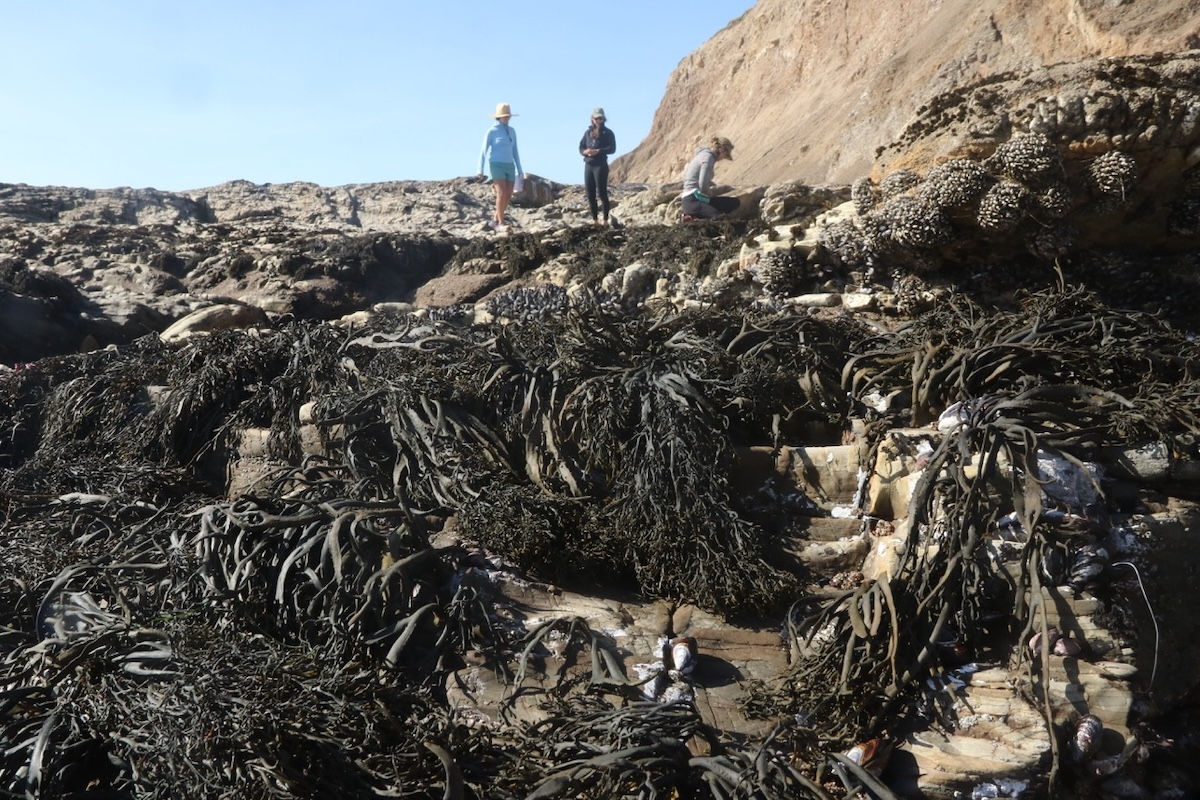
Steam wafted skyward off wet, hard-packed mud as a late-morning high tide quickly receded and thundering surf from the northwest battered teeming offshore reefs just north of Point Conception.
I was following Dr. Erica Nielsen, a coastal evolutionary ecologist, down a narrow shale gully to the beach. She was leading me to a restoration site of golden rockweed, an aquatic plant needing help in the intertidal zones of Santa Barbara County.
Golden rockweed (Silvetia compressa) is a type of small, brown seaweed that doesn’t garner the attention of the elegant, 100-foot-tall kelp found off the Southern California coast, or the robust softball-size bull kelp found further north. Still, it’s a vital piece of the ecosystem, connecting hundreds of organisms struggling to survive in an ever-changing climate.
“Rockweeds are declining in California due to a combination of climate change, extreme weather events, urbanization, and other human impacts,” said Nielsen. “Declines in golden rockweeds are largest in southern California.”
Surviving in the upper intertidal zone exposes rockweeds to strong Santa Ana winds that can quickly dry them out. Marine heat waves like the one this March also have direct negative impacts, and human trampling and pollution also contribute to the degradation. Rockweeds’ natural predators include marine snails and limpets.
Building Resilience
Restoration of rockweed is still in its infancy stages, but researchers are moving fast. Nielsen said five full-time biologists have been working for nearly two years on recovery sites at the Dangermond Preserve near Point Conception. There are other active sites at the Channel Islands, and more cultivated out of Cal Poly San Luis Obispo and UC Santa Cruz.
Nielsen also works closely with Dr. Halley Froehlich at UCSB, who runs an on-campus aquaculture lab. Donor receptacles are taken from the ends of adult rockweed to produce baby rockweed. The lab simulates the ebb and flow of tides by pumping water in and out of its tanks.
Point Conception is an ideal venue for rockweed due to warm ocean currents flowing north and cold waters moving south. Late fall to early winter is the peak fertility period.
“Rockweed is supposed to be here,” said Nielsen. “Point Conception is a great place to test this. We want to bolster populations of rockweed, so they are more resilient. We want to get ahead of climate change.”
Neilsen and her team utilize north-facing intertidal zones to reestablish rockweed sites. The baby rockweed does better there because there’s less direct sunlight on them during low tides. And there’s more protection from north/northwest swells during the winter.
Algal Underdogs
Golden rockweed is often overlooked. It grows smaller and shorter than other kelps, and doesn’t have a long reach to easily photosynthesize. However, what it lacks in size it makes up for by providing cover for large numbers of organisms. Nielsen said a study found that more than 100 species are associated with golden rockweed, including mussels, anemones, other seaweeds, sandcastle worms, chitons, and marine snails.
It’s 29 degrees cooler on average under rockweed, even when it’s low tide and it’s exposed to the sun. “The loss of the rockweed canopy decreases the buffering habitat that is available to shade other rockweed individuals, leading to further declines,” said Neilsen. “This is why we are hoping to develop restoration tools that can bolster existing populations and create large, healthy rockweed beds that can better withstand future climatic threats.”
Once baby rockweed plants have been established in the aquaculture lab, they are transplanted in the field. The young plants are attached to epoxy discs that have been bolted into rocks at the restoration sites. Their eggs and sperm are located in small bulbs at their tips, and at low tide, they disperse. Thus far, researchers have reported a 20 percent success rate of reproduction.
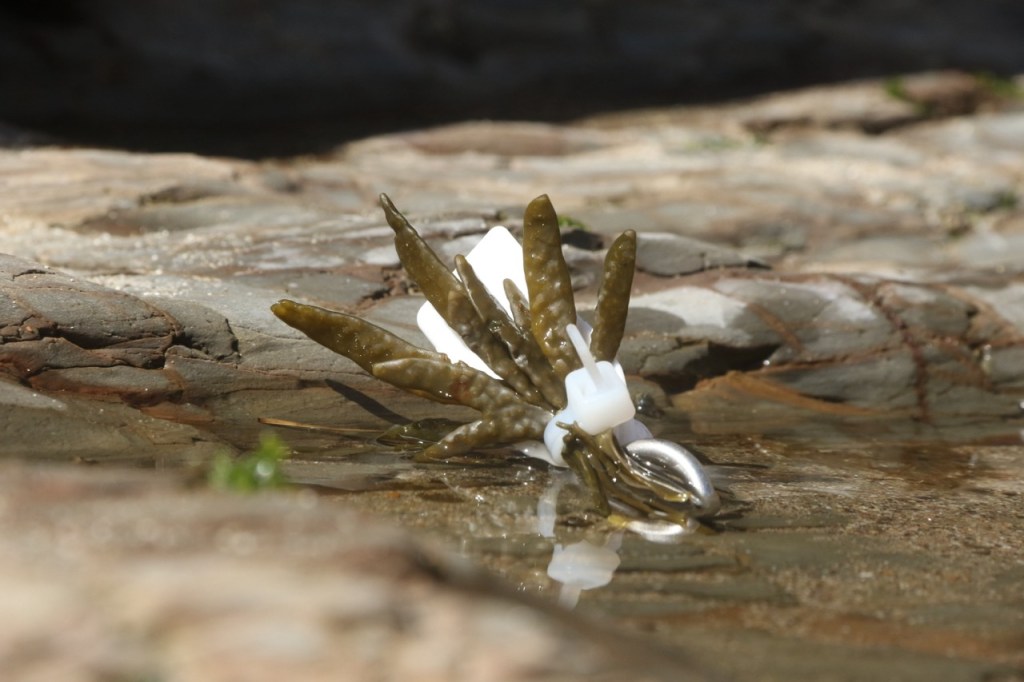
Neilsen and her team are also trying another technique using a hook and zip tie. The hook is screwed into rocks, and young rockweed branches are zip tied to the hook. The branches are replaced with fresh ones in monthly intervals, and close inspections carry on for six months.
“So, it is a long wait until we will be able to say if this method is effective,” said Neilsen. “But even in the past few months we have seen positive outcomes, which is that the branches generally stay attached to the bolts, and we can see the conceptacles on them have opened, thus releasing the eggs and sperm.”









You must be logged in to post a comment.