

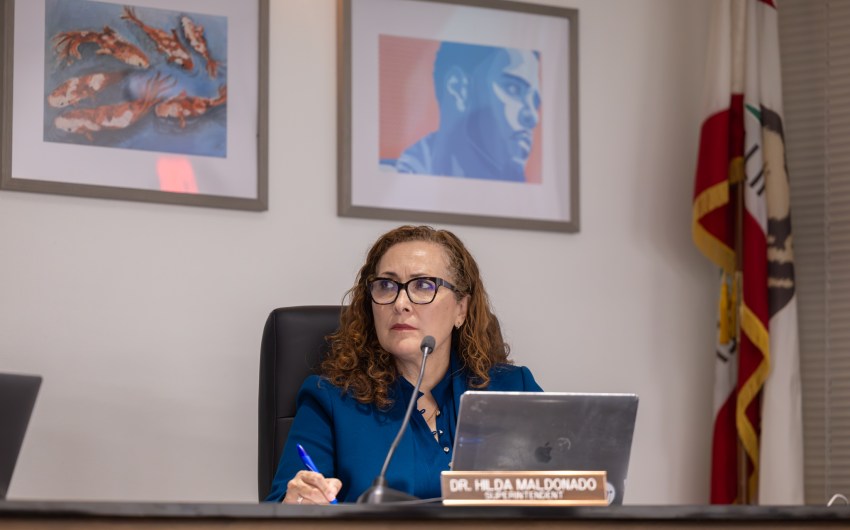
The motto for the State of Our Schools forum, hosted by the Santa Barbara Education Foundation and Santa Barbara Unified School District Superintendent Dr. Hilda Maldonado on Thursday morning, was “Learning at the speed of change.”
How fast exactly is change? Unclear. But to support vulnerable student populations and achieve educational justice, Maldonado noted that changes must occur quickly and keep up with a rapidly evolving world, with many parents and community members urging the district to step on the gas.
She emphasized that the district’s efforts go beyond solar panels and fair employee pay — two hot topics in the district. Two of the district’s priorities, she noted, are preparing students for college and making sure they can pay for it when they get there, citing the fact that most California 9th-graders will not earn a bachelor’s degree.
“We design a system to prepare students for a world that is changing … right now, we’re designed to get the results we are getting,” Maldonado said.
By Design?
Challenges in literacy and math achievement were highlighted by the forum’s speakers, matching the writing on the wall — literally. Data from state tests and district-wide demographics were posted around the venue.
Last spring’s test scores showed results the district is currently “designed” to achieve, including both progress and shortfalls. Schools are currently grappling with new curricula and also still working to recover from learning loss, and to heed lessons learned, during the pandemic. (Even now, with lockdown-learners being four years older.)
The 2023-24 test results from the California Assessment of Student Performance and Progress (CAASPP) showed that while overall scores for 3rd through 8th grades and 11th grade remained similar to previous years, 3rd and 8th graders improved in both English Language Arts (ELA) and math.
Most other grades either matched their 2023 scores or dipped slightly below.
However, longitudinal data — tracking results over the course of three years — indicated consistent improvement from 4th to 6th grade, with 37 percent of 4th graders meeting ELA standards rising to 50 percent by 6th grade. That includes Hispanic, Latino, and socioeconomically disadvantaged students (who make up 61.1 percent of the district’s students). This age range also saw significant improvement in math scores across the board.
“What we’re seeing here is actually growth in terms of how kids did over the three years,” said District Chief Operating Officer Steve Venz in his presentation to the school board on Tuesday.
On the other hand, the 7th to 8th grade cohort underperformed in ELA, reflecting a trend of decline in math as well.
‘We Need to Do More Work’
Students with disabilities maintained low scores without much improvement.
“I’m very concerned about dyslexics,” activist Monie De Wit told the board Tuesday night. She noted that for special education students in 4th grade, only 13.8 percent are meeting requirements, and in 11th grade, only 10.6 percent are meeting requirements.
“It takes too long for students to get the help they actually need .… We have so many vacancies, too,” she added, mentioning that the district recently hired 24 para educators to combat special education shortages. “Special education has been a mess for decades, actually, when you really drill down on it. Can we think about that and do something? Because this is really painful and sad.”
Boardmembers also expressed concerns about student achievement. Boardmember Sunita Beall questioned the curriculum, saying that there seems to be a “stagnation” in math achievement. “How do we look at this curriculum we’ve adopted and understand why the scores are not continuing to go up?” she asked.
In response, Venz brought up that in the process of adopting this year’s Local Control and Accountability Plan (LCAP), which sets goals on student achievement for district spending, they added additional mathematics support at the junior high level.
“We know the areas in which we need to do more work,” explained Assistant Superintendent of Elementary Education Denise Alvarado. “Upper grade levels are the area of focus for us definitely; the younger grades are where we’re seeing an increase in our progress.”
‘A Very Squishy Kind of Thing’
Boardmember Bill Banning warned about considering this data without a grain of salt — “It’s truly impossible to get a snapshot that tells us where we’re succeeding when we look at three bar graphs going up.”
“I appreciate all this data, but I want to remind us again that this is a business of humanity. This is people,” he continued. “This is teachers that are breaking their backs to do what they can, and not everyone comes in with the same starting point, hence the training,” referring to the voluntary training for teachers in ELA and, specifically, the science of reading.
It has now been a year since the district began its implementation of its new literacy curriculum. It just spent $23,000 on LETRS, an acclaimed research-based program designed to equip early childhood educators to support literacy development in young children, for all preschool teachers and district curriculum specialists (covering training for 40 staff members).
“I just want to make sure that we understand that data is a very squishy kind of thing when it comes to educational achievement,” Banning said.
‘These Things Take Time’
At the State of Our Schools, data also reflected declining enrollment, which has been steadily dropping statewide over the past decade and is projected to continue to decline in all but two California regions over the next decade.
And, on a more positive note, it also showed that the number of high school graduates meeting college admission requirements is “moving in the right direction,” Maldonado said, with the number currently hovering around 60 percent.
“Is it moving as fast as you want it to? Probably not,” she said. “But these things take time, and we’re seeing progress.”
Dos Pueblos High School, on its own, is currently beating both the county and the state in this area of student preparedness. Principal Bill Woodard attributed that to quality counselors and an emphasis on students having “endless possibilities.”
Related Posts




Premier Events

Fri, Oct 23
5:30 PM
Solvang
Solvang Haunted House and Street Fair

Fri, Oct 23
7:00 PM
Santa Barbara
Beth Amine’s 20th Anniversary Wildcat Dance Variety Show
Fri, Oct 23
7:00 PM
Santa Barbara
This & That Performs at Roy

Fri, Oct 23
9:00 PM
Santa Barbara
Casa de la Raza Fundraiser: Brasscals! with DJ Darla Bea
Sat, Oct 24
10:30 AM
Santa Barbara
Picnic in the Cemetery: A Live Historical Event
Sat, Oct 24
11:00 AM
Goleta
2nd Annual Charger Cup to Benefit DP High Golfers

Sat, Oct 24
12:00 PM
Santa Barbara
Makers Hive Market

Sat, Oct 24
2:00 PM
Santa Barbara
Japanese Sacred Architecture: Shinto and Buddhism

Sat, Oct 24
2:00 PM
Santa Barbara
Thriller 2026 – Get Scary for Charity!

Sat, Oct 24
3:00 PM
Santa Barbara
Downtown Santa Barbara Trick-or-Treat
Fri, Oct 23 5:30 PM
Solvang
Solvang Haunted House and Street Fair
Fri, Oct 23 7:00 PM
Santa Barbara
Beth Amine’s 20th Anniversary Wildcat Dance Variety Show
Fri, Oct 23 7:00 PM
Santa Barbara
This & That Performs at Roy
Fri, Oct 23 9:00 PM
Santa Barbara
Casa de la Raza Fundraiser: Brasscals! with DJ Darla Bea
Sat, Oct 24 10:30 AM
Santa Barbara
Picnic in the Cemetery: A Live Historical Event
Sat, Oct 24 11:00 AM
Goleta
2nd Annual Charger Cup to Benefit DP High Golfers
Sat, Oct 24 12:00 PM
Santa Barbara
Makers Hive Market
Sat, Oct 24 2:00 PM
Santa Barbara
Japanese Sacred Architecture: Shinto and Buddhism
Sat, Oct 24 2:00 PM
Santa Barbara
Thriller 2026 – Get Scary for Charity!
Sat, Oct 24 3:00 PM
Santa Barbara

