

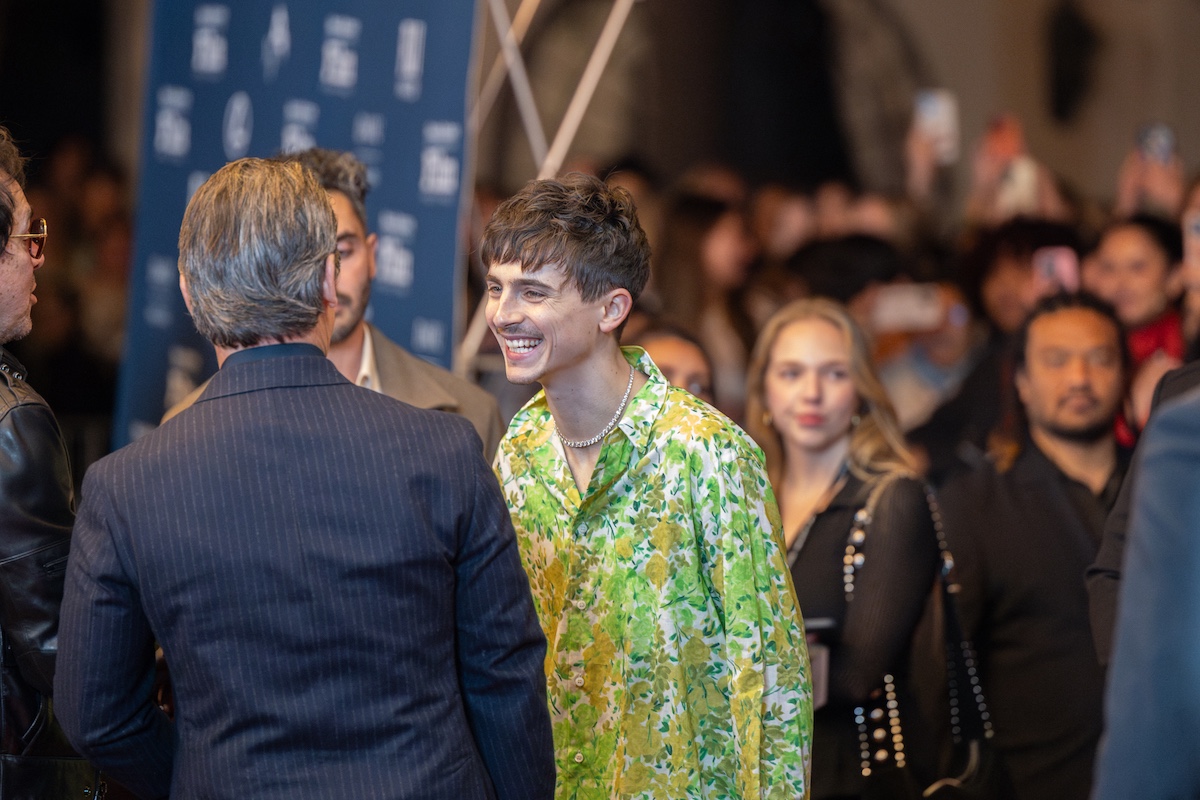
Never mind the haters and the purists, one of the great facsimile performances of an actor playing a real character was Timothée Chalamet’s masterful turn as a young Bob Dylan in A Complete Unknown.
As Unknown director James Mangold said in his presentation of the “Artist of the Year” award to a bright green-shirted Chalamet at the Arlington last night, “acting is not lying. It’s telling the truth. It’s a misconception. Timothée is a truth-teller.”
Via Chalamet’s frequent references to Dylan during the evening — with his pal (and Dune costar) Josh Brolin in the bro-style interviewer seat — made it clear that the young actor still has Dylan very much on the brain. What may be less clear is how much he knows about Timothée Chalamet the person, given the starry blur of impressive acting roles and meteorically rising celebrity the 29-year-old has achieved in the past decade.
It has to be said that this was one of the more entertaining and often off-script SBIFF tributes in memory, and we’re not just talking about the moment the subject had to take a bathroom break before his acceptance speech. At one point, Chalamet mustered some bluster in his rhetorical rope-a-dope way, saying, “I feel like I’m one of the good guys and I work really hard. I’m just hungry, man. I want to keep going. I’m 29 — I feel like the clock is ticking.”
Brolin did a mock-incensed double take and blurted out “I’ll kill you, motherfucker. I’m turning 57 tomorrow.” That was a cue for Chalamet to stand up and lead the audience in a hearty round of “Happy Birthday.”
Chalamet later spoke intensely about his deep dive into the Dylan role, initially started years ago but interrupted by COVID. “I had five-and-a-half years to prepare. With the respect I have for Bob Dylan, there was no need to put myself in it. The movie took on a life of its own. Everyone was lasered in.
“This was about great thinkers in a great time. Now, we’re beaten down. Back then, there was hope. This was a lifetime’s work. This was a spirit being.”
Getting Game
Color Book may qualify as the film with the highest yield of emotional intensity from a tale of deceptive simplicity. In writer-director David Foster’s disarmingly powerful “small” film, we follow the saga of a man (Will Catlett) and his 11-year-old son Mason (Jeremiah Daniels) making their way to an Atlanta Braves game but are thwarted by various obstacles along the way.
Yet the tellingly critical details in the story are the fact that Mason has Down Syndrome and that father and son are enduring a deep but not openly acknowledged mourning state soon after the mother’s death in a car crash. It is a testament to the refined filmic language here that details of the full story and the urban atmosphere in which it takes place are laid out in a subtle but carefully constructed expressive palette.

Some elements of both the external aspects and Mason’s interior world are shown through his simplistic drawings, or by going through the mother’s belongings in the mangled wreck in a junkyard. The visual language of this post-neo-realist wonder, by cinematographer Nikolaus Summerer, lavishes with tranquil static shots or urban landscapes viewed through train and bus windows, not to mention intimate two shots of father and child — all in a rich black and white patina. Dabney Morris’ musical score lends fittingly bittersweet sonic backdrop with its ambient chamber music cues.
All the elements come together in one of the strongest — yet also most subtle — films of this festival, with echoes of Charles Burnett’s landmark Killer of Sheep. It may go without saying that the film is also a ripe vehicle for tear duct cleansing.
Darndest Things
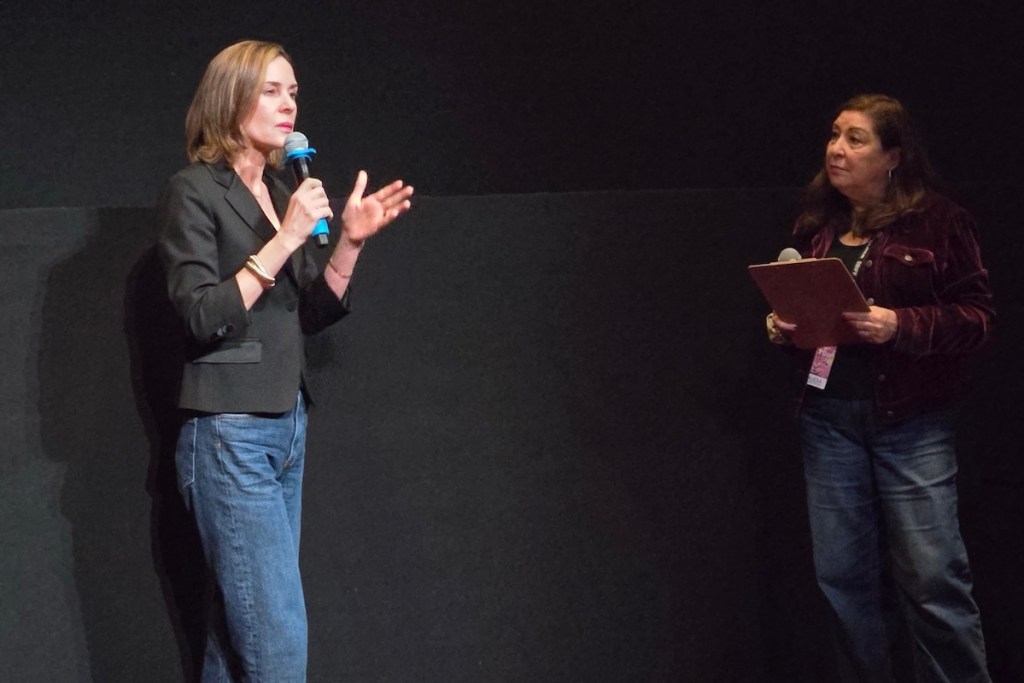
Another remarkable child actor in this SBIFF, albeit from a wildly different time and place, is the charismatic ragamuffin Lexi Venter as Bobo, the jejune star of Don’t Let’s Go to the Dogs Tonight. Although only 7 years old at the time of the shoot of this adaptation of the best-selling 2001 memoir by Alexandra Fuller gives an unusually nuanced yet free spirited performance as the daughter of an unstable racist mother in Rhodesia circa 1980. The mother is played with proper downward spiraling persona by Embeth Davidtz, who acquired rights to the book and ended up writing a script and making her directorial debut with the piece. The historical setting is the conflicted conflict riddled landscape of Rhodesia/Zimbabwe under the control of the tyrannical Robert Mugabe, with Black-white relations turning violent and volatile.
Davidtz was on hand for a Q&A at the Riviera Theatre yesterday afternoon, where she spoke about having stumbled on the precocious non-actor Ventor after extensive auditions of professionals. “It had to be a wild, feral and completely authentic child for the role to make it work,” she said. “I now feel protective of her, to keep the Hollywood from getting its hands on her.”
She also described the long gestation of the project, and the difficulty of “turning the 23 years of the book into a screenplay. I couldn’t find a director, and I didn’t want to be in it, but I couldn’t find an actor (to play the mother). I would never do that again,” she insisted, with a laugh, “I was flying without a parachute.” But things came together beautifully, as witness the end result.
Maid to Order
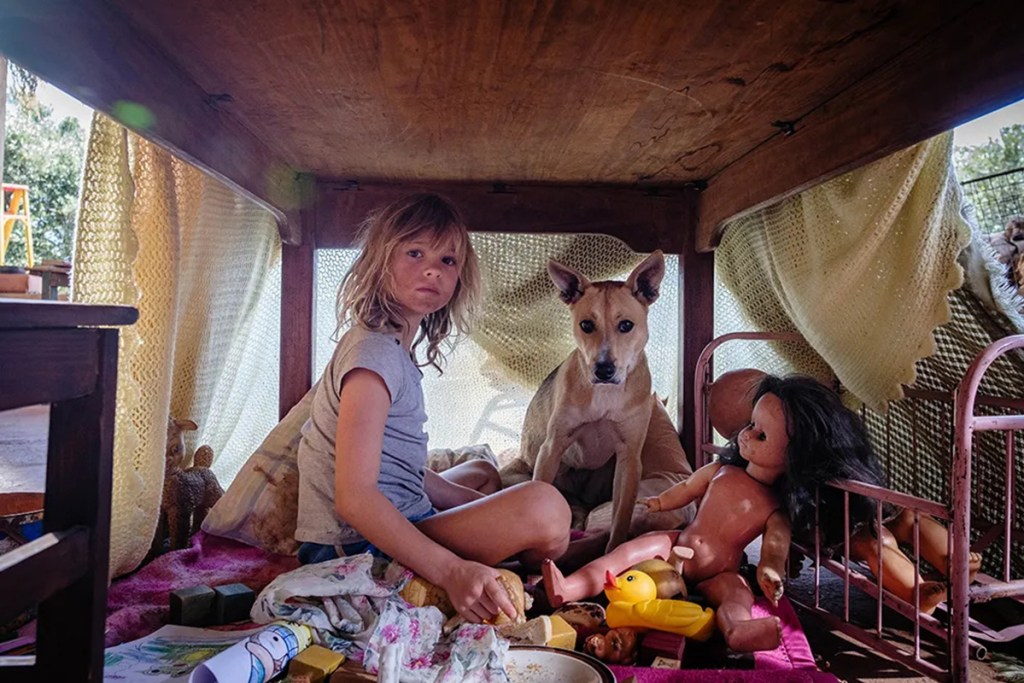
The shrewdly-paced and sneakily provocative Argentine film Linda has a simmering power of seduction, emanating around the title character. Eugenia “China” Suárez plays a quietly commanding and beautiful maid in a house where each member of the family unit falls in love and/or lust with her, of both genders. Writer-director Mariana Wainstein has coyly deployed a strategy by which we the viewers — aka voyeurs-also fall prey. Wainstein knows that we know that she knows that some basic cinema-stamped manipulation is afoot.
But the critical plot point in her characterization is the fact of Linda’s inner strength and self-prepossessed awareness of her effect on others is counter-balanced by a poise, conveyed with minimal dialogue. Given those dynamics, the film becomes a fascinating study in seething sensuality, but with undertones of feminist critique. Women ultimately rule in this domestic drama irradiated with in-house longing.











You must be logged in to post a comment.