

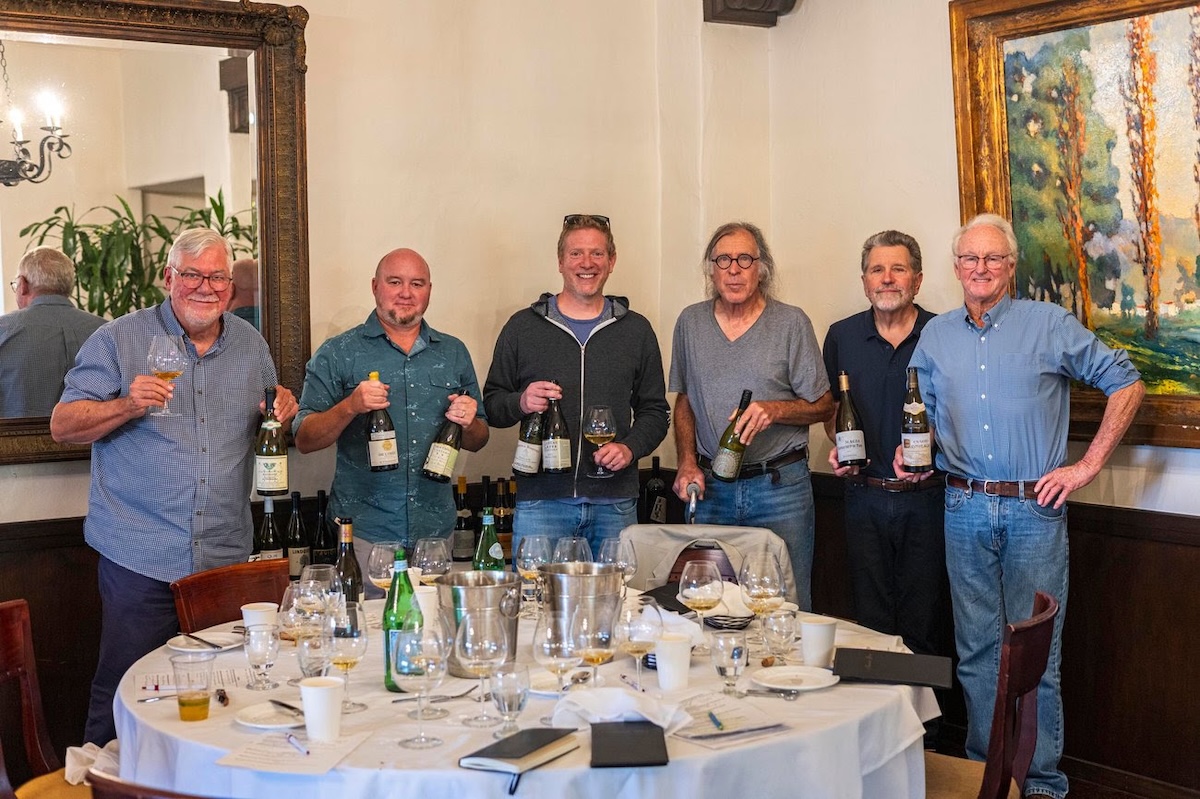
If you’re a student of California wine history, or a fan of Rhône-style wines from France and beyond, or a curious collector who enjoys watching white wines age, then our lunchtime gathering at the University Club in downtown Santa Barbara on a recent Friday would go down in your books as legendary.
At my table were three of California’s preeminent Rhône pioneers, Santa Barbara’s seminal viticulturist, and one of the world’s most respected Rhône experts. We’d come together to discuss and taste 25 white Rhône wines from near and far, dating back to the 1980s all the way up to the present day.
If none of the above appeals to you, perhaps you’ll at least find intrigue in the rarity of our six-man symposium.
“One thing’s for sure,” said Bob Lindquist before we tasted the first of 25 bottles of white Rhône wines. “There’s nowhere else in the world where people are drinking this same set of wines today.”
The People
Lindquist, as you may know, bet the farm on the Rhône’s best known variety, syrah, when he launched his Qupé Wines in 1982, and was soon dabbling in white Rhône grapes like marsanne and roussanne as well. The Qupé brand is now owned by Andrew Murray, but Lindquist continues to produce excellent Rhône bottlings under the Lindquist Family Wines label.
Hosting us was Patrick Will, the Santa Barbara–based vice president of Vintus, which imports and sells wines from across France. Will’s reputation is unparalleled — he’s in all the cool French wine societies — and he’s developed such a reputation in the Rhône particularly that famous families there, like the Guigals, consider him to be part of theirs. He’s also a University Club member, hence the setting.
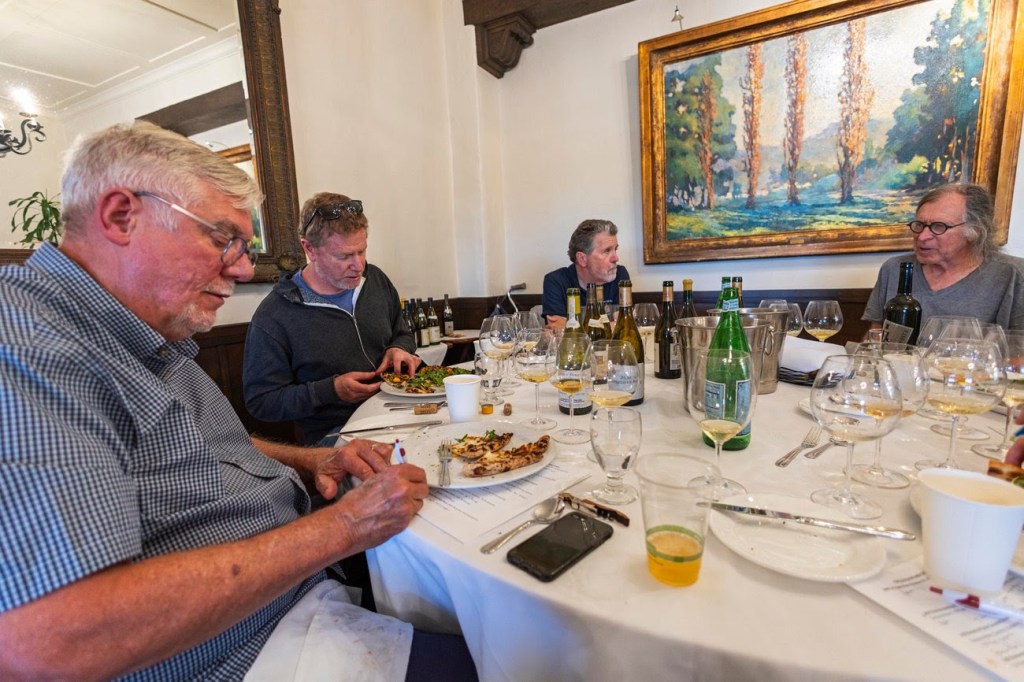
I’ve known both Bob and Patrick for years, so earlier this year, when I was asked to write an article about the ageability of Rhône wines for Wine Enthusiast, they were at the top of my list to call. At the end of each chat, we agreed that the three of us needed to all get together to try a bunch of older white Rhônes. It only took six months to find a day that worked.
By the time we nailed the time and place, the list of potential wines was growing, and we suddenly understood we should invite more people. We all agreed to add our mutual friend Jeff Newton, who founded Coastal Vineyard Care Associates in 1983, becoming the modern master of vineyard development and management in Santa Barbara County for the ensuing decades. (He’s mostly retired now, so his schedule was clear.)
As I plotted what wine to bring myself — my cellar is nowhere near as deep as these guys’, and most of my aged domestic Rhônes were made by Lindquist anyway — I reached out to Jason Haas at Tablas Creek. The Paso Robles producer was co-founded in 1989 by Jason’s dad, longtime French wine importer Robert Haas, and the Perrin family of Chateau de Beaucastel, who are based in the historic Rhône zone of Châteauneuf-du-Pape.
With a direct line to vines and expertise from the Rhône, Tablas Creek quickly became the viticultural soul of the American Rhône movement. Today, many of the Rhône vineyards around the United States are based on vines that came through Tablas. As I was emailing Jason to inquire about older wines for sale, I realized we should invite him, and so we did. He was immediately in, despite the four-hour round-trip drive.
We had one slot left, so I suggested Randall Grahm, the iconoclastic founder of Bonny Doon Vineyard who started championing Rhône varieties from his Santa Cruz vineyards in the mid-1980s. He was christened “The Rhône Ranger” by Wine Spectator in 1989, and continues to push Rhône boundaries, among others, today. That goes for both his partnership with Gallo called The Language of Yes (those grapes are from Rancho Real along 101 just south of Santa Maria) and for Popelouchum, a wildly ambitious, semi-wild vineyard near San Juan Bautista.
Neither Lindquist nor Will thought that Randall would make the trek down from Santa Cruz. But I said I knew him well enough, so let me give it a try. I texted him the basics, and, 90 minutes later, he replied, “I think I can and can certainly bring some older wines.”
The Cali Wines
“What a treat this is,” said Jason Haas as we started our tasting, which was organized from young to older wines, starting in California (marsanne then roussanne then blends) and finishing on France, from the southern to northern Rhône.
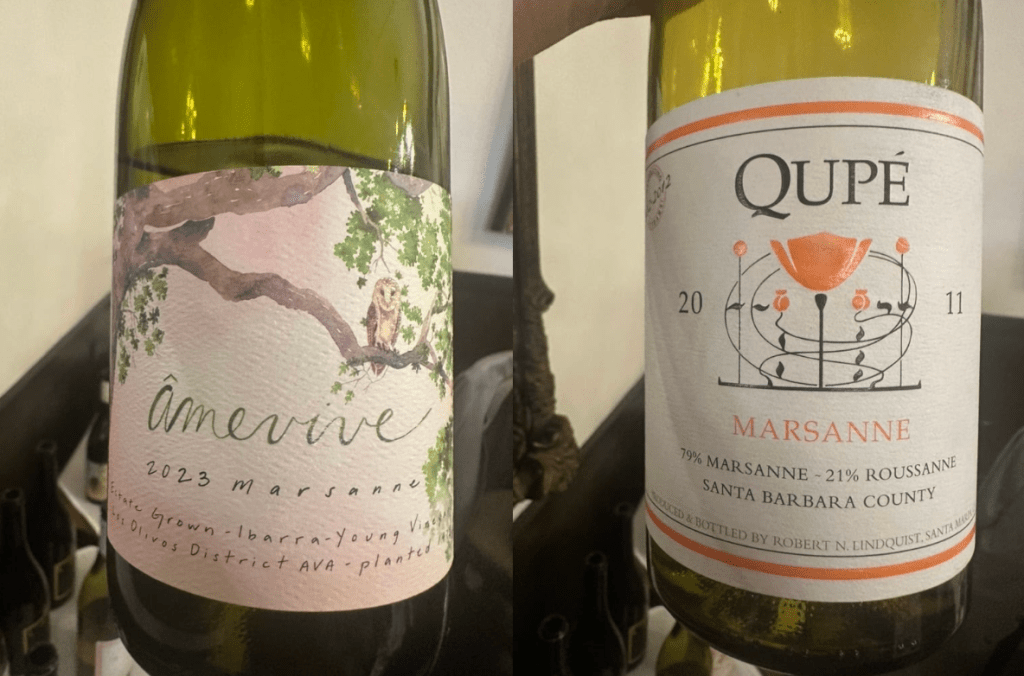
The small-world-of-wine connections started immediately, as we sipped from a bottle of 2023 Âmevive marsanne grown at the Ibarra-Young Vineyard. The property is now managed by regenerative farming apostle Alice Anderson, who makes the Âmevive wines, but Lindquist managed it for most of three decades, going back to 1986.
He told us how he got the marsanne cuttings from Grahm (who didn’t remember that), and Grahm explained how he had two clones of marsanne at the time, a good one and a bad one. Lindquist wasn’t aware of that, nor was Haas (who got some of the same marsanne later), but both seemed to acquire the good clone.
My favorite of the Qupé marsannes was the 2011, which was so fresh and vivid that I would have believed it was a 2021. The 2006 and 1993 impressed as well, but showed more of those honeyed characteristics that emerge on marsannes with time.
Grahm applauded Lindquist’s patient approach, offfering, “Bob, I admire the fact that you have so much faith in your customers and faith in the wine that you are prepared to make wines that take a long time to really show themselves.”
To which Lindquist quickly replied, “That doesn’t mean I sold them!” In fact, even today, after years of building up the reputation of white Rhônes, Lindquist says there are only two accounts in the entire country interested in purchasing older vintages of marsanne and roussanne.
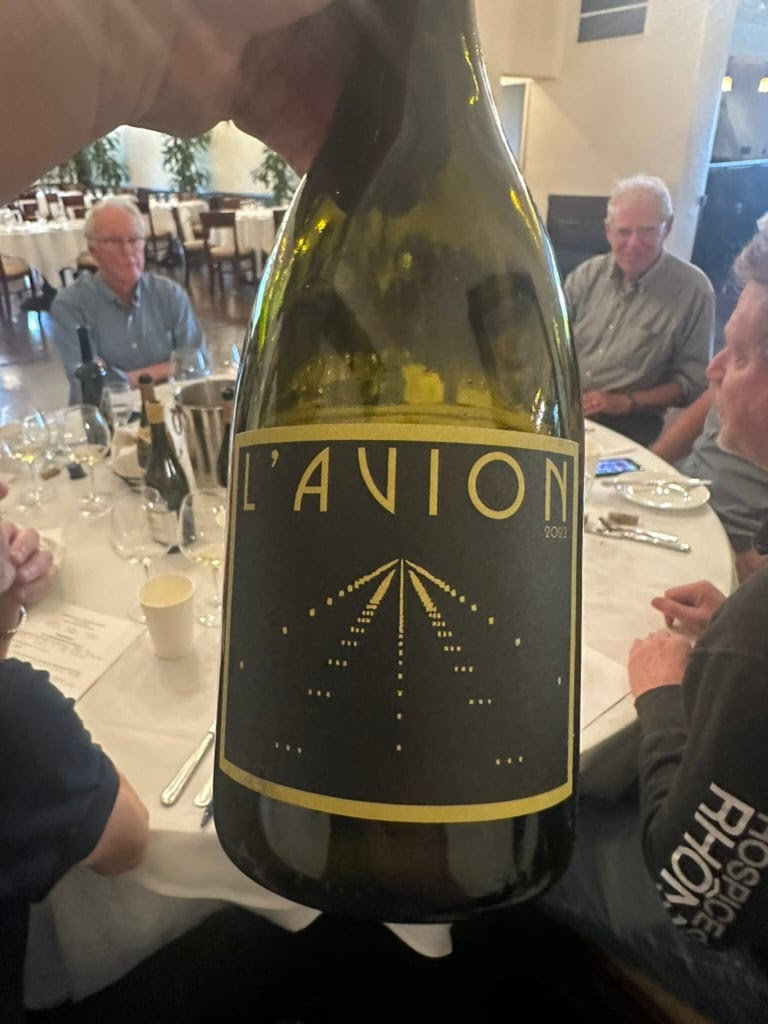
The California roussannes and blends included Stolpman’s L’Avion (2023 and 2015, which was “fresh as a daisy,” said Will), a number of Qupé and Lindquist Family bottlings (2006, 2011, 2021, all still alive), and four Bonny Doons: three Le Cigare Blancs (2009 reserve, 2013’s reserve, and regular, which I preferred) and the 1989 Le Sophiste.
The later wine included the roussanne that Grahm brought to California from France in a suitcase, propagated, and eventually sold to a nursery. When others bought the vines, it was discovered to be viognier, not roussanne, leading to lawsuits and lore. Tasting the 1989 today, which also included 8 percent marsanne, it was a bit over the hill, but still enjoyable. Had it been real roussanne, it probably would have held up a bit better.
He also brought two of his Popelouchum white blends of grenache blanc and grenache gris, the 2021, which was full of lychee and star fruit flavors, and the 2017, the first vintage of this brand ever. The breakdown of each vintage comes down to which grapes the wild turkeys prefer each year, said Grahm.
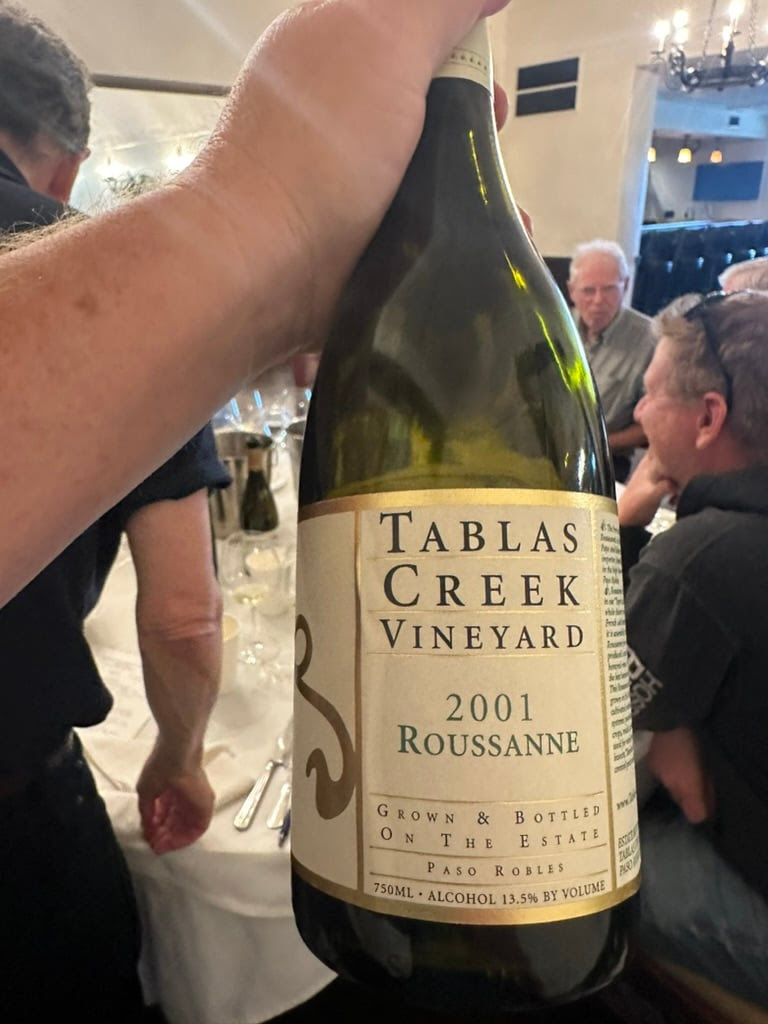
Highlights of this stretch were the two Tablas Creeks: the 2001 roussanne, which was the blend-minded winery’s first bottling that listed a single grape on the label; and the 1997 Blanc, the first Tablas Creek wine ever.
“I do not know the blend,” said Haas. “I have researched it. We cannot find it anywhere in our records.”
Haas was “super happy” with how the ‘97 was showing, as was I, and only in part because that was the wine that I bought off of Tablas for this tasting. (I did nearly ruin the cork upon opening, but Haas saved it.) Given the history and how well it held up, the 1997 Blanc was probably my favorite wine of the entire tasting.
“It was this one and the next vintage that convinced us,” said Haas of how the 1997 revealed the potential for white wines in Paso. “We had really underestimated the potential of where we were for whites. We went into this thinking that we’d be like Beaucastel, 85 to 90 percent red. But this showed that we can do something great with whites here. Now we’re almost 40 percent white.”
The Frenchies
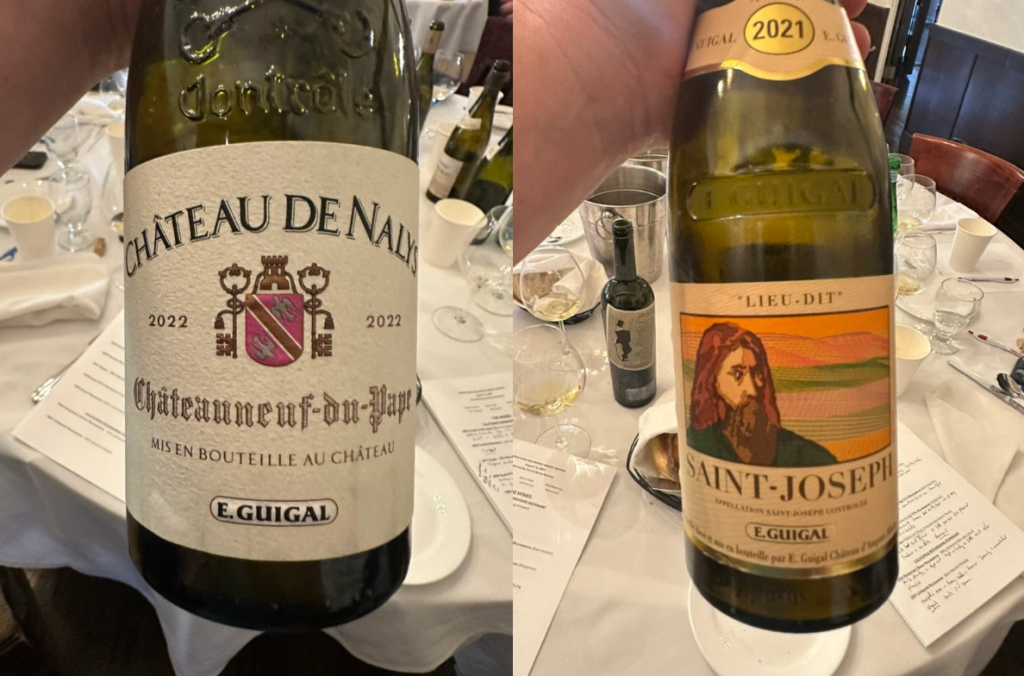
We excitedly moved into the French wines, with Will taking on the role of presenter. The three Châteauneuf-du-Pape blancs were distinct. The 2022 Château de Nalys hit all the classic notes of stone fruit, honey, nut, and light wax, while the 2022 Rotem and Mounir Saouma Magis revealed the winemaking preference for a reductive Burgundian style, as the wine emerged through gunpowder scents into fresher, tightly wound tones. Haas brought a 1992 Beaucastel that he found in his late father’s cellar, which was surprisingly vibrant despite its 33 years of age.
With some of those same names as players in his tale, Grahm regaled us of the true roots of how he accidentally brought home viognier rather than roussanne so many years ago. None had heard the details of that saga, or knew which chateaux were involved. Much laughter ensued.
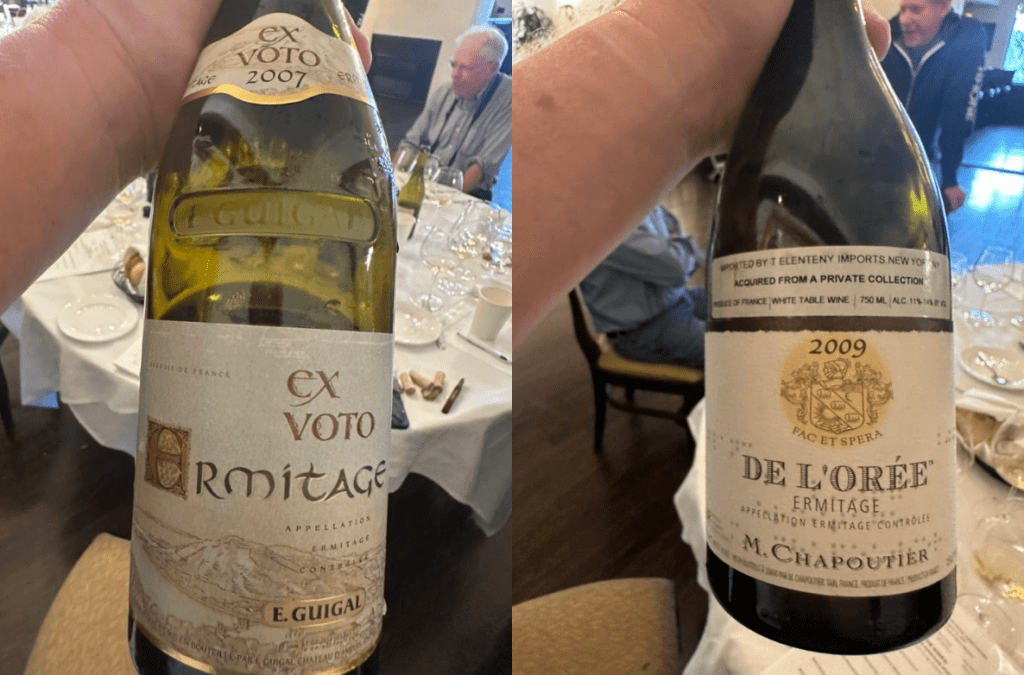
The best known names came out for the northern Rhône lineup, all marsanne-led bottlings: two Guigal Ermitage Ex Voto Blancs (2007 and 2020, still buzzing with acidity); a 2009 Chapoutier Hermitage L‘Orée (I bought that one off of Industry Wine Merchant, and it was one of my faves of the day); and, often considered one of the best whites on the planet, a 1995 Jean-Louis Chave Hermitage Blanc. I somehow managed to take the dregs of the Chave home, and it still wowed neighbors into the wee hours that evening.
Will also tossed in a 2021 Guigal St. Joseph Blanc, just for good measure.
The Talk
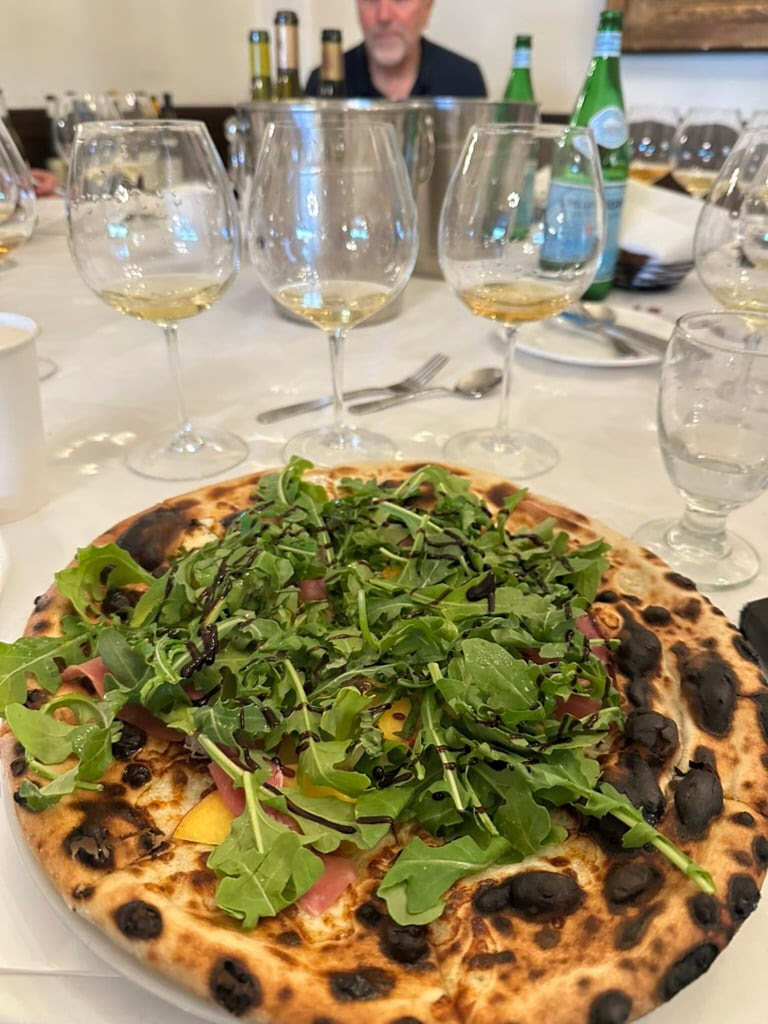
We managed to stay on schedule and wrapped up our tasting as lunch arrived. Three of us opted for the peach pizza special, feeling that stone fruit was a nice pairing for the wines; two more went for shrimp tacos; and Will chose the cauliflower steak, one of his preferred dishes at the club.
Our lunch conversation veered through the myriad topics you’d expect when lifelong experts sit around the same table. On viticulture, we talked about how some of the best wines come from compromised, virus-kissed vines. “This is the essential paradigm,” said Grahm. “You can’t have it all; you can’t have ultra clean, perfect wine. You have to be able to live with a little bit of ambiguity.”
Added Haas, “The idea that a plant can be free of virus is as much of a fiction as the idea that a human body can be free of bacteria. There’s always a certain amount that’s in there. It’s just a question of balance.” He’s found that regenerative farming — the agricultural methodology that Tablas helped pioneer for vineyards — reduces the stress levels on the vines, so even some of his most compromised vines are doing much better.
We also covered how Americans are still learning that, for fine wine, you need to grow vines on land that has a tiny bit of soil atop a true bedrock base. “They need to be in touch with geology, whether it’s limestone or granite or basalt or whatever,” said Newton. “I think that’s where the minerality comes from. I don’t think Americans or even Californians understand that.” (On the minerality front, I announced that I’d be stealing Haas’s use of “broken stone” as a tasting note for my future wine reviews.)
On winemaking, Lindquist relayed how he learned early on from, of all people, Gerard Chave — the father of the modern Hermitage master Jean-Louis Chave — how to process marsanne so that it didn’t smell like canned corn. He was told to put it into the barrel as clear as possible, without lees. “I started doing that, and it made all the difference,” said Lindquist. “Nothing against canned corn!”
We delved into the topic of grenache gris, which is a large part of Grahm’s Popelouchum bottlings, and how there are other grenaches beyond gris, blanc, and noir to explore, namely grenache peluda (“hairy”) and grenache rouge. We also touched on the many other white Rhône grapes that play lesser roles, such as picardan and bourboulenc, both of which are now grown and bottled by Tablas Creek.
There was general consensus that for white Rhônes, even for those advertised as single varietal wines, a bit of blending in other grapes goes a long way. “We have never been as happy with something that was 100 percent roussanne as we have been with the ability to add a little bit of the higher acid, more mineral grapes in,” said Haas. His sentiment was reflected in the breakdown of the wines we tried, very few of which were simply single varieties.
The Takeaway
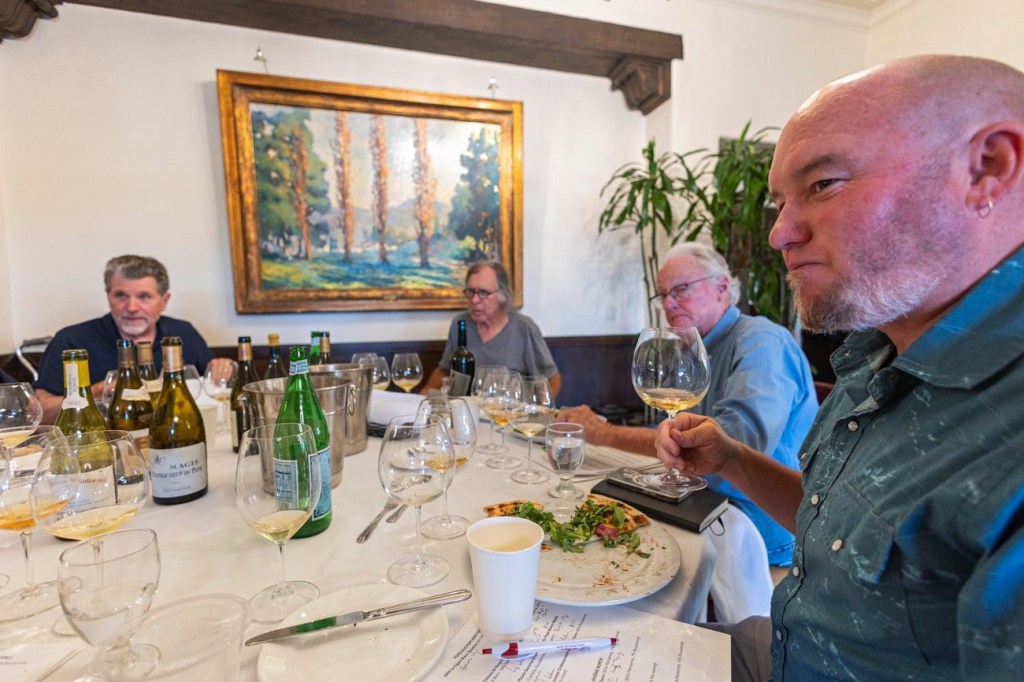
By the time the photographer Macduff Everton showed up to snap some group shots, we’d tasted and talked about all the wines. When Macduff asked which wine to try, Will quickly replied, “It’s a ridiculous, ridiculous embarrassment of riches. It’s really just a question of where you want to go.”
Grahm had opened our gathering two hours earlier with the question of why do white Rhônes age well at all, since most lack the acidity found in other notably cellar-worthy whites, like racy chardonnay and sharp rieslings. Lindquist posited that there are antioxidant elements in these oily grapes, though the science of it remains a bit unclear. I’m okay with the magic.
We’d clearly proven our theorem, that white Rhônes can age remarkably well. But I was curious if we’d discovered more. “What did we learn?” I asked the table.
Haas jumped in. “This shows that what we’re doing in California can stand proudly against the best examples from France,” he said.
Ever the contrarian, Grahm only partially agreed, finding a bit more minerality in the French wines. “There’s still, to me, a little more dimensionality,” he said.
“Well,” said Lindquidst, “and a little more sunshine in the California wines.”
Sunshine versus broken stones, peach pizza versus shrimp tacos, Châteauneuf-du-Pape versus Cigare Blanc. Our dilemmas that day were merely of the dionysian sort. No wonder we’re already plotting a similar trod through red Rhônes.







You must be logged in to post a comment.