

As if to partially satisfy the inherent art-worldly question “What’s lurking in your vaults?” the Westmont Ridley-Tree Museum of Art has tapped its permanent collection for its current exhibition, with focus and purpose. Specifically, the collection is surveyed in terms of a surprisingly rich niche of works on paper by sculptors, under the rubric of Between Planes: Exploring Sculpture through Print. Much of the credit goes to the generosity of Westmont alums Dewayne and Faith Perry’s Print Acquisition Fund, mixed in with art on loan.
Like the UCSB Art, Design & Architecture Museum’s recent permanent collection show Beyond the Object, the exhibition doubles as a visual treat unto itself and an unveiling of treasures rarely made public. Make no mistake: Between Planes is a soft-spoken dazzler of a show, well worth a visit before its December 20 closing date. For anyone reflexively lured by the presence of major art-world figures on beckoning walls, the show’s exhibition checklist includes Alexander Calder, Louise Bourgeois, Richard Serra, Auguste Rodin, Jacques Lipchitz, Henry Moore, Jean Arp, Claes Oldenburg, and Alison Saar, among other worthy lateral-minded artists.
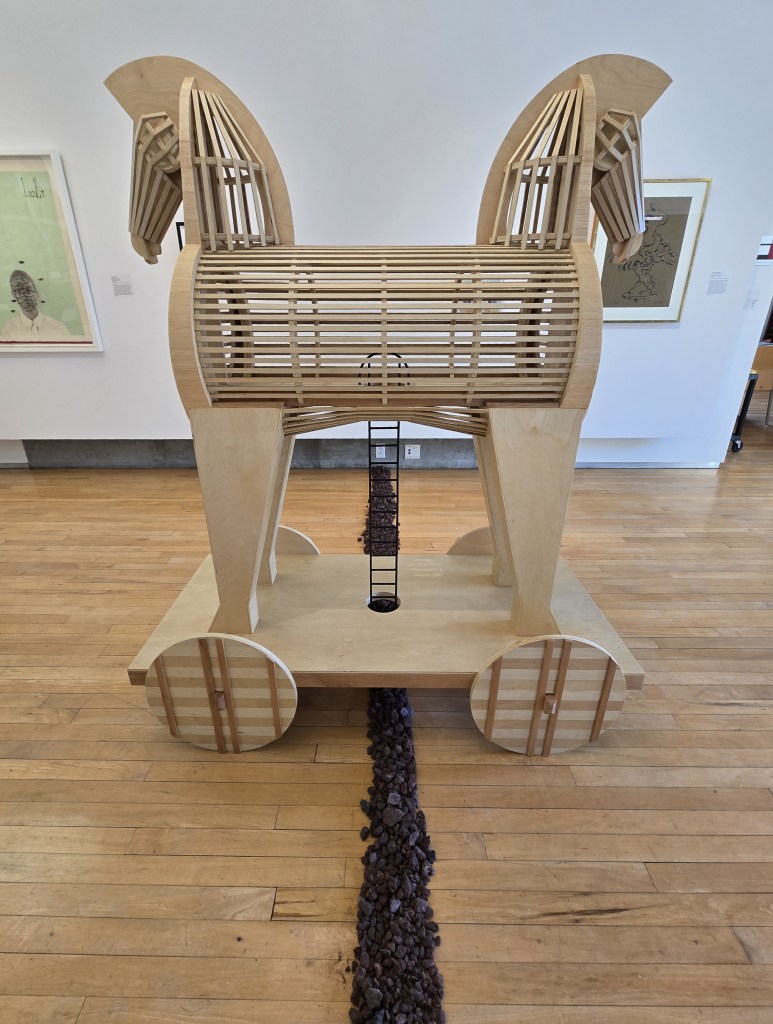
Some of the most intriguing moments in the sampling come with the coupling of a given artist’s sculptural and paper productions, starting in the museum’s entryway gallery. Mexican artist Marcos Ramirez ERRE’s eye-chart-like framing of a telling Salman Rushdie quote (“Even the freest of free societies are unfree at the edge”) blends with his two-headed, wooden “Toy An-Horse” sculpture, a comment on strained U.S.–Mexico relations also sporting a line of actual stones to across the gallery. (Warning: Don’t step on the art.)
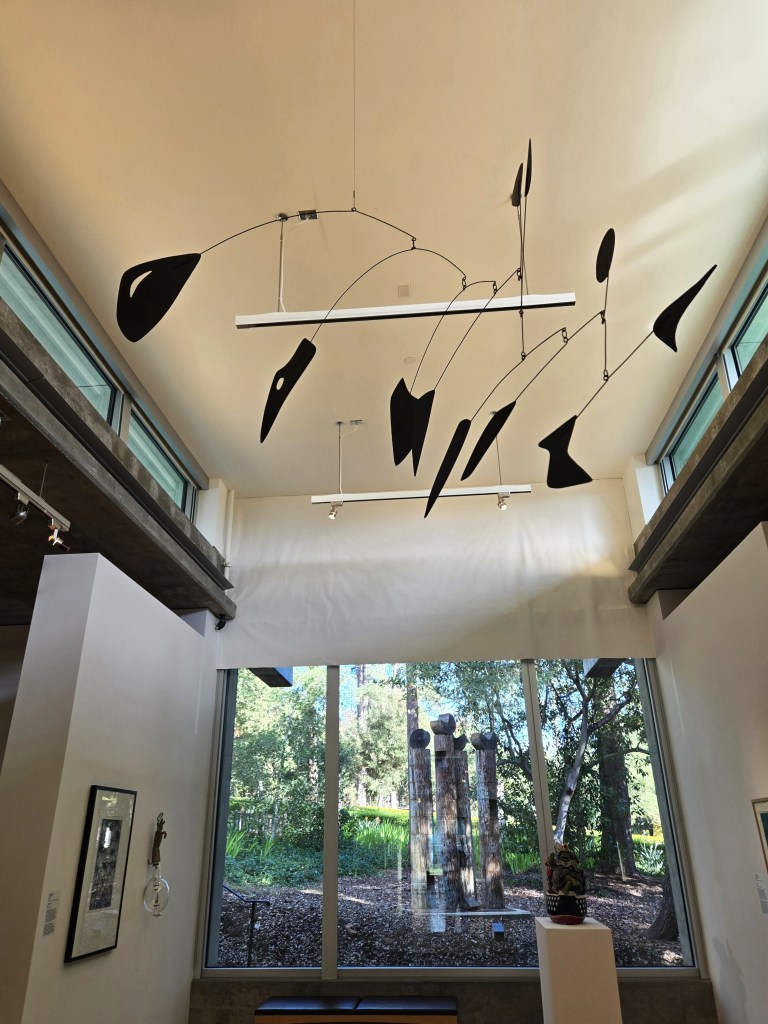
In the most celebrated case here, the starry centerpiece of the show is a pairing of Calder works, his Mondrian-inspired color and line meshing print “Bleu Coole en Gris (Blue Streak on Gray)” and the aerial sculpture “The Smile and the Eye.” A classic example of Calder’s mobile mastery, the piece is a delicate balancing act — of line, air, shape — with sly hints of the title’s references.
In the exhibition, a particular intrigue rises from insights into the twists of visual imagination from sculptors when limited to simple, flat expressive circumstances. Oldenburg’s “Sketch for a Sculpture in the Form of a Steel Tack” is a radically scaled-down game plan for what would become one of his famed epic visions of everyday objects — in this case, a lowly but beautiful thumbtack. Bourgeois is known for her complex structures — complex, physically, emotionally, and referentially — but here is seen via “Feet (from 11 Drypoints),” a study of said body part, tracing her early traumas in life.
Judy Pfaff is associated with sculptural installations, but here shows the long, scrolling piece “Planet on the Table,” a rolling compendium of planetary and inner space imagery.
We can see traits of the sculptural through a drawn format, in the monolithic black blocks of “Promenade Notebook Drawing III,” by Richard Serra, he of massive yet minimal sculptures sometimes doubling as life-sized mazes. Lipchitz’s sinuous hand and eye feed the lean, writing lines of another prominent Westmont Museum acquisition, “Bellerophon Taming Pegasus,” suggesting the drama and physicality of his sculptures.
A similar across media showing comes through with the figurative/sculptural impulses of Henry Moore and Alexander Archipenko’s spare linear arabesques.
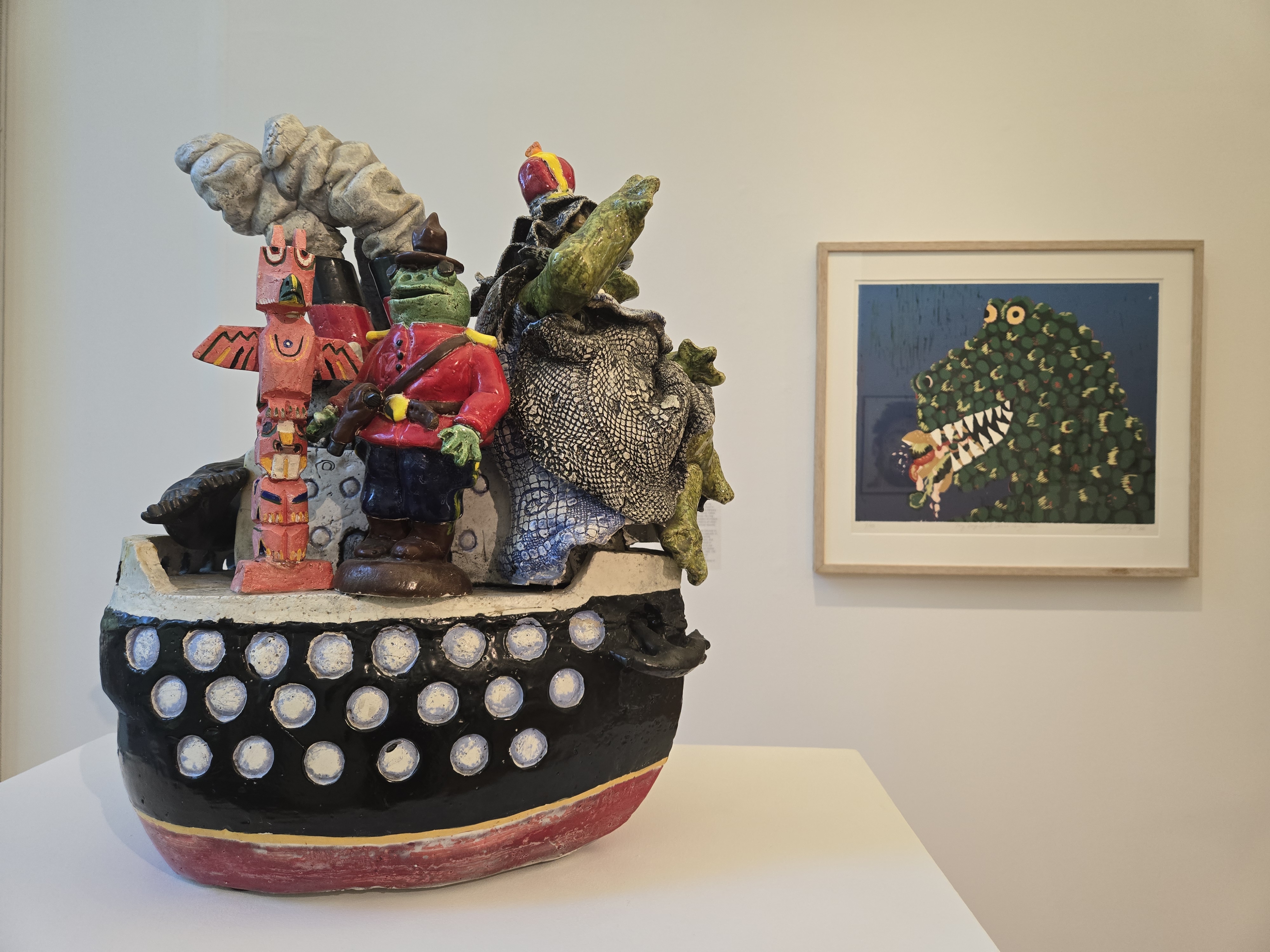
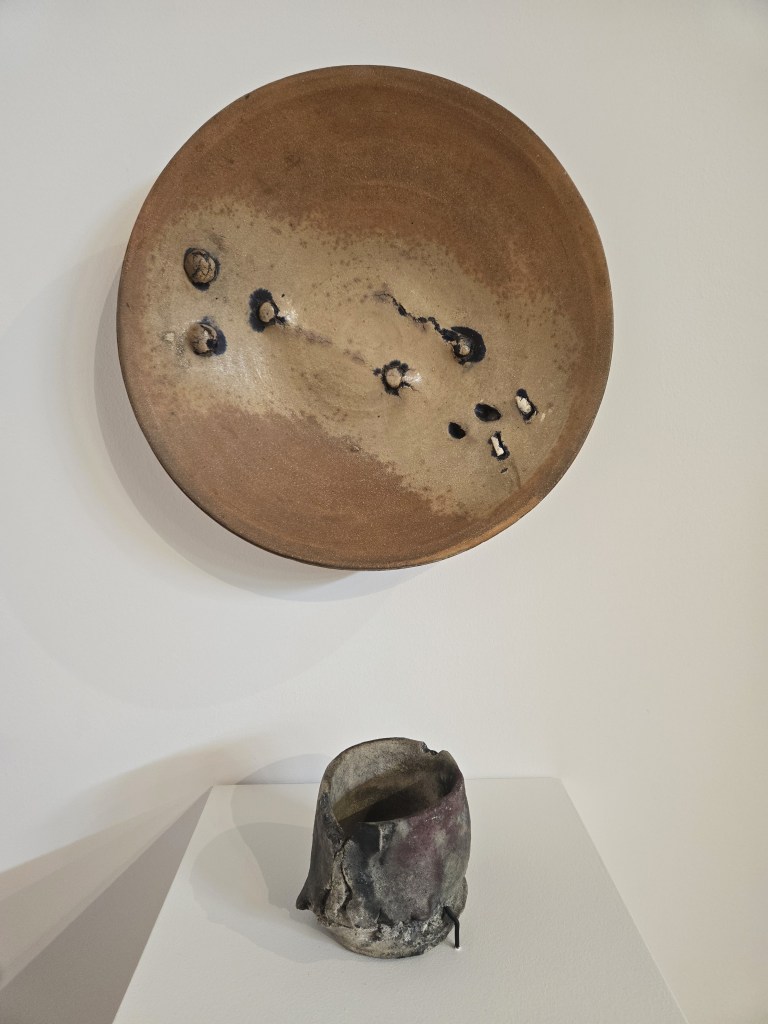
The often-underrated domain of innovative ceramic sculpture has its due spotlight here, courtesy of celebrated Bay Area artists Peter Voulkos and Don Reitz, working with new techniques and aims beyond conventional ceramic traditions. Elsewhere, ceramics are put to fruitful creative use by David Gilhooly, part of the Funk Ceramic movement in San Francisco, whose woodcut “My Dog Spot Loves Big Macs” and animalistic pile up sculpture “Old Vic” feature cartoony characters and wryly misleading titles. Artist Akio Takamori’s ceramic figure in lotus position, on the floor, speaks to his Japanese-illustration-evoking, Adam-and-Eve-esque lithograph “Fruit Tree.”
A fairly direct sculpture-paper link can be found in Saar’s two companion pieces, created as part of a collaborative pact with Santa Barbara City College’s Atkinson Gallery in 2019. The well-established African-American artist’s lithograph “Coup de Grâce” finds a Black woman biting the thread trailing from a massive ball of yarn. Adjacent to that, the small bronze and cloth sculpture “Inheritance” depicts a woman balancing an oversized white cloth ball, symbolizing the burden of Alison’s famed artist mother, Betye, as a child, after her father died.
Dug Uyesaka, a beloved veteran of the local art scene, naturally works across mediumistic borders, as seen in his twofer of an untitled drypoint piece — a skein of linear kineticism — and “Guided by Voices II,” a prime example of his natural aplomb in the art of organic assemblage.
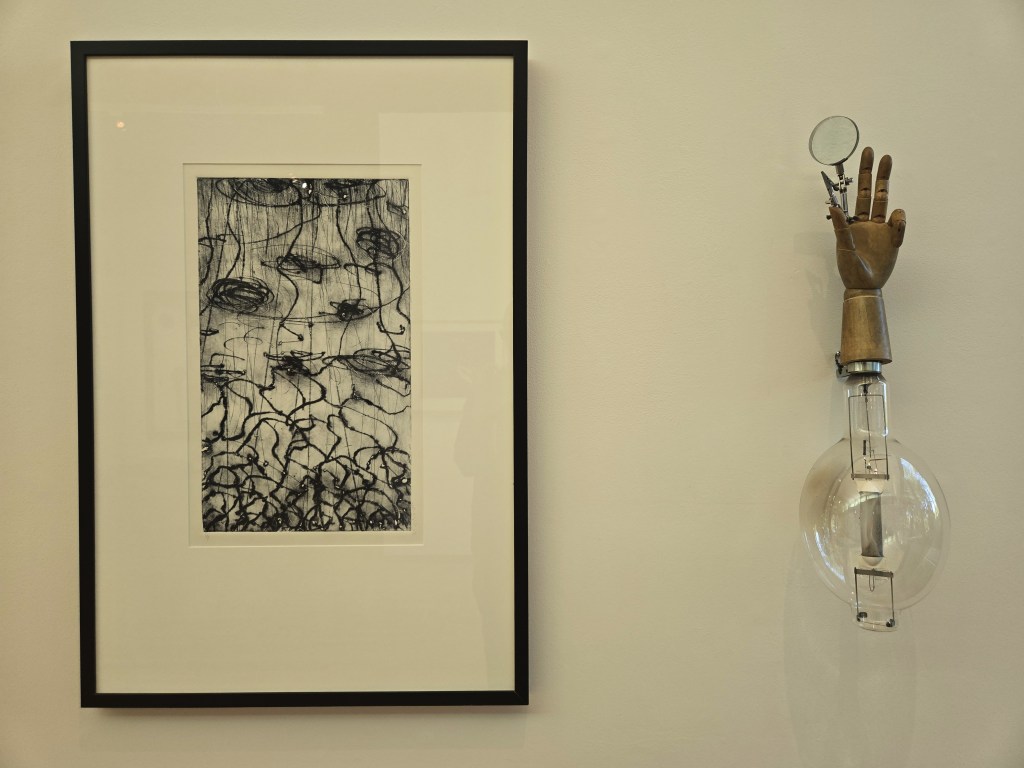
Another one of the Santa Barbara–based artists on view — and like Uyesaka, the subject of a major show in this museum — is Dane Goodman, whose large, untitled monotype is mated with a buoy-like sculpture on the floor before it. Somehow, common visual, formal, and thematic elements link the two works, with their deceptively simple, allegorical iconography. As Goodman writes of these two early ’90s works, his works on paper “referenced my sculptural work, either existing ones or ones imagined.”
Goodman’s statement could serve as a touchstone or adage for some essential nature of the show, as a whole. Generally, these artists’ three-dimensional thinking has filtered into two-dimensional media, and vice versa. At the center is the driving force of imagination, taking sometimes radically different shapes and dimensionalities, to suit the muse.
Between Planes: Exploring Sculpture through Print is on view at Westmont Ridley-Tree Museum of Art (955 La Paz Rd.) through December 20. See westmont.edu/between-planes.
Related Posts

Premier Events
Fri, Sep 11
2:00 PM
Santa Barbara
Music & Meditation SB with Robert DeMaine, cello
Sat, Sep 12
9:00 AM
Santa Barbara
Santa Barbara Sea Glass & Ocean Arts Festival
Sun, Sep 13
9:00 AM
Santa Barbara
Santa Barbara Sea Glass & Ocean Arts Festival
Fri, Sep 11
5:00 PM
Santa Barbara
Romeo & Juliet at Elings Park

Fri, Sep 11
7:30 PM
Santa Barbara
Planned Parenthood CCC After-Hours Event!

Fri, Sep 11
7:30 PM
Santa Barbara
Selah Dance Collective: “Beethoven’s Tango” and “The Stranger”
Sat, Sep 12
9:00 AM
Santa Barbara
Community Walk with ‘Latino Outdoors’

Sat, Sep 12
10:00 AM
Santa Barbara
Planned Parenthood’s 52nd Annual Mary Jane McCord Book Sale
Sun, Sep 13
10:30 AM
Santa Barbara
Meet PBS Kids Character Buddy the Dinosaur
Sun, Sep 13
1:00 PM
Santa Barbara
SB Jazz Society: Jazz du Jour with Sandy Cummings at SOhO

Sun, Sep 13
4:00 PM
Santa Barbara
PPCCC YA (Planned Parenthood Young Advocates) Community Reading

Sun, Sep 13
6:00 PM
Santa Barbara
The Papas and Mamas – A MAMAS & PAPAS Experience
Mon, Sep 14
6:30 PM
Santa Barbara
Science Pub: Fire – History, Science and Practice
Fri, Sep 11 2:00 PM
Santa Barbara
Music & Meditation SB with Robert DeMaine, cello
Sat, Sep 12 9:00 AM
Santa Barbara
Santa Barbara Sea Glass & Ocean Arts Festival
Sun, Sep 13 9:00 AM
Santa Barbara
Santa Barbara Sea Glass & Ocean Arts Festival
Fri, Sep 11 5:00 PM
Santa Barbara
Romeo & Juliet at Elings Park
Fri, Sep 11 7:30 PM
Santa Barbara
Planned Parenthood CCC After-Hours Event!
Fri, Sep 11 7:30 PM
Santa Barbara
Selah Dance Collective: “Beethoven’s Tango” and “The Stranger”
Sat, Sep 12 9:00 AM
Santa Barbara
Community Walk with ‘Latino Outdoors’
Sat, Sep 12 10:00 AM
Santa Barbara
Planned Parenthood’s 52nd Annual Mary Jane McCord Book Sale
Sun, Sep 13 10:30 AM
Santa Barbara
Meet PBS Kids Character Buddy the Dinosaur
Sun, Sep 13 1:00 PM
Santa Barbara
SB Jazz Society: Jazz du Jour with Sandy Cummings at SOhO
Sun, Sep 13 4:00 PM
Santa Barbara
PPCCC YA (Planned Parenthood Young Advocates) Community Reading
Sun, Sep 13 6:00 PM
Santa Barbara
The Papas and Mamas – A MAMAS & PAPAS Experience
Mon, Sep 14 6:30 PM
Santa Barbara



You must be logged in to post a comment.