

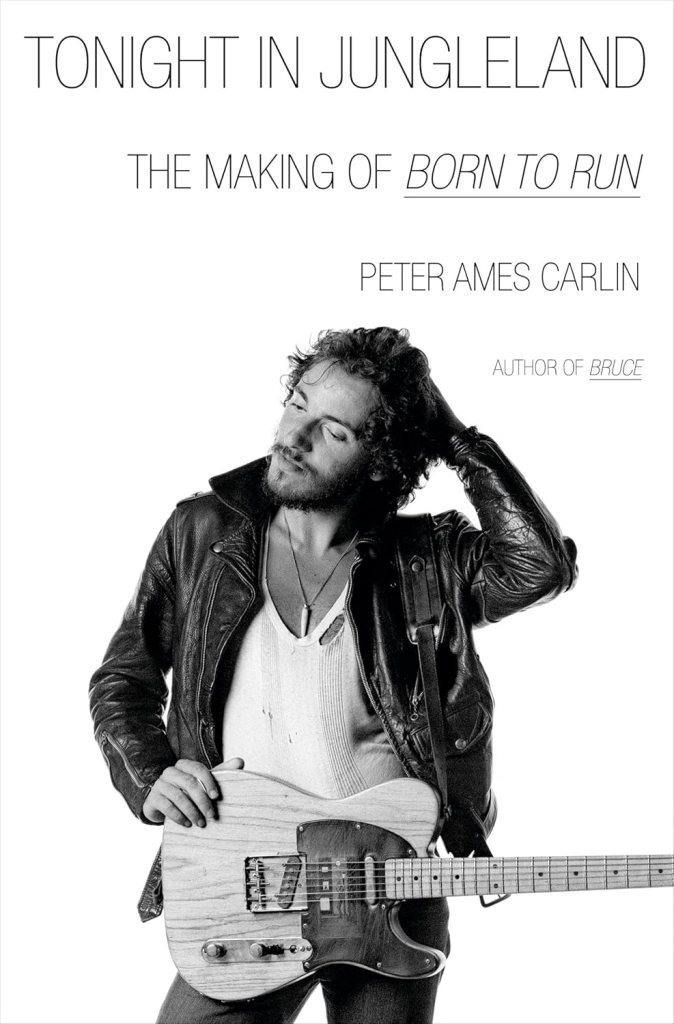
2025 was the year of the Bruce Springsteen biopic Deliver Me from Nowhere, but it was also the 50th anniversary of Springsteen’s first great album: Born to Run. While Deliver Me from Nowhere, based on the book by Warren Zanes, was about the making of Springsteen’s stark acoustic album Nebraska, Peter Ames Carlin’s Tonight in Jungleland: The Making of Born to Run takes us into the creation of that “wall of sound” masterpiece.
Springsteen’s first two albums — Greetings from Asbury Park, N.J. and The Wild, the Innocent & the E Street Shuffle — were mostly recorded live: “Set up the mics to capture the sound as clearly as possible, count off the song, and then let ‘er rip.” But Born to Run is when Jon Landau wrested control of the producer’s chair from Mike Appel, and Landau had a decidedly different approach when it came to making records, arguing that “the technical verities of the recording studio create a necessary paradox: capturing the parts separately sounded more alive and powerful than a full-band-in-the-studio recording ever could.” The result was an album that rightly finds its place at or near the top of just about any Greatest Albums of All Time list.
Carlin, an experienced music journalist and author of the biography Bruce, is pals with Springsteen and Landau, so he has the scoop on what happened during those momentous moments in the studio — at least as they are now remembered by the principals, including the album’s studio engineers and all the members of the E Street Band. He puts that inside information to good use. There is granular detail about everything from the songs’s origins to the tension between Landau and Appel to photographer Eric Meola’s cover shoot, to how open Springsteen was to trying out every possible sound combination in every song: “A string section. An ascending guitar riff repeated through the verse. A chorus of women chiming in on the chorus. An even bigger chorus of women ooh-ing behind the third verse.” And on, and on, with the studio costs always rising, and the album’s release date getting ever nearer.
A close reader of Springsteen’s lyrics and their evolution through various drafts, Carlin describes how Springsteen would pen the words of a song in longhand, sing them into a concert or the recording studio, then, dissatisfied, return to the revision process, hammering away until he got exactly the lyric he wanted. Of the title track, for instance, Carlin writes: “A song that had started as a nearly surrealist portrait of a world gone mad … had been remade into a vibrant highway saga that, while heavily symbolic, could be recognized as existing on the Asbury Park boardwalk.”
Carlin is right to focus on the quality of Springsteen’s lyrics on Born to Run. On that album, and its follow-up, Darkness on the Edge of Town, he achieved a poetic quality that is exceedingly rare in rock and roll. On the earlier records, Springsteen had been prolix and grandiose, sometimes, especially on the first album, seeming to have swallowed a rhyming dictionary. On later albums, starting with The River, he often pared his lyrics back until he sometimes sounded as though he were writing for a 1950s rockabilly trio or a Wood Guthrie tribute band.
But the songs on Born to Run are a marvel, at least in part because of the artful way in which the music surrounds, supports and echoes the lyrics. In “Jungleland,” for instance, the album’s nine and a half minute closer, the lovely opening string arrangement prepares us for the story of “the Magic rat [who] drove his sleek machine / Over the Jersey state line” and into a world of trouble. “The poets down here,” Springsteen tells us, “don’t write nothing at all, / They just stand back and let it all be,” and the music attempts to capture that paradox, perhaps most fully in Clarence Clemons’s famous two-minute sax solo, which Springsteen famously micro-managed: “Bruce talked Clemons through each note and passage, had him play through each note and passage, had him play them all individually, then together.” Then there’s the hard-charging title song, with its razor-sharp guitars and another classic Clemons sax solo that prove to be just the right match for Springsteen’s image- and metaphor-rich ode to those who “sweat it out on the streets / Of a runaway American dream.” Of course, no great album is complete without a great surprise, and on Born to Run we have the jazz-inflected “Meeting Across the River,” a noirish short story in verse about a couple of losers from Jersey hoping to score big in the big city.
The book’s final chapter and epilogue find Carlin drinking tequila with Springsteen in his beach house on the Boss’s 75th birthday. They chat for such a long time that the “logs in the fireplace have burned to embers, the tequila is down to a final sip at the bottom of the glass. There’s plenty more where that came from, but outside the maritime fog is thinning, the sun just coming through.” What Springsteen fan wouldn’t want to be in Carlin’s place?
Yet this would be my lone quibble with Tonight in Jungleland. As the author of a forthcoming book about Springsteen, I’ve come to realize how hard it is to resist romanticizing the Boss and his journey from hardscrabble Freehold, New Jersey, to worldwide fame. His characters may flame out, but Springsteen himself always triumphs. Granted, Carlin is writing about one of his, and my, favorite albums, but I could have occasionally wished for the author to have a tad more distance from his subject. Admittedly, that’s particularly difficult in a book like this one, when the album’s entire project is myth-making, but it’s important to remember that our earthly heroes are only mortal after all.
This review originally appeared in the California Review of Books.





You must be logged in to post a comment.