Apollo once served as a shepherd, charged with tending sacred cattle and keeping chaos from the herd. It was less about ownership than stewardship — knowing when to protect, when to prune, and when intervention was unavoidable.
That, in essence, is the position Jay Griffith now occupies at Santa Barbara’s Frog Wall.
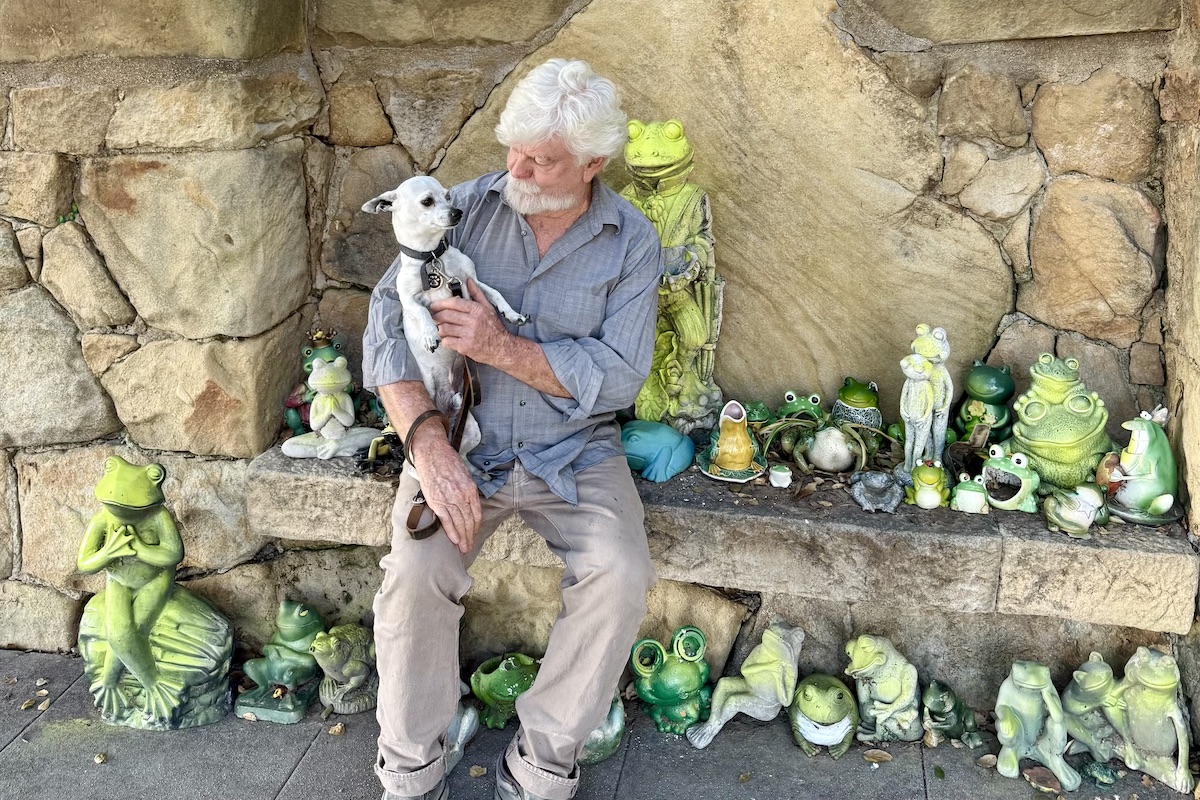
The stone wall along Paterna Road — an unofficial shrine that, over decades, accumulated hundreds of ceramic, rubber, plush, and painted frogs — entered a new chapter last winter, when longtime residents noticed the collection thinning. The change sparked rumors and concern, prompting a December Santa Barbara Independent article reporting that the wall had been significantly cleaned up, though not erased.
Shortly after that article ran, Griffith called.
He hadn’t been quoted, he said, and wanted to explain what had actually happened. So he invited me to his home — a historic Riviera property he purchased nearly three years ago — and walked through the story from the beginning.
Griffith, a landscape designer and historian, said he knew about the Frog Wall when he bought the property and was happy to inherit it. “I knew I was adopting quite the responsibility,” he said, referencing the wall’s status as a kind of civic sacred cow.
“I’m a defender of the amphibians myself,” he added.
That affection, however, came paired with realities the public doesn’t always see. In recent years, the Frog Wall had become more than a roadside curiosity. Candles were being left and burned at its base, wax dripping down the stone. The wall sits in a designated fire hazard area — the kind of place where roadside signage explicitly warns drivers they are entering a high-risk zone.
“When I finally went down there and saw the candles, I was gobsmacked,” Griffith said. “That became a 9-1-1.” The candles, he said, marked a turning point — not out of disdain for the shrine, but out of concern for safety.
Frogs, it turns out, are not just decorative. Across cultures, amphibians have long carried symbolic weight — tied to fertility, rebirth, cleansing, and transformation. In ancient Egypt, the frog-headed goddess Heqet was worshipped as a protector of childbirth.
Griffith learned quickly that the Frog Wall had attracted “certain factions” who honored frogs in ways that went beyond casual admiration. While many neighbors cherish the wall as a quirky landmark, others view it less romantically — as what Griffith described as an “attractive nuisance,” one that draws gatherings and attention that not everyone welcomes.
Navigating that divide has required something closer to diplomacy than landscaping.
“The sidewalk, of course, is not my property, and the parkway is not my property, nor are the street trees,” Griffith said. “But in most cities, the owner of the adjacent property is the custodian. It’s not the law — it’s an understood general contract with polite society.”
That custodial role, he said, shaped his approach. Frogs were temporarily removed, photographed, cataloged, and stored while the wall and surrounding landscape were cleaned, replanted, and stabilized. Over the years, stuffed animals had decayed in the rain, debris accumulated in crevices, and rats infested the space, requiring protective gear for gardeners.
“It was an editing,” Griffith said. “Not an elimination.”
At the same time, his work extended beneath the surface. One of the lesser-known reasons frogs congregated at Paterna Road in the first place is that the area once supported a natural creek. Over time, that flow had been diverted and buried.
Griffith removed the diversion and restored the native water path, reshaping the creek bed and creating a vernal pool — a seasonal wetland designed to retain moisture and support fragile native species. This winter, for the first time since he bought the property, he spotted a live frog returning to the area.
“The real frogs are coming back,” he said.
That ecological detail reframes the story. While ceramic frogs became the focus of public anxiety, living amphibians — unseen, vulnerable, and native — were reclaiming the space that inspired the shrine is dedicated to in the first place.
Griffith said he wants the wall to continue — just in a way that respects the land, the neighbors, and the history. “It’s a fine tightrope to walk,” he said, “honoring the shrine while also honoring fire safety and civic responsibility.”
So, the herd remains. Just thinned.